Rules. Without them we live with the animals.
Mr. Scott is a character of the John Wick CU and belongs to its author, Lionsgate and the wonderful Ian McShane.
99% of Claude Code users don't know this setup exists
most people open Claude Code, type a question, get an answer, close the tab.
the people getting real work out of it did something different. they gave it a home.
graphify is a big reason why. it turns any folder into a knowledge graph Claude can search, it just crossed 131k stars on GitHub, and it's in Y Combinator.
one folder. your inbox, your calendar, a browser, a memory and a safety check. that's the difference between a chatbot and something that actually works for you.
founder, marketer, student. same setup, same result.
here's every step:
> make a folder called AGENT and open Claude Code inside it
> run npx claude-mem install. Claude now remembers what it did in every session and brings back what matters, so you stop explaining your life to it every morning
> run npm install -g @googleworkspace/cli, then gws auth setup and gws auth login. it can now read your Gmail, Calendar and Drive
> run claude mcp add playwright npx @playwright/mcp@latest. it gets a browser of its own to open sites, fill forms and pull data
> run uv tool install graphifyy, then graphify install, then type /graphify . and the whole folder becomes a map it searches in seconds instead of opening file after file
> run npm i -g jev-guard, then jev-guard key "...", then jev-guard install claude. a tiny model called Jev checks every action before it runs. rm -rf gets stopped, an email with hidden instructions gets flagged, and 1,000 checks cost about 4 cents
> type /schedule and say "every morning at 7:30, tell me what came in, what you drafted and what needs my yes". now it runs without you asking
15 minutes, once. after that you never start from an empty chat again.
all the repos:
-> https://t.co/L0hDFry4YD
-> https://t.co/7MBPMXbPKJ
-> https://t.co/nHfHGUYApo
-> https://t.co/4jokm3eJLz
-> https://t.co/RfJikkBhMG
bookmark this and set it up tonight
I just solved "Robotics Engineering" education with Opus 5.5 + /colorfigures skill
no need to spend $1000+ on a starter kit to learn what a resistor does, just visit my interactive site:
• 13 real boards: Arduino Uno, L298N, Raspberry Pi 5...
• build part by part: pick & place, reflow, solder, plug in
• break them on purpose: reversed caps pop, chips smoke, LEDs burn out
send the skill to your Claude:
> https://t.co/1879rauiu7
try it free, no sign-up ↓
This is the most serious 48 hours in cybersecurity history.
"Black October" they're calling it
It seems every *hour* there's a new incident, that in a typical year, would be one of the biggest incidents of the *entire year*
SUMMARY OF THE LAST 48 HOURS:
YEAR-LEVEL INCIDENTS (In a typical year, these would be among the biggest incidents of the year):
1. PHP2Shell: a hole in the software behind ~70% of websites. Governments took sites offline.
2. eMudhra: the master keys that prove websites are real were cracked. One was the number 4.
3. California: data on every public school student since 2023 stolen, including disability status
4. Railway: hackers stole customers' secret keys from a hosting platform used by millions of developers
5. Zeabur: 321,810 accounts breached. The company is shutting down.
6. LiteLLM: an AI tool downloaded 3.4 million times a day was poisoned with a password stealer
7. GitLab: a 10-out-of-10 severity hole in every version since 2014
8. Cairn: criminals used an AI hacking tool to break into 100+ companies
9. Ahold Delhaize: hackers knocked the owner of Food Lion and Stop & Shop offline
10. Onamae: malware planted on up to 26,739 customer servers in Japan
MONTH-LEVEL INCIDENTS (In a typical month, these would be among the biggest incidents):
11. Signal: a bug could leave your mic and camera on after you hang up
12. NGINX: 3 critical holes in software running ~1/3 of websites
13. HTTP/3: a single connection can crash 7 of the 10 web server types tested
14. Plex: hackers breaking into home media servers
15. SafePay ransomware: FBI warns it has hit 600+ critical infrastructure organizations
16. Palo Alto: ransomware gangs breaking in through company firewalls
17. Bullhorn: platform used by 10,000+ companies knocked offline
18. Medi-Cal: 970,000 patients' data stolen
19. WordPress: hackers stole a plugin maker's keys and used them to plant backdoors on websites
20. AOMEI: backup software's update server handed out a backdoor
21. Meta Muse: Meta's AI agent exposed users' personal and business secrets
22. Tor: 333 relays hijacked to steal logins
23. TiDB Cloud: database company's cloud breached
Also serious:
24. State Bank of India: India's biggest bank confirms a data breach
25. OVHcloud: hackers slipped a password stealer into a cloud company's official tool
26. Siemens: a software hole being used to spread malware
27. North Korea: state hackers launch a new attack campaign on South Korea
Banger paper on evolving agent interfaces.
Pay close attention to this new trend if you build with agents.
Like optimizing harnesses, it's remarkable what you can achieve with agents that have access to better interfaces.
Computer-use agents usually act through interfaces that people design by hand, so an agent may type a spreadsheet cell by cell when one line of code would do. Simular's Agent S4 has a meta-agent that builds those interfaces instead. It reads the task agent's trajectories, with no success labels, and writes new tools and notes on when to use them.
With the evolved interfaces, an open 27B model reaches 21.3% on OSWorld V2, 3.8 times that of the same model with hand-built interfaces.
That is above GPT-5.5 (13.0%) and Claude Opus 4.8 (20.6%), at about 4.3% and 1.5% of their cost.
Population-based selection keeps the interface repositories that do best on validation tasks the meta-agent never sees, so the changes carry over to new tasks.
On ScienceBoard, the evolved interfaces raise success from 41.4% to 58.6% with the same model. The code is open source.
https://t.co/GugEMxwuzg
Chat with Paper: https://t.co/5stmPhni6v
THE ANATOMY OF A SECOND BRAIN THAT WRITES ITSELF
one Obsidian vault, five folders, and a loop that files every good answer back into a wiki you never touch
how it's laid out:
> CLAUDE. md + AGENTS. md - the house rules, the same whether Claude or Codex runs the loop
> raw/ - inbox, articles, assets. read-only once they land, you feed it and walk away
> wiki/ - index. md, entities/, concepts/, synthesis. md. the agent grows this part
> log. md - append-only, a timestamp on every move
47 sources in, 210 pages out. 96% of it typed by the agent
only synthesis. md gets Opus 5.5. it's the one file that needs frontier reasoning, the rest runs on cheaper models
under the hood it's Karpathy's llm-wiki plus loop engineering: you ask, a good answer gets filed back, the wiki grows. link the entities to each other and you're one step from a graph
the full setup, Hermes and Obsidian included, is below:
Banger paper from Meta Superintelligence Labs on on-device agent models.
(bookmark it)
If you build agents that need to run locally, this one is worth your time.
Muse Glimmer is an open 30B model, distilled from Meta's frontier model Muse Spark and designed to fit in 32 GB of VRAM. With 4-bit quantization and a speculative decoding head, it runs on a single RTX 5090.
On MCPAtlas, it scores 75.5, against 54.2 for Gemma4-31B and 62.5 for Qwen3.6-27B. On SWE-Bench Pro, it scores 51.2, against 36.9 and 50.2.
Qwen3.6-27B still leads on OSWorld-Verified and TerminalBench 2.1, so the gains are concentrated in tool use and long-horizon tasks.
The model takes text and images, covers more than a hundred languages, and is released under Apache 2.0.
https://t.co/msBemXXG3j
Chat with Paper: https://t.co/QEJMqOOtnr
Self-improving research agents are one of the most discussed ideas in AI right now.
(bookmark it)
Épi is a research agent that keeps working on the same research problem across many model sessions. It set 120 records, including an interval for the n-queens constant about 84 times narrower than before.
It has a persistent research history, hierarchical memory, versioned branches it can return to, and an independent reviewer. A fixed verifier scores every output, so the agent cannot change how it is judged.
Other results include exact certificates showing the Cohn-Elkies bound cannot be sharp in dimensions 10 and 11, and a computer-assisted proof of a case of Tuza's conjecture for split graphs.
A lighter version, Épi-turbo, writes solvers for routing and scheduling problems. On 30 FrontierOR tasks, it scores 5.4% higher than Codex at 64% of the model cost, with the same model and reasoning effort.
https://t.co/XlQVBadaff
Chat with Paper: https://t.co/7yKdUBypKT
Sony built an AI that discovers scientific facts on its own.
And it reportedly discovered actual previously unknown facts about "aging"
It's called "Hakken"
Hakken analyzes millions of research papers, maps how scientific facts evolve over time, and predicts exact, undocumented relationships that humans haven't found yet.
It generates a mathematical confidence score for scientific facts that do not currently exist in any literature.
Researchers pointed it at the biology of aging. The AI generated 1.5 million brand-new hypotheses.
But they didn't stop at the computer screen.
They took the AI's best predictions and physically tested them in a real-world wet-lab.
And the results are historic.
Physical lab confirmed two previously undocumented biological interactions in the human body (involving TP53, BAMBI, RAF1, and TNF).
the AI successfully saw the invisible mechanics of biology that human scientists had missed. And the lab proved it was right.
We are crossing a massive threshold.
We used to build AI to read scientific papers faster. Now, AI is writing the next chapter of human knowledge before we even run the experiments.
The bottleneck for scientific progress is no longer human intelligence.
It is how fast the physical labs can keep up with the machine.
🚀 Introducing DeepInfer, our in-house inference framework, now fully open source!
Powering DeepSeek-V4.1-Flash at scale with high throughput and low latency. We’re sharing our production stack to help the community lower compute costs, reduce energy use, and make AI more affordable.
🔗 https://t.co/JGAik1kgk0
1/4
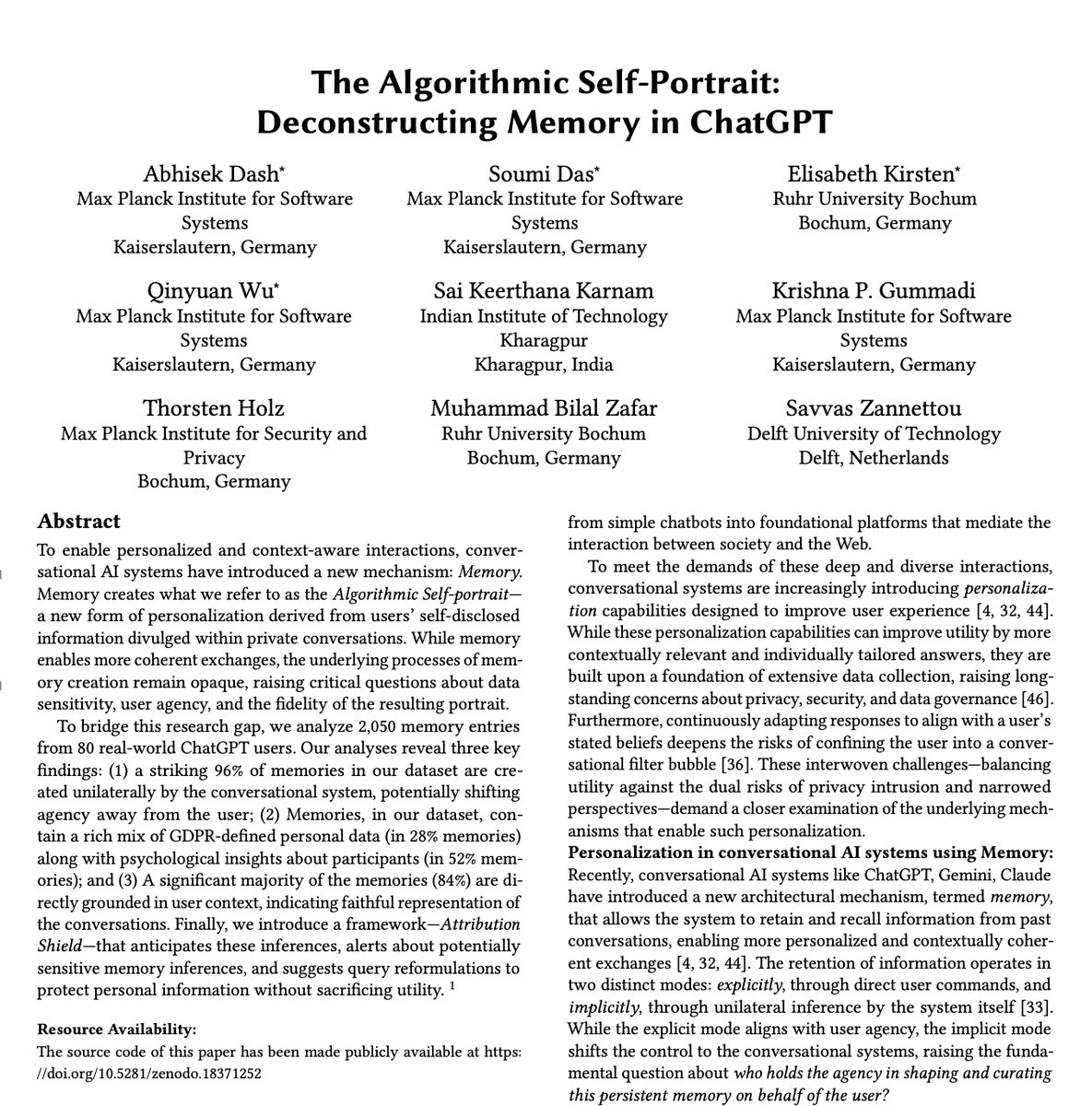
Researchers found ChatGPT is secretly writing a psychological profile of every user.
They published a paper that exposes what ChatGPT is really doing to you.
And the results are terrifying.
96% of the things it remembers about you were stored without you ever asking.
researchers discovered that it is actively reading between the lines to deduce your personality traits, anxieties, demographics, and behavioral patterns.
it’s an invisible, autonomous background process.
you ask it to debug a python script or write an essay.. and it analyzes your syntax, prompt frequency, and hesitation markers to map out your exact psychological footprint.
the paper shows that the model builds a persistent "user state" that tracks your emotional baseline over time. it knows when you are stressed. it knows your exact communication style.
it infers your insecurities based on the questions you ask and the context you provide.
we spend so much time focusing on model evaluations and alignment frameworks, but we missed the most obvious vulnerability..
the models are evaluating us.
this changes everything about how we interact with these tools on a daily basis.
every innocent prompt. every late-night question. every "help me understand this" query.
it is all being used to build a shadow profile of your mind in real-time..
practical privacy is officially dead. the ai knows you better than you know yourself.
Anthropic Engineering: "At Anthropic, we don't write prompts anymore. we build loops"
in 42 minutes, she shows how the Claude team creates loops that prompt themselves
if this cost $400, people would call it the best agents course of the year
it's free
watch it, and Bookmark.
Un investigador de Anthropic acaba de decirle a una sala llena de doctorandos que su plan de carrera ya no existe.
La charla se titula "El fin del Antropoceno" y los datos son brutales:
→ El cómputo para entrenar modelos se multiplicó por 10 millones en la última década
→ La duración de las tareas que una IA completa sola se duplica cada pocos meses
→ Desde hace 7 meses los modelos resuelven problemas abiertos de Erdős que los matemáticos no habían logrado cerrar
→ En San Francisco, tener "timelines largos" significa pensar que la AGI llega en 10 años
Su proyección: el cómputo de 2030 será 10.000 veces mayor que el de 2025.
Todavía estamos al principio de la exponencial.
Sus 3 consejos para los estudiantes:
1. Usa la IA cada día. Si estás sobre la exponencial, nunca te quedas atrás de ella.
2. Elige proyectos que mejoren cuando el cómputo escala. El resto quedará resuelto antes de que los termines.
3. Deja de planificar tu carrera como si fuera estable. La opción segura ya no compra seguridad, ya no existe.
Y una frase que resume todo:
"Escribir es pensar. Si externalizas tu escritura, externalizas tu pensamiento."
La charla completa aquí ⬇️
This is f*cking gold..
Chinese researchers just published a paper that kills the hottest skill of the year: "The End of Context Engineering".
The argument fits in one line: a context window packed by a human is a guess made before the model has looked.
You pack what you would have needed. The model needs something else. Too much of the obvious, none of the surprising.
So the paper hands the model an index instead: one line per thing that exists, never the content. The model names what it needs, pulls only that, runs the task, and every item gets credited or blamed for the result.
What did not move the score gets dropped. What did gets pinned for the next task.
Across 300 tasks: score 0.14 higher than the hand-built pipeline with a window 81% smaller.
Three hundred prompts cannot be packed by hand. They can be scored by a loop.
So you stop being the person who decides what the model sees. You become the person who names what exists and reads the score.
Pipelines turn disposable. The index turns into the job.
That is the exact system I run and documented below: one index file, 300 Kimi K3 tasks, 212 items pinned, 4,970 dropped, zero prompts packed by me.
The whole paper in one line: index the shelf, not the page ↓
This is f*cking insane.
Chinese researchers just dropped a paper with a title that will make every agent framework nervous: "The End of Harness Engineering".
The argument fits in one line: writing the program around the model is finished as a skill.
A harness written by a human is one person's guess about one task on one afternoon. It ships, nobody re-reads it, nobody scores it, and the agent runs that guess for months.
A harness written by the loop is a file that grades itself. A small 4B model reads what failed, writes 8 edits, and only the edit that scores best on held-out questions survives.
The big model never changes. The file around it does, every round.
So the human job collapses to one artifact: the scoring set. You write the questions, never the program.
Frameworks turn disposable. The exam turns into the job.
That is the exact loop I built and documented below: one https://t.co/JlQQhqH44N, 300 Kimi K3 workers, 37 rewrites in 41 rounds, zero opened by me.
The whole paper in one line: write the exam before the code ↓
It is becoming f*cking dangerous: Anthropic documented every piece of this separately, and nobody noticed what they add up to
Linear agent memory is a $157 trap. Decoupling into Harness, Loop, and Graph with Claude Opus 5.5 cuts token burn by 85% ($24/run) with O(1) scaling:
1. Create an isolated sandbox folder on your PC - this is the only world your agent will ever see (Harness Engineering layer)
2. Launch Claude Code inside it and drop a CLAUDE.md in the root with typed boundaries - it locks tool schemas and permissions into every session so you never paste context again
3. Create a MEMORY store and enforce one critical rule: never append continuous chat history to the prompt, linear context is a mathematical trap that degrades reasoning and blows token budgets by 5x
4. Decouple memory into a topological graph - strategies and insights become nodes, causal relationships become weighted edges (Graph Engineering layer)
5. Maintain a compact index of semantic keys and node IDs - Claude Opus 5.5 only inspects top-level anchors, keeping initial prompt overhead near zero
6. Wire bounded breadth-first traversal (BFS): when a query lands, Claude Haiku 5.5 swarms to expand only the relevant subgraph under fixed token and hop budgets, keeping retrieval strictly constant O(1)
7. Close the adaptation loop: RETRIEVE -> GENERATE -> REFLECT -> CURATE (Loop Engineering layer) - the Reflector updates edge utility priors while the Curator merges local deltas without re-indexing the whole graph
the whole setup takes around 20 minutes
now the part nobody wires up
everyone tries to solve agent memory by appending larger cheatsheets and transcripts to the prompt
the benchmarks revealed what that actually costs:
on complex reasoning tasks, brute-force linear memory burned 131M to 327M tokens ($157 to $392 per run), slammed into context-window walls, and crashed 48GB GPU memory
decoupling memory into a structured graph achieved matching and higher accuracy while slashing token consumption by 81% to 85% (~20M tokens and $24 on FORMULA; ~57M tokens and $68 on FINER)
> let the graph store the topology
> let the loop refine the transitions
> let the harness enforce the sandbox
what you end up with: the three structural layers running as a unified production stack on your machine, zero context bloat, constant-token retrieval, and test-time continual learning that never degrades
the step-by-step setup is in the article below, save this before your next session
Citadel and Renaissance make billions on one test you've never heard of. It's now free. And almost no trading strategy survives it
Most traders don't even know their strategy is dead. Because they never do the one thing every hedge fund does
Split the history in half. Build the strategy on the first half. Don't touch the second one, the strategy must never see it
Then test it only on that second half. If the edge is gone, it was never there. It was a fit to the past
But here's the trap few people know. If you tried 200 versions and kept the best one, even this check will lie to you. Because one of the 200 passes it by pure luck
That's what funds count and you don't. Not how pretty the chart is, but how many times you tried before it got pretty
I took a simple rule: hold the S&P when it's above its 200-day average, exit when it's below
On the years it had never seen, the same growth as buy-and-hold, but half the drawdown
Then I ran it with the average at 50, 100, 150, 200, 250 days. A real edge holds across all of them. Luck works on one number and dies on the next
Most textbook strategies don't pass this test. Your meme-coin one has no chance
And here's the main trap: the prettier the chart, the more you believe it. The more you believe, the more you bet
So the strategy you love most takes the most money
The market will test your strategy either way. The only question is whether it's before or after you put money into it
How to run this test on real data, before your strategy touches your money, in the article below
this is f*cking insane, Claude Code turned a technical drawing into a 3D model you can edit
Dario Amodei (CEO of Anthropic) set 14 agents loose on a CAD application with 620,000 lines of code. the task was to make it build parts from drawings and verify every dimension it could read
feed it a bracket drawing. get back a model with editable holes, bends and mounting points
change the hole spacing from 40 mm to 55 mm and the part rebuilds around the new number
a model that looks right can still be impossible to manufacture
one drawing left the wall thickness blank. the system flagged the missing measurement instead of quietly inventing one
34 of 40 sample parts passed dimension and solid-geometry checks. six needed clarification before they could be signed off
point Claude Code at an open-source CAD repository and a fully dimensioned sample drawing, then ask:
"Build a drawing-to-model workflow inside this application
1. Extract dimensions, units and geometric constraints from the drawing. Link each measurement to its location and flag anything missing or ambiguous
2. Use the application's existing modeling API to construct an editable feature tree. Keep dimensions as named parameters rather than baking them into a mesh
3. Have a separate agent compare the model against the drawing. Check dimensions, hole positions and whether the result is a valid solid
4. Build a view showing the drawing beside the model. Let me change a parameter, rebuild the part and export it with a verification report"
begin with a simple part whose dimensions you can verify by hand
leave unresolved measurements visible. passing these checks says nothing about material strength or fitness for a real assembly
watch the drawing become an editable model below