Wirex today is increasingly an infrastructure company.
The retail business gave us years of experience operating cards, accounts, payments, scheme connectivity and compliance ourselves. The shift was to take that operating stack and make it available to other companies building financial products.
We launched the infrastructure business in November 2025. In 131 days, it became the fastest stablecoin payment infrastructure to reach $1B in annualised onchain volume. That run rate has since passed $2B.
Partners can now build with cards, accounts, payouts, settlement and other financial products through one integration, with an average signed-to-live timeline of 44 days.
That is the direction of the business now. We are building the infrastructure other companies use to bring stablecoin-powered financial products to market.
In this conversation with @samconnerone, Community Lead Developer at @circle and @arc, our Group CEO and Co-Founder @matveevp explains how Wirex moved from retail into infrastructure and what that focus looks like today.
Wirex infrastructure is now live on @Arc. 🤝
With Arc mainnet officially live, we’re bringing our banking and payment infrastructure onto the network, giving builders a new settlement layer for stablecoin-powered financial products.
The Solid Card is now live across a much wider global footprint, with Wirex powering the infrastructure behind this expansion. 🤝
@SolidYield is expanding its card product across Europe and key markets in Asia, Latin America, Africa and the Middle East.
That wider rollout gives more Solid users access to the same core experience:
→ Spend directly from a non-custodial wallet
→ Keep earning yield until the moment of payment
→ No separate off-ramp step before spending
→ Use the card anywhere Visa is accepted
More reach for Solid, with the same product experience users already know.
We have crossed $1B in total onchain card spend processed through our infrastructure.
The milestone comes just 10 months after our launch, alongside:
→ 100K+ total addresses
→ 11M+ total transactions
A strong first chapter, and the pace is only picking up.
Wirex is now live on Tempo for stablecoin card programs.
Through @wirexapp, enterprises can use Tempo for near-instant stablecoin settlement, simpler reconciliation, opt-in privacy, and predictable low fees for their card programs to operate at scale.
Projects building stablecoin payment products with Wirex can now choose Tempo as their settlement layer.
Tempo will be a key settlement layer for enterprise products built on our infrastructure. 🤝
1/ Wirex 🤝 @tempo
We’re adding Tempo as a settlement layer option to our banking and payment infrastructure, making it a key partner for enterprise stablecoin card programmes built through Wirex.
Stablecoin cards can feel global to the user while the settlement infrastructure underneath still runs through a single base currency.
@Paymentscan’s latest research looks at how that affects cross-border card costs, why multi-currency settlement can reduce the overhead, and why relatively few stablecoin card programmes support it today.
The research also highlights where Wirex is already moving ahead, with onchain settlement in both USDC and EURC and the widest local issuance footprint of any stablecoin issuer tracked by Paymentscan.
Glad we could support the research. Thanks to @Paymentscan, @tstereth and @datadashboards for the breakdown.
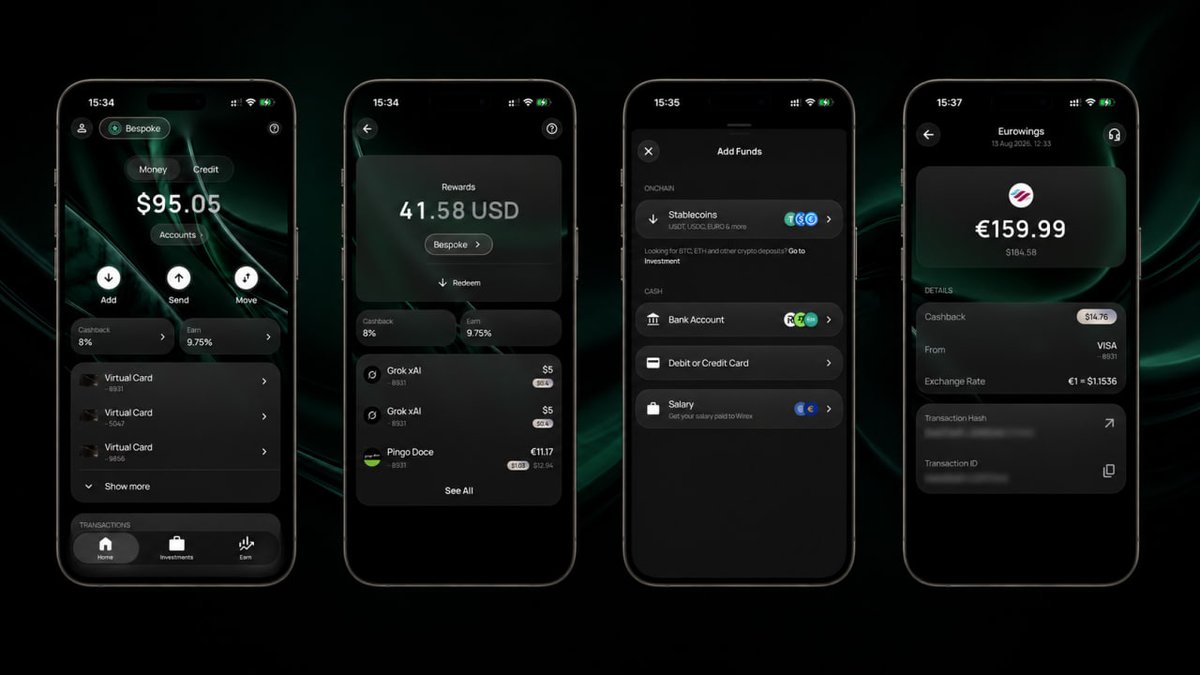
Another Wirex-powered money app is getting ready for launch.
Rewards are becoming a bigger part of how neobanks create an experience people want to keep coming back to, and @PulsarMoneyApp is making that part of the experience with Pulsar Pro.
It brings richer rewards, with more ways to earn and cashback users can control.
And we’re glad to be supporting that launch, with Pulsar among the first products going live on our infrastructure and @arc as the settlement network from day one of Arc mainnet on September 16.
Stablecoin banking is moving too fast for six-month launch cycles.
Stablecoin neobanks, card programmes and embedded finance products are competing in a market where new use cases can emerge quickly and user expectations change just as fast. Getting to market sooner has become part of the product strategy.
But speed only matters if the infrastructure underneath can support it properly.
At Wirex BaaS, the average path from an idea to a live product is 44 days.
A lot still has to happen inside those 44 days:
→ Product fit and programme scope are defined
→ Compliance and onboarding requirements are aligned
→ Commercial terms are finalized and the contract is signed
→ Accounts, cards and payment infrastructure are configured
→ Integrations move through sandbox testing and iteration
→ Payment flows and settlement are tested end to end
→ Final production checks are completed before launch
The timeline is shorter, but the requirements are still there.
That is increasingly what stablecoin infrastructure needs to deliver. Companies building stablecoin banking products need to move at the pace of the market while knowing the compliance, payments and operational layers underneath are ready to move with them.
Send Cards have officially launched.
Native USDC on Base can now fund everyday Visa spending directly inside @Send.
A major step for the Send product, powered by Wirex BaaS infrastructure.
Stablecoin card spend is accelerating fast, and the infrastructure behind it is scaling with it.
Great to partner with @gizmolab_ and have them integrating Wirex BaaS across their products and client builds, bringing card issuing, BIN sponsorship, fiat spend and vIBANs into the stack.
Another route for teams to build on Wirex infrastructure. 🤝
1/ Send is taking its next step with Wirex. 🤝
We’re partnering with @Send to power Send Cards and the infrastructure around them, designed so a payout can be usable the moment it arrives.
When you tap a stablecoin card at a coffee shop, a lot more happens than “stablecoins get spent.”
The merchant still sees a normal card payment, and to the user, everything looks simple - tap, approval, done.
But behind that moment is an entire payments infrastructure working in the background.
At the point of payment, the transaction travels through the card network to the issuer, where the card, available funds, limits and risk controls are checked before it can be approved.
Behind the balance, stablecoin infrastructure connects the value the customer holds with the card transaction. Depending on the setup, stablecoins can also be used further down the chain for settlement with the card network.
After the tap, the transaction still needs to be cleared, settled and reconciled. And if something happens later, refunds, disputes, chargebacks and fraud investigations all need to be handled too.
And that is just one transaction.
Behind every card programme sit fraud monitoring, compliance, disputes and chargebacks, card lifecycle management, Apple Pay and Google Pay provisioning, reporting, scheme requirements and the operations needed to keep all of it working reliably.
So a card programme is ultimately all of these layers working together as one system, with the card itself only being the most visible part.
We operate that infrastructure today across 75+ clients, with hundreds more exploring integrations, and +$2B in annualised onchain card spend.
And through the same API, partners can also access EUR, USD and GBP accounts, on/off ramps, FX, yield, merchant-funded cashback, Push-to-Card payouts and travel services alongside card issuance.
For teams that want to obsess over the card experience their users see while we obsess over everything underneath it, contact us at [email protected] or visit https://t.co/pa3EhixtzU
Wirex is a Visa partner, an issuer for 75+ clients, and a Crypto Card
As an issuer: @wirexapp is a Visa principal member, so no sponsor bank sits between them and Visa taking a cut. They have been doing this from London since 2014
July was $161.3M, up 29% in a month, across 1.77M payments and 52,611 active addresses. A $91 average ticket, so groceries and coffee, not batch settlements dressed up as volume
Wirex says 75+ clients signed, with hundreds more in the pipeline. The ones I track myself:
BingX, Kolo, PlasBit, uTorg, Trustee, GoMining, HEVN, Coca, Simple
As a card: Wirex One launched in June and is already at $44.3M, up 114% over the last 30 days, the fastest growth in the top ten
And that $161.3M is a floor, not a ceiling. The offchain part of their settlement is not counted here at all, and the visible part alone is the second largest issuer in the market
Were you counting Wirex?
Pulsar is partnering with @wirexapp to extend its fintech stack, starting with the first Pulsar cards.
One app to hold, move and spend, with a card that works in 110+ countries.
Early access is now open.
1/ Wirex 🤝 Pulsar Money
We’re partnering with @PulsarMoneyApp, a multi-currency money app built on stablecoin rails, marking our first BaaS partner launch on @Arc.
Early access opens today, with Wirex providing infrastructure for cards, named accounts and on/off-ramps. 🧵
Private early access to Pulsar opens now.
Today Pulsar goes into the hands of its first users. A small, close group to start.
Everyone on the waitlist comes next, cohort by cohort.
1/ Your fintech product can feel simple, while what sits underneath it rarely is.
That’s why we’ve spent 11+ years building payments infrastructure, now supporting $2B+ in annualised volume.
Here are 10 reasons partners choose to build with us 👇
Just dropping by to say that August 4 set a new daily ATH for card spend across Wirex BaaS.
Another record is in the books, and we’re nowhere near done.