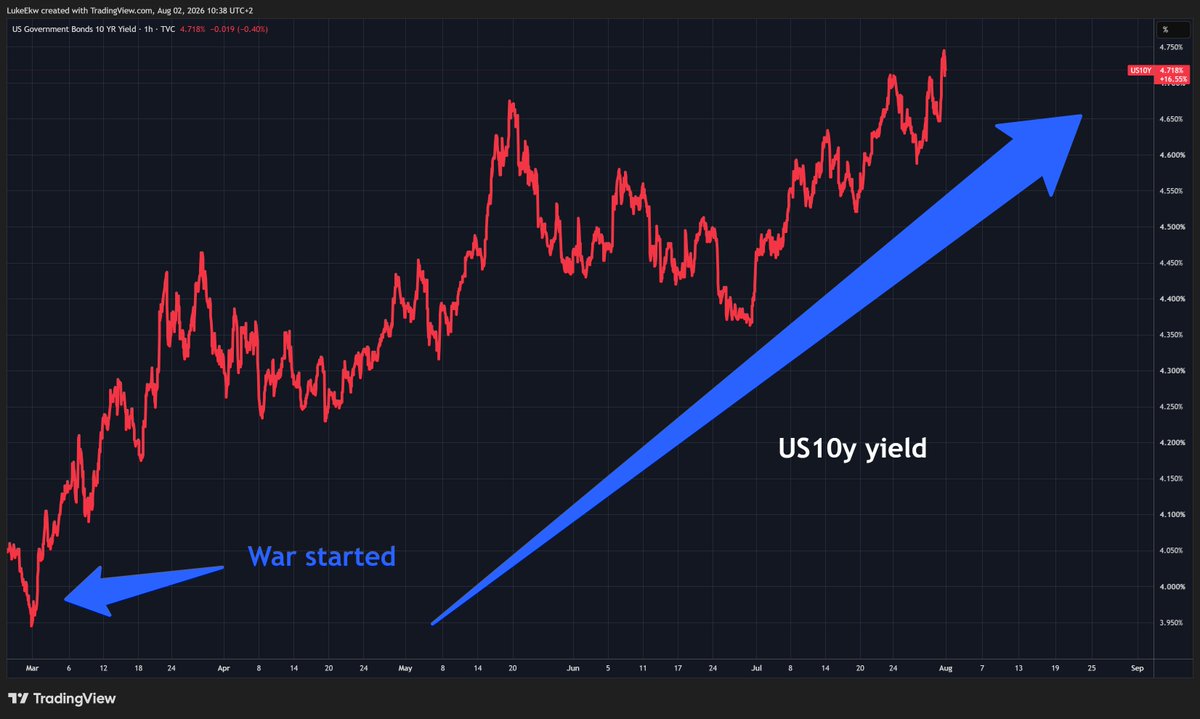
The US simply can't afford this war... and the market knows it.
Normally, during times of crisis, investors seek safety in bonds, especially US Treasuries... supposedly the safest assets in the world.
But this time is different.
Investors are looking at:
- $40T in debt
- ~$120T in unfunded liabilities
- $2T annual deficits
- Debt issuance growing ~8% per year since 2000
- 10-year yields approaching 5%
You can't enter a major war with debt-to-GDP above its WWII peak and expect the rest of the world to finance it.
Especially when it's becoming increasingly obvious that you're losing.
Japan🇯🇵 is currently executing what may become the most catastrophic monetary policy error in modern financial history.
The Bank of Japan (BOJ) is trapped in a brutal, zero-sum macroeconomic corner: they cannot raise rates aggressively without completely nuking the finances of the most heavily indebted nation in the developed world, yet holding off means watching their sovereign bond market slide toward a systemic collapse.
By burning billions in foreign reserves to artificially prop up a dying Yen while simultaneously printing money to buy their own crashing bonds, Japanese policymakers are essentially holding a grenade with the pin pulled.
If this experiment detonates, it will make Arthur Burns’ 1970s stagflationary missteps look like a minor accounting error.
🚨 THE JAPANESE DOOM LOOP: Why a Economic Crisis is Unfolding
1. The Burning Yen & Empty Buffers
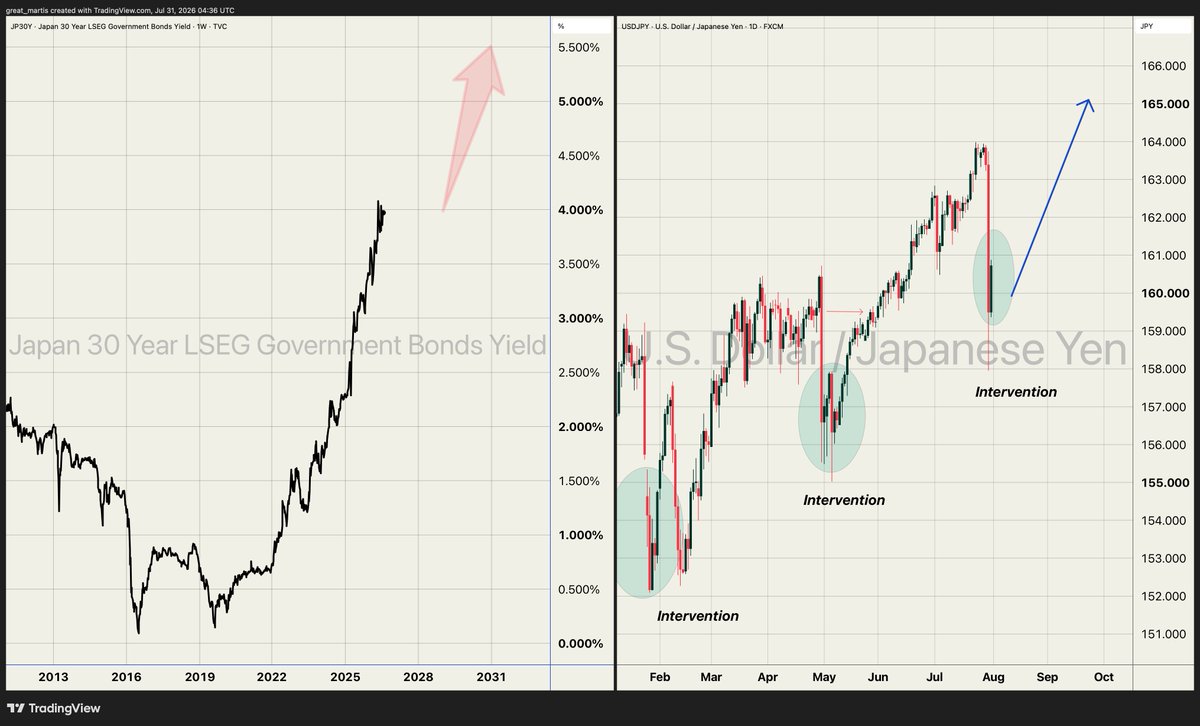
The Sinking Currency: The Yen continues to languish near historic 40-year lows against the US Dollar.
Desperate Interventions: Tokyo is burning through its real-money reserves, executing massive FX "ambush" interventions..selling US Treasuries to buy Yen.
The Limited Impact: This multi-billion dollar defence is failing. The market is absorbing the intervention cash and continuing to dump the currency because the underlying structural math is broken.
2. A Sovereign Bond Market Under Siege
Yields Exploding: Long-term Japanese Government Bond (JGB) yields are hitting multi-decade highs, with 40-year yields breaching 4%.
The BOJ Left Holding the Bag: Traditional institutional investors are fleeing the fixed-income market. To prevent an outright market freeze, the BOJ is forced to act as the ultimate "buyer of last resort," absorbing more than 50% of all outstanding government debt.
3. The 250% Debt Trap meets an Aging Demographic
The World’s Highest Debt: Japan’s gross national debt sits at an astronomical 250%+ of its GDP.
The Math of Ruin: If the BOJ raises short-term rates aggressively to protect the Yen, government interest payments will explode exponentially.
Demographic Collapse: A rapidly aging, shrinking workforce cannot generate the tax revenue needed to cover skyrocketing debt-servicing costs. Raising rates directly threatens to bankrupt the state's social safety net.
4. The Onset of Vicious Stagflation
Imported Inflation Shock: Because Japan imports the vast majority of its energy and food, the obliterated Yen has triggered a massive cost-of-living crisis.
Drowning Living Standards: While basic survival costs surge due to global supply shocks, real domestic GDP growth remains functionally stagnant.
The Policy Trap: Japan has effectively engineered a worst-case scenario: a hyper-inflated cost of living paired with an economic growth trajectory that is completely flatlined.
Curtains.
⚠️ WARNING
Every global crash starts with South Korea.
It sounds ridiculous.
Until you look at the history.
1997:
- The Korean won collapsed
- KOSPI crashed
- Foreign exchange reserves nearly ran out
- Then the Asian Financial Crisis spread across the world
2000:
- South Korean semiconductor stocks topped first
- Months later, Nasdaq dumped 78%
- The Dot Com Bubble popped
2008:
- Korean stocks started breaking down
- Just over a month later, Lehman Brothers collapsed
- The global financial system went with it
2021:
- Bill Hwang used extreme leverage through Archegos
- The fund exploded
- Global banks lost more than $10 billion
- Credit Suisse alone lost $5.5 billion
2022:
- Do Kwon launched LUNA and UST
- More than $40 billion vanished almost overnight
- Then came Three Arrows Capital, Celsius, and FTX
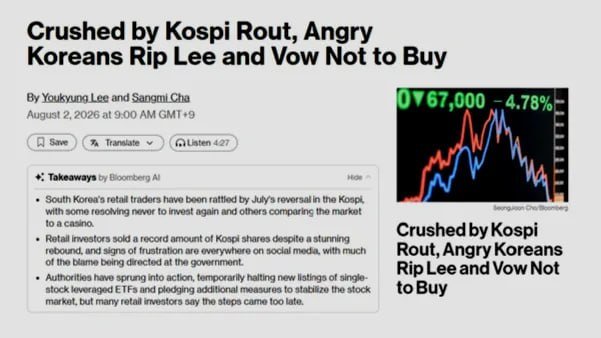
Now the warning is coming from KOSPI again.
Samsung and SK Hynix dominate the index.
More than $30 billion flowed into leveraged products tied to the two companies.
These products rebalance every day.
When prices rise, they buy more.
When prices fall, they are forced to sell.
The deeper the market falls, the more selling the products create.
KOSPI has already fallen 25% in just a month.
The leverage that created the boom is now creating the crash.
Forced selling is feeding more forced selling.
South Korea has warned the world before.
It's warning us again.
Pay attention.
The bond market is out of control.
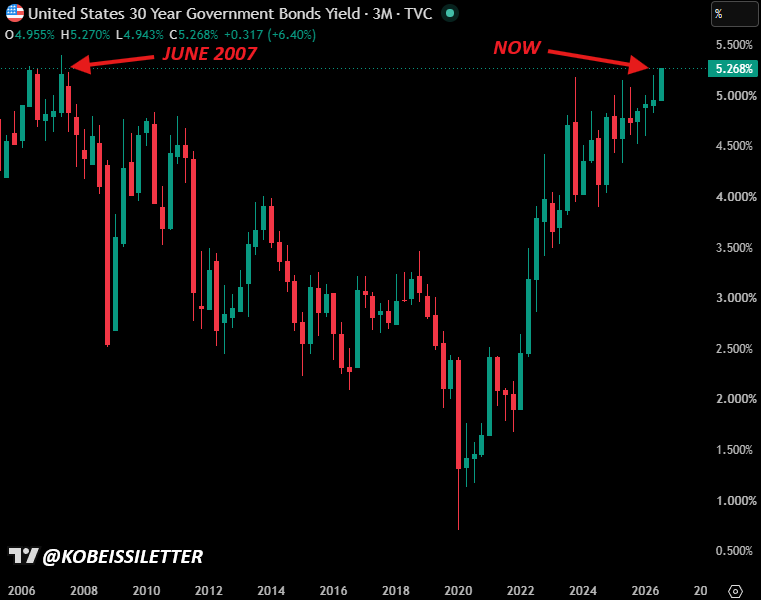
The US 30Y Note Yield is now up to 5.27%, its highest level since June 2007.
This officially marks a +450 basis point rally since the low seen in 2020.
At the current pace, we are on track to see US 30Y mortgage rates exceed 7.50% by year-end.
And to top it all off, Fed Chair Warsh is now adamant that the market should operate independently, without Fed guidance.
Even without rate hikes or Fed guidance, the market is sending rates higher; operating exactly how Fed Chair Warsh wants it to operate.
The bond market will soon be the most talked about component of global capital markets.
This simply is not sustainable.