$SYZYGY is live on Pons.
CA : 0x69f287e4353b83ea35553040e60d121ca29b4625
Syzygy is building a local-first AI stack designed to make powerful intelligence more efficient, private, and accessible directly from the machines people already use.
From highly compressed models and optimized inference to autonomous agents and a complete desktop environment, Syzygy is working toward a future where AI doesn't always have to live behind a cloud API.
The ecosystem is live. More is coming.
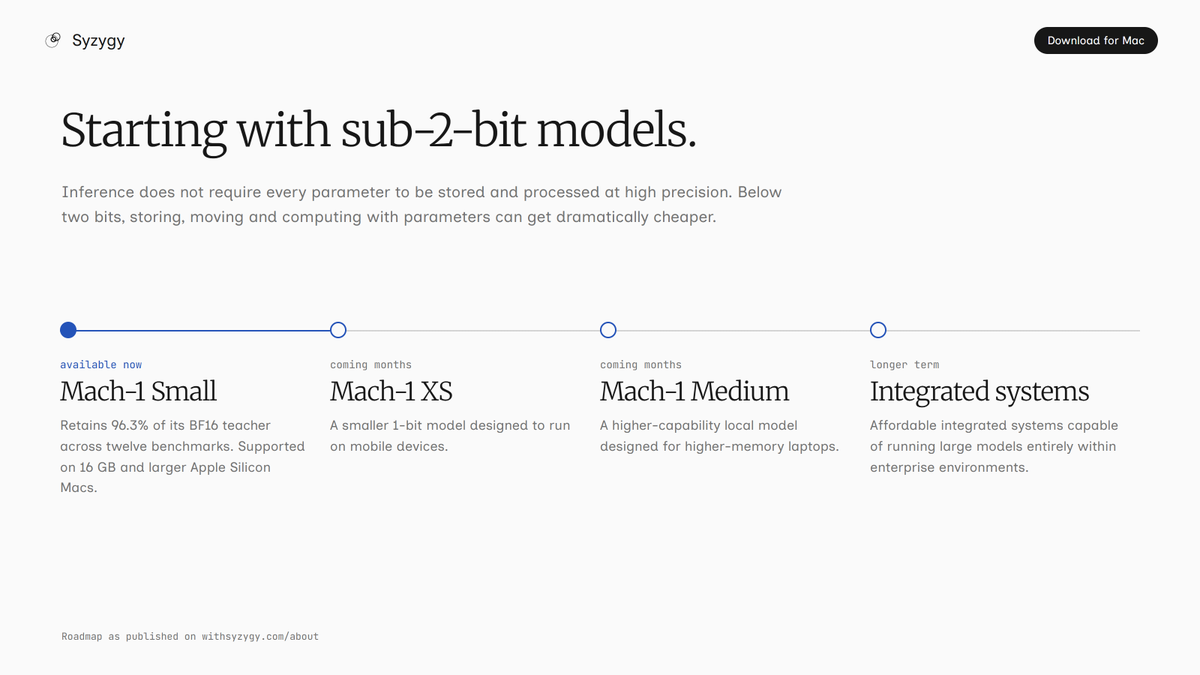
Mach-1 Small is the first model. It isn't meant to be the last.
Syzygy's published roadmap goes smaller, then bigger, then beyond the laptop entirely: phones, higher-memory machines, and hardware that lives inside the enterprise. What's next, in order:
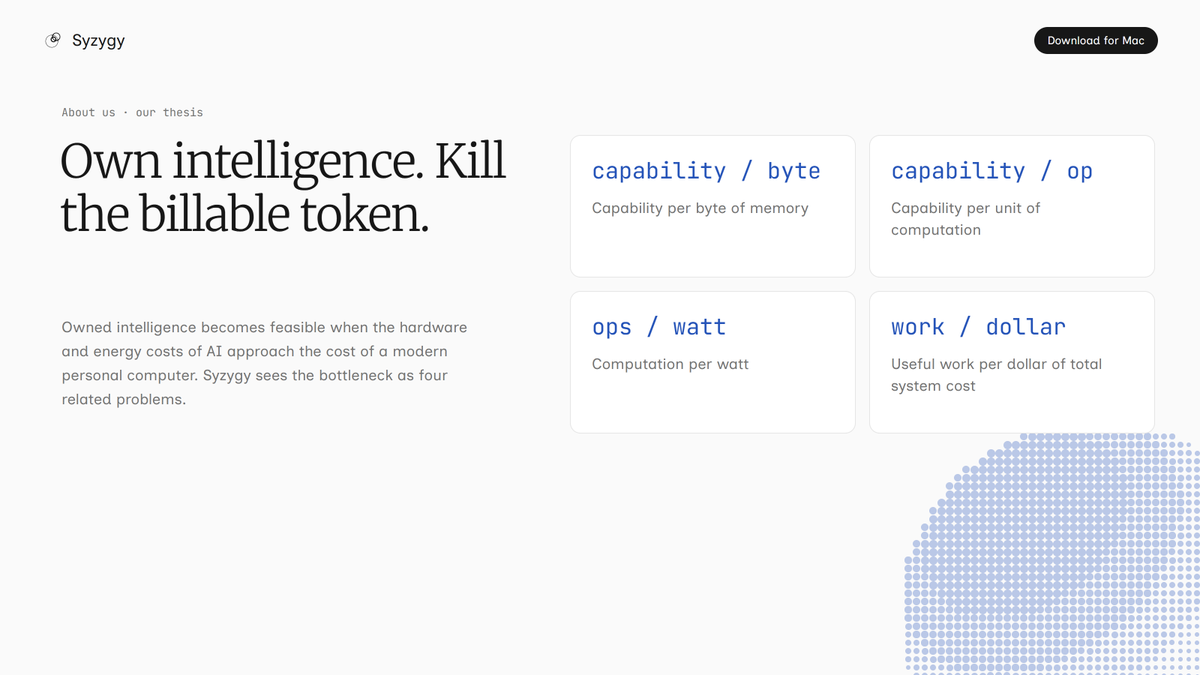
Almost every AI provider today charges for usage, per GPU hour or per million tokens, not for outcomes. Syzygy calls that renting intelligence, and argues it's misaligned by design.
The first signs are already showing in software engineering: companies spending on tokens at a level approaching the cost of human labour, then capping token use per engineer.
Syzygy's thesis is ownership. Once intelligence can be owned like an operating system, the incentive shifts from metering units of reasoning to completing as much useful work as possible. That becomes realistic when AI costs approach the cost of a personal computer, which comes down to four problems: capability per byte, capability per op, ops per watt, and work per dollar.
Mach Studio is where it all comes together: Mach 1 Additive 35B, the Mach engine and the Syzygy harness, in one app.
It uses your computer and browser, works across connected apps, and runs recurring tasks on its own. All without leaving your Mac. In beta for Apple Silicon.
Most of the race in AI is about making models bigger. Syzygy is working on the other axis: intelligence density, meaning how much capability you get per bit, per watt, per gigabyte.
Mach 1 Additive 35B is the first result. It's a multiplication-free model at 1.7 bits per weight, and against its own BF16 teacher it keeps an average of 96.3% of the score across 12 benchmarks.
That density is what makes local practical. On an 8,192-token prompt it answers in 12.9 seconds on-device, where the comparison models take 22.3 and 36.8.
Powerful open models, running entirely on your Mac: private, offline, and yours. In beta for Apple Silicon at https://t.co/PWJz4niEIL.
4. Put it to work
Model, engine and harness together give a local agent what you expect from cloud agents: using your computer and browser, connected apps, recurring tasks. It ships in Mach Studio.
A smaller model needs a more disciplined agent loop, not a bigger prompt.
Syzygy's agent SDK keeps the context focused, makes tools available only when they're useful, recovers from mistakes, and gives you precise control over every action.
The four parts ↓
3. Permission at the level of the action
Set each tool to Allow, Ask, or Block, configure computer access per app, and review every tool call in the conversation. Sensitive actions stay gated without approving every step.
2. Make the context window go further
Older work is compacted, important facts move into memory, and independent subtasks run in isolated contexts. Same work, smaller footprint.
1. Find the right tools when they're needed
The harness searches the full catalog and loads only what the current task needs. 3 of 142, not all 142, so the model doesn't pay the context cost of every integration.
Anyone can shrink a model. The real question is what's left afterwards.
Syzygy measures it the strict way: each model against its own BF16 teacher, averaged over 12 benchmarks.
Mach 1 Additive 35B → 96.3% retained
Ternary Bonsai 27B → 93.6%
Gemma 4 Q2_K_XL → 85.6%
Mach 1 gets there at 1.7 bits per weight, without a single multiplication.
A note on fairness: the Gemma 4 figures are PrismML's published measurements, not a run Syzygy did itself. Per-benchmark detail is on https://t.co/PWJz4niEIL.
16 bits per weight is the usual starting point. Mach 1 Additive 35B runs at 1.7.
No multiplications. Less memory, compute, and energy. And it keeps 96.3% of its own BF16 teacher's score across 12 benchmarks.