I did not read the book, but only a ballet after the literature - which must be just an excerpt of the original, expressed in voice-less dance.
With your reply, I have started to read it. I am only in the first few chapters out of several tens. But I am already drawn into the depths of emotion that the author so vividly depicts - many of us would hide or ignore in our daily life.
Thank you @rjs
@rjs I remember you shared this interview analysis exercise a while ago. Not many people share multi-interview analysis including clustering. I remember I was very appreciative because of that.
Sophisticated, even philosophical. What I'm seeing here is "Structure" that identifies tension, disequilibrium, struggle, non-consumption - the river between one bank and the other. That's demand-side. "Novelty" and "Momentum" are supply-side - the formation of bridges. In the generative era, once the Structure is identified, bridges can be built remarkably quickly. And many versions could be built.
What this leaves open is around a later stage of Momentum. At the end of the day, it's humans who decide which bridge to cross, and unless enough humans cross a bridge repeatedly, it gets washed away and loses momentum fast. The bridge that sustains and becomes Actualized Structure is the one humans choose to "hire." In this sense, the later stage of Momentum returns to the demand-side - a Latent Structure slightly updated from the one we started with.
@jasonfried AI is the average of the past, whereas humans have their perspectives and opinions that they have formed by pains, excitements, regrets, surprises, all of those they have gone through. They are real. At the end of the day, humans are the ones who will experience what we do.
@rjs This is powerful. Unlike top-down strategy handoffs, this team moved together from abstract to concrete - and back. That shared motion builds real connectedness across levels. I suspect those involved won’t forget what it felt like to work that way.
@anvanvan@rjs @481fiftytwo Shape Up can help orgs own consequences - top to bottom. Betting means those in charge live with what they choose. Shaping forces trade-offs before the work begins. That’s how orgs build memory and momentum. Without it, ideas swirl, and the org spins.
If you are a product professional, the recent talk by Ryan Singer is an important one to watch. In his 30-minute talk, he presents an overview of a product design technique called Breadboarding.
https://t.co/wcPe4zRh6y
@jasonfried@jeisson It demonstrates the meetup is not given, but created by app participants. Love it. Will try to do a similar execution in our sweet basecamp for the next company meetup. Thank you for sharing and hope you can have a good rest.
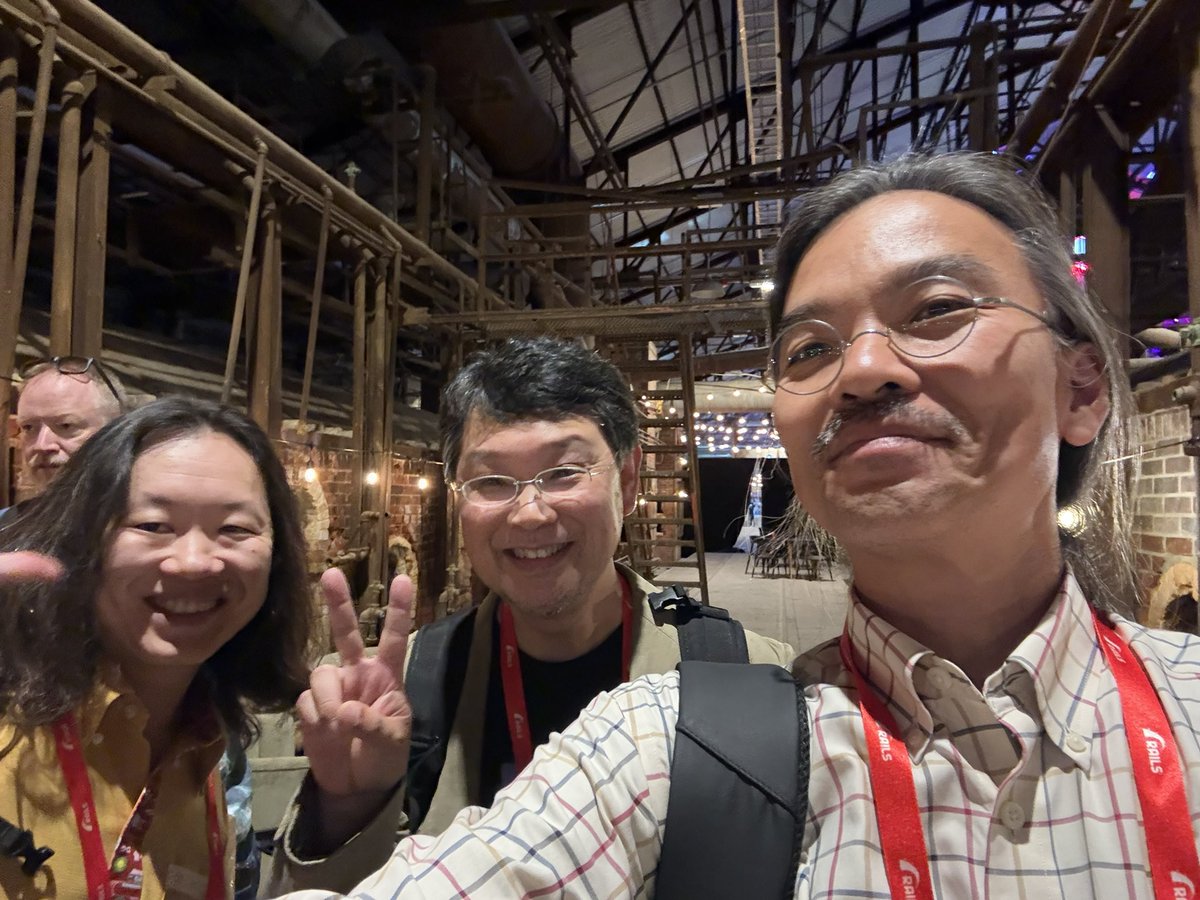
@a_matsuda@yukihiro_matz@paracycle As a historian, but not as a creator of the history, this conference has been a really good material to understand the primary cause and effect in history. The historian shouldn’t be in front of @yukihiro_matz and @a_matsuda, but forgive me I had only 3s to take this picture.
A challenge can be an opportunity. While this statement seems obvious at first glance, I’ve come to realize that it’s really hard to embrace both in a personal life and in the business context. https://t.co/C5Avk6PlxW
@rjs This unfolding can take place before an execution and/or during an execution. The thing is we can’t ask the person in charge of an execution to do all the unfolding or the execution will blow up. Understanding what be unfolded before the execution takes experiences.
@rjs To a degree. There’re 2 modes in Prod Eng. 1. carving out x and y as in y=f(x). 2. figure out f & build it out. The 2 modes need different types of momentum. Going back and forth between the modes is hard. I see the product role finding f is becoming much less important though.