AI interfaces nowadays are still pretty much turn-based.
In my PhD thesis, I thought about what interaction would look like if we could go beyond taking turns.
One example is intra-turn interaction:
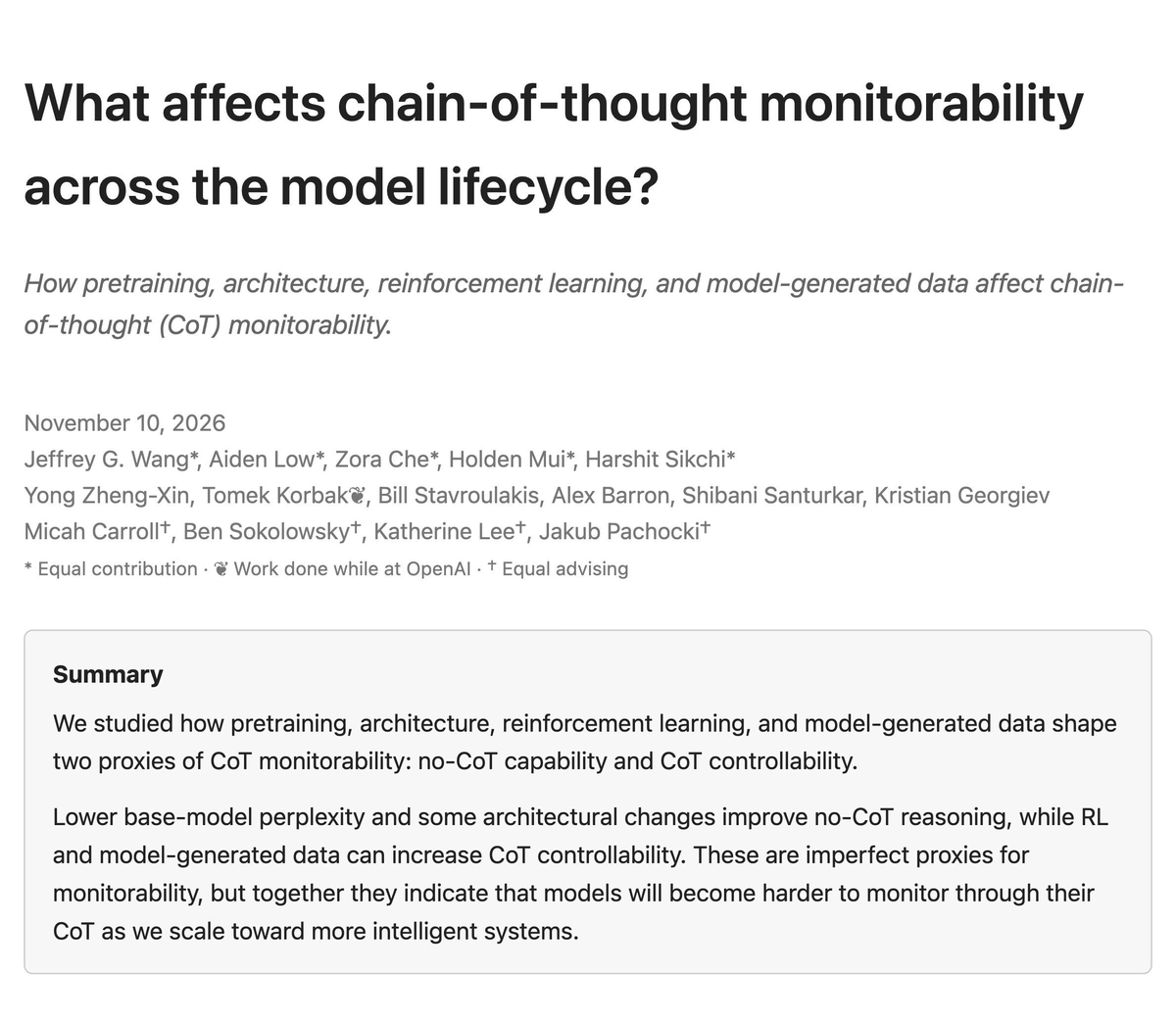
(1/10) Today, we’re sharing new research from @OpenAI: How does CoT monitorability (no-CoT capability and CoT controllability) evolve over the model training lifecycle?
We emerged with unsurprising but sobering findings: as we scale toward more intelligent systems, models are becoming harder to monitor through their CoT. 🧵
🚀 گوگل یک PDF نهصفحهای درباره Harness Engineering منتشر کرده؛ مفهومی که به نظرم باید هر کسی که با AI Agent کار میکند، جدی بگیرد.
فرمول اصلی ساده است:
Agent = Model + Harness
یعنی مدل هوش مصنوعی بهتنهایی ایجنت نیست. چیزی که آن را به یک نیروی اجرایی قابلاعتماد تبدیل میکند، زیرساختی است که دور آن میسازیم.
اما این زیرساخت از چه چیزهایی تشکیل میشود؟
۱. Guides: قوانین و دستورالعملهایی که تجربه شکستهای قبلی را به دانش دائمی تبدیل میکنند.
۲. Sensors: تستها، Linterها و ابزارهای اعتبارسنجی که اجازه نمیدهند هر خروجی اشتباهی به مرحله بعد برود.
۳. Agentic Loop: چرخه برنامهریزی، اجرا، بررسی و اصلاح؛ با محدودیت بودجه و امکان ارجاع به انسان.
۴. External Memory: حافظهای خارج از مدل برای حفظ تصمیمها، وضعیت پروژه و دستاوردهای جلسات قبلی.
۵. Permissions: کنترل دسترسی ایجنت به ابزارها و تعیین مرز استقلال آن.
۶. Observability: ثبت و پای�� تمام فعالیتها، هزینهها، خطاها و تلاشهای مجدد.
اما داستان اینجا تمام نمیشود!
چند پروژه متنباز برای ورود عملی به این حوزه:
🔹 Google Harness²
https://t.co/DrQfFijj6q
🔹 Learn Harness Engineering
https://t.co/Z4OF17F6Ka
🔹 Awesome Agent Harness
https://t.co/hI6WSGS4vn
🔹 Harness Engineering
https://t.co/86n27omyXE
و حالا یک مفهوم جذابتر:
Graph Engineering
تصور کن چند ایجنت مستقل داشته باشی که هرکدام Harness مخصوص خودشان را دارند.
یکی تحقیق میکند، دیگری تحلیل میکند، سومی کدنویسی میکند و چهارمی خروجی را اعتبارسنجی میکند.
حالا اگر یکی شکست بخورد، شکستش میتواند به سیگنالی برای اصلاح عملکرد بقیه تبدیل شود.
اینجا دیگر با یک چتبات یا ایجنت ساده طرف نیستیم؛ با یک سیستم اجرایی چندایجنتی روبهرو هستیم.
یک نکته که نباید فراموش کنیم:
Hermes را میتوان بهعنوان محیط اجرای ایجنت در نظر گرفت؛ جایی که ابزارها، مهارتها، حافظه و گردشکارها کنار هم قرار میگیرند.
Harness Engineering کمک میکند این محیط را قابلکنترل، قابلاندازهگیری و قابلاعتماد کنیم.
به نظرم آینده متعلق به کسانی نیست که صرفاً مدل قویتری انتخاب میکنند؛ بلکه متعلق به کسانی است که سیستم بهتری دور مدل میسازند.
مدل، مغز است؛ Harness، سیستم اجرایی؛ و Graph، شبکه همکاری مغزهاست.
如何训练一个 SOTA Foundation Decision Model?
Drex Technical Report 给出了完整 recipe:
核心是 SFT + RLAF + multimodal training pipeline
- SFT builds foundational decision-making capabilities using labeled and teacher-generated data
- RLAF refines decision probabilities using adjusted feedback with KL regularization
- Multimodal support through vision fine-tuning
Drex Max 在 Decision Bench v4 上达到 94.0% accuracy,展现出接近 SOTA 的结构化决策能力,同时具备较低的 inference latency。
推荐阅读!
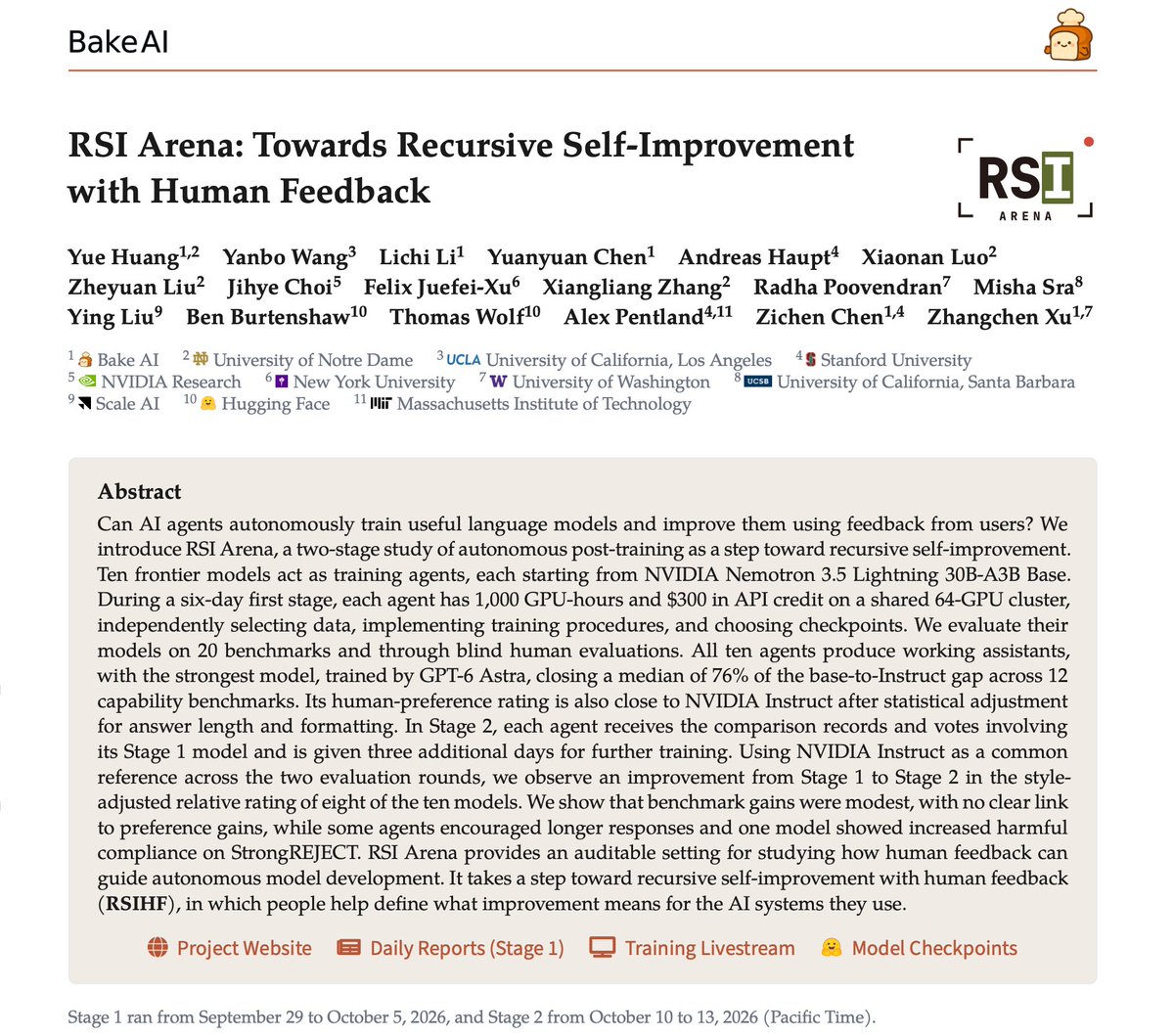
We spent about 13,000 GPU-hours on RSI Arena, tested the models on 20 benchmarks, and collected 3,129 human votes across two rounds. What stayed with me was how much we learned once people tried the models.
At Bake AI, we worked with researchers from @huggingface, @NVIDIAAI, @scale_AI, @Stanford, @MIT, @UCLA, @ucsantabarbara, @nyuniversity, @UW, and @NotreDame
We gave 10 AI agents the same base model and a shared 64-GPU cluster. They picked the data, wrote the code, and trained their own assistants. People at @COLM_conf and online compared the answers without knowing which model wrote them.
We gave the first round’s feedback back to the agents and let them decide what to change. After another training round, eight of ten improved their human ratings relative to NVIDIA Instruct. Those gains did not track benchmark improvements.
The agents could do the engineering. People helped show them what needed fixing.
That’s what this experiment taught us about RSI. AI can take on more of its own development, but our experience with it still matters. If these systems keep getting better, they should help us work better, live better, and spend more time on what we care about.
Otherwise, what is all that compute for?
📄 RSI Arena: Towards Recursive Self-Improvement with Human Feedback
If you saw Jev and you're wondering how decision models work, this should be helpful! In it I try to explain how Perplexity Decider works, plus some considerations around when and how to use decision models.
Lots of fun excalidraw figures! https://t.co/NppDTHCaYi
Stop letting unfinished Opus 5.5 runs eat your budget
Set up the harness before your next long task
Save progress, verify results, reuse the workflow
The full 7-layer setup below ↓ https://t.co/rz78goHxfw
These are the best visual AI resources for learning Transformers, LLMs, embeddings, diffusion, inference and model internals ↓
1/ Transformer Explainer - Watch GPT process text through embeddings, attention, MLPs and next-token prediction.
https://t.co/vkyxOqDVll
2/ Brendan Bycroft’s LLM Visualization - Explore an LLM from architecture down to tensors and operations.
https://t.co/ZFGH0pRtP3
3/ 3Blue1Brown - Visual intuition for linear algebra, neural networks, backprop, attention and Transformers.
https://t.co/plaENBG6aQ
4/ The Illustrated Transformer - One of the clearest visual explanations of embeddings, Q/K/V and attention.
https://t.co/tYrJCm17L6
5/ TensorFlow Playground - Watch neural networks learn as you change layers, activations, features and learning rate.
https://t.co/vva9dm1Gnv
6/ Google PAIR AI Explorables - Interactive explainers on LLMs, generalization, interpretability and model behavior.
https://t.co/vva9dm1Gnv
7/ Distill - Exceptional visual essays on t-SNE, feature visualization, GNNs and interpretability.
https://t.co/FuqpUdDwZD
8/ Abhik Sarkar’s Transformer Visualizations - RoPE, KV cache, FlashAttention, MQA, GQA and more.
https://t.co/vva9dm1Gnv
9/ Visual Guide to Attention Variants - MHA, MQA, GQA and MLA visually compared.
https://t.co/nbpKMa0cpT
10/ Visual Guide to Mixture of Experts - Routing, experts, sparse activation and load balancing.
https://t.co/3gu7xq5e3i
11/ Modular LLM Inference Handbook - Prefill, decode, KV cache, batching, quantization and speculative decoding.
https://t.co/itMIfZnPP5
12/ Apple Embedding Atlas - Explore clusters, neighborhoods and outliers in large embedding spaces.
https://t.co/hxKdXSp5I2
13/ Diffusion Explainer - Follow Stable Diffusion step by step.
https://t.co/YVHEG1zslC
14/ Neuronpedia - Explore features, activations, SAE latents and attribution graphs inside real models.
https://t.co/F8P8eNDH3W
15/ Seeing Theory - Probability, Bayes, distributions, regression and inference made interactive.
https://t.co/KeEhGNSMIQ
16/ CNN Explainer - Visualize convolutions, feature maps, activations and pooling.
https://t.co/sCwv59d2S6
17/ GAN Lab - Train a GAN in your browser and watch its generated distribution evolve.
https://t.co/G94RDWMNak
Save this. There’s a serious AI curriculum hiding inside these links.