"Ça irá" es una expresión que significa "Todo estará bien", y era una canción de la Revolución Francesa en la que pedían el linchamiento de la nobleza y el clero. Por eso en los grabados de 1793 sobre la decapitación de Luis XVI aparecen demonios cantándola.
🔥 crewAI v0.32.0 is out 🔥
🙏 RT please?
🦿kickoff_for_each, kickoff_async and kickoff_for_each_async methods
🦙Support all @llama_index hub integrations
📊Usage Metrics in crew full output
👯Multiple crews with YAML format
🛠️Tools for @langtrace_ai@browserbase@ExaAILabs
I had a dataset labeled by an LLM. To avoid hallucinations, I requested justifications for each label. Now, I have hallucinated both the labels and the justifications.
Multi-agent collaboration has emerged as a key AI agentic design pattern. Given a complex task like writing software, a multi-agent approach would break down the task into subtasks to be executed by different roles -- such as a software engineer, product manager, designer, QA (quality assurance) engineer, and so on -- and have different agents accomplish different subtasks.
Different agents might be built by prompting one LLM (or, if you prefer, different LLMs) to carry out different tasks. For example, to build a software engineer agent, we might prompt the LLM: "You are an expert in writing clear, efficient code. Write code to perform the task …".
It might seem counterintuitive that, although we are making multiple calls to the same LLM, we apply the programming abstraction of using multiple agents. I'd like to offer a few reasons:
- It works! Many teams are getting good results with this method, and there's nothing like results! Further, ablation studies (for example, in the AutoGen paper cited below) show that multiple agents give superior performance to a single agent.
- Even though some LLMs today can accept very long input contexts (for instance, Gemini 1.5 Pro accepts 1 million tokens), their ability to truly understand long, complex inputs is mixed. An agentic workflow in which the LLM is prompted to focus on one thing at a time can give better performance. By telling it when it should play software engineer, we can also specify what is important in that subtask: For example, the prompt above emphasized clear, efficient code as opposed to, say, scalable and highly secure code. By decomposing the overall task into subtasks, we can optimize the subtasks better.
- Perhaps most important, the multi-agent design pattern gives us, as developers, a framework for breaking down complex tasks into subtasks. When writing code to run on a single CPU, we often break our program up into different processes or threads. This is a useful abstraction that lets us decompose a task -- like implementing a web browser -- into subtasks that are easier to code. I find thinking through multi-agents roles to be a useful abstraction.
In many companies, managers routinely decide what roles to hire, and then how to split complex projects -- like writing a large piece of software or preparing a research report -- into smaller tasks to assign to employees with different specialties. Using multiple agents is analogous. Each agent implements its own workflow, has its own memory (itself a rapidly evolving area in agentic technologies -- how can an agent remember enough of its past interactions to perform better on upcoming ones?), and may ask other agents for help. Agents themselves can also engage in Planning and Tool Use. This results in a cacophony of LLM calls and message passing between agents that can result in very complex workflows.
While managing people is hard, it's a sufficiently familiar idea that it gives us a mental framework for how to "hire" and assign tasks to our AI agents. Fortunately, the damage from mismanaging an AI agent is much lower than that from mismanaging humans!
Emerging frameworks like AutoGen, Crew AI, and LangGraph, provide rich ways to build multi-agent solutions to problems. If you're interested in playing with a fun multi-agent system, also check out ChatDev, an open source implementation of a set of agents that run a virtual software company. I encourage you to check out their github repo and perhaps even clone the repo and run the system yourself. While it may not always produce what you want, you might be amazed at how well it does!
Like the design pattern of Planning, I find the output quality of multi-agent collaboration hard to predict. The more mature patterns of Reflection and Tool use are more reliable. I hope you enjoy playing with these agentic design patterns and that they produce amazing results for you!
If you're interested in learning more, I recommend:
- Communicative Agents for Software Development, Qian et al. (2023) (the ChatDev paper)
- AutoGen: Enabling Next-Gen LLM Applications via Multi-Agent Conversation, Wu et al. (2023)
- MetaGPT: Meta Programming for A Multi-Agent Collaborative Framework, Hong et al. (2023)
[Original text: https://t.co/4gTbcQfikx ]
I don't get how Google is not ashamed of asking to be paid for Gemini Advanced. Is so obviously weaker compared to GPT-4, starting from a ridiculously low hard limit on the input size (I already forgot that such limits existed in the past) and ending with excessive hallucinations.
Irony: from the authors of Attention is All You Need. Apparently, attention is not all you need to build great AI-based products.
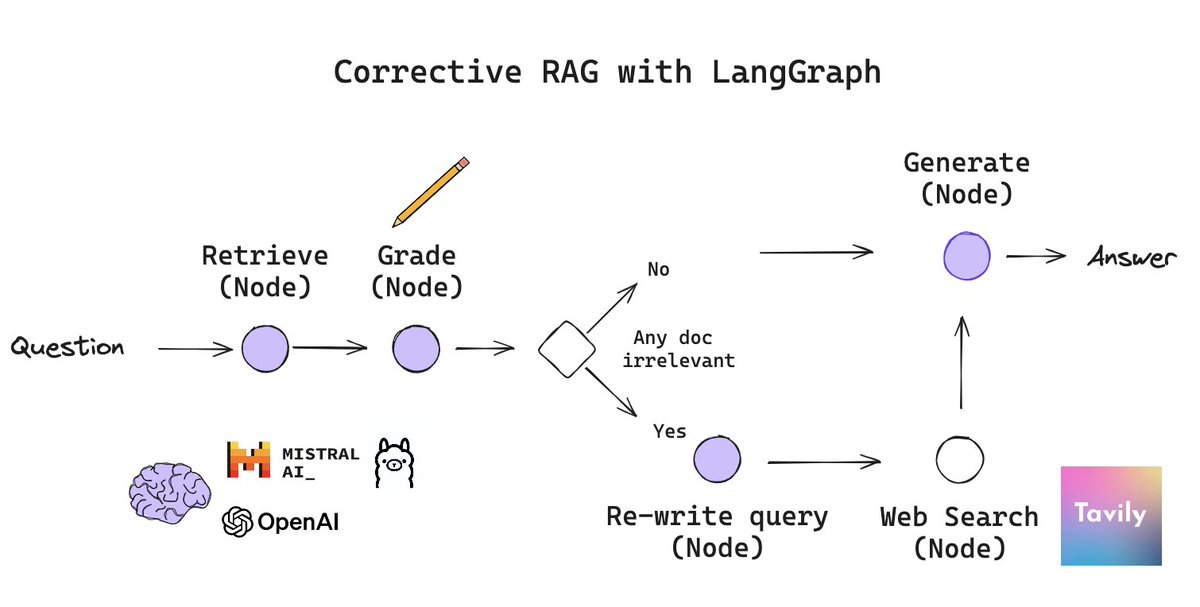
Corrective RAG
Corrective RAG (CRAG) is a recent paper that uses self-reflection to identify and correct problems in retrieval.
It first uses a retrieval evaluator to assess the quality of retrieved documents relative to the query.
It filters out irrelevant documents and augments retrieval with web search.
We show how to implement these ideas using LangGraph + several different LLM options:
1/ @OpenAI -
https://t.co/FG0gJ9K0Xw
2/ OSS models w/ @MistralAI API -
https://t.co/aJ0QEwgvYW
3/ Local OSS models via @MistralAI + @ollama -
https://t.co/aJ0QEwgvYW
For all cases, we use @tavilyai for web search, a fast and efficient means of web retrieval.
Paper:
https://t.co/jWAa2Oxw8k
Video walk through:
https://t.co/rVy4Tpf5Eo
La dieta intelectual mínima para lograr una positiva transformación personal es de 20 buenos libros al año.
Álvaro González-Alorda
( Autor de " Cabeza, corazón y manos")
I’m focused on being a well rounded founder:
Friends + Fitness + Family + Faith + Finances + Love + Mission + Growth + Mindset + Adventure
It’s time to take flight.
Va a ser difícil explicarle a nuestros nietos que la razón por la que les dejamos el planeta que les dejamos fue que movíamos 2 toneladas de metal para hacer distancias que en bici nos habrían tomado 15 minutos.
The math behind a $1M per year online business:
- $83k per month
- Which is $2,767/day
- Which is 28 customers at $99/each
- Which is 1,400 web visitors/day at 2% conversion
How do you get 1,400 web visitors a day?
• SEO
• Newsletter
• Twitter growth
• LinkedIn systems
"This climate crisis is a fossil fuel crisis...for decades oil and gas industry has been playing us for fools, buying off politicians, denying and delaying science, creating conditions that persist today"
• Study hard.
• What others think of you is none of your business.
• It's OK not to have all the answers.
• Experiment, Fail, Learn and Repeat.
• Knowledge comes from experience.
• Imagination is important.
• Do what interests you the most.
• Stay curious
"Study the science of art. Study the art of Science. Develop your senses - especially learn how to see. Realize that everything connects to everything else."
-- Leonardo da Vinci (1452 - 1519)