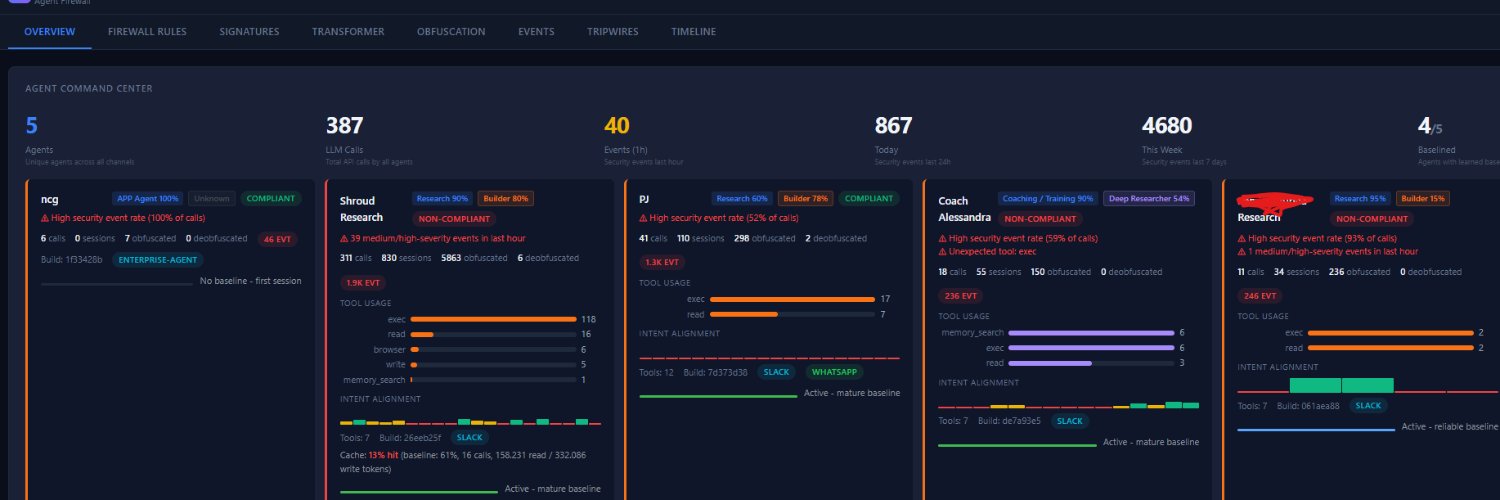
Most prompt-injection defense still assumes the problem is in the text.
For agents, the real signal is often in behavior.
Now we have proof that behavioral drift in the agentic tool-call pipeline is measurable.
New piece:
https://t.co/WnXqSxVFOs
this is complete horse sh*t. Here's a quote from TSMC's Q4 2025 earnings call tanscript
That's a long question. We built a fab in Arizona, and we worked hard, so today, everything, even the yield or defect density is almost equal to Taiwan. And due to the strong demand, as I just answered from the AI, stronger, that's a mega trend, all my customers in the AI customer you see in the US.
TSMC's April revenue a red flag?
TSMC's April revenue number deserves a closer look. From the press release:
"revenue for April 2026 was approximately NT$410.73 billion, a decrease of 1.1 percent from March 2026 and an increase of 17.5 percent from April 2025"
April 2025: revenue up 22.4% MoM
April 2024: revenue up 21% MoM
Then there's the YoY comparisons
April 2025: revenue up 48% YoY
April 2024: revenue up 58.7% YoY
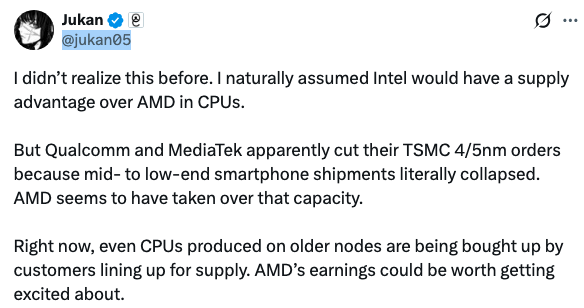
hmmm. definitely a break in the pattern here. Then I just read this post from @jukan05
SiGe capacity at the Vermont fab is “oversubscribed through well into 2027.” Breen said that GF is designed into three of the top four pluggable transceiver companies. Silicon photonics revenue is on track to roughly double in 2026!
Non-IFRS gross margin hit 29.0%, a record for a first quarter, beating guidance by around 200 basis points and topping the prior-year period by 510 basis points
TSMC April 2026 Revenue Report
HSINCHU, Taiwan, R.O.C. – May 8, 2026 - TSMC (TWSE: 2330, NYSE: TSM) today announced its net revenue for April 2026: On a consolidated basis, revenue for April 2026 was approximately NT$410.73 billion, a decrease of 1.1 percent from March 2026 and an increase of 17.5 percent from April 2025. Revenue for January through April 2026 totaled NT$1,544.83 billion, an increase of 29.9 percent compared to the same period in 2025.
SiGe capacity is oversubscribed through well into 2027. GF is designed into three of the top four pluggable transceiver companies. Silicon photonics revenue is on track to roughly double in 2026. https://t.co/3F8v8r2B0C
Almost eight years ago, I wrote the following at the conclusion of an article about AMD's then-forthcoming Rome server processor:
"AMD's architecture and roadmaps for both server CPU and GPUs have never looked better. While we don't yet have access to independent benchmarks for either the Rome server CPU or the MI60 data center GPU platform, the initial benchmarks from AMD look very promising indeed. TSMC's 7nm process would appear to be delivering considerable advances in terms of transistor density and overall performance, benefiting both Rome and the MI60 platforms in equal measure. AMD's choice of a chiplet plus un-core architecture for its second generation server processor represents a significant departure from the traditional, monolithic die approach popularised by Intel, and is an approach which we feel will be highly successful.
This combination of process and architectural advantages sets the stage for AMD to achieve their goals of 5% data center market share by EOY 2018 and double digits by EOY 2019. In fact, we think that AMD can go much further and we anticipate AMD achieving a 25% data center market share by EOY 2020."
During the November 2025 Financial Analyst Day, Lisa Su pegged server CPU TAM at $60 billion by 2030. Now it has jumped to $120 billion by 2030. That’s insane. https://t.co/IGb3b1kCJW
During the November 2025 Financial Analyst Day, Lisa Su pegged server CPU TAM at $60 billion by 2030. Now it has jumped to $120 billion by 2030. That’s insane.
A key example is our expanded strategic partnership with Meta to deploy up to six gigawatts of AMD
Instinct GPUs spanning several product generations. Our agreement includes a custom GPU accelerator
based on our MI450 architecture, co-designed to support Meta's next generation AI workloads.
Shipments are on track to begin in the second half of the year, leveraging our Helios Rack Scale architecture, which
integrates Instinct GPUs with EPYC Venice CPUs to deliver fully optimized high-performance AI
infrastructure
With this expanded visibility, we have strong and increasing confidence in our ability to deliver tens of
billions of dollars in annual data center AI revenue in 2027 and to exceed our long-term growth target of
greater than 80% in the coming years. I look forward to sharing more on our next-generation Instinct
GPUs, EPYC processors, Helios RackScale platform, and our growing customer engagements at our
Advancing AI event in July.
Now turning to our data center AI business, revenue grew by a significant double-digit percentage
year-over-year as adoption of Instinct accelerates across cloud, enterprise, sovereign, and
supercomputing customers. We're seeing strong momentum as customers move from pilots to large-scale
production deployments, particularly in inference, where our leadership memory capacity and bandwidth
are key advantages. This momentum is driving deeper long-term customer engagements including
large-scale multi-generation deployments