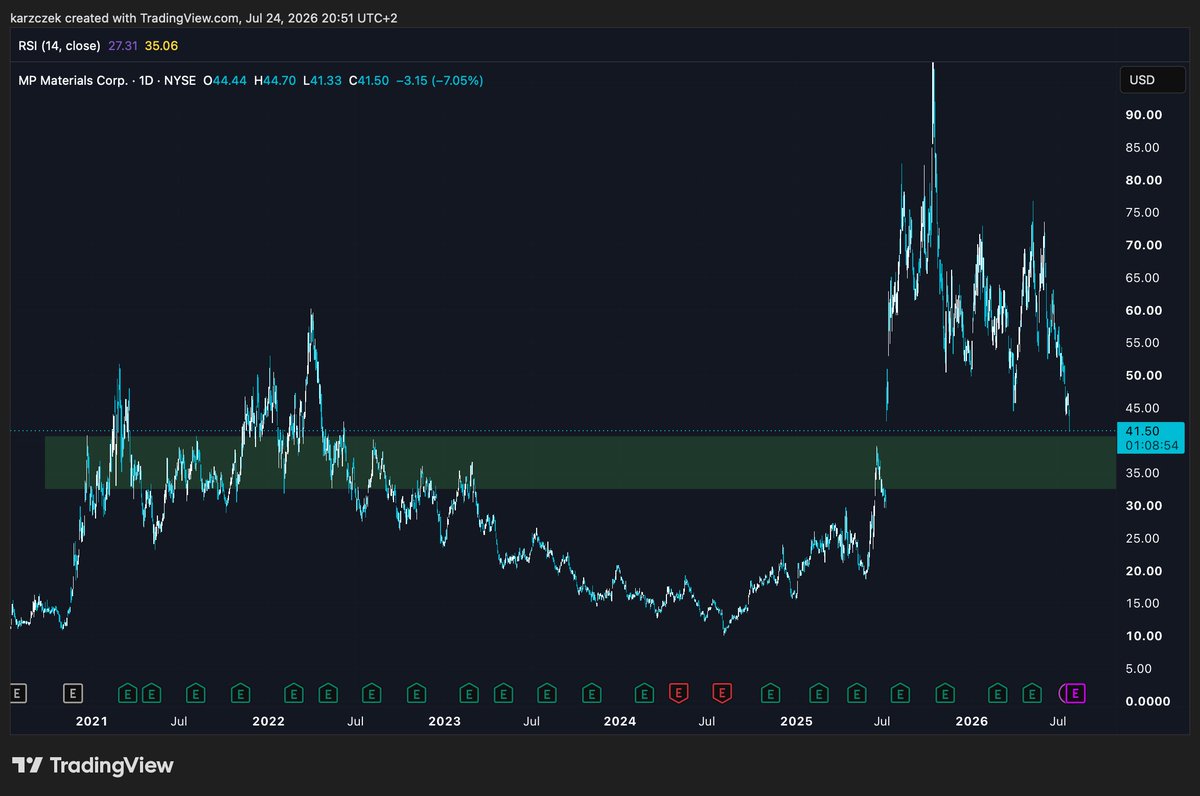
I shared my interest in $MP recently. Today I bought the dip at $40.14. Here you have four charts on $MP that describe the business underneath the price.
Upstream restarted. 2025 REO production hit a record 50,692t, up 12% year over year, from a reserve base of 28.96M short tons at 5.89% TREO. The dashed 2030 path is my own assumption, not company guidance.
Midstream is where the inflection actually sits. Separated NdPr went from 200t in 2023 to 2,599t in 2025, and Q1 2026 printed 917t of production against 1,006t of sales. That is +63% and +117% year over year.
The five-year income statement is the part most people misread. 2021-22 was a high-price concentrate business on a simple cost base. Then Stage II ramp costs, magnetics start-up and the July 2025 exit from all sales to China landed at once. Revenue can fall while strategic value rises, because material now gets separated or stockpiled at home instead of shipped.
Segment mix says the same thing. Materials carries the company at $114.5M of revenue plus price protection income, roughly 32% margin. Magnetics is $21.1M, and its 45% margin comes from precursor products rather than finished magnets. That number will not survive contact with a real magnet mix.
I bought at $40.14 today. The reason is arithmetic, not narrative. At the 2026 high a fully diluted EV of $19.3B needed around $1,072M of 2030 EBITDA at 18x to make sense. At $40.14 it needs $408M. Same ore body, same $110/kg floor through 2035, same 10-year framework covering 100% of 10X output, same 2028 commissioning target.
Q2 results land 6 August. Finished-magnet share versus precursor mix is the number that matters.
Keep in mind $MP
Over 95% of motors in a humanoid use rare earth permanent magnets. Roughly 40 motors per unit. Several kilograms of NdFeB per robot.
2026 to 2027: a few thousand tonnes globally, low single digit percent of the high performance market.
2028 to 2030: tens of thousands of tonnes, or 20 to 30% of current global high performance output.
What’s inside a Vera Rubin NVL72. A typical NVL72 configuration includes:
- Total memory in the range of ~20.7 TB HBM4 (GPU) + ~54 TB LPDDR5X (CPU). $DRAM $MU $SKHY
- 72 NVIDIA Rubin GPUs (each with up to 288 GB of HBM4 high-bandwidth memory). $NVDA
- 36 NVIDIA Vera CPUs (each with 88 custom Olympus cores and up to 1.5 TB of LPDDR5X memory).
- NVLink 6 switches providing up to 260 TB/s of scale-up bandwidth across the rack.
- ConnectX-9 SuperNICs and BlueField-4 DPUs for high-speed networking and data processing.
- Full liquid cooling and modular tray design for faster installation and serviceability.
Delivery day at our Microsoft DCs as the first production Vera Rubins arrive. A huge thank you to our partners at @nvidia and our Azure hardware and datacenter teams for all the incredible work that brought us to this milestone!
Nevertheless from PA perspective $BTC is sitting currently at resistance so at least some more sideways to come imo between the bottom and this top range
The interesting thing about these extreme weekly $BTC sigma moves:
🔴 The major negative sigma events have been remarkably consistent and they showed up around major bottoms.
🟢 The positive sigma events are different. They often came after a drawdown and were followed by sideways action or another pullback.
But in the bigger picture, those positive extremes often marked a regime shift after a bear market.
Not necessarily a signal to buy the exact bottom, more like a sign that the market structure may be changing.
And the latest +7.12σ move is now the largest weekly sigma move in the dataset.
Worth watching. That's why I am just holding and waiting patiently especially with my $CRCL stack
The interesting thing about these extreme weekly $BTC sigma moves:
🔴 The major negative sigma events have been remarkably consistent and they showed up around major bottoms.
🟢 The positive sigma events are different. They often came after a drawdown and were followed by sideways action or another pullback.
But in the bigger picture, those positive extremes often marked a regime shift after a bear market.
Not necessarily a signal to buy the exact bottom, more like a sign that the market structure may be changing.
And the latest +7.12σ move is now the largest weekly sigma move in the dataset.
Worth watching. That's why I am just holding and waiting patiently especially with my $CRCL stack
Part 4 of 6. Ranked worst to best, one a day.
$APP trades at $305, down 59% from its December 2025 ATH. AppLovin sells one thing - an AI engine called Axon that decides which ad to show, for mobile game and e-commerce advertisers.
It lost a fifth of its value in one session on a 1.2% revenue miss. The economics underneath are the best in this group. Q2 revenue $1.92B, up 53%. Adjusted EBITDA $1.61B, up 58%, margin up roughly 300bps to 84%. Gross margin 88.3%. Net income from continuing operations up 64%. Share count down from 340.0M at end 2024 to 335.3M, with $551M repurchased in the quarter.
An 84% margin on nearly $2B of quarterly revenue is not a normal outcome. It exists because AppLovin sells model output rather than media inventory it has to buy - incremental compute costs about ten cents per incremental revenue dollar, and 70% of every new dollar reaches EBITDA.
Now the part most people miss. Almost none of this growth comes from signing new advertisers. It comes from shipping model improvements that make existing advertisers spend more. Over the last twelve quarters, every outsized one had a release behind it. Q2 was the quarter where the release landed after the period closed.
The second engine is consumer and e-commerce, where spend finished 28% above the Q4 2025 level - beating the seasonal peak in a seasonally slow quarter. The way in is unusual: instead of building a salesforce, AppLovin pays e-commerce analytics providers for access to the merchants whose attribution data they already hold.
"There's an awareness problem, but we're early in this category" - Adam Foroughi, CEO, August 2026.
Key risk:
Growth slowed because an engineering schedule slipped. If one release moves the revenue line that visibly, the moat is the pipeline, not the platform.
Resolution:
Q3 revenue against the $2.055B - $2.085B guide, and conversion back toward 75%. Management guided that range while explicitly excluding any model release not already deployed. They have removed their own excuse, which makes this the most falsifiable quarter of the six.
Third place and it moves up two spots if Q3 lands.
Part 5 tomorrow.
Part 3 of 6.
Ranked worst to best, one a day.
$UBER trades near $78, down 25% from its 52-week high of $101.99. Uber runs the marketplace that matches 208 million monthly users to rides, food and freight, and takes a cut of what flows through it.
On the reported numbers this was the strongest quarter of the six. It ranks fourth because of what it is spending the money on.
Reported revenue grew 12%, and that gap is disclosed rather than hidden. Business model changes cost eight percentage points of revenue growth, with the UK change alone explaining roughly 400bps of the ~500bps decline in mobility take rate. Underlying net take rate is broadly stable. The 4.9% Adjusted EBITDA margin on bookings is also a blend, and the blend hides the shape. Mobility runs 7.6% segment operating margin on its bookings, Delivery 3.8%. Delivery is the faster grower at 26% and the thinner one. Group margin can rise while the mix pulls the other way, so the segment line is the one to watch, not the headline.
The reason this is not first is supply. Uber owns the demand endpoint and rents everything that fulfils it. That works while supply is fragmented and commoditised, which human drivers are. Autonomous fleets are neither - they are capital assets owned by a handful of well funded companies, each of which can build its own app. Waymo ended the Phoenix partnership in July and is working to exit the contract, and exclusivity in Austin and Atlanta ends by early 2028.
"We want to make sure that we're not dependent on one partner" - Dara Khosrowshahi, CEO, August 2026.
This is a wide moat business generating real cash at a 4.9% margin on bookings, which leaves limited absorption capacity for a large integration error. The strategy is right. The number of things happening at once is the reason it sits here rather than higher.
Part 4 tomorrow.
A lot of people talk about some unrealistic targets in $CRV. I’m not trying to come up with any imaginary goals here. I’m sticking to what I see, and I think that at some point this kind of minimum will be reached. If someone speaks about higher targets than this is unjustified.
There's a decent chance that $LINK will attack those highs. Actually one of a few alts with real world utility, they cooperate with Mater Card as I can recall. The chart itself looks really clean
Part 3 of 6.
Ranked worst to best, one a day.
$UBER trades near $78, down 25% from its 52-week high of $101.99. Uber runs the marketplace that matches 208 million monthly users to rides, food and freight, and takes a cut of what flows through it.
On the reported numbers this was the strongest quarter of the six. It ranks fourth because of what it is spending the money on.
Reported revenue grew 12%, and that gap is disclosed rather than hidden. Business model changes cost eight percentage points of revenue growth, with the UK change alone explaining roughly 400bps of the ~500bps decline in mobility take rate. Underlying net take rate is broadly stable. The 4.9% Adjusted EBITDA margin on bookings is also a blend, and the blend hides the shape. Mobility runs 7.6% segment operating margin on its bookings, Delivery 3.8%. Delivery is the faster grower at 26% and the thinner one. Group margin can rise while the mix pulls the other way, so the segment line is the one to watch, not the headline.
The reason this is not first is supply. Uber owns the demand endpoint and rents everything that fulfils it. That works while supply is fragmented and commoditised, which human drivers are. Autonomous fleets are neither - they are capital assets owned by a handful of well funded companies, each of which can build its own app. Waymo ended the Phoenix partnership in July and is working to exit the contract, and exclusivity in Austin and Atlanta ends by early 2028.
"We want to make sure that we're not dependent on one partner" - Dara Khosrowshahi, CEO, August 2026.
This is a wide moat business generating real cash at a 4.9% margin on bookings, which leaves limited absorption capacity for a large integration error. The strategy is right. The number of things happening at once is the reason it sits here rather than higher.
Part 4 tomorrow.
Part 2 of 6.
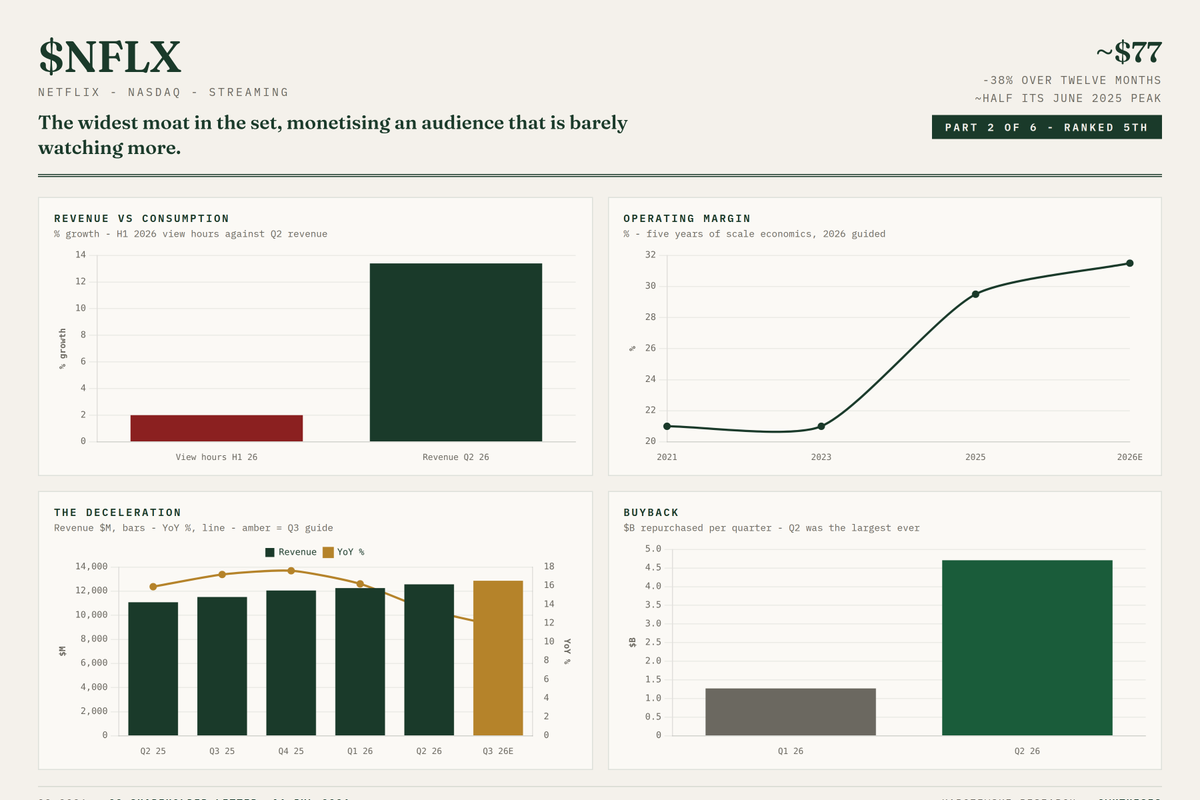
$NFLX trades near $77, down 41% over twelve months. Netflix streams series, film, live sport and games to paying members in almost every country, and is building an ad tier alongside it.
Two judgements, kept separate. On the business, no reservations.
- Q2 revenue $12.56B, up 13.4%.
- Operating margin 33.4%.
- Diluted EPS $0.80, a slight beat.
- Full year guidance of $51.0B to $51.4B with a 31.5% operating margin and about $12.5B of free cash flow, all reiterated.
Operating margin went from 21% in 2021 to a guided 31.5% in 2026 while cash content spend grew roughly 2% a year. That is scale economics working as it should, and it is the widest moat in this group.
On the price, separately. Roughly 20x forward earnings against 11-12% guided revenue growth and that multiple needs the growth rate to stop falling. The problem is what is producing the growth.
View hours grew 2% in the first half of 2026. Revenue grew 13.4%. The entire gap is price and advertising. Both work, and both have a ceiling - advertising doubles to roughly $3B this year, and doubling again needs more hours or higher CPMs.
Q3 guidance of $12.86B implies 11.7% growth, the slowest since 2023. In the same letter, Netflix moved its engagement report from quarterly to annual starting 2027.
"Our season two fall off has actually slightly improved this year relative to last year" - Ted Sarandos, Co-CEO, July 2026.
Key risk: monetising a flat audience is a strategy with a duration, and the disclosure on that audience just got thinner.
Capital return does the heavy lifting - $4.71B repurchased in Q2, the largest quarter ever, $27.1B left. One caveat on that $12.5B: it was raised from $11B on the one-off Warner Bros fee, so recurring is nearer $11B, or about 3.4% of market cap retired a year.
A compounding machine, not a growth story, and the multiple has to be paid accordingly.
Part 3 tomorrow.
$TEM is up 55% since my call and I think in a HTF perspective there's so much more room to grow taking into account in which direction this space is going.
New one on my radar: $TEM
The market prices it as a cash-burning diagnostics lab. The real asset is the 500-petabyte multimodal dataset underneath - the part that compounds.
Diagnostics is the volume engine. Data is the platform: pharma pays nine figures to build on it, NRR 126 percent, Data segment growing 40 percent toward 650 million by 2028.
Here is why AI is the potential driver. As healthcare AI scales, the bottleneck stops being models and becomes data. Linked clinical, molecular and imaging data at scale is the scarce input, and it cannot be rebuilt overnight. Tempus owns one of the largest such datasets and is turning it into foundation models - selling intelligence, not just tests.
Revenue up 36% organic, gross margin near 70%, stock 45% off highs. Pre-FCF and unproven on monetization, so highest growth means highest variance.
Whole crypto is hitting key resistance now.
Our $CRCL position is up 42%, but this is also a key area. I wouldn’t mind a pullback at all, I’d actually be happy to buy more.
There’s a good chance we see some resistance here and move lower first.
Current average entry: ~$64.30.
I am not taking profits until at least $220 that will give us around 250% gain
Bessent saying the U.S. is moving quickly to implement the GENIUS Act is a big deal.
Faster implementation → more regulatory clarity → more institutional adoption of stablecoins.
$USDC could be one of the biggest winners and the real beneficiary? $CRCL
$MU is putting $10B over ten years into a dedicated memory research lab in Boise. This is separate from the >$250B already committed to US manufacturing and R&D.
What it funds: critical memory technologies, advanced memory and compute architectures, packaging, and future semiconductor manufacturing. University collaborations and global satellite labs sit inside the same envelope. Groundbreaking is planned for calendar 2027, with capacity for hundreds of researchers. The company anchors it on 62,000 lifetime patents.
Sanjay Mehrotra:
"America's AI future will be built on American-made memory."
The scale deserves context. $1B per year against FY25 revenue of $37.4B is roughly 2.7 percent of sales meaningful as a signal, modest as a line item, and it lands at the point of maximum cycle euphoria with DRAM contract prices up triple digits year over year. Long-horizon research also has no revenue attribution window. Nothing here adds a wafer before 2027, so it does not touch the current shortage.
$SKHY SK hynix just sent a massive signal.
After today’s selloff, the company approved a ₩40T (~$28.6B) buyback at roughly 3.3% of shares outstanding with every repurchased share to be cancelled.
Even more important: SK hynix raised its shareholder-return target to >50% of cumulative FCF through 2027.
Management is basically saying: the market is undervaluing the business and with AI memory demand still driving record cash generation, this is a pretty strong vote of confidence.
$DRAM $MU $SNDK
$FUTU Q2 2026 record volume
- Revenue $918.2M, +35.6% YoY from $677.2M.
- Gross profit $792.5M, margin 86.3% vs 87.4%.
- Operating income $569.2M, +33.5%, operating margin 62.0% vs 63.0%. Net income $464.4M, +41.6% from $328.1M.
- Diluted EPS per ADS $3.33 vs $2.33.
Net income grew faster than operating income. The gap sits below the line: effective tax 16.3% vs 18.3%, and equity method swung from minus $3.0M to plus $8.3M. Hold both constant and net income grows roughly 35%, in line with EBIT. The headline overstates the operating quarter.
Volume was the story and the counter-story. Trading volume $819B, +78.8% YoY, with US stocks at $640B. Commission income reached $428.5M, up only 30.3%. Implied blended rate fell from roughly 7.2bps to 5.2bps. That is mix rather than price: US notional carries a lower rate per dollar traded.
CEO Leaf Hua Li on client assets:
"The growth was mainly attributable to higher market valuation of clients' stock holdings."
Guidance: the FY26 target of 800,000 net new funded accounts is unchanged. H1 delivered 477,000, or 59.6% of target, leaving 323,000 for H2. The company issues no revenue or margin guidance.
The Q1 trough on the chart is the CSRC penalty, not the business - operating income that quarter was $450M - and with it out of the base
$SKHY SK hynix just sent a massive signal.
After today’s selloff, the company approved a ₩40T (~$28.6B) buyback at roughly 3.3% of shares outstanding with every repurchased share to be cancelled.
Even more important: SK hynix raised its shareholder-return target to >50% of cumulative FCF through 2027.
Management is basically saying: the market is undervaluing the business and with AI memory demand still driving record cash generation, this is a pretty strong vote of confidence.
$DRAM $MU $SNDK
$CRCL position is up 25 percent. Price is approaching resistance and I am not acting into it. If it clears, the thesis carries. If it gives back, I add. Nothing else to do.
Bessent saying the U.S. is moving quickly to implement the GENIUS Act is a big deal.
Faster implementation → more regulatory clarity → more institutional adoption of stablecoins.
$USDC could be one of the biggest winners and the real beneficiary? $CRCL
$TEM up 18% on a catalyst that was not its own.
$MRNA and $MRK reported that intismeran autogene, an individualized neoantigen therapy, met its Phase 3 endpoint in adjuvant melanoma added to pembrolizumab. $MRNA nearly doubled.
The read-through is structural. An individualized neoantigen therapy is built from the patient's own tumor. No sequencing, no product. If the class reaches standard of care, genomic profiling becomes a manufacturing input rather than a diagnostic step.
That is what $TEM already runs at scale. Q2 revenue $382.5M, up 22%. Diagnostics $289.3M on oncology volume up 31%. MRD volumes about 9,000 tests, up 38% sequentially. The pending Personalis deal at $1.5B enterprise value buys tumor-informed MRD outright.
So the market is pricing the probability that a therapeutic class arrives which cannot function without the sequencing layer.
Two things did not reprice. A Phase 3 readout is not approval, approval is not reimbursement, and reimbursement is not volume - any uplift lands 2028 at the earliest. And no contractual link is disclosed. $TEM lists AstraZeneca, Bristol Myers Squibb and BioNTech as partners. Intismeran is not among them.
The economics are also unfinished. Q2 GAAP net income of $5.6M contains $98.5M of unrealized securities gains. Operating cash use was still negative.
Today widened the question, not the answer. Next test is the Phase 2 renal cell readout, possible by year end.
New one on my radar: $TEM
The market prices it as a cash-burning diagnostics lab. The real asset is the 500-petabyte multimodal dataset underneath - the part that compounds.
Diagnostics is the volume engine. Data is the platform: pharma pays nine figures to build on it, NRR 126 percent, Data segment growing 40 percent toward 650 million by 2028.
Here is why AI is the potential driver. As healthcare AI scales, the bottleneck stops being models and becomes data. Linked clinical, molecular and imaging data at scale is the scarce input, and it cannot be rebuilt overnight. Tempus owns one of the largest such datasets and is turning it into foundation models - selling intelligence, not just tests.
Revenue up 36% organic, gross margin near 70%, stock 45% off highs. Pre-FCF and unproven on monetization, so highest growth means highest variance.