Delighted to share our new manuscript published this week in @JITC showcasing a novel oncolytic herpes simplex virus armed to express a Bi-specific T cell Engager which targets NKG2D ligands in glioblastoma.
@Oncolytics_oxon@OxfordOncology@BRUKresearch
New #JITC review: Oncolytic viruses and antibodies: are they more successful when delivered separately or when engineered as a single agent? https://t.co/jWDtZx9Frl @wktpeter@theRafLab
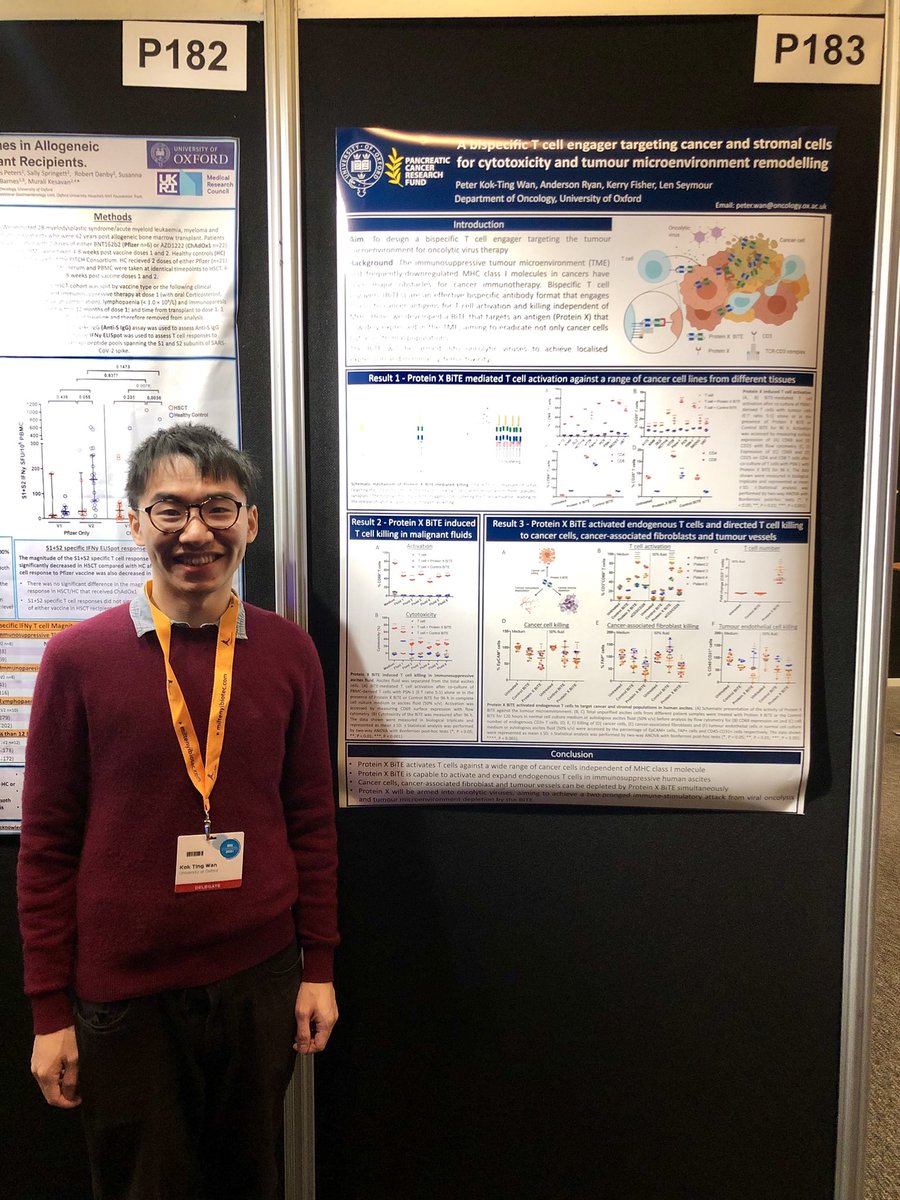
Look out for a poster today presented by one of our talented PhD students @wktpeter on his work using Bispecific T cell Engagers for cancer immunotherapy at P-183 #BSI21 (2/4)
If you are an @OUHospitals clinician, @UniofOxford staff or student that works in cancer research, diagnosis or treatment - then join our membership
Join the community & contribute to a world where cancers are diagnosed earlier & treated more effectively
https://t.co/oKYuavVCeE
A fantastic new review from our lab in @jitcancer highlighting the importance of HLA loss when considering immunotherapy in patients. There is an increasing need for predictive biomarkers for selection of patients who will receive such therapies. https://t.co/dyuOLI6auQ
Congratulations to @wktpeter from our lab who just won best presentation today at the Oxford University Student Symposium. His work has huge potential and was extremely well presented.
Some of the very talented DPhil students in our lab presenting their work at the annual symposium. They have worked incredibly hard this year and have made some fantastic progress!
Pleased to announce another new publication from our lab by a very talented PhD student reviewing current strategies to target the tumour microenvironment to tackle cancer https://t.co/WKxVjonGAV
How can viruses help us to fight #cancer?
@Oncolytics_oxon lab have a new paper investigating the use of a herpes #virus to deliver immunotherapy treatment and kill tumour cells! The video below shows it working (cancer death in green)
Read more here: https://t.co/lPtT8RfBgO
Thrilled with our latest publication. We use an oncolytic herpes to express a bispecific antibody, activating T cells, generating an inflammatory response and killing cancer & tumour supporting cells. With support from @CRUKOxford and @OxfordOncology https://t.co/pE1YjABXAi