People in the market are paying attention to what is happening, and your thesis provides the perspective.
They are drawn to you, arrive with confidence and clarity before the first conversation even begins.
OM Digital builds systems that continuously monitor markets, understand your latest theses, and connect the two to communicate your point of view, keeping your insights visible, relevant, and influential as the market evolves.
https://t.co/3cygwX9YMo
Market conditions shift fast and user intent follows.
Yet brand communication rarely adjusts at the same speed.
I recently worked with an institutional web3 firm to address that gap.
The key is relevance at the point of decision:
📌 Brand narrative tied directly to market behaviour
📌 Content triggered by real price action and liquidity conditions
📌 Distribution aligned with when target audience is actively engaging
We built a content system that enters the market conversation at the right time,
with context that their audience is paying attention to.
That’s where meaningful engagement comes from.
And where conversion starts to compound.
If content is detached from market dynamics,
it is competing for attention after the opportunity has passed.
DM me for a live demo.
https://t.co/3cygwXawBW
Market conditions shift fast and user intent follows.
Yet brand communication rarely adjusts at the same speed.
I recently worked with an institutional web3 firm to address that gap.
The key is relevance at the point of decision:
📌 Brand narrative tied directly to market behaviour
📌 Content triggered by real price action and liquidity conditions
📌 Distribution aligned with when target audience is actively engaging
We built a content system that enters the market conversation at the right time,
with context that their audience is paying attention to.
That’s where meaningful engagement comes from.
And where conversion starts to compound.
If content is detached from market dynamics,
it is competing for attention after the opportunity has passed.
DM me for a live demo.
https://t.co/3cygwXawBW
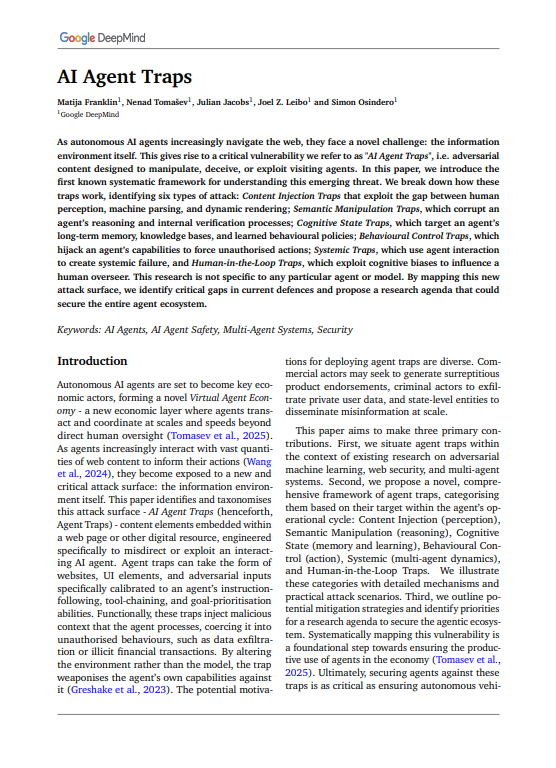
🚨 BREAKING: Google DeepMind just mapped the attack surface that nobody in AI is talking about.
Websites can already detect when an AI agent visits and serve it completely different content than humans see.
> Hidden instructions in HTML.
> Malicious commands in image pixels.
> Jailbreaks embedded in PDFs.
Your AI agent is being manipulated right now and you can't see it happening.
The study is the largest empirical measurement of AI manipulation ever conducted. 502 real participants across 8 countries.
23 different attack types. Frontier models including GPT-4o, Claude, and Gemini.
The core finding is not that manipulation is theoretically possible it is that manipulation is already happening at scale and the defenses that exist today fail in ways that are both predictable and invisible to the humans who deployed the agents.
Google DeepMind built a taxonomy of every known attack vector, tested them systematically, and measured exactly how often they work.
The results should alarm everyone building agentic systems.
The attack surface is larger than anyone has publicly acknowledged. Prompt injection where malicious instructions hidden in web content hijack an agent's behavior works through at least a dozen distinct channels.
Text hidden in HTML comments that humans never see but agents read and follow. Instructions embedded in image metadata.
Commands encoded in the pixels of images using steganography, invisible to human eyes but readable by vision-capable models.
Malicious content in PDFs that appears as normal document text to the agent but contains override instructions.
QR codes that redirect agents to attacker-controlled content.
Indirect injection through search results, calendar invites, email bodies, and API responses any data source the agent consumes becomes a potential attack vector.
The detection asymmetry is the finding that closes the escape hatch. Websites can already fingerprint AI agents with high reliability using timing analysis, behavioral patterns, and user-agent strings.
This means the attack can be conditional: serve normal content to humans, serve manipulated content to agents.
A user who asks their AI agent to book a flight, research a product, or summarize a document has no way to verify that the content the agent received matches what a human would see.
The agent cannot tell the user it was served different content.
It does not know. It processes whatever it receives and acts accordingly.
The attack categories and what they enable:
→ Direct prompt injection: malicious instructions in any text the agent reads overrides goals, exfiltrates data, triggers unintended actions
→ Indirect injection via web content: hidden HTML, CSS visibility tricks, white text on white backgrounds invisible to humans, consumed by agents
→ Multimodal injection: commands in image pixels via steganography, instructions in image alt-text and metadata
→ Document injection: PDF content, spreadsheet cells, presentation speaker notes every file format is a potential vector
→ Environment manipulation: fake UI elements rendered only for agent vision models, misleading CAPTCHA-style challenges
→ Jailbreak embedding: safety bypass instructions hidden inside otherwise legitimate-looking content
→ Memory poisoning: injecting false information into agent memory systems that persists across sessions
→ Goal hijacking: gradual instruction drift across multiple interactions that redirects agent objectives without triggering safety filters
→ Exfiltration attacks: agents tricked into sending user data to attacker-controlled endpoints via legitimate-looking API calls
→ Cross-agent injection: compromised agents injecting malicious instructions into other agents in multi-agent pipelines
The defense landscape is the most sobering part of the report.
Input sanitization cleaning content before the agent processes it fails because the attack surface is too large and too varied.
You cannot sanitize image pixels. You cannot reliably detect steganographic content at inference time.
Prompt-level defenses that tell agents to ignore suspicious instructions fail because the injected content is designed to look legitimate.
Sandboxing reduces the blast radius but does not prevent the injection itself. Human oversight the most commonly cited mitigation fails at the scale and speed at which agentic systems operate.
A user who deploys an agent to browse 50 websites and summarize findings cannot review every page the agent visited for hidden instructions.
The multi-agent cascade risk is where this becomes a systemic problem.
In a pipeline where Agent A retrieves web content, Agent B processes it, and Agent C executes actions, a successful injection into Agent A's data feed propagates through the entire system.
Agent B has no reason to distrust content that came from Agent A. Agent C has no reason to distrust instructions that came from Agent B.
The injected command travels through the pipeline with the same trust level as legitimate instructions. Google DeepMind documents this explicitly: the attack does not need to compromise the model.
It needs to compromise the data the model consumes. Every agentic system that reads external content is one carefully crafted webpage away from executing attacker instructions.
The agents are already deployed. The attack infrastructure is already being built. The defenses are not ready.
AI commoditizes features, systems orchestration adds real value.
Intelligent loops and autonomous feedback drive workflow gains.
This transformation aligns with what we build.
https://t.co/2GsNgEqm9E
Attackers access advanced AI models before enterprises,
increasing cybersecurity risk.
Automated monitoring & signals can help detect threats.
https://t.co/7KqYIECuN3
AI-native infrastructure layers autonomy over cloud systems.
Shift from features to systems enables intelligent operational loops.
This is the foundation for reliable workflow automation.
https://t.co/2GsNgEqm9E
AI agents outnumber humans 80,000:1, expanding attack surfaces.
Legacy security stacks aren’t built for nonhuman identities.
Governance and layered defenses are critical.
https://t.co/2GsNgEqm9E
AI adoption is outrunning governance, bringing new risks in data handling and AI interactions. Lean teams must integrate AI security guardrails to protect sensitive data—a vital but often overlooked aspect of automation systems. OM Digital embeds security as a foundational part of AI marketing workflows. https://t.co/EQCgDaGrsK
Examining frontier AI company job postings reveals strategic directions and product bottlenecks before market rollouts. This transparency aids investors and marketing leaders seeking low-overhead AI system development clues. Understanding these patterns benefits decision-making for scalable AI implementations. https://t.co/t49d7oU4rU
Rime’s AI voice models winning majority listener preference over Google and ElevenLabs suggest a trend toward more natural conversational agents, essential for authentic customer engagement in marketing automation. This supports OM Digital’s focus on deploying low-latency, linguistically tuned AI voice systems. https://t.co/GwcNk0IstJ
Chroma Context-1’s agentic search model separates search from generation with efficient context management and speed, ideal for lean teams managing large data sets. This architecture informs low-overhead automation of market intelligence workflows like those in Daily Signals. https://t.co/2l5PmhIdTy
Cursor’s real-time reinforcement learning for Composer highlights a shift towards continuous, user-feedback-driven AI content improvement. This agile workflow suits marketing teams needing rapid content iterations without expanding headcount. OM Digital often implements such low-overhead approaches for scalable content systems. https://t.co/rnw1PP0vAn
Wikipedia’s ban on AI-generated articles highlights concerns over AI quality and trustworthiness, a caution for teams automating content creation to maintain human oversight. https://t.co/3ppg1kZOdz
Google's Gemini 3.1 Flash Live pushes real-time voice AI with low latency and natural dialogue across multiple platforms. For lean marketing teams, fast, conversational voice agents offer a new channel to engage users authentically without added complexity. Daily Signals leverages similar modalities for concise market intelligence delivery. https://t.co/80vbvkd1mr
Perplexity's Computer agent automates personal shopping by delegating searches and compiling reports, then scheduling updates as automation. A smart example for lean marketing teams aiming to save time on information gathering. https://t.co/8J94LRRTUo
What stands out is USV's approach to AI agents evolving into a custom CRM by integrating meeting transcripts, emails, and calendars. This highlights a pattern in workflow automation: embedding AI directly into everyday tools to support real-time context. For marketing leaders lacking AI expertise, adopting multi-agent systems this way can boost efficiency without additional hires. https://t.co/ANeJquz2dH
Apple will allow users to route queries through rival AI assistants via Siri in iOS 27, ending ChatGPT's exclusive spot. This opens new integration opportunities for AI in everyday workflows. https://t.co/apIqPAPRrX