On this date in 1911, 17% of the U.S. land area was at or above 100°F (37.8°C). It was ≥100° in 30 states.
🌡️ 112°F (44.4°C) in AZ
🌡️ 111°F (43.9°C) in CA
🌡️ 110°F (43.3°C) in NE
🌡️ 109°F (42.8°C) in KS, MO, and OK
🌡️ 108°F (42.2°C) in IA
🌡️ 107°F (41.7°C) in TN
🌡️ 106°F (41.1°C) in IN, MA, and NY
🌡️ 105°F (40.6°C) in AR, KY, IL, PA, and TX
🌡️ 104°F (40.0°C) in MI, UT, and WI
🌡️ 103°F (39.4°C) in MN, NH, OH, SD, and WV
🌡️ 102°F (38.9°C) in LA, ME, and VT
🌡️ 101°F (38.3°C) in ID
🌡️ 100°F (37.8°C) in NJ and VA
The frauds employed by the World Weather Attribution tell us that the heatwave this weekend is unprecedented, but that's because they intentionally ignore inconvenient pre-1950 data.
Absolutely true. Renewables are expensive window dressing. Nuclear is ready to go, reliable and boring, exactly what we need. Politicians throw money at windmills while the grid gets less stable.
Here is a real unadjusted temperature graph 1900-2010.
1930's were the warmest in the record.
This is a cycle and the albedo has gone down from 30% to 29% which has caused the recent warming trough a reduction in loud cover.
CO2 changes played no part.
Just 5,000 years ago, the Arctic looked very different.
During the Holocene Thermal Maximum, summers in the northern hemisphere were 3C warmer than today.
And life thrived.
Birch and spruce forests expanded all the way to the edges of the Arctic Ocean in places like northern Siberia and Alaska. Ancient pollen, macro fossils and soil records confirmed these weren't isolated trees. They formed sustained forests, replacing tundra with thriving ecosystems.
Permafrost back then was weak, patchy or absent. Peatlands developed, supporting rich life where frozen ground would later take over.
But around 5,000 years ago, colder and wetter conditions returned. This marked the neoglacial period. The trees retreated, permafrost spread. And the Arctic became the frozen, barren expanse we know today.
Yet the land still remembers. Buried trunks, preserved seeds and deep peat layers tell the story of a greener, warmer north. Ignored in today's narratives is an inconvenient truth: The climate is always changing, and history shows us warmth is beneficial for life.
My wife and I own a pharmacy. Last month we spent days trying to pry one prescription loose from a company that did everything it could to hold onto it.
The drug was everolimus. A generic. It treats cancer and protects transplant patients from rejecting their new organ. Not exotic. Not rare. A pill.
The patient wanted it filled with us because we're cash-pay and cost-plus. No insurance. No PBM. No secret markups, no games. Our price was $318. That's not cheap by our standards — most of what we fill runs under $20 — but it was honest.
Here's what that same prescription looked like on the other side of the counter.
In 2023, Medicare was paying about $6,645 for it. That's roughly 21 times our price for the identical medication. Medicare spent around $240 million on everolimus alone that year. If they'd paid our price, they'd have saved roughly $230 million. On one generic drug.
So how does an insurance company profit off a drug that expensive? Don't they pay for it?
No. You pay for it. In your premiums. Their job isn't to spend less — it's to keep your healthcare dollars circulating inside their own companies. And the tool they use is called spread pricing.
Spread pricing works like this: the middleman bills the health plan one price, pays the pharmacy a lower one, and keeps the difference. You never see it. On TRICARE, they pay an independent pharmacy like mine about $311 to fill everolimus. That barely covers our cost of the drug. Meanwhile the plan gets billed thousands. That gap — north of $6,000 on a single fill — is pure margin the middleman pockets.
Now here's the part they'd rather you not think about.
The pharmacy we were fighting was Accredo. Accredo is owned by Express Scripts. Express Scripts is the pharmacy benefit manager owned by Cigna. Same company, three masks. That nesting-doll structure isn't an accident — it's the whole design. When the pharmacy, the PBM, and the insurer are all one entity, they can shuffle money between their own pockets and call it whatever they want. The confusion is the product.
And this isn't a story about one weird drug. It's the business model.
The FTC has been digging into exactly this. In its January 2025 report on the three biggest PBMs — CVS Caremark, Express Scripts, and OptumRx — staff found those companies marked up specialty generic drugs by hundreds and thousands of percent when dispensing through their own affiliated pharmacies. Just those markups generated more than $7.3 billion above what the drugs actually cost to acquire, from 2017 to 2022. One in five of the specialty generics they studied was marked up over 1,000%. Some cancer generics: over 3,000%. On top of that, the FTC pegged spread pricing on those same drugs at another $1.4 billion.
One example straight from the FTC's files: dimethyl fumarate, a multiple sclerosis drug. Costs about $177 to acquire. The PBMs paid their own pharmacies close to $4,000 for a 30-day supply. Same trick. Different drug.
And they steer the profitable ones to themselves on purpose. Pharmacies affiliated with the big three took in 68% of specialty dispensing revenue in 2023 — up from 54% in 2016. The prescriptions marked up more than $1,000 disproportionately end up at their own pharmacies, not independents like mine.
So when we called to transfer this patient's everolimus to be filled without insurance, it landed like we were asking them to set $6,000 on fire. Of course they stonewalled us.
That's why we fired them.
No insurance means no invisible $6,000 charge buried in a premium you can't itemize. It means the price you see is the price. Ours was $318. Theirs was thousands. Same pill.
B. No. He had already been injured by someone obstructing ICE before and this was a repeat. The responsible persons are the Democratic politicians lying to their citizens and convincing them to obstruct ICE. They also refuse to coordinate with ICE and release criminals back onto the street.
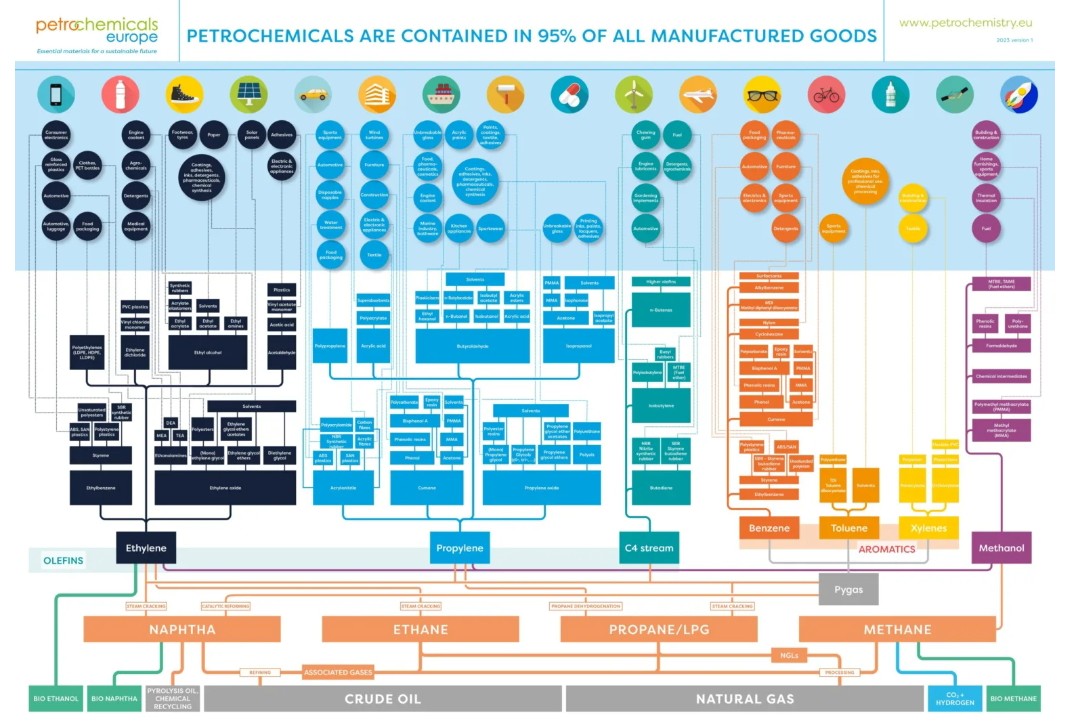
Take away the hydrocarbons, and we lose virtually overnight everything that makes us modern.
The world relies almost entirely on hydrocarbon byproducts. It's an intricate, deeply woven symbiosis that cannot be replaced by simply stumping up a big battery—an industrial-scale solution that hasn't even been invented yet.
Wind and solar cannot produce a single one of the thousands of derivatives that cascade from oil, honed by more than a century of invention and assimilation.
Without these derivatives, the visible iconography of wind turbines and solar farms could not be built in the first place. They would be unable to darken our familiar landscapes with dystopian industrial grids. Global reliance on hydrocarbons affects the entire human production chain—from the extraction and processing of metals and rare earths to refining and manufacturing.
Take bitumen, which rolled out the entire world's networks of roads and highways. Think about the heavy, diesel-powered machinery, maritime shipping and aviation fleets that move food and raw materials worldwide. They rely almost exclusively on hydrocarbons for both fuel and lubrication. Imagine a world without them.
Modern medicine and healthcare are fundamentally built on hydrocarbon derivatives. High-grade medical equipment, sterile syringes, intravenous tubing, surgical gloves and the plastic casings for life-saving machinery - they are all manufactured from petrochemical resins. There is not a single sterile modern hospital in the entire world that could function without oil.
The global food supply chain is equally linked to hydrocarbon extraction. The insulation on electrical wiring and the advanced polymers inside every television and smartphone ever built come from fossil fuel derivatives. Meanwhile, oil and natural gas remain the fundamental precursors to all industrial fertilisers and pesticides.
Think of commonplace items like paints, synthetic fabrics like polyester and nylon, detergents, cosmetics, and pharmaceuticals. They all depend directly on hydrocarbons.
A renewable energy culture will never replace the raw physical material that builds the roads, runs the hospitals, grows the food and makes our technology function.
This deeply woven foundation is the essence of modern life.
Be honest, who knew that Hamas summer camps in the Gaza Strip for 13-17 year olds was about using real AK47s with real bullets and real military training, to attack Israelis?
Who knew, besides UNRWA?
US golf courses use 531 billion gallons of water per year. That’s down from 759 billion gallons per year in 2005 and is 0.5% of total annual water withdrawals in this country. And somehow, the country manages to not look like the Sahara Desert.
Meanwhile, data centers - the things actually powering the future instead of your uncle’s 18th hole mulligan - use somewhere between 17 and 70 billion gallons annually. That’s 0.017% to 0.070% of total withdrawals.
Or, for the math-challenged among us, roughly 3-14% of what the golf courses are using.
Sure, plopping a massive data center in the middle of nowhere without proper planning and infrastructure can stress local water systems. That’s called “basic engineering,” folks, not some apocalyptic thirst apocalypse.
But these lurid headlines screaming that AI is going to suck the rivers dry and leave us fighting over the last drop like Mad Max at a Buc-ee’s?
Pure, unadulterated bullshit.
Anyone parroting that nonsense is a paid or unpaid CCP Useful Idiot.
And yeah, China’s been quietly funding the opposition to US data centers because they’d love nothing more than to lap us in AI while we tie our own hands with performative environmental panic.
They win if enough credulous (or outright traitorous) Americans keep falling for it.
Priorities, people. We can handle a few server farms. The real existential threat is apparently the back nine at the country club.
Source: Ty Beard
The cost of a 'transition' away from reliable, cheap and available power is staggering.
The world has already spent roughly $147 trillion so far on what is a social experiment that dismantles the bedrock of our affordable and reliable energy. This transition cost has been framed by McKinsey Global at $275 trillion by 2050. It pays for:
* Complete rewiring and upgrading of every global electricity grid ($21 trillion).
* Overhauling industrial systems (like the essential production of steel and cement).
* Changing agricultural practices and vehicle fleets (replacing heavy mining vehicles, road transport, shipping and agricultural equipment with EV alternatives).
This staggering outlay is not just the proliferation of wind turbines and solar panels scarring our wilderness, scenic, rural and coastal. So far, the essential battery technology does not exist.
There is $128 trillion still to go - 2.5 times the world's yearly Gross Domestic Product.
REPORTER: “Has there been a single moment since 1967 when you thought that the Arabs are ready to talk?”
GOLDA MEIR: “No. The world must realize that it’s not about a piece of land. They just refuse to believe that we have the right to exist at all."
She was right all along.
😂The people who claim we can run our ultra-high-energy civilization on such garbage are lying. Their goal has been, since Malthus and then Heidegger, to dismantle our high-energy civilization, not "sustain" it.