AI agents are evolving fast, but the questions around accountability, real-world impact, and who bears the cost matter more than ever.
Micha’s latest piece offers a thought-provoking look at where this could be heading:
https://t.co/DXLS2kWShE
What do you think? Are we building responsibly enough? 🤖🌍
Comment below @anthenor's post!
Holder count is the most honest adoption signal in crypto. It cannot be manufactured by market makers or wash trading. $NODL stands at 128,255 holders on ZKsync Era, ahead of DePIN peers with market capitalizations many multiples larger. The network grows wherever smartphones go. Verify it on OKLink.
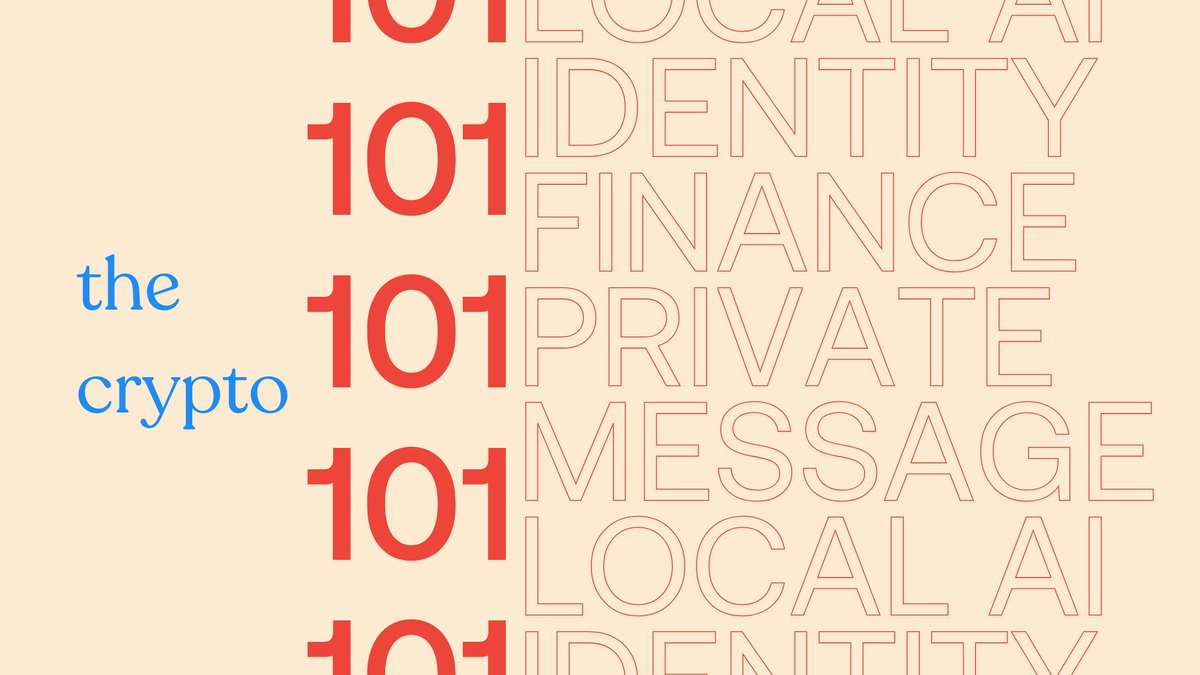
🌐 Crypto 101 e35 brings it all together: compute, communication, identity, and assets, one sovereign stack, and Nodle's trust network underneath it.
To close the week:
What's the single most important lesson you've learned in web3 or crypto so far?
👇 One sentence, for someone starting today
https://t.co/Pja9i97jGN
📉 What we cover in this edition:
🎲 How weak randomness can weaken a seed phrase
🧱 Why hardware wallets reduce risk but do not remove it
🔄 Why a firmware patch alone cannot fix an already exposed seed
🚚 How to migrate funds to a safer wallet
🧠 What this means for anyone new to self-custody
📖 Read the full breakdown:
https://t.co/Zcl8Kysege
🔐 “Not your keys, not your coins” has been crypto’s golden rule for years.
But the past week added an uncomfortable twist: holding your own keys only protects you if those keys were generated securely in the first place. ⚠️
Crypto 101 e36 breaks down what really happened, and why. 👇
🔐 Fourth layer: assets.
Self-custody means holding your own private keys, no exchange, no bank, no middleman.
Crypto 101 e35 breaks down the tradeoff: full control, full responsibility.
If you could go back to your first months in crypto, what would you tell yourself about managing your own keys?
👇 Share your lesson learned
https://t.co/Pja9i97jGN
🏷️ Third layer: identity.
An ENS name is something you actually own, unlike a profile a platform can delete.
Crypto 101 e35 explores how self-owned identity travels with you.
If you had to give one piece of advice about managing your on-chain identity, what would it be?
👇 Share it below
https://t.co/Pja9i97jGN
https://t.co/yWitTSlxZb just got a new look, and a much bigger job.
Your BLE tags can now be found, tracked, and verified by any of a billion smartphones across 175 countries, no dedicated readers needed.
Roole already proved it: 1M vehicles, 40% stolen-vehicle recovery, 10M dollars+ recovered.
First 10,000 devices onboard free.
💬 Second layer: communication.
Decentralized messaging means no single company or country can read your conversations or shut them down.
Crypto 101 e35 covers why that matters more than ever.
Thinking back to your first steps in crypto:
What confused you most about privacy, wallets, or messaging?
👇 Share your story
https://t.co/Pja9i97jGN
📱 The first layer of a sovereign stack: computation.
Local AI means a model runs directly on your device, so a query never has to leave your phone.
Crypto 101 e35 breaks down why that matters for privacy and ownership.
If you could tell someone brand new to web3 one thing about keeping their data on their own device, what would it be?
👇 Share your take
https://t.co/Pja9i97jGN
Crypto 101 · e34 is about identity that belongs to you: wallets, names, and proofs that don't depend on one central platform.
To close the week:
What's the single most important lesson you've learned in web3 or crypto so far?
👇 One sentence, for someone starting today
https://t.co/26rjWm3kgr
What if your phone, your messages, your identity, and your assets all worked on a stack you actually control?
Crypto 101 e35 explores the idea of a sovereign stack, where each layer answers to the user first.
Zero-knowledge proofs let you prove something is true without showing the data behind it.
Crypto 101 · e34 explains why that matters more than ever as more platforms demand ID checks and verification.
If you could go back to your first months in crypto, what would you tell yourself about privacy and security?
👇 Share your lesson learned
https://t.co/26rjWm3kgr
🔐 Every app asks the same question: prove who you are.
But most of them expect you to hand over everything, your name, your ID, your whole profile, just to get in the door.
Crypto 101 · e34 explores a better way: proving only what's needed and keeping the rest to yourself.
If you could tell someone brand new to web3 one thing about identity and privacy, what would it be?
👇 Share your take
https://t.co/26rjWm3kgr
A decentralized identifier (DID) means your identity belongs to you, not a platform.
No central database. No single company deciding whether you exist online.
Crypto 101 · e34 breaks down what DIDs actually are and why they matter.
Thinking back to your first steps into crypto:
What confused you most about identity, wallets, or logging in?
👇 Share your story
https://t.co/26rjWm3kgr
This is a good reminder that growth on its own isn’t enough.
What do you think - is purpose what makes the difference between being busy and actually building something meaningful?
Your wallet address is a string of random characters. Your ENS name is something you actually own.
Crypto 101 · e34 covers how ENS turns identity into something portable, readable, and fully yours.
If you had to give one piece of advice about managing your on-chain identity, what would it be?
👇 Share it below
https://t.co/26rjWm3kgr
🔐 Every app you use today asks the same question: prove who you are.
But proving who you are usually means giving up everything: your name, your email, your ID, your whole profile.
There's a better way. One where you prove only what's needed, and keep the rest to yourself 👇
Crypto 101 · e33 is not just about encryption and laws. It’s about people figuring out how to protect what matters in a changing digital world.
If you had to summarize your own journey into crypto or web3 in one short lesson for beginners, what would it be?
👇 One sentence, one lesson, for someone reading this on day one
https://t.co/pAw54MvkwG