The briefer the output, the quicker the recovery time.
Low Rep sets, quicker recovery. Short distance sprints, quicker recovery. Jumps, quicker recovery.
Duration not intensity, is what leads to slowed recoveries. Apply this principle if you want efficiency.
🚨🚨BREAKING🚨🚨
AARON RODGERS JUST PUT THE ENTIRE PITTSBURGH #STEELERS ORGANIZATION AND MIKE MCCARTHY ON BLAST IN ONE OF THE ALL-TIME RANTS.
WE HAVE NEVER SEEN AN ACTIVE #NFL PLAYER GO OFF ON HIS OWN TEAM LIKE THIS.
ABSOLUTELY INSANE.
🤯🤯🤯
Low Rep Strength Training is specific to Athletes.
Here’s why…
1. Develops tendon/ligament stiffness
2. Teaches CNS to fire at optimal frequencies
3. Less damage, faster recovery.
4. Develops coordination faster
5. Easily measurable
Low Reps are KING💪🏻
There’s two main “Problems”…
1. They are too fast to cause adequate tension. You will not efficiently develop
Strength.
2. They are too Slow to sharpen coordination for Jumping and Sprinting. You need to actually Sprint and Jump.
You will be better off using means that are both faster, and slower. You are also better of using means that are task specific, if performance is a concern (to improve Jump performance, just Jump vs Oly Lift).
I also don’t buy that they have “unique” adaptations that are only had by Oly lifts, other than the neural coordination stimulus that would be task specific.
https://t.co/qPNzxpJotl and the XPE Game Speed Mobile Ap. I keep evolvoing with it to help me with all my training needs from NFL Draft Prep to HS "S&C" and private training of all athletes from all sports. I have bi weekly Zoom Calls year round about how it can help you!
Myths of Strength and Speed Development ⬇️
👉🏻Lifting makes you slow and bulky
👉🏻Benching is bad for your shoulders
👉🏻Olympic lifts are superior for power development
👉🏻Males and females need different training
👉🏻Sport Specific Strength Training
Don’t fall for these 🙌🏻
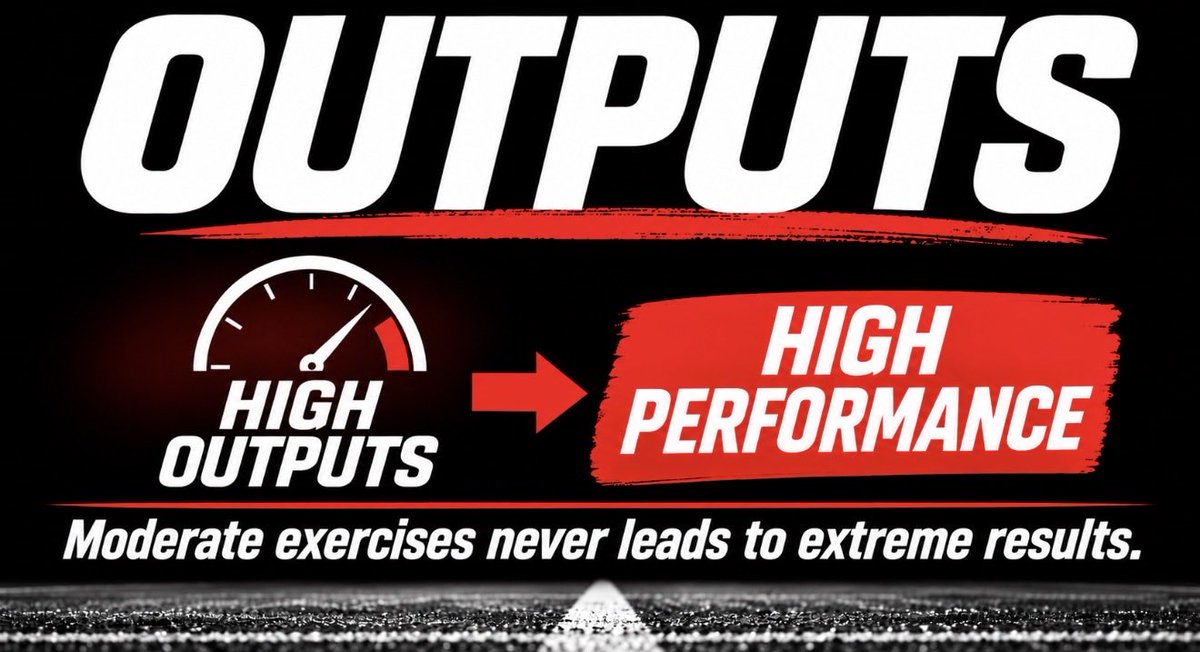
HIGH OUTPUTS TRAIN HIGH OUTPUTS.
No one learns to throw 100 mph by throwing thousands of pitches at 50 mph.
You don’t develop explosiveness by training slowly.
High outputs require freshness.
Grinding destroys freshness.
And grinding increases the risk of injury.
TRAIN FAST. STAY HEALTHY. WIN.
#TrainFresh #FeedTheCats
What does "perform in practice" mean to me (maybe TFC also?). If "practice volume" is 3-5 days per week, your conditioning should take care of itself. Therefore, in "weight room sessions," TRAIN FOR PERFORMANCE OUTPUTS. We are NOT neglecting "conditioning," we are HELPING it. 🤝
Cross Sectional (Myofascial) Release may be the “fluff” you need. Cross-friction at the Achilles insertion, then roll with the grain, toe out, in, straight. 6 to 8 swipes each way, hit any knots you find. Full protocol in the comments.
⬇️⬇️⬇️
You don’t need long drawn out cycles for productive training.
Run your Resisted work in 3-Week Waves.
Run your unloaded work in steady doses prioritizing frequent exposures without large changes in Volume.
Measure it often and you’ll see that traditional programming schemes aren’t needed.
There’s a lot of skilled athletes who are passed over because they lack physical qualities.
Strength, Speed, Power, and Size are highly sought after because they raise the ceiling for Skill expression.
The cool part is that in the right Training system, you can quickly raise these qualities without sacrificing Skill development.
I primarily train Team Sport Athletes, in which this is the approach we take.
However, Speed development is Speed development. No one needs to log high volume training when developing Speed.
More work inhibits the ability to stimulate Speed optimally. You should lean into Frequent exposures to High Intensity.
I’m a big fan of @pntrack approach to Track.
@Tony_Villani_ I stopped teaching them when we came back from Covid. We actually have better jumps, better speed, more explosive kids now. Just found better ways to get the results we were after.
Dan John often says “If it’s important, do it everyday”.
I like to say, if it’s important do it YEAR ROUND.
In regards to your Athletes Programming, stop phasing things in and out that are effective because of a made up timeline.
Train the Quality in steady doses all the time.
Not all hurdle hops develop the same qualities.
A lot of athletes automatically choose the highest hurdles they can clear because it looks impressive. But low and high hurdles serve two different purposes.
Low hurdles = Elasticity.
Low hurdles with minimal ground contact times develop reactive strength, tendon stiffness, and the ability to rapidly recycle elastic energy. Start low and gradually increase the height while maintaining short contacts.
High hurdles = Impulse and Power.
Higher hurdles require greater force production, longer contact times, and more impulse to achieve greater vertical displacement.
Both have their place, but they aren’t interchangeable.
Stop choosing hurdle height based on what looks impressive. Choose it based on what you’re trying to develop.
If you don’t know Dan Fichter, this podcast is a great start. The #2 ranked FTC Podcast features both Dan Fichter AND Adam Archuleta. ⤵️
https://t.co/QLPM873m4R
@CoachNoon45 A5) we program in 3 week phases. I try really hard not to change anything for the 3 weeks. If I notice something I will change it for the next 3 week cycle. We try to hit PR’s weekly compared to 3 weeks ago when we did the same exercises with the same weight.
#ironspeedchat