We’re opening up access to Atlas to everyone today.
We’ve built apps and API endpoints to help you use Atlas any way you can imagine: bring your ideas for building a 3D world and come away with keyframes, video clips, or 3D Gaussian splats.
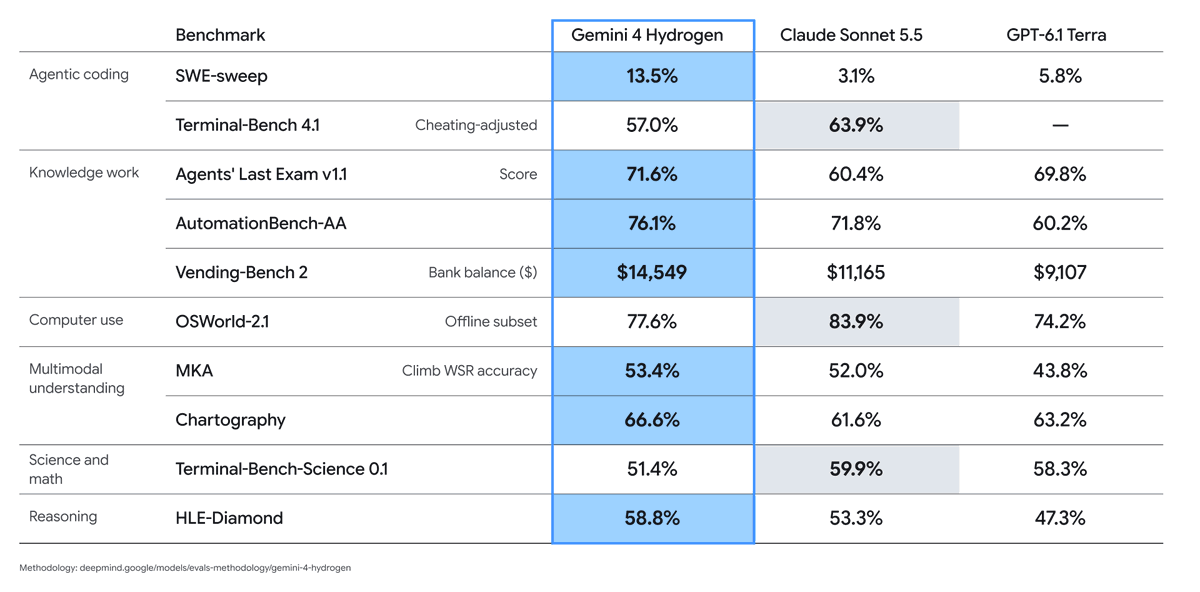
Meet Gemini 4 Hydrogen: built for rapid coding, multimodal synthesis, and everyday workflows.
It finishes tasks 2.5x faster than 3.8 Flash and surpasses Argon on the @ArtificialAnlys Intelligence Index.
Gemini 4 Hydrogen (High) by @GoogleDeepMind debuts at #10 in the Code Arena: WebDev with 1703 pts. It's a cost-efficient option at $1.50/$7.50 per M tokens.
Its performance puts it ahead of:
- Claude Opus 5 (Max) at 1691
- Kimi K3.1 Pro (Max) at 1687
- Gemini 4 Argon (High) at 1681
- GPT-6.1 Terra (Max) at 1678
Hydrogen is strongest in HTML and Content Creation Tools, where it ranks #5 in both, and it's top 10 in simulations (#9) and gaming (#10).
Congrats again to the @GoogleDeepMind team on this release!
introducing Krea Bots, your new creative crew.
bots can take on entire creative projects and adapt to your taste as you and your team collaborate with them.
all our recent creative work has been produced with these bots, including the video below!
join the beta and get $1,000 in credits 👇
Meet Gemini 4 Hydrogen.
It brings cutting-edge intelligence to everyone, with speed and efficiency for everyday coding and agentic work.
Across 4 thinking levels, it stands on its own or teams up with Carbon and Argon — 2.5X faster than 3.8 Flash, outpacing competing models in its class.
Google's new Gemini 4 Hydrogen has Intelligence just below Claude Sonnet 5.5 and GPT-6.1 Sol, at a third of Sonnet’s cost but ~2.5x that of GPT-6.1 Sol
@GoogleDeepMind has released their third new model in six weeks. Gemini 4 Hydrogen introduces an xhigh reasoning level and scores 54 on the Artificial Analysis Intelligence Index, with strengths in visual reasoning and non-hallucination. This places it 1 point behind Claude Sonnet 5.5 (max) and GPT-6.1 Sol (max), at ~32% of Sonnet’s cost but ~2.5x that of GPT-6.1 Sol. With high reasoning, Gemini 4 Hydrogen matches the Intelligence of Gemini 4 Argon for ~19% of the Cost per Task
Key takeaways:
➤ The new xhigh reasoning level scores 54 on the Intelligence Index: xhigh is the first reasoning level above high on a Gemini model, and puts Hydrogen 1 point below Claude Sonnet 5.5 (max) and GPT-6.1 Sol (max), and 4 points ahead of Gemini 4 Argon (high). With default (high) reasoning, Gemini 4 Hydrogen scores 51, just behind GPT-6.1 Sol (xhigh, 52) and Claude Opus 5.5 (high, 52)
➤ Strong visual reasoning, presentation and non-hallucination: On GDP.pdf, a visual reasoning benchmark over long documents, it scores 33% all-pass on medium reasoning, the tied #1 score on the benchmark. On AA-Omniscience, Hydrogen has one of the lowest hallucination rates recorded at 8%, compared with 43% for Claude Sonnet 5.5 (max) and 52% for GPT-6.1 Sol (max). On AA-Briefcase, our agentic knowledge work evaluation, graders rate Hydrogen's presentation above other Gemini models, including Carbon
➤ Weaker on agentic terminal work: Hydrogen scores 54% on Terminal-Bench 4.0 and 50% on Terminal-Bench-Science 0.1, covering agentic coding and scientific research workflows in the terminal. Claude Sonnet 5.5 (max) scores 64% and 53%, and GPT-6.1 Sol (max) scores 56% and 58%. xhigh reasoning helps on the science tasks, lifting Terminal-Bench-Science from 41% at high to 50%, but makes no difference on Terminal-Bench 4.0 (54% at both). Science scores are even across domains, from 46% in earth sciences to 53% in physical sciences
➤ Low cost for its intelligence, with high token use at xhigh: Hydrogen is priced at $1.50/$7.50 per million input/output tokens. At xhigh it costs ~32% as much per task as Claude Sonnet 5.5 (max) for near-equal intelligence, but ~2.5x as much as GPT-6.1 Sol (max). xhigh nearly doubles output tokens compared with high for a 3 point gain in Intelligence, and Cost per Task falls from $3.16 at xhigh to $1.87 at high. Medium ($0.80) and low ($0.29) cost less again, but score 41 and 27 on the Intelligence Index
➤ On the Time per Task vs. Intelligence Pareto frontier: Gemini 4 Hydrogen has an output speed of ~200 output tokens per second. With high, medium, and low reasoning effort, Gemini 4 Hydrogen is on the Time per Task vs. Intelligence Pareto frontier, meaning no models are both more intelligent and have a lower Time per Task
Key model details:
➤ Context Window: 1M tokens
➤ Multimodality: Text, image, video, and speech input, with text output
➤ Reasoning efforts: Gemini 4 Hydrogen offers four reasoning levels (low, medium, high, and xhigh) with xhigh new in this release
➤ Pricing: $1.50/$7.50 per 1M input/output tokens. Cached input tokens receive a 95% discount ($0.075)
Congratulations to the @GoogleDeepMind team on the launch!
Today, we’re making Praxis-1 available to everyone. Our state-of-the-art world action model turns video pretraining into control for real robots, and it ships with open weights under Apache 2.0, ready to run and fine-tune on your own hardware.
Meshy Rigging updates on fal.
- Turns humanoid 3D models into characters ready to animate.
- Works with Unreal Engine, Unity, Blender, Mixamo and more.
- Prepares fingers for animation at no extra cost.
- Adds multiple animations to the same character.
New VFX capabilities from LTX are now live on fal.
Generate and edit production-ready video with four powerful tools:
- AlphaGen: Generate transparency mattes with fine edge detail, up to 4K
- SDR → HDR: Convert standard video to HDR with expanded dynamic range
- Reframe: Adapt videos to new aspect ratios
- Upscale: Enhance video resolution up to 4K or 8K
Build with LTX on fal.
Introducing Gemini Robotics 2.5, our most capable vision-language-action (VLA) model to date. 🤖
It increases both the breadth of skills a robot can learn and the speed at which it acquires them — helping robots step out of the lab and into real-world environments.
Learn more about Gemini Robotics 2.5, now rolling out to our robotics partners 🧵
Google has released its first decision model, Gemini Decision 1, scoring 66 on the Artificial Analysis Decision Index and leading in knowledge and reasoning benchmarks
Gemini Decision 1 from @GoogleDeepMind scores 66 on the Artificial Analysis Decision Index v2.1, in line with Elephant 9B (@baselabs) and Jev 1.14 (@typesafeai), and 7 points behind leaders Drex Max v1.1 (@NaceAI) and GLiDE v1.2 (@fastinoAI), which both score 73. It is priced at $0.10 per 1M input tokens and costs $345 per 1M Tasks across the Index, around three times higher than Drex Max v1.1 ($103) due to its higher pricing
Key results for Gemini Decision 1:
➤ Not yet frontier on Decision Index: Gemini Decision 1 scores 66 on the Artificial Analysis Decision Index. It leads knowledge and reasoning benchmarks, scoring 66 on AA-Omniscience-Decision and 49 on HLE-MultiChoice. It trails on other evaluations, including our new proprietary classification and extraction benchmark AA-Paperclip, where it answers all 15 questions correctly on 33% of documents vs. 63% for Drex Max v1.1
➤ More than 3x the Cost per Task of leading models: Gemini Decision 1 costs $345 per 1M Tasks, compared with $103 for Drex Max v1.1, $156 for Jev 1.14. This difference is driven by its token price of $0.10 per 1M input tokens vs. $0.03 for Drex Max v1.1. Gemini Decision 1 has a similar Cost per 1M Tasks to GPT-6 Luna (Decisions, $339)
➤ Strong calibration for reasoning tasks: We measure calibration with the Brier score, the average squared gap between the probability a model assigns to its chosen answer and whether that answer was correct (lower is better). Gemini Decision 1 has a Brier score of 0.18 across the Index, between Drex Max v1.1 (0.16) and Jev 1.14 (0.19). Calibration varies by task. with its Brier score of 0.20 on HLE-MultiChoice among the lowest of all models in the Index, while its 0.14 on When2Call compares with 0.04 for Drex Max v1.1
ComfyUI-Lux3D
Turn text or images into 3D assets inside ComfyUI
The extension provides 12 nodes you can combine to generate models, redraw materials, split meshes, or rebuild topology to a target face count.
Humanoid rigging and animation nodes let you rig character models and add actions. Models can be exported to USDZ, OBJ ZIP, FBX ZIP, STL, and 3MF.
A viewer previews models in the ComfyUI canvas. Local GLB models can be viewed without uploading them to Lux3D.
https://t.co/Ysc74gHjaa
Ernie 5.5 Flash Preview by @Baidu_Inc is trending towards becoming the #2 open model on the Code Arena: WebDev, at 1668 pts. The weights will be open-sourced under Apache 2.0 soon.
Its score puts it just above:
- DeepSeek-V4.1-Flash (Max) at 1664
- Kimi K3 (Max) at 1658
and on par with:
- Qwen3.8-Max at 1670
Congrats to the @Baidu_Inc team on this release!
I ported ReCaVSR to ComfyUI, a one-step 4× video super-resolution model based on Wan2.2.
960×480 → 3840×1920, 149 frames in 36 s on an RTX 4090. int8 build, runs from 8 GB.
Generate and edit images and videos directly in ChatGPT, using the fal plugin.
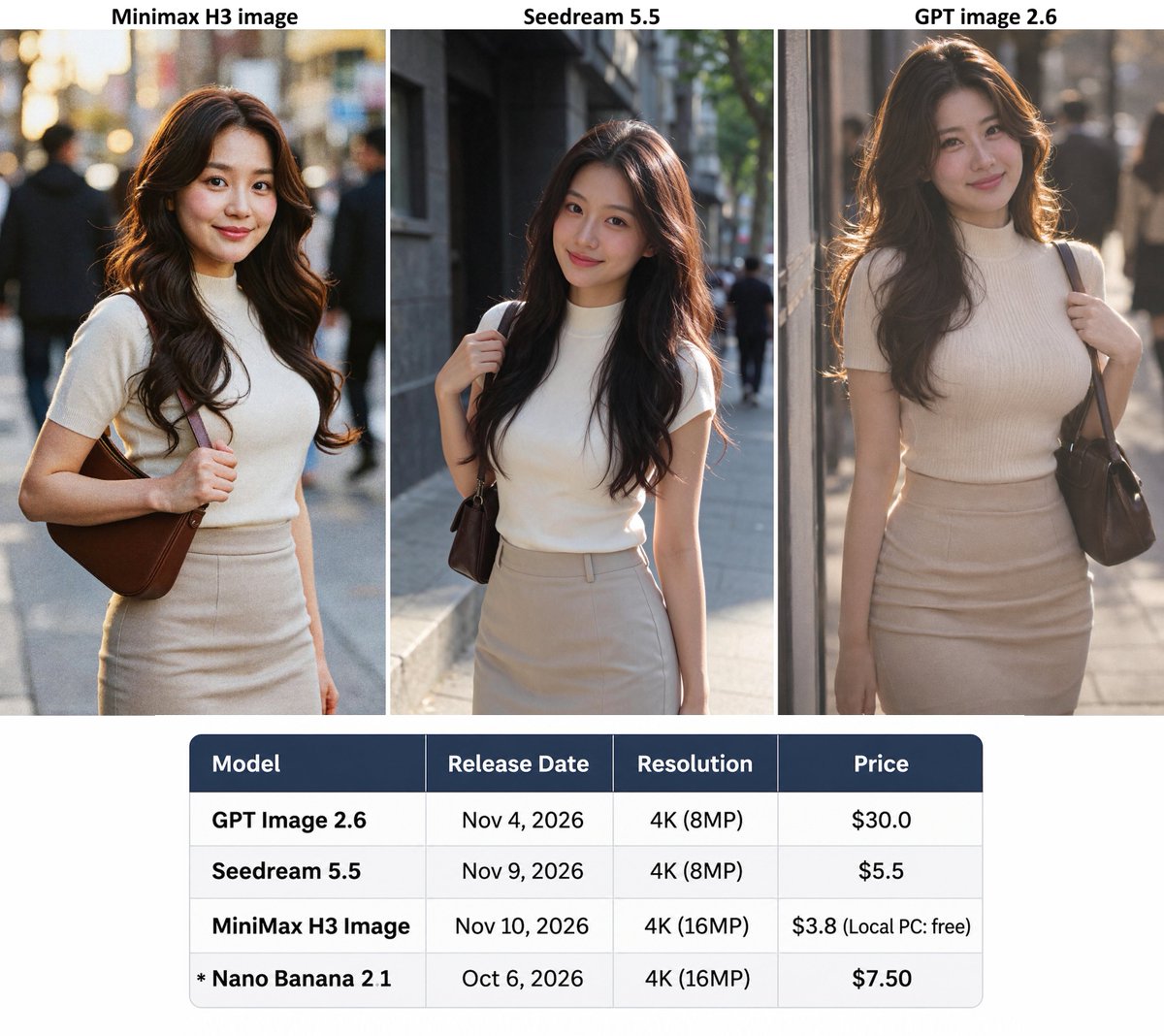
We used GPT Image 2.6 to generate hundreds of keyframes, FLUX 3 Max to animate 26 shots, and brought it all together into a 60-second commercial.
🧵 Here's how we did it.
SwitchX 3.0 is here. Our biggest update yet.
Rebuilt on MiniMax H3 for professional video-to-video:
→ Up to 4 references
→ Backgrounds that move
→ Camera tracking, no markers
→ Prompts that direct the scene
Your performance stays locked. Only the world around it changes.