Thanks, Kenneth. Based on the latest filings, Macquarie remains involved.
The October 7 8-K confirmed a $116M standby letter of credit supporting the 207MW PPA, with approximately $60M funded through Macquarie term loan proceeds. That brings disclosed term loan draws to roughly $80M, including the initial $20M.
The new PIPE will repay approximately $36M under the Macquarie facility, including the applicable MOIC premium. That does not mean Macquarie has exited the project.
There is also an existing financing option of up to $200M following a qualifying lease, subject to conditions.
I haven’t seen confirmation of a separate additional draw specifically in early October. The key distinction is between committed facilities, actual draws, and conditional future funding.
My focus remains on whether these financing arrangements help convert the secured power into binding tenant leases and project execution.
$NUAI | Is the Market Overreacting to the $64M PIPE?
The $2.75 private placement is dilutive, but I believe the announcement deserves a balanced assessment.
The negatives:
23.27M new shares, representing approximately 16.6% dilution to existing shareholders’ ownership.
The discounted offering price reflects a difficult financing environment.
Significant capital requirements remain, and no binding hyperscaler lease has been announced.
The positives:
NUAI secured $64M in equity commitments despite substantial pressure across the AI infrastructure sector. Access to capital is critical for development-stage companies.
Approximately $36M will be used to repay Macquarie debt, including the applicable MOIC premium, reducing near-term financing pressure.
Phase 1 has secured up to 207MW of contracted power under a 20-year PPA, with delivery expected in Q3 2027.
Most importantly, management explicitly stated that leasing negotiations are progressing across Phases 1 and 2, covering a total of 757MW. These are negotiations, not signed leases, but the commercial scope is significant.
The company also referenced a financing option of up to $200M following a lease agreement, subject to applicable conditions.
My perspective:
In a stronger market, this financing might have been viewed as a positive step toward commercialization. Today, the market seems primarily focused on dilution and the discounted issuance price.
I believe the more important question is whether NUAI can convert its secured power resources into long-term contracted cash flow.
The PIPE does not eliminate execution risk, but it also does not indicate that the underlying 207MW project has deteriorated.
Positioning & Risk Management
I have increased my underlying common stock position in $NUAI, reflecting my continued confidence in its long-term potential.
At the same time, I believe maintaining appropriately sized options hedges can help manage downside exposure and reduce the impact of extreme market volatility.
Being bullish on a company’s long-term fundamentals does not mean leaving a concentrated position completely unhedged.
My investment thesis remains focused on project execution, financing progress, and the conversion of power capacity into contracted revenue—not short-term market sentiment.
$NUAI #AIInfrastructure #DataCenters #RiskManagement
From a business management perspective, I believe the first priority for a development-stage company is securing sufficient capital to survive, execute, and ultimately commercialize its projects.
You cannot build a multibillion-dollar infrastructure business without funding.
Equity dilution is not inherently a failure of management. The real questions are whether the financing terms are reasonable, whether management is acting in shareholders’ interests, and whether the capital brings the company closer to generating sustainable cash flow.
In $NUAI’s case, the financing appears consistent with its current development stage and execution needs.
I judge management by how effectively it converts capital into commercial progress and long-term value per share—not simply by the short-term reaction to a financing announcement.
Capital is the means. Commercial execution is the goal. Long-term value creation is the ultimate measure.
@JSCC2020Lee Exactly. The bigger story isn’t any single data center. It’s how West Texas is building a second economic layer on top of its existing energy infrastructure. Seeing it on the ground makes that shift much more tangible.
Drove through Abilene, Midland and Odessa, Texas, and saw something bigger than any single data center project.
Along I-20, major highway upgrades are underway. Near $NUAI’s TCDC site, local roads have been resurfaced. Power lines, industrial infrastructure and construction activity define the landscape.
West Texas was built around oil and gas. Now, the same region is emerging as a potential energy-and-compute corridor for the AI economy.
The competitive advantage isn’t just cheap land. It’s access to energy, industrial infrastructure, available space and a long-established culture of building at scale.
Abilene, Midland and Odessa may increasingly serve a dual purpose: powering the traditional energy economy while supporting the next generation of digital infrastructure.
This transformation is bigger than $NUAI, and bigger than any single hyperscaler lease.
Projects will still have to prove execution. But the regional shift is worth watching.
Sometimes the bigger investment thesis becomes clearer when you leave the screen and drive through the landscape.
#WestTexas #AIInfrastructure #DataCenters $NUAI
@robinivski That’s what makes a market 🙂
You’re betting the project never gets built. I’m betting execution keeps stacking up.
The filings will settle the debate better than either of us can.
$NUAI announced a new $100M ATM program today.
My view: this is neither purely bullish nor purely bearish.
An ATM is a financing tool, not an immediate $100M dilution.
The company is not obligated to sell any shares, and management can decide when, how much, and at what price to issue.
That said, the market is right to price in some near-term pressure:
• potential future dilution
• additional share supply on rallies
• uncertainty around how aggressively the ATM will be used
At ~$7/share, fully using the program would require roughly 14M new shares, so the dilution is not trivial.
But the other side of the equation matters too.
$NUAI is moving from development-stage planning into actual execution:
• Phase 1 power is now contracted
• permitting continues to advance
• construction readiness is improving
• future project capital requirements are becoming more real
Having access to equity capital reduces financing risk, even if it introduces dilution risk.
For me, the interesting part is how this interacts with my options strategy.
Most of my earlier short puts are now close to expiration or have already captured nearly all of their premium.
So if the ATM announcement creates short-term pressure on the stock — while the underlying thesis remains unchanged — it may create another attractive put-selling window.
That is exactly the type of setup I look for:
temporary price pressure + elevated IV + improving fundamentals
I am not trying to predict whether $NUAI trades at $6.50, $7, or $7.50 next week.
I am asking a different question:
At what effective price would I be comfortable owning more shares if assigned?
If the market gives me attractive premiums at strikes where I am willing to own the stock, I am happy to let volatility work for me again.
The ATM may create a short-term ceiling.
But it may also create the next volatility opportunity.
The key questions now are not simply “Is there dilution?”
They are:
How much is actually issued?
At what price?
And what value does that capital create?
Personal investment view, not financial advice. $NUAI
Even if they do raise some capital, that’s not exactly a surprise at this stage. The project is moving into execution, and some dilution was always part of the possible funding mix.
The real question is not whether they raise — it’s how much, at what price, and what value that capital creates.
@PDphillyPhil Good catch. The ATM may be the headline, but the direct-lease optionality is probably the more interesting part. If management can keep more of the economics without needing the JV wrapper, that’s a much bigger story. “Think bigger” indeed.
A small but interesting $NUAI update.
On July 31, $NUAI closed at $4.66.
Today, August 28, it closed at $4.66 again.
Exactly the same price.
So over the past month, the underlying stock produced essentially 0% return.
My account, however, is up about 8% for the month.
That return came almost entirely from selling options.
This is exactly why I keep saying that high IV can be valuable when the underlying thesis remains intact.
The goal is not to predict every move in the stock.
The goal is to own a company I still like, then systematically monetize the volatility around that position.
In a month like this:
• the stock goes nowhere
• IV stays elevated
• covered calls generate cash flow
• time decay works in your favor
So even with a flat underlying, the portfolio can still produce a meaningful return.
That is the part of the strategy I find most interesting.
I am not relying only on capital appreciation.
I am trying to combine:
long-term equity upside + volatility premium + time decay
And now I am adding another leg to the process:
selling puts during relative weakness, while continuing to sell covered calls into relative strength.
As long as the company’s fundamental risk remains manageable and the long-term trend stays intact, a high-volatility stock can create opportunities on both sides of the range.
A flat stock does not necessarily mean a flat portfolio.
Personal investment view, not financial advice.
@gainzalgo I’m not necessarily buying the dip outright, but I do think this pullback creates a better setup for selling puts.
High IV + a lower stock price is attractive to me as long as the underlying thesis hasn’t changed and I’m comfortable taking assignment.
High IV by itself is not necessarily attractive. $NUAI
What matters is why IV is high — and whether the underlying risk is actually improving.
That is what makes $NUAI interesting to me right now.
The market is still pricing it like a very high-risk development-stage asset, with IV often above 150%.
But at the same time, several risks are gradually being reduced:
• land is secured
• the development path is clearer
• power strategy is becoming more defined
• financing visibility has improved
• institutional participation has increased
That may be creating a temporary mismatch:
fundamental risk is falling faster than the volatility premium is compressing.
For an option seller, that can be a very attractive setup.
The best environment is not simply “high IV.”
It is when the market is still pricing yesterday’s level of uncertainty, while the fundamentals are already moving into the next stage.
If $NUAI continues to de-risk through leases, financing, power agreements and construction milestones, I would expect two things over time:
• equity valuation may rise
• IV should gradually compress
That is why the current phase may be especially interesting for covered calls and cash-secured puts.
This is not theoretical for me — option premium has been a larger contributor to my returns than the underlying stock itself this year.
I do not expect this window to last forever — but it may persist long enough to matter.
Personal investment view, not financial advice.
@Rob51541682 Same here. The key for me is that I’m comfortable owning the stock if assigned.
High put premium is great, but it only works if you actually like the underlying. That’s what makes $NUAI different from a lot of other high-IV names.
The WSJ is now calling the Permian Basin a new AI data-center land rush.
I found that interesting because I visited West Texas earlier, and the conclusion I came away with was very similar.
What stands out to me is that this is almost exactly what I observed when I visited West Texas earlier and wrote about the region.
At the time, my view was simple: West Texas is not just an oil-and-gas story anymore. Its real advantage for AI infrastructure comes from the combination of land, natural gas, water, transmission access, fiber, and—most importantly—speed to power.
Since then, more projects have started to confirm that thesis.
Chevron and Microsoft, Amazon, CoreWeave, Liberty Energy, TPL and others are all moving toward large-scale AI infrastructure in the Permian.
In that sense, the WSJ article is less a new idea to me than an independent confirmation of what I saw on the ground.
For $NUAI, this matters.
The question is no longer whether West Texas can become a major AI infrastructure hub. That thesis is increasingly being validated by much larger players.
Personal investment research, not financial advice.
Over the past few weeks, two major policy developments have further strengthened my long-term thesis on $ELBM.
The U.S. is moving to keep battery black mass within North America to strengthen domestic refining, while the DRC has banned exports of copper and cobalt concentrates to encourage more value-added processing at home.
These are not isolated events.
They reflect the same long-term trend.
The global competition is no longer just about who owns the minerals.
It is increasingly about who controls refining capacity and builds an integrated critical minerals supply chain.
This is exactly why I’ve been following $ELBM so closely.
I no longer view ELBM as simply a cobalt refinery.
I believe it is evolving into a North American strategic critical minerals platform, where refining, recycling, domestic resource development, and future processing capacity reinforce one another.
The Ontario cobalt refinery, the proposed U.S. nickel refinery, battery recycling, hydrometallurgical processing, and the Iron Creek cobalt-copper project are not separate stories. They are all pieces of the same long-term strategy.
Based on this framework, I believe ELBM has entered a valuation range where building an observation position makes sense.
I have established an observation position of tens of thousands of shares, not because every uncertainty has disappeared, but because a meaningful position allows me to follow the company with greater discipline as each milestone is validated.
There are still significant execution risks ahead, including Ontario financing, Nasdaq compliance, capital management, and continued project execution.
Another reason my position remains an observation position is that ELBM does not yet have listed options. Options are an important part of my investment framework because they allow me to actively manage risk and improve capital efficiency. Until that market develops, common shares remain the only practical way for me to participate while continuing to validate the thesis.
My objective is not to predict the next short-term price movement.
My objective is to determine whether a strategic asset is being continuously validated before the broader market fully recognizes its long-term value.
I’ll continue tracking every major milestone and update my thesis as new information becomes available.
$ELBM
I’ve been following $ELBM closely over the past few months, and I believe the company is entering one of the most important validation windows in its history.
Today’s announcement wasn’t just another press release.
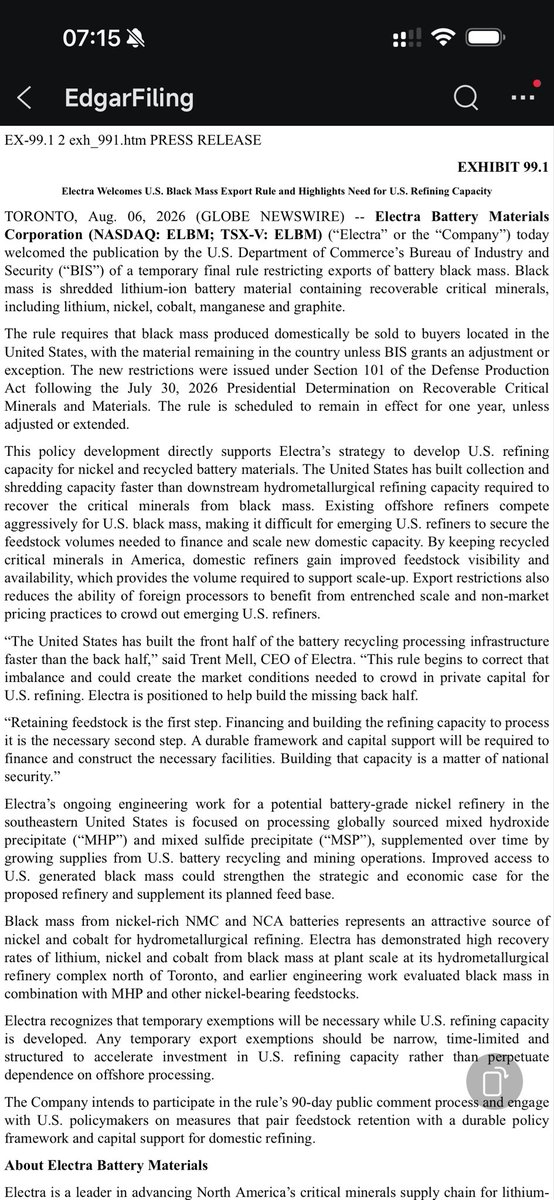
It shows management is actively positioning ELBM within the evolving U.S. critical minerals strategy following the latest U.S. policy restricting exports of battery black mass. Rather than simply welcoming the policy, the company is presenting itself as part of the domestic refining solution for North America’s battery supply chain.
For me, this doesn’t immediately change the financial outlook, but it does strengthen the long-term strategic thesis.
Over the next several weeks, I’ll be watching five key milestones:
Ontario government financing.
Continued refinery construction progress.
Nasdaq compliance before the September deadline.
Capital management and potential dilution.
Whether management continues to deliver on every announced milestone.
This is why I view the next phase as an execution test rather than a valuation debate.
Every milestone either validates or weakens the original investment thesis.
I’ll continue tracking the company closely and update my research as new information becomes available.
$ELBM #CriticalMinerals #BatteryMaterials #EnergyTransition
How I think beginners should approach options $ASPI , $NUAI
Many people see options as inherently high-risk products.
I see them primarily as tools for risk management, position management, and improving capital efficiency.
I also don’t think beginners need complicated strategies. Simple strategies are often easier to understand and manage.
Before trading, learn the basics:
• Calls and puts
• Strike prices
• Expiration dates
• Implied volatility
• Time decay
• Assignment
• Position sizing
Most importantly, don’t chase premium. Start with the company.
A recent example:
In addition to $NUAI, I have been following $ASPI and would be willing to begin building a position below $4.
Instead of buying shares immediately, I sold 60 cash-secured $4 puts for approximately $0.50, expiring in about 20 days.
Premium received: approximately $3,000.
Two possible outcomes:
Above $4 at expiration:
The puts expire worthless, and I keep the premium.
Below $4 and assigned:
I purchase 6,000 shares at $4, with an effective cost basis of approximately $3.50 after the premium.
Either outcome works for me.
I either earn income while waiting, or establish an initial position at a price I was already willing to pay.
The risk still exists: if $ASPI falls significantly below $3.50, I will have an unrealized loss.
That is why research, position sizing, and being prepared for assignment matter more than the premium itself.
Options are tools. Their risk depends on how they are used.
Personal experience, not financial advice.
@happyhunting78@Noname1089723 Quite a few people seem interested in this topic. It’s getting late here, so I’ll put together a more complete post about how I approach options tomorrow.Thank you!
Situational Awareness: The Real Lesson Is Risk Management
The sale of most of Situational Awareness’s public-equity portfolio to Citadel has triggered plenty of “AI prophet falls from grace” commentary.
I see it differently.
Leopold Aschenbrenner’s real contribution was helping investors understand the AI infrastructure thesis: AI is not only about models and software. It requires enormous investment in computing power, semiconductors, memory, electricity and data centers.
That logic remains valuable. A failure in portfolio management does not automatically invalidate the underlying industry analysis.
The real problem was expressing a long-term thesis through concentrated positions and high leverage during extreme market volatility.
You can correctly predict the direction of an industry over the next five years and still fail because you cannot predict every weekly or monthly market move. The market has no obligation to prove you right according to your timetable.
My own portfolio is also focused on AI infrastructure, but I combine long-term holdings with selling calls and puts to generate recurring income and control risk.
During the volatile markets of the past few months, even when some underlying stocks fell approximately 20%–30%, I kept my monthly portfolio drawdown below 5%.
But selling options is not automatically conservative. Covered calls require fully owned shares, and short puts are conservative only when you have enough capital to accept every assignment. Otherwise, they are simply another form of leverage.
Situational Awareness teaches us two important lessons:
Respect the market. Conviction is necessary, but overconfidence is dangerous.
Respect professional expertise. Industry research, company selection and risk management are different skills. Deep knowledge of AI cannot replace disciplined portfolio management.
Study the insight, but do not copy the leverage.
The goal is not to be right every day. It is to remain in the market long enough for a sound long-term thesis to be proven right.
#SituationalAwareness #AIInfrastructure #RiskManagement #OptionsTrading #Citadel