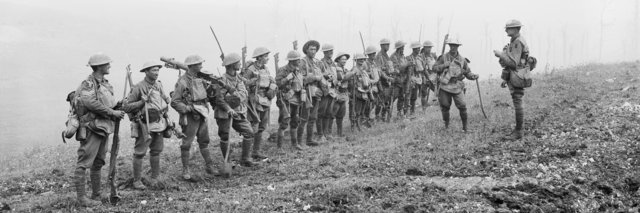
'Easy Red Sector', Omaha Beach - approx. 0700 on the 6th June 1944
Photographer Robert Capa landed at Easy Red Sector, Omaha Beach with the men of Easy Company, the 2nd battalion, 16th Infantry Regiment, US Army 1st Division.
After completing his task of photographing the landings, Capa’s survival instincts took over. Seeing another craft approaching the beach, he fled towards it. After he was hoisted aboard, the vessel took a direct hit from a German shell and several men on board were killed. Capa survived and transferred to a troop ship for the return journey to England.
On arriving in Weymouth, Dorset, Capa put the four rolls of 35mm film in a courier’s pouch together with several 120mm rolls that he had shot before the invasion. He also included a note to John Morris, Life’s London office picture editor, that stated, ‘John – all the action’s in the 35mm.’ With his films safely on their way, Capa boarded the first boat returning to France.
When the courier arrived at the Life office, Morris urged his staff to develop the films quickly in order to meet the publication deadline. They were given to 15-year-old darkroom assistant Dennis Banks to develop.
The incident that followed has become as famous as Capa’s images. A few minutes later, Banks returned to Morris’s office in tears, saying, ‘They’re ruined! Capa’s films are all ruined!’ In the rush to process and dry the films, Banks had placed them in a wooden drying cabinet and closed the doors. The heat had been so intense that the emulsion had melted and all that was left, as Morris discovered as he examined the films, was ‘a brown sludge in frame after frame’.
Only 11 of the 108 original frames were salvaged.
This photograph is contact screen frame 7/neg. 35
@PrincessOfSummr@iowahawkblog Thanks, I'll remember that when i have a freshing glass of a 1:1:1 mixture (by parts/weight) of ice, water, and ammonium chloride (NH₄Cl)!
They called them flying coffins. The men who volunteered to fly them knew exactly why.
The Allied gliders of D-Day were made of fabric stretched over a frame of wood and metal tubing. They had no engine. No armor. No weapons. No parachutes for the men inside. They were towed to France at 130 mph on the end of a 300-foot nylon rope attached to a C-47, and when the rope was cut, there was one chance to land.
One. No go-arounds. No second approach. Whatever was below you was where you were going.
What was below them was Normandy at night.
The Germans had spent weeks preparing. Under orders from Field Marshal Rommel, they had driven wooden stakes into every open field in the region, angled to impale gliders on landing. The French called them Rommelspargel. Rommel's asparagus. Thousands of poles, many with mines or artillery shells wired to the tips, packed into every field large enough to land on.
What the glider pilots had not been properly told was the scale of the Norman hedgerows. The bocage. These were not English garden hedges. They were ancient earthen walls, some dating back centuries, topped with dense root systems and trees, rising 50 feet in places, bordering fields barely 200 yards long. A Horsa glider coming in at 100 mph hitting a hedgerow did not survive it. Neither did most people inside.
Some fields were flooded. Some were mined. Many were both.
517 gliders went into Normandy. 97 percent were abandoned in the field by the end of the operation. Most were destroyed.
General Don Pratt, assistant commander of the 101st Airborne, was in the first glider wave. His pilot managed to find a field near Hiesville and brought the glider down. It slid across the wet grass without slowing and hit a hedgerow at speed. The co-pilot died instantly. The pilot, Lieutenant Colonel Mike Murphy, broke both legs. General Pratt suffered a broken neck. He became the first American general to die in the Battle of Normandy. His glider had landed in one piece.
Sergeant Eric Wilson's glider did not. It hit a building at high speed. Both of Wilson's legs were broken. He was trapped inside the wreckage, unable to move, in enemy-held Normandy, for two and a half days before anyone reached him.
Lieutenant Den Brotheridge had come in earlier than anyone, in the first glider to land in France, the silent coup de main assault on Pegasus Bridge just after midnight. His glider stopped 47 yards from its target. He led his men out at a run, reached the bridge, and was shot. He died within minutes, the first Allied soldier killed by enemy fire on D-Day.
The men who survived the landing did not get to stop. Glider pilots were not assigned to combat units. Once down, they were expected to fight as infantry, dig foxholes, guard prisoners, carry ammunition, do whatever was needed. Most of them had trained to fly, not to fight on the ground behind enemy lines in the dark.
They did it anyway.
Of the 517 gliders that went in, 222 were Horsa gliders. Most were destroyed either on landing or by German fire in the hours that followed. The Waco CG-4As fared slightly better but 97 percent of all gliders from the entire operation were eventually abandoned in Norman fields, broken and empty.
The men who flew them were not pilots in the traditional sense. They were soldiers who had been given just enough training to put an unarmed, engineless box of fabric and wood into a dark foreign field at 100 mph, full of men and equipment, with one attempt and no margin for error.
Many of them got it exactly right.
Many of them did not come home.
Today is June 6th.
Remember them too.
🚨 BREAKING NEWS 🚨
Vickrum Digwa has reportedly been attacked at HMP Armley, where he is currently being held following the murder of Henry Nowak.
⚠️ Reports indicate that a mixture of sugar and boiling water was thrown in his face, causing serious burns.
🏥 His injuries are not believed to be life-threatening, but he has reportedly suffered significant facial burns and skin damage.
🚑 He is currently receiving treatment in the hospital wing at HMP Armley.
Share the brilliant news!
UPDATE: 2026 ISLE OF MAN TT RACES CONCLUDE FOLLOWING WEATHER-IMPACTED SCHEDULE
The Isle of Man TT Races has confirmed that no further racing will take place at the 2026 event, and the Milwaukee Senior TT will be declared a result after yesterday’s one-lap.
Following consultation between the Clerk of the Course and the Isle of Man Met Office, it has been determined that the forecast weather conditions around the Course are not looking to sufficiently improve within the required time, and the remaining available operational windows do not provide a suitable opportunity for any further racing to be completed safely.
As a result, the Milwaukee Senior TT result has been declared based on the positions at the end of a lap one of Friday’s original race start. Subsequently, the Carole Nash Sportbike TT Race 2 has been cancelled and will not take place.
Dean Harrison has therefore been declared the winner of the 2026 Milwaukee Senior TT.
A full update and results are available at https://t.co/7jNaQAlOYu
A TT tribute to Joey 🏁
Michael Dunlop completed a tribute lap of the Mountain Course on a replica of his uncle Joey's winning Honda machine from 2000.
#BBCBikes