I made an exit strategy so you don't have too!
So my main take away from the last bull run is you go into the bull market not knowing what is going on and you will assume you will figure out the top and sell perfectly.
This does not happen even and you will get burnt. I did and i'm sure that many of you will have had similar experiences. There are so many ways to exit the market, here is just one idea I had that makes sense to me. Please change this as you see fit to taylor your portfolio.
Step 1, Making a duplicate portfolio tracker: On coingecko/ coinmarketcap make a new portfolio. This will be important for this strategy. Once you start selling (this point will be discussed), you will not mark the sales on this duplicate portfolio. Only on your main one. This is so we can accurately track the % we should be selling.
Step 2, when to start selling: This is not an exact science, however for the purpose of this I have chosen one month after the previous break of ATH. Feel free to change this however the rest of the data below will use this.
Step 3: Estimating the length of the bull run: Below I will show the length of the last 3 bull runs from the point where they break the ATH.
2013, the break of ATH to top is 272 days. This was a very volatile bull markets however we don't expect this due to the size the market has grown too.
2017, the shortest of the three at 230 days.
2021, the longest bull run lasting 348 days.
So here we have 3 bull markets to work with. Obviously we have to assume that something will change majorly for the next rally, however we use what we have to give ourselves the best chances.
Average of the 3 = (348 + 230 + 272) / 3 = 283 days. Minus one month which we wait before we start to sell will equal 262. That is what we will be working with.
Step 4, the strategy: First of all I will be working on the assumption that you are trying to sell 100% of the portfolio.
100% / 262 = 0.38%. This is what percent needs to be sold per day to achieve 100% sold using our time estimate.
Now, you should not sell everyday 0.38%. Once you wait the month after the previous ATH breaks, you start counting percent, each day accumulating. E.G. day 1 = 0.38, day 2 = 0.76 etc. You let this build until a green green day which you sell. Could be worth waiting for the largest moves (+10-20%). Once you sell this amount, the count resets to 0.
So why did we create the second portfolio? Because if you are selling the ratio in your portfolio would change. For example, if you hold 1 BTC and sell 50%, then the next day you sell 50% again, you would have 0.25 BTC. Not sold 100%. However, if you keep one portfolio not touching it when you sell, you can put in say what is 5% in dollars and the next day 5% again, and you would have sold 10%. Otherwise the maths will get extremely complicated.
Once you get toward the end, you might have to sell on some red days. Don't be afraid! This is very important if you want to take full profits, so in the last say 100 days be less picky about you sell days. We always speak about DCAing in so use this strategy if you would like to DCA out :).
NFA and Always DYOR!
I didn't want this hill to be gone after four minutes, so I left the gate open.
You can walk it yourself now. All 482 are up there, each with its headline, its date and Bitcoin's price that day.
Go find the one from the year you first heard it.
🔗 https://t.co/ZhnWrmrt9G
Bitcoin has been declared dead 482 times since 2010.
I went back and read them, starting with the very first one. A lot of them are funny now. Some were written on its worst days.
So I made a video about sixteen years of it.
When did you first hear Bitcoin was dead?
Bitcoin has been declared dead 482 times since 2010.
I went back and read them, starting with the very first one. A lot of them are funny now. Some were written on its worst days.
So I made a video about sixteen years of it.
When did you first hear Bitcoin was dead?
Onchain vaults are evolving into a core capital-allocation layer, connecting stablecoin liquidity with growing borrowing demand.
Fintech integrations and tokenized assets are expanding the reach of onchain lending.
The shift is happening across the entire vault ecosystem.
---
➤ From Yield Aggregation to Capital Allocation
- 2020: Yearn popularized vaults by automating lending, reward harvesting, and reinvestment.
- 2024 onward: Modular lending fragmented liquidity across isolated markets, creating demand for vaults that aggregate capital.
- Modern vaults: Pool stablecoins and allocate capital across approved lending markets using curator-defined risk parameters.
Vaults have moved beyond yield aggregation to become an allocation layer for onchain credit.
---
➤ Three Catalysts Driving Vault Growth
Three forces are accelerating adoption:
- Stablecoin growth: Rising use in payments, savings, and treasury settlement creates a larger pool of capital for lending.
- Fintech integrations: Coinbase, Kraken, MetaMask, and Robinhood are bringing vault-based lending to existing customers, making fintechs a distribution channel for DeFi.
- RWA tokenization: Tokenized funds and private credit expand the collateral base, allowing holders to access stablecoin liquidity without selling their assets.
Stablecoins supply capital, fintechs distribute it, and RWAs expand borrowing demand.
---
➤ Vault Adoption Is Scaling
The market has moved well beyond early yield aggregators:
- Overall vault deposits: ~$11.5B
- Morpho: ~58% market share, with deposits approaching $7B and 300K+ unique depositors.
- Steakhouse: ~$2.8B in curated deposits.
- Morpho vaults: ~5.7% of DeFi TVL and ~2.1% of stablecoin supply.
@ethereum and @base are major networks for vault activity, with USDC leading deposits. Fintech and institutional participation are also growing.
---
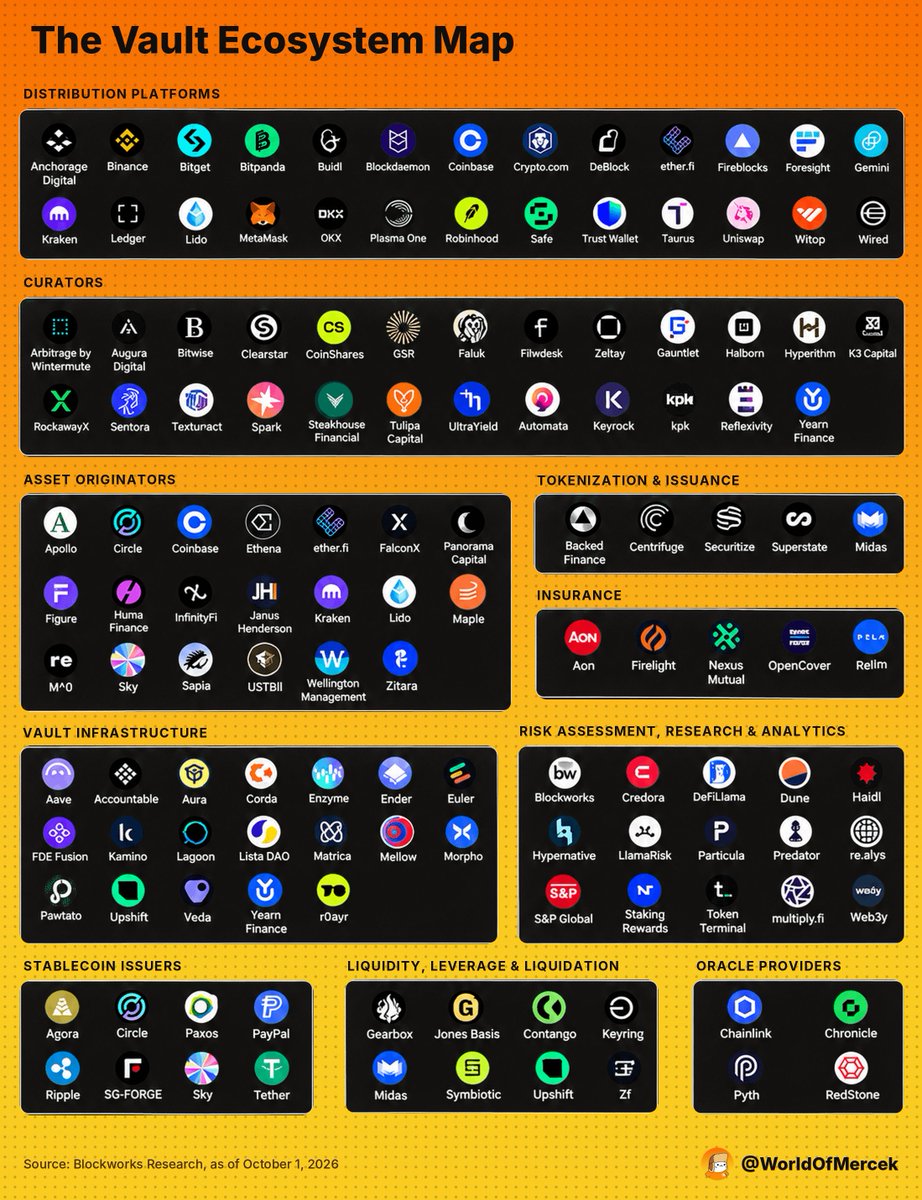
➤ The Onchain Vault Ecosystem
A report by @SteakhouseFi X @block_stories maps 10 layers of the vault ecosystem:
- Distribution: @coinbase, @binance, @krakenfx, @RobinhoodApp, @MetaMask
- Curators: Steakhouse, @gauntlet_xyz, @SentoraHQ
- Asset issuers: @circle, @ethena, @maplefinance
- Tokenization: @centrifuge, @Securitize, @SuperstateInc, @MidasRWA
- Insurance: @NexusMutual, @Firelightfi, @OpenCover
- Vault infrastructure: @Morpho, @aave, @eulerfinance, @kamino
- Analytics: @DefiLlama, @Dune, @tokenterminal
- Stablecoin issuers: @tether, @Paxos, @PayPal
- Liquidity: @GearboxProtocol, @symbioticfi
- Oracles: @chainlink, @PythNetwork, @ChronicleLabs, @redstone_defi
Vaults connect capital providers, asset issuers, lending markets, risk managers, and distribution platforms into one financial ecosystem.
---
➤ How Vaults Allocate Capital and Manage Risk
Steakhouse Prime $USDC on Morpho (Base) provides a practical example of vault allocation.
- Total deposits: $138M
- $cbBTC/USDC: $123.4M (89.4%)
- $WETH/USDC: $11.9M (8.6%)
- $cbETH/USDC: $2.8M (2%)
Different roles separate risk management from capital execution:
- Curator: Proposes lending markets and exposure caps.
- Allocator: Deploys capital within approved limits.
- Sentinel/Guardian: Can block or veto specified changes.
Exposure increases require a seven-day timelock, giving depositors time to review changes and withdraw, subject to available liquidity.
---
➤ Vault Risk and the Curator-Insurance Layer
Vault risk spans three layers:
- Vault: Smart-contract and access-control failures.
- Protocol: Exploits, oracle manipulation, and incorrect lending parameters.
- Asset: Collateral declines, stablecoin depegs, and credit defaults.
Curators assess underlying assets, token wrappers, and lending markets before setting exposure limits and monitoring risk.
Insurance adds another layer of protection, but less than 1% of vault AUM is estimated to be insured. Coverage generally applies to defined failures, not market losses or borrower defaults.
---
➤ How Businesses Are Using Vault Infrastructure
Vaults create opportunities for five participant groups:
- Fintechs: Monetize customer balances through lending products.
- Asset managers: Tokenize funds and use them as collateral for financing.
- Stablecoin issuers: Increase demand and circulating supply.
- Institutional borrowers: Access financing without selling underlying assets.
- Allocators: Delegate capital allocation and risk management to specialist curators.
Three examples show how this is taking shape:
- Coinbase: Combines crypto-backed borrowing with USDC lending to monetize existing customer balances.
- Circle: Uses Earn Kit to help fintechs integrate vault-based yield without building DeFi infrastructure themselves.
- @FasanaraDigital: Connects tokenized investment funds with onchain lending markets.
---
➤ Institutional Adoption Could Define the Next Phase
Vaults are expanding into institutional private credit, bespoke investment mandates, and permissioned repo markets.
The next growth phase depends on fintech integrations, deeper RWA liquidity, stronger risk frameworks, and regulatory clarity.
Borrowing products could ultimately generate more revenue for fintechs than yield-based Earn products.
Most testnets give you a faucet and a list of tasks. @RocX_official is trying something a bit different.
It's a DeFi app that also tracks what you actually contribute. You submit your posts or videos, the community rates them, and that activity counts toward your points alongside the usual DeFi actions.
The testnet is live on Base Sepolia and only takes a few minutes:
1. Head to https://t.co/1zSJGPe2Xl
2. Connect your wallet and link your X
3. Follow @RocX_official
4. Try Today's Mission and the Weekly Mission
It all runs on testnet, so no real funds involved. Worth a look if you're curious where "proof of activity" ideas go from here.
RocX’s major testnet update is live.🚀
A refreshed platform. New daily and weekly missions. More ways to earn Active Energy.
Our RocX OG SBT will recognize:
• The top 1,000 eligible wallets by AE balance
• 100 randomly selected from the remaining eligible wallets
At least 10 valid PoA links are required for eligibility. SBTs will be distributed after mainnet launch.
We’re still at the very beginning.
Connect your wallet and social account, explore the new missions, and start building your RocX activity.
Your journey starts here → https://t.co/3mo0i86GrJ