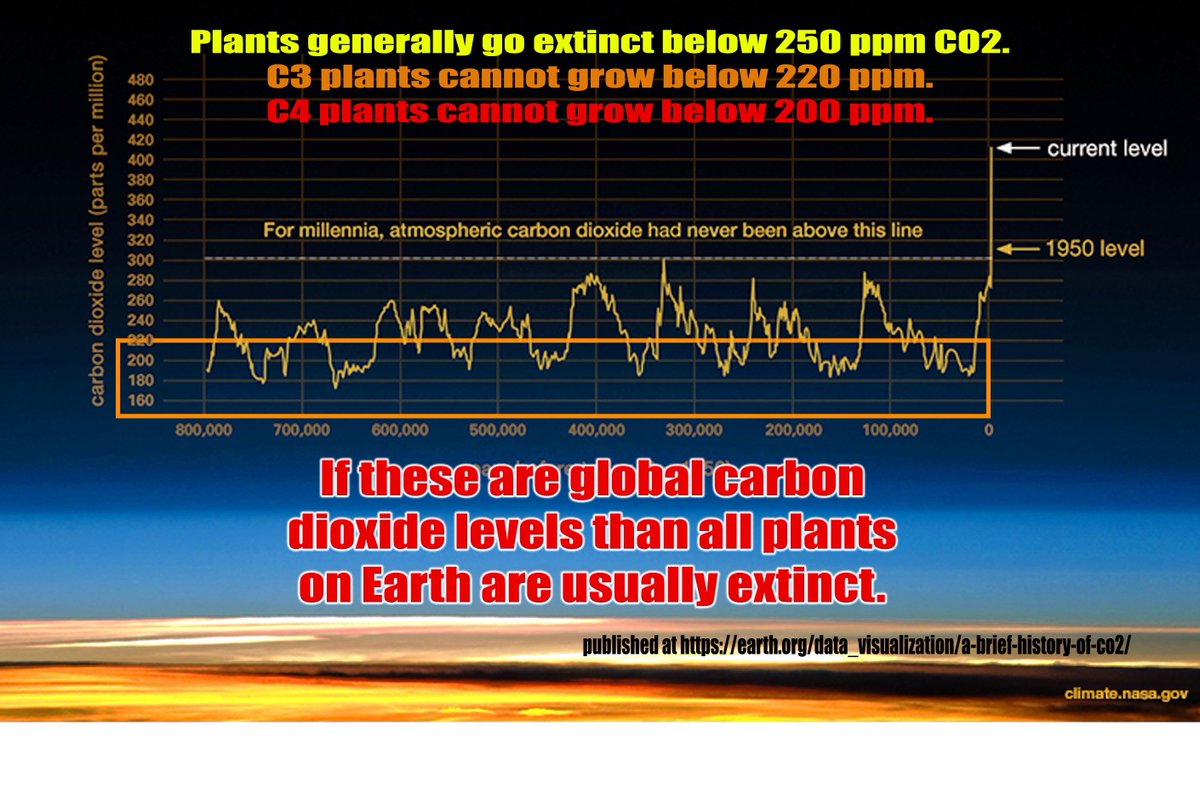
@WillBlair1982@_ClimateCraze@SkylineReport Growth falls to ZERO near 200ppm CO2 with ideal CO2 at 1175 ppm @ 70.6F (standard temp). Which one of those numbers are we close to?
@SkylineReport You're showing a graph created with CO2/temperature correlation. 🤨
Here is Veizer, a much cleaner data set of tropical oxygen isotope series compared with GeocarbIII.
Yellow shows forest fire periods. CO2/temp decouple w/o forest fires.
@MauriceMur4768@morshaa1@BladeoftheS Story got my attention years ago - herders on the southern edge of the Sahara. The paths they took began to become green, making journeys easier.
It was suggested the animal dung and urine was fertilizing the ground.
But why didn't those paths get green long ago?
I get it now.
Many factors come into play. Greening has a cooling effect in warm climates, usually minor but enough to offset 39 +/-14.5% of global warming in India (agricultural desert transformation). Greening contributes to significant heating in the Arctic (30%).
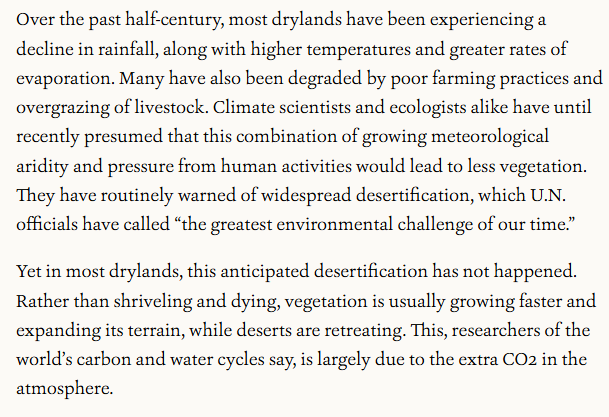
Higher CO2 levels increase plant water efficiency and drought tolerance.
The Sahara is greening already without increased rainfall despite rising temperatures. https://t.co/gGhfyaj12N
The future is looking very green. 🥳
@DeanH2963@martinrev21 I can't see half of Earth's oxygen disappearing for gas releases. The Siberian Traps included large-scale coal fires.
Great Dying is the wrong analogy anyhow. Capitanian and rainforest collapse were beginning.
https://t.co/jMsowRMeYT
@martinrev21 Based on O2/CO2 ratios we were on the brink of a Capitanian mass extinction and a new Age of Amphibians and Giant Insects.
Instead, we are on course to skip that, skip a Great Dying, and move instead into a new Age of Dinosaurs.
@martinrev21 Based on O2/CO2 ratios we were on the brink of a Capitanian mass extinction and a new Age of Amphibians and Giant Insects.
Instead, we are on course to skip that, skip a Great Dying, and move instead into a new Age of Dinosaurs.
@MauriceMur4768@morshaa1@BladeoftheS Thanks for the input!
Looks like about +5C at 1300ppm shown on this graph where heat tolerance is +9C.
That's global while non-Arctic gains are about half that, proving no problem for hot region plants at all.
@ecoolafartist Fine, discuss it all you want but never tax, mandate, or impose anything.
Obama was an Indonesian Muslim bent on destroying America just like the rest of them. Still is.
The 50% gone in 30 years is a dubious, strictly measurement-based assessment. It encompasses bicarbonate deposition, weathering, lumber, and other sinks.
The immediate sinks are plants (30%) and oceans (25%). Plant abundance adjusts quickly. Ocean surface levels mirror atmospheric levels, adjusting instantly.
Plant sinks are likely to saturate when plant area is maximized and atmospheric CO2 levels reach between 1000 and 1800ppm (maximum growth).
Nothing in the atmosphere is truly 'excess' until maximum plant growth levels are exceeded.
Ocean sinks can not saturate below 1,000,000 ppm.
There is no known limit to the amount of carbon which can be removed through weathering (soil deposits), rock weathering (chemical aqueous deposits), and deep water deposition.
The 50% gone in 30 years is a dubious, strictly measurement-based assessment. It encompasses bicarbonate deposition, weathering, lumber, and other sinks.
The immediate sinks are plants (30%) and oceans (25%). Plant abundance adjusts quickly. Ocean surface levels mirror atmospheric levels, adjusting instantly.
Plant sinks are likely to saturate when plant area is maximized and atmospheric CO2 levels reach between 1000 and 1800ppm (maximum growth).
Nothing in the atmosphere is truly 'excess' until maximum plant growth levels are exceeded.
Ocean sinks can not saturate below 1,000,000 ppm.
There is no known limit to the amount of carbon which can be removed through weathering (soil deposits), rock weathering (chemical aqueous deposits), and deep water deposition.
'Excess' does change some things, particularly accelerating growth in the Arctic and hot, dry areas. The additional heat melts ice as do trees growing over frozen tundra, stabilizing warmer conditions.
The added CO2 raises maximum photosynthesis temperatures 5C while non-Arctic temperatures are up only 0.7C and plants very much like that.
Carbon added to land life is permanently locked away proportional to CO2 levels - not specifically but collectively. Potential plant growth has increased 52%. Actual growth and actual plant mass have both increased 25% globally. That's about 30% of the fossil fuel carbon used in this period.
That's permanently or until CO2 levels fall.
As for the glaciers there are several possible mechanisms. This global modeling of sea levels (working on upgrading to regional) shows all land masses at high elevations repeatedly (less frequently than represented), allowing for individual, non-concurrent high-altitude glaciation. (Not useful to trends of less than millions of years IMO).
Volcanoes create individual glaciers.
Major volcanic eruptions can cause brief glaciations across large areas. (Rapid onset, may endure with feedbacks.)
Pre-30Ma glacial evidence is frequently just some rock scratches without evidence of broad or regional changes (or ice, even, necessarily).
The 300-250Ma glaciation is absurd as that is the age of giant amphibians and giant insects.
Then there's extraterrestrial events - solar, dust clouds, or other which could have happened...
Milankovitch cycles are a potential triggering or contributing factor which may have contributed to or caused some cycles, but they don't seem to match glaciations half the time IMO.
I expect volcanoes are a frequently significant factor. Yellowstone's covered North America in ash repeatedly. That's a good glaciation trigger, but not, I emphasize, a global Ice Age.
As far I as I've found there's no evidence of ice ages in Asia, supporting volcanism as a continental rather than global trigger.
@Konverter22@PeterDClack The CO2 problem is a point I have seized upon myself. The easiest solution is to up the bias by 40ppm. Relevant fossil records need levels even higher than that.
*Plants can survive weeks at zero CO2 but without enough to even grow (200pm) I see no possibility of reproduction.