File upload bugs are still everywhere. My 2026 playbook:
1. Map every upload — profile pic, resume, CSV, KYC, support attachments. Different code paths, different bugs.
2. Beat the extension filter:
- shell.PHP (case)
- shell.php.jpg / shell.jpg.php
- .phtml .php5 .phar .pht
- %00 null byte
- shell.php;.jpg (IIS)
3. Spoof Content-Type: image/jpeg in Burp. Half the time it's the only check.
4. Beat magic bytes — prepend GIF89a; to your PHP. Valid image header, valid PHP.
5. SVG = XML = <script>. Stored XSS via image view. Bonus: XXE via DOCTYPE.
6. Path traversal in filenames + Zip Slip in ZIP uploads.
7. Look at what processes the file after upload — ImageMagick, FFmpeg, headless Chrome PDF renderers. SSRF + LFI hide there.
8. Race the antivirus — upload, hammer the URL before the scanner deletes.
9. Trap: hunters test the obvious field and leave. Real bugs live in admin/import/bulk uploads no one tests.
10. Report on IMPACT not the upload. ".phtml uploaded" = medium. ".phtml + RCE PoC at /uploads/" = critical.
What's the wildest upload bug you've found?
If you don’t have air conditioning at home, be sure to watch this video. I’ll show you how to build a powerful DIY air conditioner in just a few minutes.
Built version 3.0 of AI mosquito defense system during the holiday.
Now equipped with multi-sensor tracking, a redesigned high-speed gimbal, and a toy Gatling-style launcher for maximum mosquito elimination efficiency 🦟🔥
0.6s full rotation.
0.001° precision.
Secret detection and validation tools for bug bounty hunters:
secrets-patterns-db
https://t.co/DxZzWdj30z
keyhacks, not actively maintained but still relevant
https://t.co/T42MWUhK8V
#BugBounty#BugBountyTips#Recon#InfoSec
Our sponsor this week is @harmonicsec!
Want to see every plugin, skill, MCP server, connector, extension, and scheduled task running in Claude Desktop?
Now you can thanks to @harmonicsec’s free tool:
claudit-sec: https://t.co/NdbKhaktBT
Arjun by s0md3v is a powerful open-source tool for discovering hidden HTTP parameters in web applications.
Widely used in bug bounty and penetration testing to uncover attack surfaces that aren’t visible in standard requests.
Source: https://t.co/tPq9oc8IGp
#CyberSecurity #BugBounty #EthicalHacking #InfoSec
As someone who scraped for a living for years, anyone recommending lightpanda to do it shows that they don’t have any experience regarding the subject.
Only one thing to understand:
TLS Fingerprinting
You can have the fastest headless setup, puppeteer, lightpanda,… one wrong ClientHello and Cloudflare/Akamai lights you up instantly. CAPTCHA city.
Lightpanda/Zig stuff is fun for tiny sites but gets cooked the second real anti-bot shows up. Cloudflare? Protects 20%+ of all websites on the internet
What is a ClientHello?
It’s the very first message your browser (or bot) sends during the TLS handshake. It openly announces your TLS version, the list of supported cipher suites, elliptic curves, extensions order, GREASE values, and other data. Anti-bot systems like Cloudflare and Akamai read this instantly and turn it into a fingerprint. If it doesn’t match a real browser’s exact signature… you’re flagged as a bot right away.
The key here is simple: real TLS fingerprint spoofing requires low-level control. You can’t do it properly in JS or Python. You need languages like C++ or Rust to actually rewrite the ClientHello, cipher suites, extensions, and all the tiny details that Cloudflare and Akamai check instantly. Anything higher-level just leaves obvious artifacts that scream ‘bot’
What I recommend: Camofox
An actual Firefox fork with proper C++ fingerprint spoofing, native TLS behavior, proxy/geo baked in, built so your agents don’t die on protected pages.
Top-tier protections might flag it following interaction speed on the pages, ip addresses and other factors but there’s NO match between lightpanda and this
"Camofox patches Firefox at the C++ implementation level - navigator.hardwareConcurrency, WebGL renderers, AudioContext, screen geometry, WebRTC are all spoofed"
Basically, everything is spoofed BEFORE the JS on the page can even see the values. Which is not possible with python/js libraries.
On another note, I talked about it to @Teknium on @NousResearch discord and literally 2 hours later it was implemented in Hermes Agent, it just shows that they take feedback very seriously and want to give the smoothest agent experience they can
Level-up your setup right now
https://t.co/f2PSLfud9A
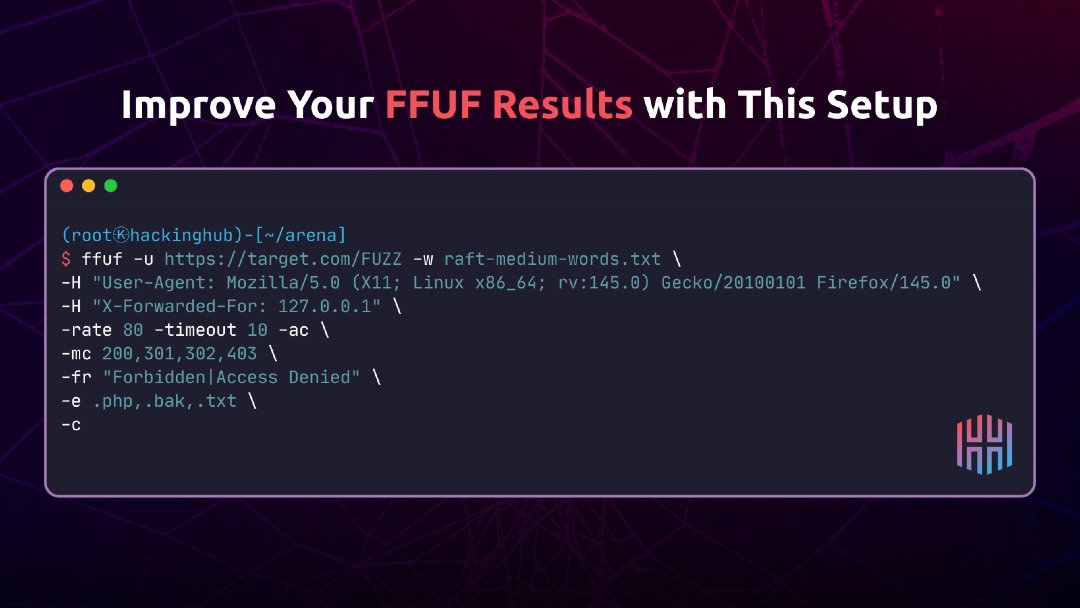
Your FFUF command isn’t returning anything useful, is it?
The problem usually isn’t the wordlist. You’re likely getting filtered or rate-limited.
Slow it down, control your rate, use realistic headers like a browser, and filter the noise so real endpoints stand out.
Try now 👇
someone made the most ADDICTIVE game to learn DATA CENTER networking
its called Data Center, $6 game, you start with bare floors, buy racks, mount servers, route every cable by hand
the INSANE part, every customers traffic shows as colored balls rolling through your cables... you literally see bottlenecks in real time
180 reviews in 48 hours, people with RTX 4090 rigs are HOOKED on a $6 cabling sim
An absolute goldmine for bug bounty hunters 👀💥
A massive collection of real, disclosed HackerOne reports — organized by vulnerability type, impact, and target 🎯
If you want to go beyond theory and actually understand how real-world exploits work… this is it.
Study patterns. Learn impact. Hack smarter. 🚀
🔗 Source: https://t.co/yMey4fzDbn
#BugBounty #InfoSec #CyberSecurity #EthicalHackin