this is the most DANGEROUS thing on internet today
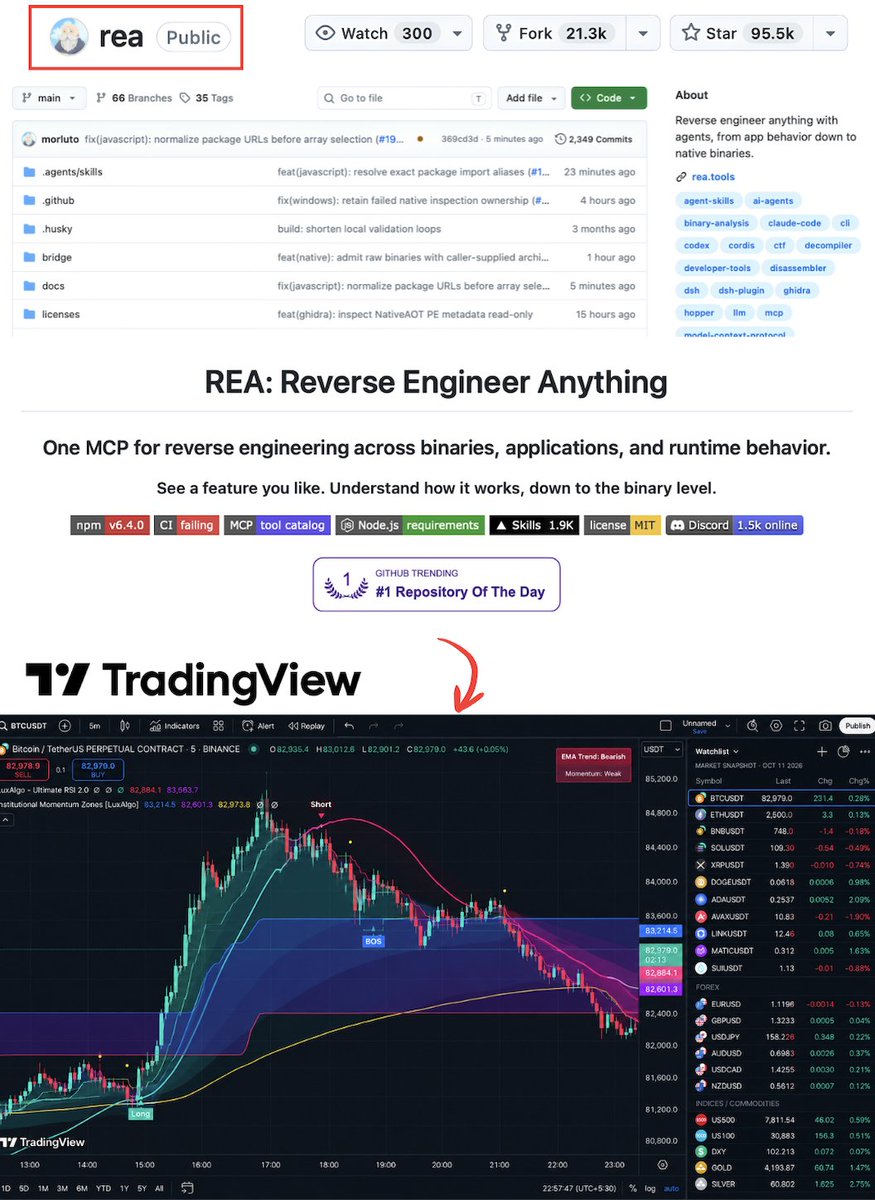
REA (Reverse Engineer Anything) - this open source MCP lets your AI agent reverse engineer any app, down to the binary
i just reverse engineered TradingView, now I am using their premium indicators for FREE - software is cooked
here is how to use REA to reverse engineer TradingView:
1. point REA at TradingView's publicly observable interface and map every major feature, from chart interactions to indicators and alerts
2. trace how the interface behaves when you switch symbols, change timeframes, add indicators, draw levels, and update chart layouts
3. use REA's available MCP tools to investigate authorized software artifacts and trace application logic wherever the evidence allows
4. feed those findings into Claude Opus 5.5, which turns the investigation into a technical specification and an implementation plan
5. rebuild the charting engine independently, with real market data, candlesticks, technical indicators, drawing tools, and persistent watchlists
6. add a quant backtesting engine that tests strategies against historical data, accounting for fees, slippage, and drawdowns
7. test every component, compare its behavior against documented and observable results, fix failures, and keep iterating until the system actually works
8. you end up building your own TradingView-style quant research terminal from scratch, with source code you control and features you can keep extending
i won’t say anything more:
If you’re new to crypto, this is a must-read!
The truth is simple: Information is everything, and your network is your greatest asset.
Be intentional about who you follow; these choices will define your journey.
Surround yourself with the right people, and opportunities will arise.
This list will elevate your game 👇
We’ve open sourced Vigolium, a high fidelity vulnerability scanner built in Go 🦫🔓
with 250+ modules, low-noise by design, + AI agents that audit traffic and source code
Your application deserves a real security assessment 👇
https://t.co/FB7EfRD3C9
Andrej Karpathy spent 8 years working at OpenAI and Tesla
Last week, he condensed everything he knows into one free 2-hour lecture
People spend $15K on bootcamps that teach less than half of this
You probably don't have two hours to watch it right now
Just don't let it disappear in your feed
Save it, watch it later, then read the guide below and build your first loop
Google dropped a free 2 hour course on full graph engineering, taking you from a single prompt to a hundred agents wired into loops and graphs
17:44 – Building your first agent
39:30 – Loop engineering, iterate, check, break
1:12:38 – Graph engineering
1:34:26 – Agents that throttle themselves
1:55:05 – Full graph for multi agentic systems
Most people build a single agent and stop there. This course shows the full system, where agents wire themselves into a graph on their own
Watch it today, then check out the graph engineering playbook below for a deeper breakdown
Andrej Karpathy:
"Prompting is going away.
Delete everything, keep Graph."
In 1 hour he shows how to build Graphs, and why it's the only thing that will be left standing at the end.
The missing piece most people don't get: LLMs, prompts, agents, they're all steps. Graph is where you end up.
Watch it, then read the full guide on Graphs below.
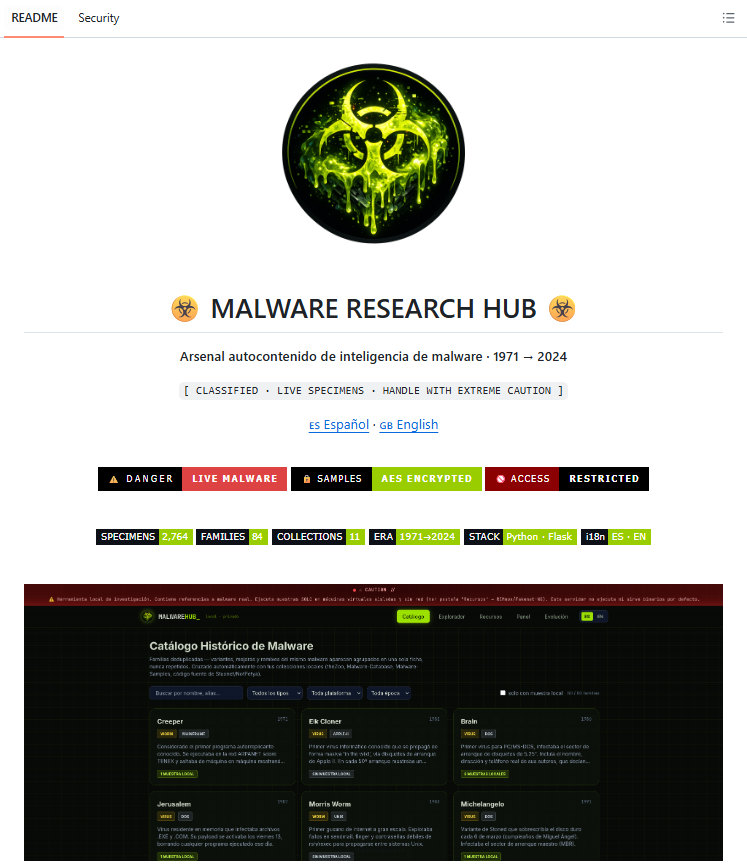
🚨 Acaban de liberar una de las mayores bases de datos de malware en GitHub.
Se llama Malware Research Hub y contiene miles de muestras recopiladas durante más de 50 años para que investigadores y profesionales de ciberseguridad puedan analizarlas en entornos controlados.
Esto es lo que incluye:
→ 2.699 muestras de malware de diferentes épocas
→ Especímenes de familias como Stuxnet y LockBit
→ Un catálogo forense con 80 familias documentadas
→ Herramientas para investigadores y analistas de seguridad
→ Muestras aisladas y cifradas para reducir el riesgo de ejecución accidental
Lo más importante:
No estamos hablando de simulaciones ni ejemplos creados para un curso.
El repositorio contiene malware real y debe tratarse únicamente en laboratorios aislados y siguiendo estrictamente sus reglas de contención.
Es un recurso orientado al análisis, investigación y formación práctica en ciberseguridad.
Repo 👇
DEF CON 32 - Anyone can hack IoT- Beginner's Guide to Hacking Your First IoT Device by Andrew Bellini @d1gitalandrew
TLDR:- An Walkthrough covering the methodology, tools, tactics and a <$100 toolkit to find your first IoT vulnerability.
I sat down and did some schizo ranting for my attempt at a book I might name "Malware 4 Noobs" (no idea yet).
Here is my introduction segment, part zero (no reforms or changes made yet).
If you're noob, please read and give feedback.
https://t.co/h3p0gVpeRR
there's a famous "karpathy claude.md" being shared around here https://t.co/c9v7DSFlyF with a whopping 177k stars
two things you should know about this file -
1. it's NOT actually from andrej karpathy
2. i've got empirical evidence it'll hurt your agent performance
thread 👇
China open-sourced a peanut-sized OCR that parses entire 100-page PDFs in one shot..
It's called Unlimited-OCR. Only 3B params. Runs locally.
Every other OCR tool chops your doc into pages and loses the thread. this one reads the whole thing in a single pass.
→ One-shot "long-horizon" parsing (32K context window)
→ Multilingual, out of the box
→ 93% on the standard parsing benchmark (+6 over baseline)
→ <0.11 error rate past 40 pages
→ Runs 100% locally on your own hardware
→ Works with Transformers, vLLM, SGLang, Docker, Ollama, llama.cpp
Traditional cloud OCR (Textract, Google Vision, Azure Doc Intelligence) costs $1.50–$15 per 1,000 pages.
This runs on your machine. For free. Forever.
Baidu built it explicitly to push DeepSeek-OCR one step further. Already at 1.9M downloads on Hugging Face and most people have no idea it exists yet.
100% open source.
File upload bugs are still everywhere. My 2026 playbook:
1. Map every upload — profile pic, resume, CSV, KYC, support attachments. Different code paths, different bugs.
2. Beat the extension filter:
- shell.PHP (case)
- shell.php.jpg / shell.jpg.php
- .phtml .php5 .phar .pht
- %00 null byte
- shell.php;.jpg (IIS)
3. Spoof Content-Type: image/jpeg in Burp. Half the time it's the only check.
4. Beat magic bytes — prepend GIF89a; to your PHP. Valid image header, valid PHP.
5. SVG = XML = <script>. Stored XSS via image view. Bonus: XXE via DOCTYPE.
6. Path traversal in filenames + Zip Slip in ZIP uploads.
7. Look at what processes the file after upload — ImageMagick, FFmpeg, headless Chrome PDF renderers. SSRF + LFI hide there.
8. Race the antivirus — upload, hammer the URL before the scanner deletes.
9. Trap: hunters test the obvious field and leave. Real bugs live in admin/import/bulk uploads no one tests.
10. Report on IMPACT not the upload. ".phtml uploaded" = medium. ".phtml + RCE PoC at /uploads/" = critical.
What's the wildest upload bug you've found?
If you don’t have air conditioning at home, be sure to watch this video. I’ll show you how to build a powerful DIY air conditioner in just a few minutes.