Located just 15 minutes by train from Amsterdam, Zaandam is a city famous for its peculiar architecture of stacked houses reminiscent of Lego pieces and for its proximity to Zaanse Schans, a historic area with iconic traditional windmills.
Tensors generalize vectors as lists and matrices as grids into higher-order arrays like 3D cubes.
Comparisons include a vector as a list, a matrix as a grid, and a 3-tensor as a cube, along with the stress tensor σij on a cube featuring arrows for components like σ11 and σ23, the product derivative rule, the Riemann curvature tensor R(u,v)w = ∇u ∇_v w − ∇_v ∇_u w − ∇[u,v]w, quantum superposition 1/√2(|00⟩ + |11⟩), and algebraic operations like the tensor product.
It is used to analyze internal forces and deformations in engineering materials and to describe the geometry of spacetime under gravity in general relativity.
A 33-year-old woman at MIT wrote the code that ran inside the Apollo 11 lunar lander, and 20 seconds before Neil Armstrong touched the moon, her program made a decision the astronauts didn't know was happening that was the only reason the mission didn't crash.
Her name was Margaret Hamilton.
She led the team writing every line of code that would fly humans to the moon and back. The part almost nobody knows is that she had to fight to be allowed to do the work at all.
Code in 1965 was not treated as real work.
Rockets were serious. Circuits were serious. Writing code was something the men at NASA thought secretaries could do on the side. Hamilton was told this to her face more than once.
So she started calling what her team did "software engineering."
She used the phrase on purpose. In meetings. In memos. To force people to treat it as a discipline instead of a chore. Colleagues laughed at her the first few times she said it out loud.
That phrase is now the name of the biggest engineering profession on earth.
The story of what her code did on July 20, 1969 is the one every kid should be taught.
Neil Armstrong and Buzz Aldrin were 3 minutes from touching down when the computer inside the lunar module started flashing an alarm.
1202.
Then again. Then 1201. Five alarms in four minutes. The computer was telling the astronauts it could not finish everything it had been asked to do.
The computer they were flying with had less memory than a modern microwave.
Someone on the checklist had left a switch in the wrong position, and a radar the astronauts did not even need right then was flooding the computer with data. It was eating around 13% of the machine's brain at the exact moment every second mattered.
In almost any other system, that overload would have frozen the machine.
A frozen machine 30,000 feet above the moon means a crash. It means two dead astronauts and a third one orbiting alone above them, waiting for a signal that would never come.
Hamilton's code did something else.
She had built the software with a rule almost nobody in her field was using at the time. When the machine ran out of room, it would not treat every task as equally important. It would look at the list of jobs it had been asked to do, throw out the ones that could wait, and keep running only the ones keeping the crew alive.
The radar was the low priority job.
The landing was the highest.
So the computer did what she had told it to do. It dumped the radar. It kept flying. The alarm was not a failure. It was the machine reporting that it was handling the overload exactly the way she had designed it to.
Down in Houston, a 24-year-old engineer named Jack Garman recognized the alarm from a test his team had run months earlier. He shouted "Go" to the flight controller. The controller shouted it up to the crew. The landing kept going.
Armstrong touched the surface with 25 seconds of fuel left.
The part that gets lost in every retelling is why Hamilton had built that safety net in the first place.
NASA had not asked for it.
She had added it on her own, years earlier, because her 4-year-old daughter Lauren had once crashed the simulator by pressing a button during a test. The button was one the astronauts had been told they would never press.
Hamilton wanted the code to survive that button press anyway.
Her bosses told her it was a waste of time. Astronauts do not make mistakes.
She insisted. The safety net went in.
Two years later, on the way to the moon, an astronaut left a switch in the wrong position. The exact class of mistake she had been told would never happen.
There is a photograph of her from that period.
She is standing next to a stack of paper as tall as she is. Every page in that stack is the code her team wrote for the mission. She is smiling at the camera like she knows something the rest of the aerospace industry has not figured out yet.
In 2016, Barack Obama put the Presidential Medal of Freedom around her neck and said the astronauts did not have much time, but thankfully, they had Margaret Hamilton.
Every autopilot in every plane you have ever flown on uses a version of what she invented. Every pacemaker. Every self driving car. Every satellite in orbit.
The idea that a machine should know which job matters most and drop the rest when it runs out of room is now the foundation of almost every safety system on the planet.
She wrote it because a 4 year old crashed a simulator and nobody else thought it was worth fixing.
The men in the room laughed at her for calling it engineering.
Then her code was the only thing in the sky that did not fail.
El 3 de julio de 1962, se proclamaba la independencia de Argelia, el imperialismo francés era derrotado, tras perpetrar una brutal guerra de exterminio colonial contra el honorable pueblo argelino.
Más de 5 millones de argelinos murieron a manos de los colonialistas franceses en apenas un cuarto de siglo, las torturas y los asesinatos contra los miembros de la resistencia argelina fueron brutales.
Los soldados coloniales franceses arrasaron pueblos enteros mientras capturaban y torturaban a todo el que se resistía, con brutales formas como la electrocución, además de usar los pozos de agua como prisiones, lanzar a los argelinos desde helicópteros con piedras atadas a los pies y decapitar sus cabezas para luego coleccionarlas.
La mayor masacre colonial francesa en un solo dia en Argelia, irónicamente se dio mientras Francia celebraba su liberación del nazismo, el 8 de mayo de 1945, cuando cientos de miles de argelinos salieron a las calles a pedir independencia, el ejército francés los acribilló a balazos matando al menos a 45.000 civiles.
Otro de los crímenes poco conocidos del colonialismo francés en Argelia, es cuando usó al pais más de 57 veces como campo de pruebas nucleares entre 1960 y 1966, los experimentos nucleares fueron 4 veces mayor al bombardeo de Hiroshima en Japón.
Los experimentos nucleares franceses mataron a más de 42.000 argelinos e hirieron a miles más debido a la radiactividad nuclear, que más de 60 años después siguen visibles sus secuelas, provocando una gran contaminación radiactiva de la tierra y el aire.
El Frente de Liberación Nacional argelino logró la claudicación del colonialismo francés en una de las guerras de liberación nacional más crueles de la descolonización africana, aunque tras 132 años de opresión imperialista, finalmente el pueblo argelino logró la expulsión de alrededor de un millón de colonos europeos originarios de Francia, Italia o España.
Francia nunca reconoció sus crímenes en Argelia y tardó décadas en ni siquiera reconocer el término "guerra" contra Argelia.
La guerra de liberación nacional que hoy se da en Palestina debe acabar igual, los colonos deben volver a Europa y se debe terminar con el apartheid racista.
Por qué la gente hace filas kilométricas para ir a este supermercado de Nueva York
Esta fila se formó hace unos días en el centro de Manhattan, en la turística zona de Times Square. / ml
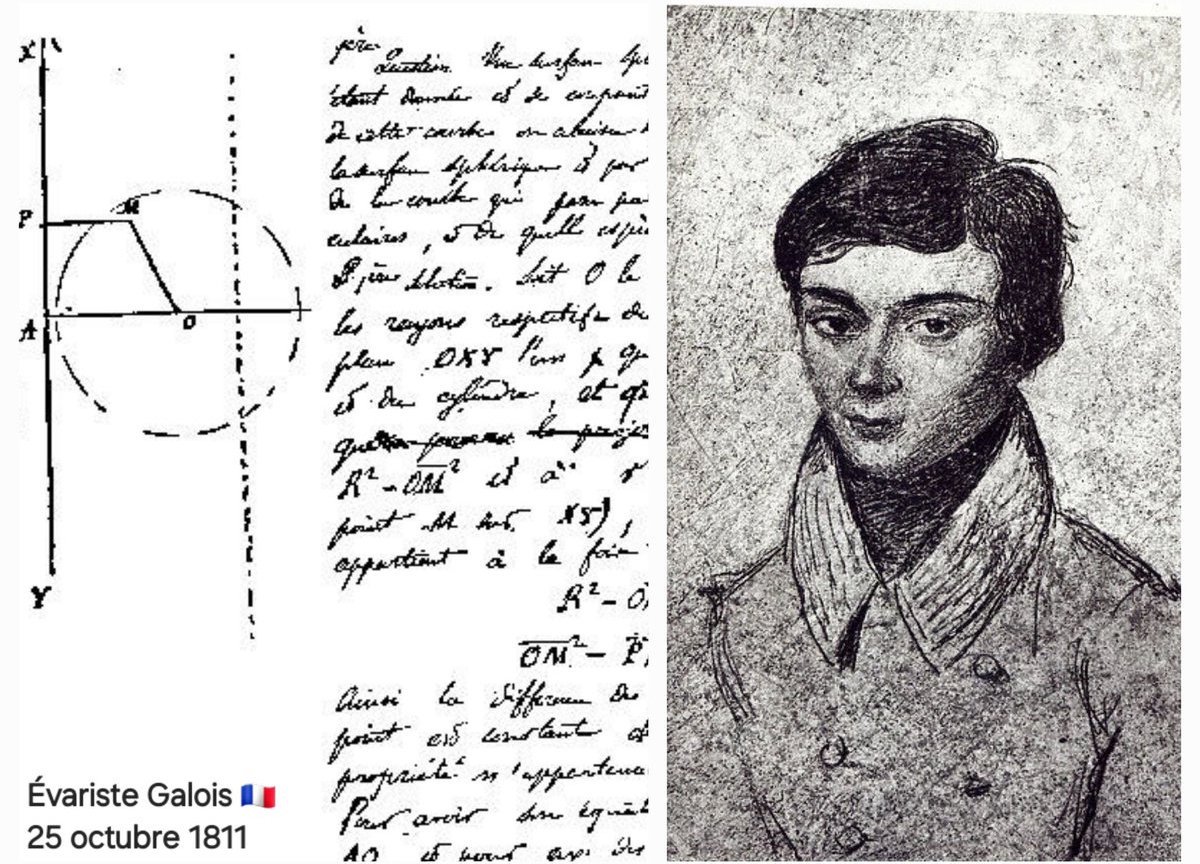
A French teenager wrote the math that now guards your bank account, and he wrote most of it in the hours before a gunfight he knew he would lose.
His work is called finite field theory. He built it before he turned 20.
Évariste Galois was born near Paris in 1811, into a country that was tearing itself apart.
He failed the entrance exam to the best engineering school in France, twice, partly because the examiner could not follow how his mind jumped ten steps ahead.
He got kicked out of another school for insulting the director in a newspaper. He was arrested for his politics. He drank for the first time in a prison cell.
He was 20 years old and almost nobody in mathematics took him seriously. The most famous mathematician in France read his work and called it incomprehensible.
Then he fell for a woman named Stéphanie, and it pulled him into a duel.
The night of May 29, 1832, he did not sleep. He sat down and started organizing everything he had figured out into a long letter to his friend Auguste Chevalier, terrified it would all die with him in the morning.
Next to one theorem, where the proof was not finished, he scrawled four words in the margin: "I have no time."
At dawn he walked to a field, stood in front of a pistol, and got shot in the stomach.
His opponent left him there. A farmer found him hours later. He died the next morning at ten o'clock. His last words were to his younger brother. Don't cry. I need all my courage to die at twenty.
His papers sat in a drawer for over a decade before anyone understood them.
Here is what he had actually done. Galois found a way to build tiny number systems that only contain a fixed handful of numbers, where you can still add, subtract, multiply, and divide without ever running off the edge.
Everything wraps around and stays inside. These are now called Galois fields.
That sounds like a toy. It is the exact structure your bank runs on.
Every time you tap your card, the encryption that scrambles your money into gibberish is doing arithmetic inside one of these fields. The standard is called AES, and it lives inside a Galois field of exactly 256 elements.
The system protecting billions of dollars a day is built on a shape a heartbroken 20-year-old sketched out while racing the sunrise.
He never saw a bank. He never saw a computer. He wrote the math and then went to die.
El vertedero que más metano emite está en Buenos Aires
En Argentina se encuentra el vertedero con más emisión de metano del mundo, el segundo gas que más contribuye a la crisis climática. Así lo determinó un estudio de la Universidad de California en Los Ángeles, que sitúa primero en el ranking global de 2025 a un depósito de residuos de la ciudad de Buenos Aires y alrededores. Los responsables del relleno sanitario cuestionan el informe, mientras los vecinos padecen el mal olor. El metano no es tóxico, pero es el precursor de otros gases que sí lo son. Un informe de Alejandro Rebossio.
MercadoZona de referenciaPrecio para una vivienda tipo de 80 m²
AlquilerCampamento1.824 euros al mes
CompraLatina311.954 euros
AlquilerAluche1.647 euros al mes
CompraAluche303.074 euros - https://t.co/TTzHFYQI82
🇨🇳El Dalai Lama dejó de estar en nómina de la CIA tras dejar de reclamar la indepedencia del Tíbet y limitarse a pedir «autonomía».
¿Motivo? El apoyo a China de los tibetanos está en máximos históricos.
Vídeo de los últimos 20 años de desarrollo en Lhasa, capital de la región:
💪🤝 ¡Un nuevo hito para el primer tren subterráneo del Perú! 🇵🇪👏👏👏 La tuneladora Delia culminó la perforación del túnel de la Línea 2 del Metro de Lima y Callao al llegar a la futura Estación Insurgentes, en Bellavista. Tras recorrer 14.3 kilómetros desde la Estación San Juan de Dios, se completa la excavación de esta infraestructura que permitirá unir Ate y el Callao en solo 45 minutos, acercando a miles de peruanos a un transporte moderno, seguro y eficiente. 👏👏
@ATU_GobPeru
América Latina ante el ascenso de China
Este volumen editado por Rebecca Igreja y @BassettiMarilia – fruto de un proyecto de @FLACSOSG – incluye capítulos de investigadores y investigadoras que han pensado mucho sobre el tema.
Descarga libre: https://t.co/KwGZw1NW3p
Working with Concepts by David Collier, edited by Zachary Elkins
Offers a lively introduction to new ideas about concepts and concept analysis in political science and international studies.
📘 https://t.co/jePLAm5GBB
El colonialismo británico llamó a Ghana como la Costa del Oro, desde 1821 saqueó el oro del pais, lo almacenó en sus reservas y robó todo tipo de artefactos que fueron expuestos en sus museos, durante más de 136 años.
Hoy el imperialismo británico sin tener minas de oro en su pais, tiene en sus reservas 400.000 lingotes de oro valorados en 320.000 millones de dólares.
Corrupción y democracia
Este texto breve de @DeliaFerreira argumenta que de no frenarse la corrupción se puede terminar con "auténticas mafiocracias, donde el Estado está gobernado o controlado por grupos criminales.”
Descarga libre: https://t.co/5VWFf4Nkq3
El significado del proverbio chino «si quieres ser feliz durante una semana, cásate; si quieres ser feliz un mes, mata a un cerdo; si quieres ser feliz toda la vida planta un jardín: https://t.co/QRxAKdkjOi







![mathemetica's tweet photo. Tensors generalize vectors as lists and matrices as grids into higher-order arrays like 3D cubes.
Comparisons include a vector as a list, a matrix as a grid, and a 3-tensor as a cube, along with the stress tensor σij on a cube featuring arrows for components like σ11 and σ23, the product derivative rule, the Riemann curvature tensor R(u,v)w = ∇u ∇_v w − ∇_v ∇_u w − ∇[u,v]w, quantum superposition 1/√2(|00⟩ + |11⟩), and algebraic operations like the tensor product.
It is used to analyze internal forces and deformations in engineering materials and to describe the geometry of spacetime under gravity in general relativity.](https://pbs.twimg.com/media/HMRRce4aQAA1I8a.jpg)