@manuginobili El Titus the Fox! Inclusive en el año 2000 cuando arrancaba te ponía un cartel tipo "wow, I can't believe people are still playing this game in 2003!" o algo así 🦊
@unclebobmartin Have you also noticed a huge increase in your ability to focus? When I gave up on white carbs, after one week I noticed I was able to laser focus on things for much longer, and I was preaching everyone I ran into about that, lol
Uno me la quiso agitar diciéndome que ahora voy a tener que buscar laburo. Hago humor girando por todo el país hace años contando chistes sobre coger con familiares. Voy a tener más trabajo que nunca.
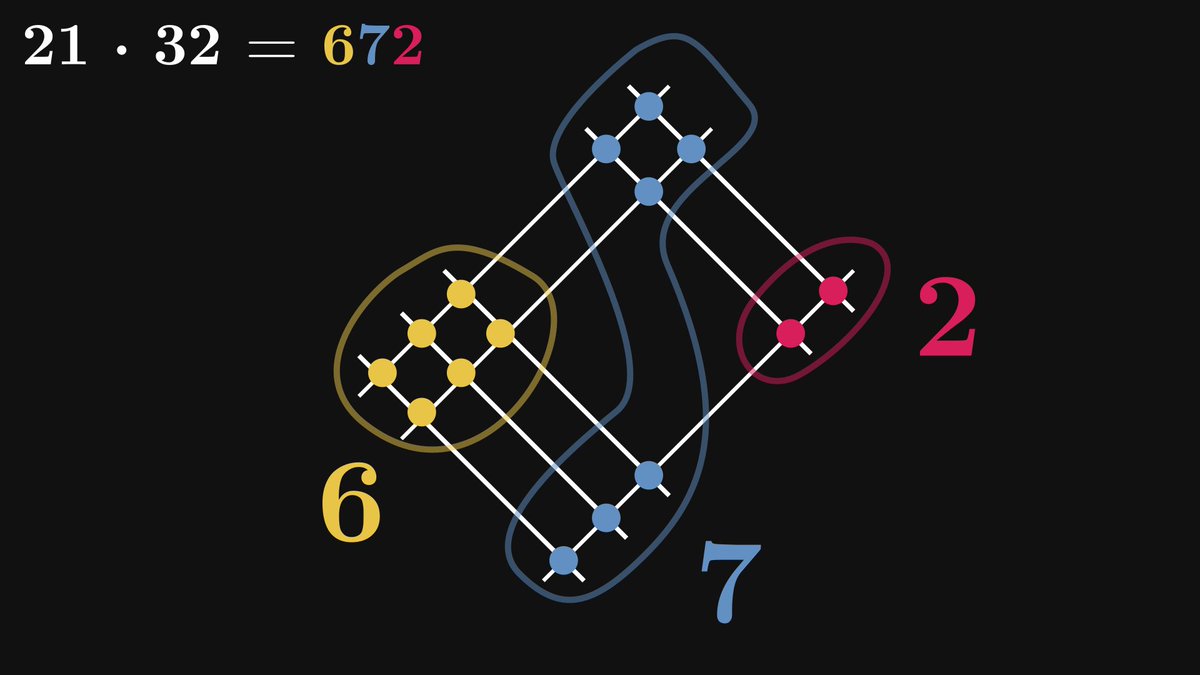
The Japanese multiplication method makes everybody feel "I wish they taught math like this in school."
It's not just a cute visual tool: it illuminates how and why long multiplication works.
Here is the full story.
Anything that moves in a circle can be turned into a computer. I thought this was obvious, but I've spent 25 years working with computers, so maybe it's only obvious to a few. I'll explain.
Suppose you write down a number on a piece of paper:
1
Suppose you want to add 1 to it:
f(x + 1)
Suppose you write down the result:
2
Suppose you keep doing that:
f(x + 1)
3
f(x + 1)
4
f(x + 1)
5
f(x + 1)
6
What are you doing? You read the old value, you perform an operation, you write down the result.
In 1936, the British mathematician Allan Turing imagined a machine that could do this, an infinite state machine. What would be needed? Three things:
1. a place to write down the value
2. an operation to perform on the existing value
3. a place to write down the new value
He theorized a piece of paper that was infinitely long, and which could therefore accept an infinite series of values.
However, in real life, we don't have pieces of paper that are infinitely long, so instead, we've relied on things that go in a circle, to simulate infinity. We can go in a circle for infinity, which is not the same as having an infinitely long piece of paper, but it does allow us to simulate infinity in a small way. This going in a circle can be electricity that goes round and round in a CPU or it can be an old fashioned water wheel, sitting in a river, part of an old fashioned mill.
This is why I said it should be possible to build a computer using only wood and string.
What is specifically needed? Three things:
1. a water wheel, whose lowest portion sits in the river. The river current forces the wheel to turn.
2. some sticks need to be attached to the water wheel. These would have to be fastened with string, so that they can move but so they don't move unless some force is applied. Likely they should be on top of some bump, and depending on the force applied, they can be pushed to the inner or outer side of the bump. These sticks would record the current state of the system. The inner side of the bumps could be considered 0 and the outer side of the bump could be considered 1. And once we have a way to record 0 and 1, we can start to apply boolean logic.
3. The trickiest part would be the sticks that read the current state and then update it based on some logic. There would have to be a small stick lightly attach, which can be knocked around as it reads the position of the other sticks -- this is tricky because this stick needs to read the other sticks without changing their positions. And then this stick, which gets knocked about lightly, would have to be attached to a gear that could multiply its force, because it would have to control the movement of the wedge which would be responsible for moving the sticks, each time the wheel goes around.
The wheel would turn. The positions of the sticks would be read. Based on the read values of the sticks, a wedge would move to a position so it can know the sticks into new positions (or leave them where they are). Every time the water wheel goes around, the sticks are read, and then moved based on their previous positions. A new state would be arrived at, based on some internal logic, based on the previous state of the system.
All existing computers are finite, even though they are conceptually modeled off an infinite state machine. You probably own a computer that has either 4, 8, 16, 32, or 64 gigabytes of RAM -- all finite numbers. Likewise, the water wheel computer would be limited, but it would be orders of magnitude weaker than existing computers. Using sticks we might be able to put in place 64 or maybe 128 sticks, giving us 64 or 128 bits. There isn't too much you can do with that, but maybe with cleverness it might be enough to program the water wheel computer to play a game of Tic Tac Toe. I suppose, given a giant water wheel and very small sticks, you might get to the point where you could program a simple game of chess. I leave it to others to imagine what the interface would be, but in the simplest case the interface is a computer programmer who reads the boolean result and then uses his/her hand to move a chess piece on a chess board.
You would need a good carpenter and, above all, someone very good with string and knots, since it would be difficult to get just the right amount of tension, so that the sticks (which record state) could move but not move easily.
There is the question of how to do the actual programming, but that part was actually worked out in real life, back during the 1700s, mostly in the Netherlands. The Dutch had looms that ran off water power and had semi-automated looms that could weave a pattern based on holes that the Dutch would drill in a piece of wood. Essentially, they had something like punch cards, but done in wood, and designed conceptually to work as a finite state machine (rather than an infinite state machine). Something similar would work here: a sheet of wood would holes punched in it would have to hold the "software" and would play a role in determining what the future state of the system should be, based on the previous state.
To come back to my main point, anything that goes in a circle can be transformed into a computer (an infinite state machine). Given limited materials, it might take a great deal of ingenuity, but it can be done. You could even build such a machine using an old fashioned water wheel on a river mill. It could be done.
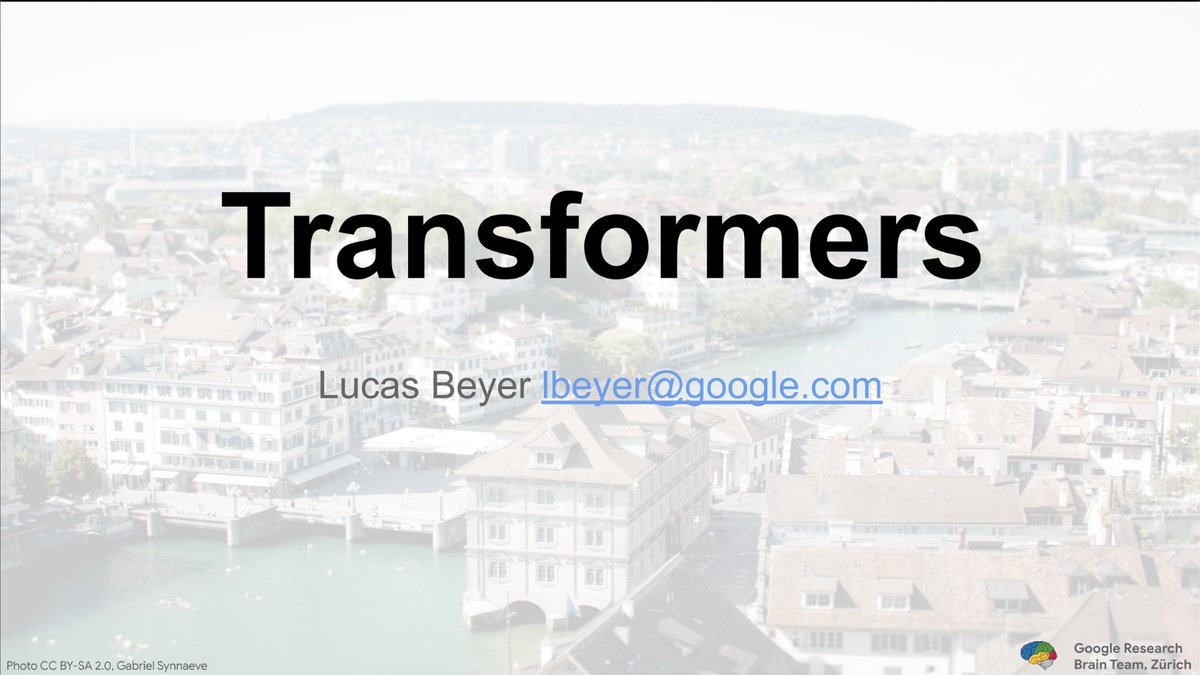
The best summary of Transformers and it’s evolution 🙏
I found @giffmana’s slides from 2022 to be the best “pocket reference” on the topic.
Many posts have covered Transformers however this one also covers the state of field before and how it got adopted to different domains.
There’s a summary of the Attention is all you need paper which is a crispy read.
I’ve read this at least 10 times today and I’d strongly recommend you check it out:
https://t.co/M5TQuTyPyg