Are you a UG student from Delhi who is about to graduate and looking for well funded career enhancing PG programs? Especially looking for a well crafted one year Masters program in economics after your four year undergraduate degree? @SRMUAP
Come and meet us at The Metropolitan Hotel on Saturday, June 13, 2026. Register!
Unlike US government bonds, Indian government bonds rely more heavily on the RBI than on private investors. That's one reason the share of domestic debt on the RBI's balance sheet has risen over the years, economist Dr. Parag Waknis (@wparag) tells @pujamehra. He explains why. Listen in!
Super interesting!
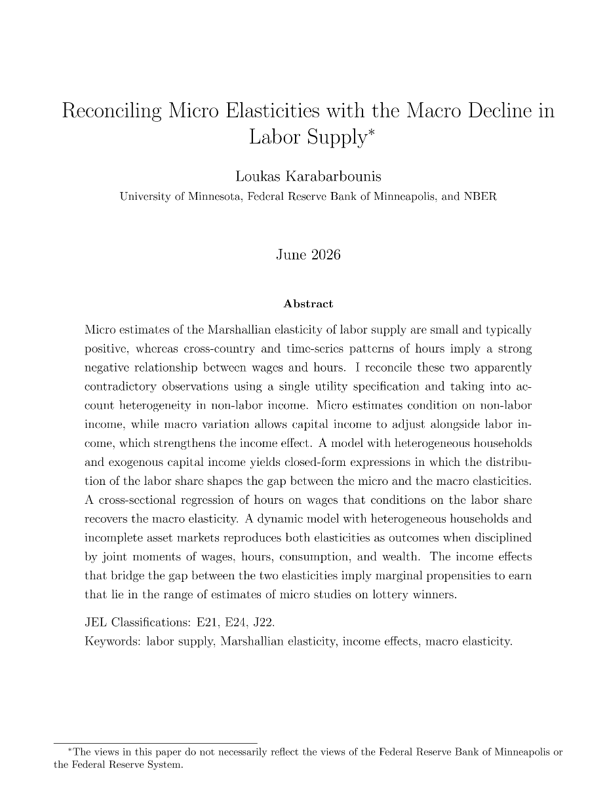
"Reconciling Micro Elasticities with the Macro Decline in Labor Supply" by Loukas Karabarbounis.
"Micro estimates of the Marshallian elasticity of labor supply are small and typically positive, whereas cross-country and time-series patterns of hours imply a strong negative relationship between wages and hours. I reconcile these two apparently contradictory observations using a single utility specification and taking into account heterogeneity in non-labor income. Micro estimates condition on non-labor income, while macro variation allows capital income to adjust alongside labor income, which strengthens the income effect. A model with heterogeneous households and exogenous capital income yields closed-form expressions in which the distribution of the labor share shapes the gap between the micro and the macro elasticities. A cross-sectional regression of hours on wages that conditions on the labor share recovers the macro elasticity. A dynamic model with heterogeneous households and incomplete asset markets reproduces both elasticities as outcomes when disciplined by joint moments of wages, hours, consumption, and wealth. The income effects that bridge the gap between the two elasticities imply marginal propensities to earn that lie in the range of estimates of micro studies on lottery winners."
https://t.co/29VmFFZDmE
Hi #EconTwitter!
Interested in #microeconometrics & causal inference?
Damian Clarke's (@UniofExeter) 𝐀𝐩𝐩𝐥𝐢𝐞𝐝 𝐌𝐢𝐜𝐫𝐨𝐞𝐜𝐨𝐧𝐨𝐦𝐞𝐭𝐫𝐢𝐜𝐬 is out! The website is free, open and very cool, with lots of code/data in #R, #Python & #Stata.
Useful for grad students!
Super interesting!
"Macro Theory with Measured Expectations" by Ralph Luetticke, Christopher Roth, Mirko Wiederholt, and Johannes Wohlfart.
"The Lucas critique holds that policy evaluations based on historical correlations can fail because policy changes alter expectation formation. We develop a new approach to monetary policy evaluation that addresses this concern: we elicit expectations under alternative policy scenarios from household surveys and feed these measured expectations into a heterogeneous agent model. The surveys reveal that the response of income and inflation expectations to interest rate changes is state-dependent. Incorporating these expectation differences into the model yields estimates of the effects of policy on aggregate consumption that are statedependent, varying with economic conditions at the time of the policy change."
https://t.co/kuY8FtgBEC
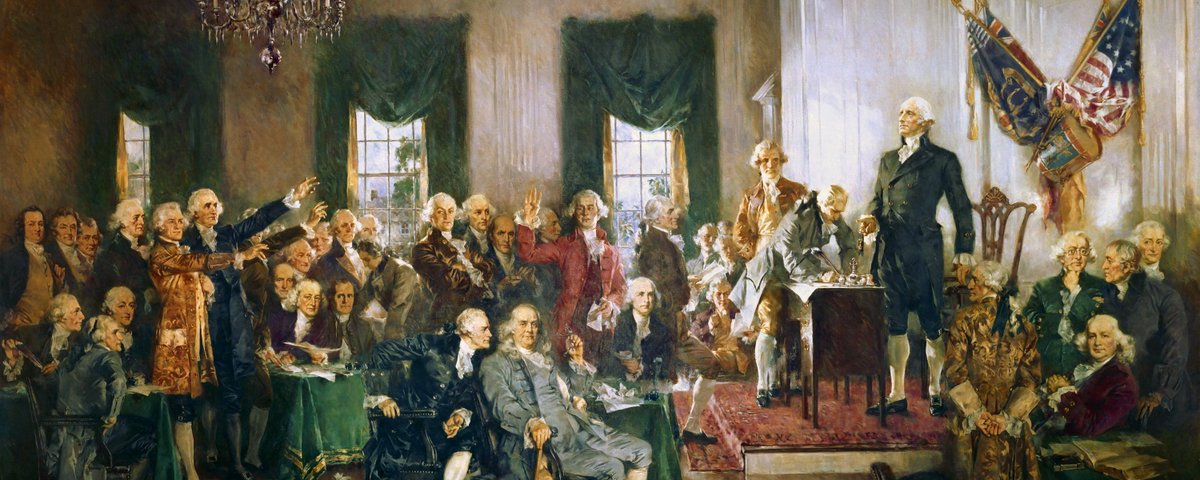
Exactly one month from today, the United States turns 250. To mark it, the Penn Initiative for the Study of Markets @Penn_Exchange is offering a free online course on the economic foundations of the American Founding.
I will lecture on June 23 and July 28, alongside Alan Taylor, Woody Holton, Joseph Wallis, and Jack Rakove, among others.
The course follows the story from colonial settlement to the early republic, showing how economics and institutions shaped political choices at every turn: the road to independence, the Revolutionary War, the Constitutional Convention, and the rival visions of Hamilton and Jefferson.
This is one of my favorite subjects in economic and legal history.
Details and registration here:
https://t.co/Xe2DlWluVi
📢 Macro Theory with Measured Expectations (with Roth, Wiederholt, Wohlfahrt)📢
The Lucas critique says policy evaluations based on historical correlations can fail because policy changes alter expectation formation.
We propose a way to address this: measure expectations under alternative policy scenarios.
Below, I quickly describe 4 key results that emerge from this approach. Details in the paper👇
https://t.co/GpBpyKzTQH
𝗧𝗵𝗶𝘀 𝗶𝘀 𝘆𝗼𝘂𝗿 𝗰𝗵𝗮𝗻𝗰𝗲 𝘁𝗼 𝗶𝗺𝗺𝗲𝗿𝘀𝗲 𝘆𝗼𝘂𝗿𝘀𝗲𝗹𝗳 𝗶𝗻 𝘁𝗵𝗲 𝗳𝗶𝗲𝗹𝗱 𝗼𝗳 𝗔𝗜!
The 𝗗𝗲𝗽𝗮𝗿𝘁𝗺𝗲𝗻𝘁 𝗼𝗳 𝗘𝗰𝗼𝗻𝗼𝗺𝗶𝗰𝘀, 𝗘𝗮𝘀𝘄𝗮𝗿𝗶 𝗦𝗰𝗵𝗼𝗼𝗹 𝗼𝗳 𝗟𝗶𝗯𝗲𝗿𝗮𝗹 𝗔𝗿𝘁𝘀 (ESLA) organises a webinar on the 𝗔𝗜 𝗜𝗻𝘁𝗲𝗴𝗿𝗮𝘁𝗲𝗱 𝗠𝗦𝗰 𝗘𝗰𝗼𝗻𝗼𝗺𝗶𝗰𝘀 𝗣𝗿𝗼𝗴𝗿𝗮𝗺𝗺𝗲 offered by 𝗦𝗥𝗠 𝗨𝗻𝗶𝘃𝗲𝗿𝘀𝗶𝘁𝘆 𝗔𝗣 on 𝗝𝘂𝗻𝗲 𝟬𝟱, 𝟮𝟬𝟮𝟲 at 04:00 pm to 05:00 pm.
𝗥𝗲𝘀𝗼𝘂𝗿𝗰𝗲 𝗣𝗲𝗿𝘀𝗼𝗻: Prof. Parag Jayant Waknis, Professor and Head of the Department, Economics
The webinar will 𝗵𝗶𝗴𝗵𝗹𝗶𝗴𝗵𝘁 how students can make more effective and informed use of AI, explore exciting career pathways in Finance & Data Science or Development & Policy, and understand how AI can become an integral part of their learning journey.
𝗥𝗲𝗴𝗶𝘀𝘁𝗲𝗿 𝗡𝗼𝘄: https://t.co/7TC1ZfbIrG
Hurry up...
#SRMUniversityAP #SRMAP #ESLA #Economics #AI #IntegratedAI
A post about Pope Leo XIV's encyclical on AI. Why the Pope is right, but perhaps not right enough.
Artificial intelligence is reshaping the world in front of our eyes: how we communicate, how we access information, how we work, how income and status are distributed among us, and soon how we fight and kill each other. Yet the public conversation about AI remains stuck on the minutiae of competition between labs, or on a false dichotomy between AI as a “stochastic parrot” with no real capabilities and AI as an alien superintelligence poised to take command of humanity.
The more important questions are about what we want from AI, and whether our current mindset, institutions, and control mechanisms are equal to the task of steering it toward our welfare.
It is refreshing, then, that a bold and powerful voice has weighed into this debate: Pope Leo XIV. As an economist who has long argued that technology is a matter of choice rather than fate, I find Leo’s intervention welcome and, on most points, on target. But on the most consequential question of what AI should actually be designed to do, Leo stops short.
Secular readers may bristle at the encyclical’s opening invocation of the Tower of Babel. They would be mistaken to stop reading there. Leo goes much further than most pundits, journalists and policymakers in the United States by recognizing that what happens to AI, and hence to humanity, is a under our control. There are multiple possible paths for AI, and which one we take will have sweeping consequences. He is also ahead of many commentators when he writes forcefully and unequivocally that “technology is never neutral, because it takes on the characteristics of those who devise, finance, regulate, and use it.”
These were the central themes of the book I wrote with Simon Johnson, Power and Progress: Our Thousand-Year Struggle over Technology and Prosperity. It is heartening to hear them taken up by a voice with Leo's reach.
The Pope is also right to question the current trajectory of AI in warfare and law enforcement. What was taboo only a few years ago – AI-driven mass surveillance, algorithms selecting targets for killing – has become routine. Many in Silicon Valley are now calling openly for a new military-algorithmic complex centered on AI as an instrument of American hard power. Leo captures something deep and too often ignored: “Any technology that facilitates attacks without seeing the face of human beings lowers the moral threshold of conflict.”
His call for the “disarmament of AI” follows directly from these observations. As he explains, disarming AI means “freeing it from the mentality of ‘armed’ competition, which today is not limited simply to the military context, but is also an economic and cognitive phenomenon.” His moral clarity in stating that “there is no algorithm that can make war morally acceptable” should be a warning to technologists rushing to design new weapons of mass destruction.
Underneath these specific concerns lies a more fundamental claim: that what is technically feasible is not the same as what is good for humanity, and that the difference depends on who controls the technology and what ideology and interests guide them.
Leo edges toward what I take to be the most important point about AI's future when he observes that “while AI promises to boost productivity by taking over mundane tasks, it frequently forces workers to adapt to the speed and demands of machines, rather than designing machines to work with those who work.”
But here he does not go far enough. He stops short of questioning the prevailing design philosophy of AI itself: a philosophy centered on mimicking human capabilities and automating human tasks, with the ultimate goal of artificial general intelligence (AGI) that can do everything a person can.
This philosophy rests on a mistake. It assumes that artificial intelligence and humanintelligence are fundamentally similar, and therefore machines should naturally take over whatever humans currently do. Yet these intelligences are fundamentally different.
Humans are “one-shot” learners. We form hypotheses from a few examples, mentally simulate possibilities, and refine our understanding through a social process of trial and error. This is how children learn language - imitating a few words, generalizing, and adjusting based on how others respond. We are not, however, very good at absorbing massive volumes of information or sifting through unstructured data for relevant patterns.
AI models are almost the opposite. They thrive on enormous training sets and excel at pattern recognition at scale. But they have, as yet, no genuine creativity, no real-world embodiment, and no capacity for trial-and-error learning grounded in interaction with the physical and social world.
When two things are different – you shouldn’t, and typically you couldn’t – use one to mimic the other. If you did, you would end up with suboptimal, disappointing results. It would have been a colossal mistake, and the Chicago Bulls’s legendary coach Phil Jackson would have gone down in the annals of basketball as one of the worst coaches in history, if he decided in the 1990s that because Michael Jordan was the better player, Jordan should mimic everything that Scottie Pippen and Dennis Rodman were doing in the team. The team went from championship to championship because these players worked together and complemented each other.
The same applies to AI and human skills.
The more productive path is complementarity – using AI to do what humans cannot, so that humans can do what they do best. An electrician aided by AI diagnostics, a nurse supported by AI in interpreting symptoms, a teacher using AI to personalize instruction for each student; these are the contours of a different AI future, one that raises rather than displaces human capability.
Optimists and industry insiders will respond that automation-first AI can still benefit everyone, provided redistributive policy keeps pace. But this argument has a poor track record. Forty years of digital automation have already concentrated gains at the top, hollowed out middle-skill work, and produced disappointing aggregate productivity growth. There is little reason to expect that an even more powerful round of automation, deployed by even more concentrated firms, will end differently. We can and must demand a different design.
The global stakes from the future of AI are even larger than those we can see around us in the United States. For the developing world, where billions still depend on the prospect of decent jobs as a path out of poverty, an automation-centric AI agenda is not merely suboptimal. It is simply transferring to foreclose the most important route to broad-based prosperity.
The biggest failing of today's AI industry is its refusal to recognize any of this. It is guided instead by an ideology of control (the industry’s own over humanity) and by a conviction that machines are uniformly better than humans.
As Leo rightly notes, this failure is enabled by the fact that a handful of companies now command the future of AI.
What we need is a combination of moral clarity and a serious, society-wide debate about what AI can do and what we want it to do. That debate must move beyond exhortation toward concrete choices: antitrust action against the dominant platforms, public investment in human-complementary AI, regulation of surveillance and autonomous weapons, and meaningful rights for workers and citizens over the data on which these systems are built.
The Pope's intervention makes such a debate a little more likely today than it was before.
It is now up to the rest of us to carry it further than he was willing to go.
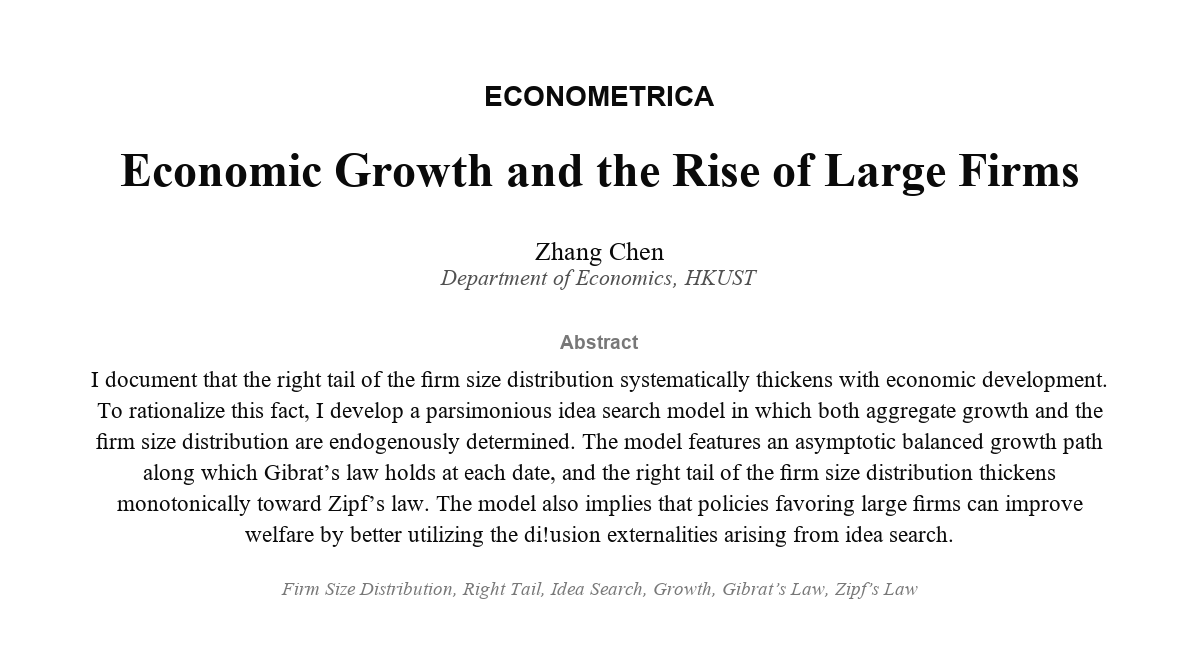
Why do richer economies have more very large firms? This paper shows that the upper tail of the firm size distribution thickens as economies grow. A model of idea search explains why, showing how growth itself can produce rising concentration.
https://t.co/ocOxbeV3Ww
Super interesting!
"A Demand Theory of the Price Level" by Marcus Hagedorn (The paper was submitted to the International Economic Review posthumously. Sadly, Marcus Hagedorn passed away too soon.).
"Heterogeneous agent incomplete markets models offer a new perspective on price and inflation determination. In contrast to complete markets, the price level is determined from the asset-market clearing condition. Fiscal and monetary policy then jointly and uniquely determine the finite steady-state price level and the inflation rate, including in a steady state in which the nominal interest rate is constant. Fiscal policy can determine the long-run inflation rate for a fiscal rule which sets the growth rate of nominal government debt, whereas both fiscal and monetary policy determine the long-run inflation rate under different tax rules."
https://t.co/xQyfA1rJEa
The AI revolution isn't just transforming industries — it's redefining how economics is taught, learned, and researched. @SRMUAP's MSc Economics program equips you with the tools and frameworks to work at that frontier. Generous funding opportunities available. Apply today.
https://t.co/xZQf2JZJ6Z
Highly relevant!
"How should central banks respond to commodity price shocks? Optimal monetary and exchange rate frameworks for commodity-exposed economies" by Thomas Drechsel, Michael McLeay, Silvana Tenreyro, and Enrico D. Turri.
"This paper shows that the optimal monetary policy and exchange rate framework depend critically on the economy’s commodity exposure. We develop a flexible but tractable model economy with commodity exports and imports, in which international financial conditions may vary with the commodity cycle. Stabilizing domestic prices is optimal for commodity exporters, in line with standard open-economy policy prescriptions. But for economies that use commodities as inputs in production, optimal policy largely ‘looks through’ the direct and indirect effects of commodity shocks on domestic prices; this contrasts with some earlier findings and policy practice (which only ‘looks through’ the direct effect). Exchange-rate pegs or strict CPI inflation targeting perform better for commodity importers because they stabilize wages and employment, though neither policy is robustly optimal. In emerging and developing economies, where financial conditions are more tied to the commodity cycle, trade-offs are starker and implementing the optimal policy may be challenging, since it requires enough credibility to keep inflation expectations anchored amidst greater volatility in some nominal variables."
https://t.co/ZrVnmkcGLt
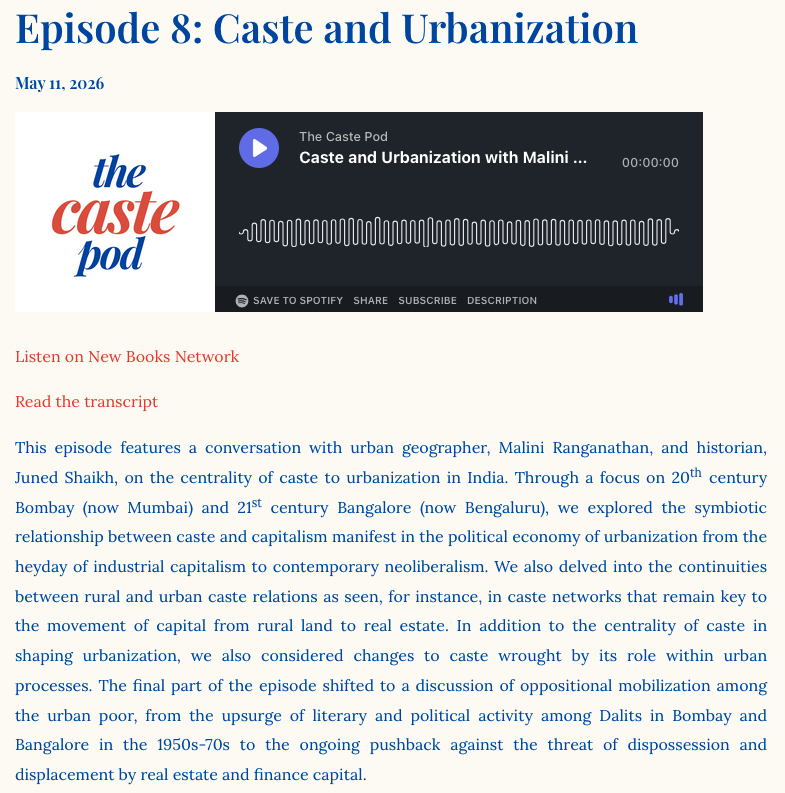
Spoke with Ajantha S. + Juned Shaikh on the relationship between caste and capitalism in Bengaluru and Mumbai. We delved into caste networks that remain key to the movement of capital from rural land to real estate, as well as Dalit, labour + slum politics https://t.co/QEBA8h48bC