We celebrated the groundbreaking of Fairhaven Meadows today in Brevard!
The 42-unit community will include 1–3 BR homes, a clubhouse, fitness room, playground and more.
Thank you to Mayor Maureen Copelof for joining us!
#AffordableHousing#BrevardNC
Last flight of an Harrier! This gorgeous aircraft buno 165357 flew from MCAS Cherry Point on May 13 for her last landing at Fort Worth Meacham Airport were she became part of the collection of the Fort Worth Aviation Museum.
Western NC: sign up for FEMA Individual Assistance now in order to be eligible for both short term and long term housing assistance.
Check out our latest video for a full update: https://t.co/OWtwSst8Mv
I’ll say this: We’re having one of the worst natural disasters ever in North Carolina. It is our Katrina; it is bad folks. I am getting message after message of desperation and asking for help and attention. I am trying to get as many stories as possible for the world to see.
*UPDATED* (and still true)
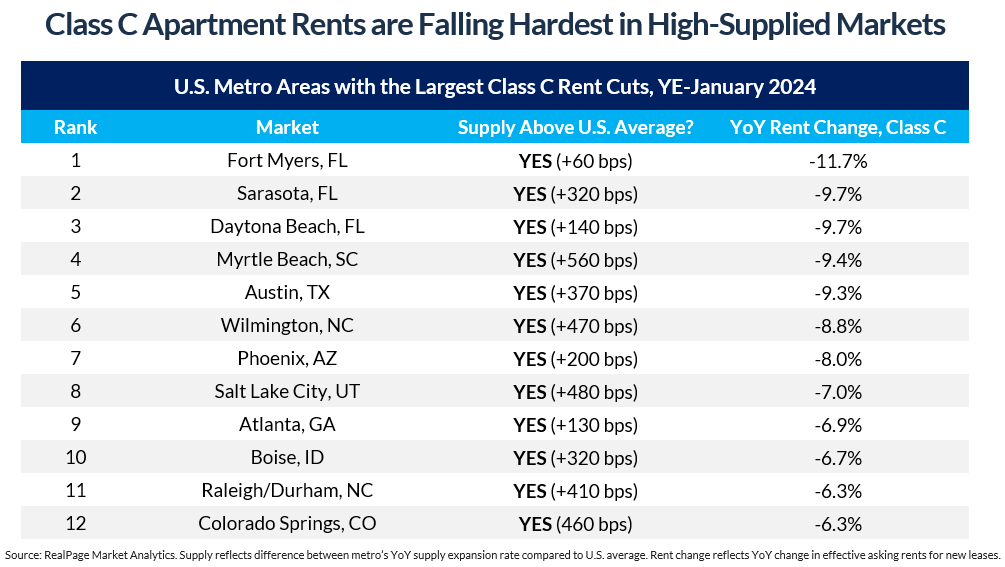
When you build "luxury" new apartments in big numbers, the influx of supply puts downward pressure on rents at all price points -- even in the lowest-priced Class C rentals. Here's evidence of that happening right now:
There are 21 U.S. markets where Class C rents are falling at least 4% YoY. What is the common denominator? You guessed it: Supply. Of those, all but one have supply expansion rates ABOVE the U.S. average.
There's no demand issue in any of these 12 markets. They're all among the absorption leaders nationally -- places like Austin, Phoenix, Salt Lake City, Raleigh/Durham, Atlanta, Tampa, Dallas, Charlotte, Orlando, etc. But they all have a lot of new supply.
Simply put: Supply is doing what it's supposed to do when we build A LOT of apartments. It's a process academics call "filtering." New pricey apartments are pulling up higher-income renters out of moderately priced Class B units, which in turn cut rents to lure Class C renters, and on down the line it goes.
Less anyone still in doubt, here's another factoid: Where are Class C rents growing most? You guessed it (I hope!) -- in markets with little new supply. Class C rent growth topped 4% in 22 of the nation's 150 largest metro areas, and nearly all of them have limited new apartment supply.
Most new construction tends to be Class A "luxury" because that's what pencils out due to high cost of everything from land to labor to materials to impact fees to insurance to taxes, etc.
So critics will say: "We don't need more luxury apartments!"
Yes, you do. Because when you build "luxury" apartments at scale, you will put downward pressure on rents at all price points.
Spread the word.
There’s a text message smishing scam going around about unpaid tolls. I got one from PA last week. My friend got one from NC yesterday. It claims you have an unpaid balance and will be face late fees of $76 or $86.
The Agency issued its first single-family bond on Wall Street in 1976 for $16.16 million!
Since then, we've issued $6 billion in bonds and managed various home buyer programs that have helped more than 139,000 North Carolinians become homeowners. https://t.co/Ay8RmV767B
The Tax Relief for American Families & Workers Act crafted by @WaysandMeansGOP is pro-growth, pro-family & cleared the House overwhelmingly. It’s time for the Senate to pass this bill to provide relief to workers & small biz. Read my op-ed in the @Suntimes:https://t.co/tpNzcKu9nP
@brianonorio This is an interesting regional thing- my grandmother (from Raleigh) considered them 2 dishes. Chicken and pastry was with flat, dense dumplings. Chicken and dumplings were had round, light dumplings, usually made from biscuit dough. Down East these were called dodgers?
When you build "luxury" new apartments in big numbers, the influx of supply puts downward pressure on rents at all price points -- even in the lowest-priced Class C rentals. Here's evidence of that happening right now:
There are 12 U.S. markets where Class C rents are falling at least 6% YoY. What is the common denominator? You guessed it: Supply. All 12 have supply expansion rates ABOVE the U.S. average.
There's no demand issue in any of these 12 markets. They're all among the absorption leaders nationally -- places like Austin, Phoenix, Salt Lake City, Atlanta and Raleigh/Durham, Boise, etc. But they all have a lot of new supply.
Simply put: Supply is doing what it's supposed to do when we build A LOT of apartments. It's a process academics call "filtering." New pricey apartments are pulling up higher-income renters out of moderately priced Class B units, which in turn cut rents to lure Class C renters, and on down the line it goes.
Less anyone still in doubt, here's another factoid: Where are Class C rents growing most? You guessed it (I hope!) -- in markets with little new supply. Class C rent growth topped 5% in 18 of the nation's 150 largest metro areas, and nearly all of them have limited new apartment supply.
Most new construction tends to be Class A "luxury" because that's what pencils out due to high cost of everything from land to labor to materials to impact fees to insurance to taxes, etc.
So critics will say: "We don't need more luxury apartments!"
Yes, you do. Because when you build "luxury" apartments at scale, you will put downward pressure on rents at all price points.
Spread the word.
@khzny There’s not. Every federal, state, and local study I’ve seen shows there’s a neutral impact on values. Greater market forces are the drivers of value change. Also, there’s no 550 unit affordable development being built anywhere in NC.
The House just voted 357-70 in support of the tax bill that would make the biggest investment in affordable housing in over two decades.
We still have to wait and see how/when the Senate will take it up. But a huge step forward today.
My bipartisan Affordable Housing Credit Improvement Act with @RepDelBene will help build nearly 2 million affordable homes. With over 200 cosponsors, Congress should pass our bill to address the growing housing crisis.
Read our op-ed in @thehill:https://t.co/FtKUtzOf9M
Good, timely piece by Reps. Darin LaHood (R-IL) and Suzan DelBene (D-WA) calling for Congress to expand and strengthen the Housing Credit:
It’s time for Congress to address the affordable housing crisis
https://t.co/upLyaZtzKB