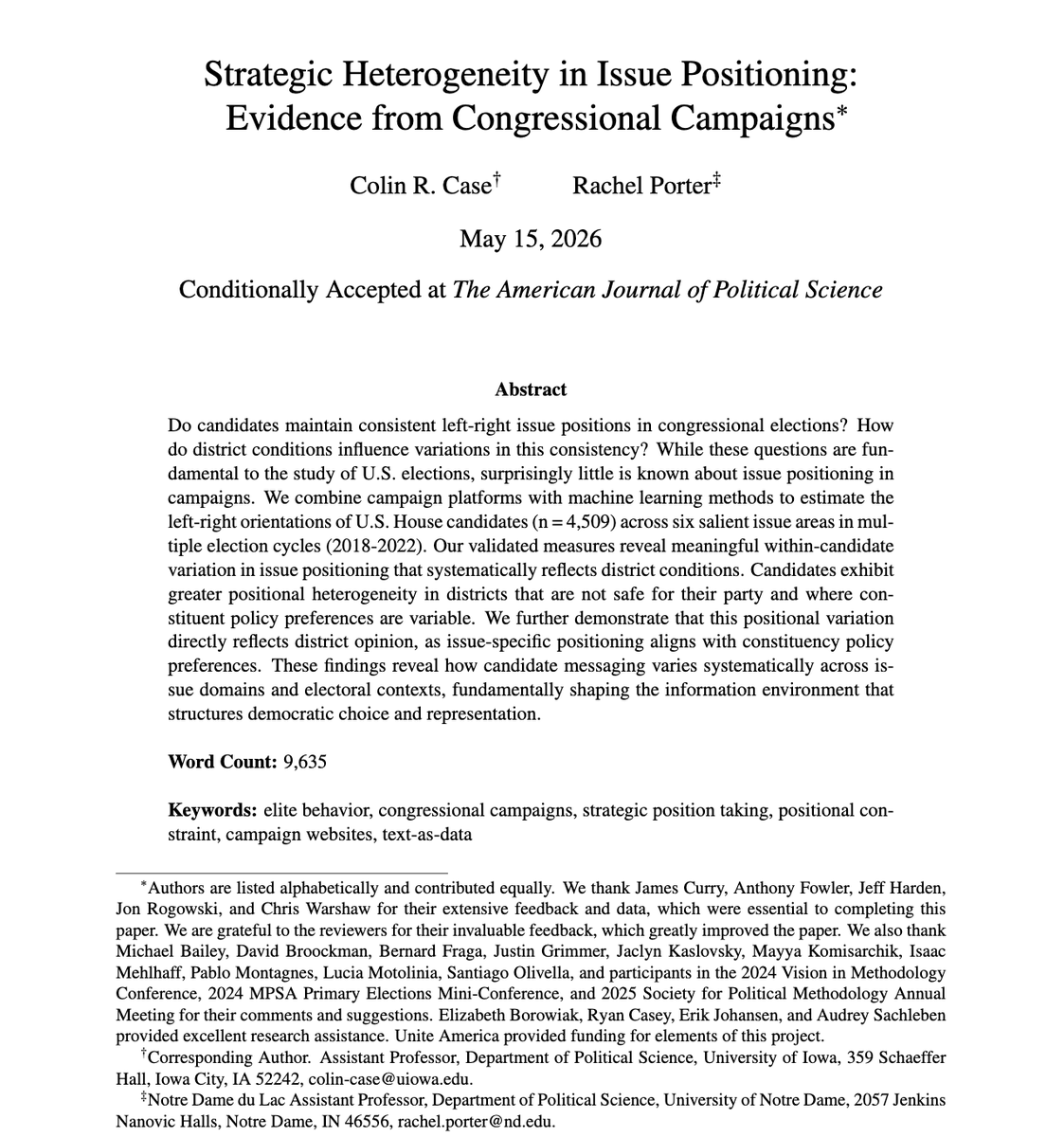
Very excited that my paper with @colinrcase has been conditionally accepted for publication at @AJPS_Editor!
Using our CampaignView data, we produce measures for candidates' left-right positioning across six salient issue areas
Big takeaways below ⬇️⬇️
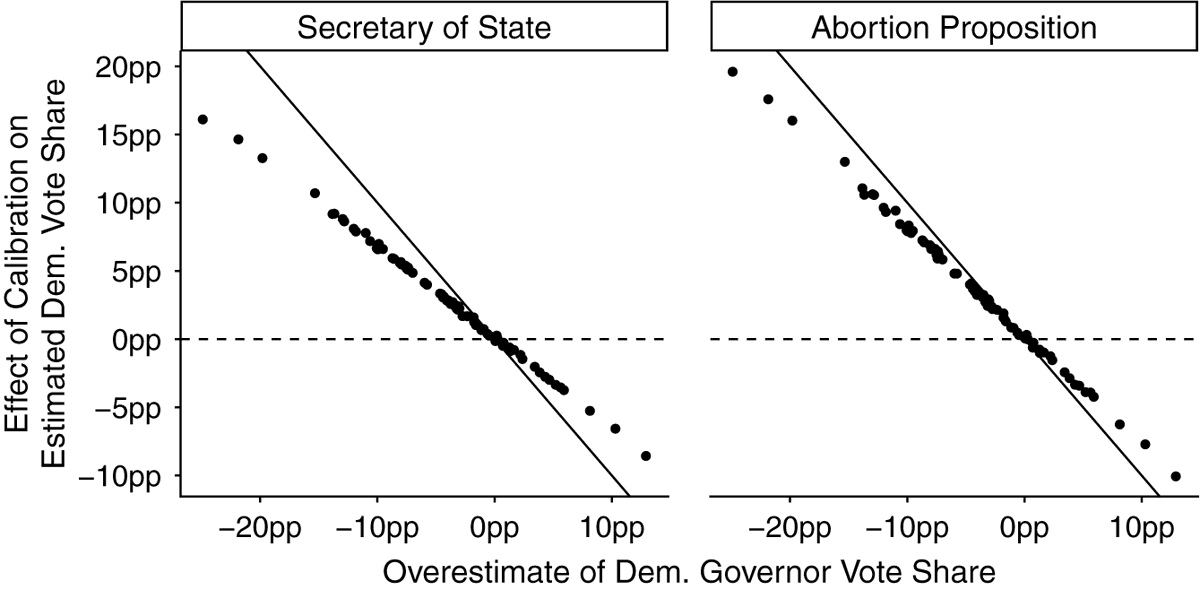
They validate this method using pre-election polling from the 2022 Michigan midterm and find that their calibrated MRP estimates reduce error by as much as two thirds. You can read the full paper here: https://t.co/afAok9jsoX
Currently in FirstView: In “Improving Small-Area Estimates of Public Opinion by Calibrating to Known Population Quantities,” @wpmarble and @joshclinton provide a framework for incorporating known population data to improve estimates of small subgroups in MRP models.
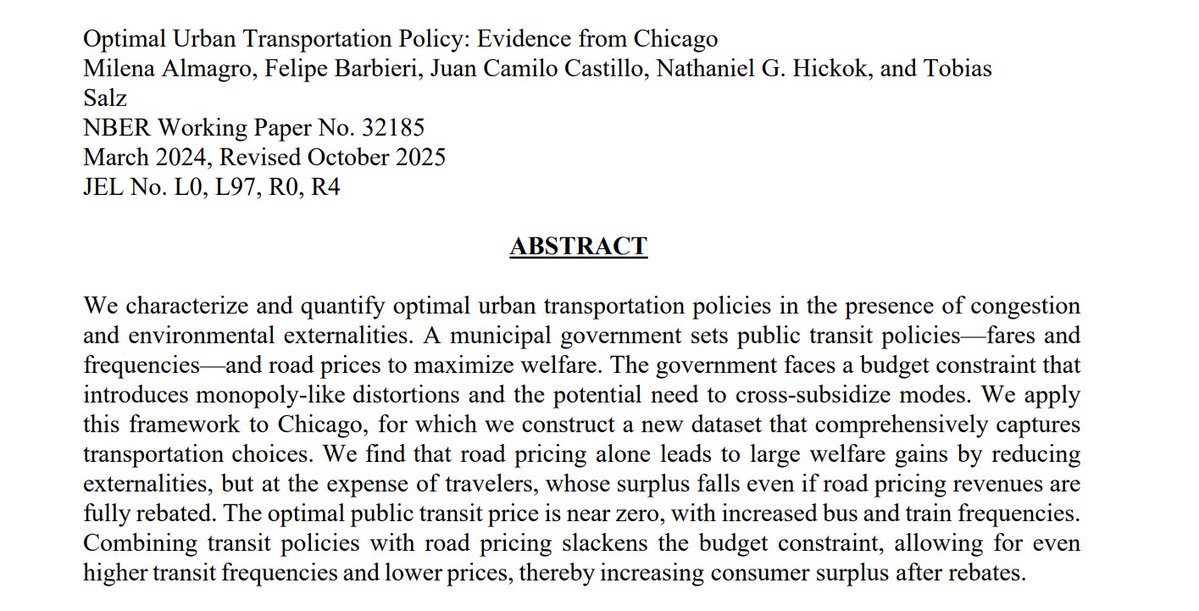
This paper is an absolutely monumental piece of work. Given incredibly detailed data on how people travel in Chicago, can one calculate the optimal prices of vehicles, roads, and public transport? It turns out -- free buses are correct! And we need massive taxes on vehicles. 1/
Wait...
Speed cameras work?
"Cumulatively, over the seven months following [speed camera's] introduction, collisions declined by 30% and injuries by 16%."
In many California cities, condominiums automatically pay much higher "impact" fees. In Palo Alto, a 1,200 square foot will pay $79,656 for affordable housing (this is not a joke) while a rental will pay $31,860 per unit.
Today was my last day working at Penn. I've been lucky to teach amazing students and work with great colleagues at @PennPORES and the polisci dept. This fall, I'll join @HooverInst as a Hoover Fellow—I'm excited to join a vibrant, interdisciplinary community of scholars there!
🚨NEW PAPER: Why are Members of Congress so extreme?
We conducted a 4-wave panel of thousands of voters in 27 districts during last year’s primary AND general elections to trace polarization’s roots
The results challenge conventional wisdom… and suggest lessons for parties🧵👇
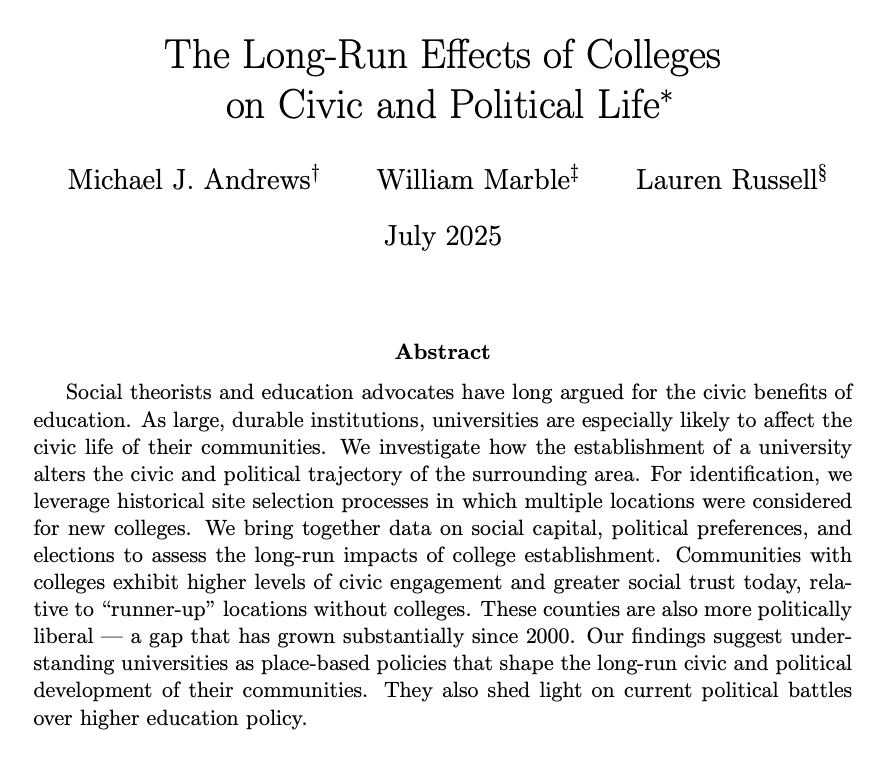
The current administration's attacks on universities risk undermining engines of civic life, just as they harm innovation and prosperity. Places with colleges are more liberal, yes, but colleges also promote the types of social capital that we need more of.
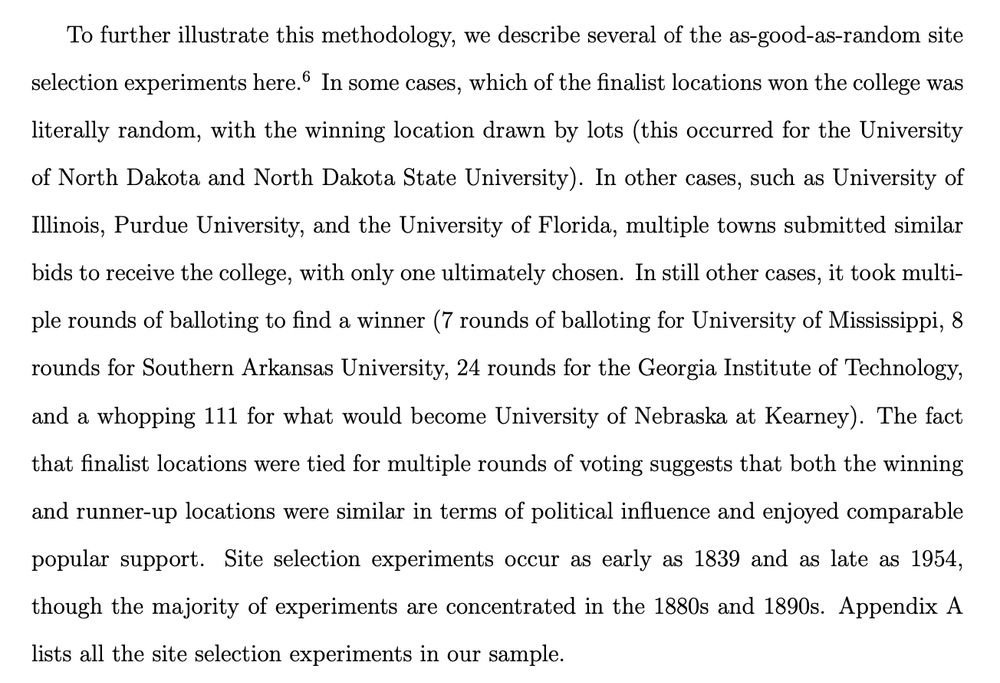
How do universities shape the surrounding community? Building on meticulous archival work by @MikeJAndrews44, we answer this question by focusing on cases where multiple locations were considered for a major university and the winning location was chosen for idiosyncratic reasons
These results contribute to a literature that understands universities as place-based institutions. We know that they profoundly affect the local economy, as economists (incl. my co-authors) have shown. We show how universities also contribute to the civic life of communities.
Decades of research documents differences in turnout, volunteering rates, office-seeking, political preferences, etc., between those with and without college degrees. But universities are place-based institutions, the effects of which may extend beyond students.
Universities often serve as "anchor institutions" that deeply affect the character of their communities. In a new paper, we (@MikeJAndrews44 / Lauren Russell) ask how (and when) the establishment of a college influences local political and civic life. 🧵
https://t.co/Vt3sxlyQCM
We (@PriyankaSethy_, @MalikMashail and I) have a related finding based on CES data: starting in around 2016, immigration support among immigrants plummeted more than among any other citizenship group. Here, we plot shifts relative to people with no immigration background.
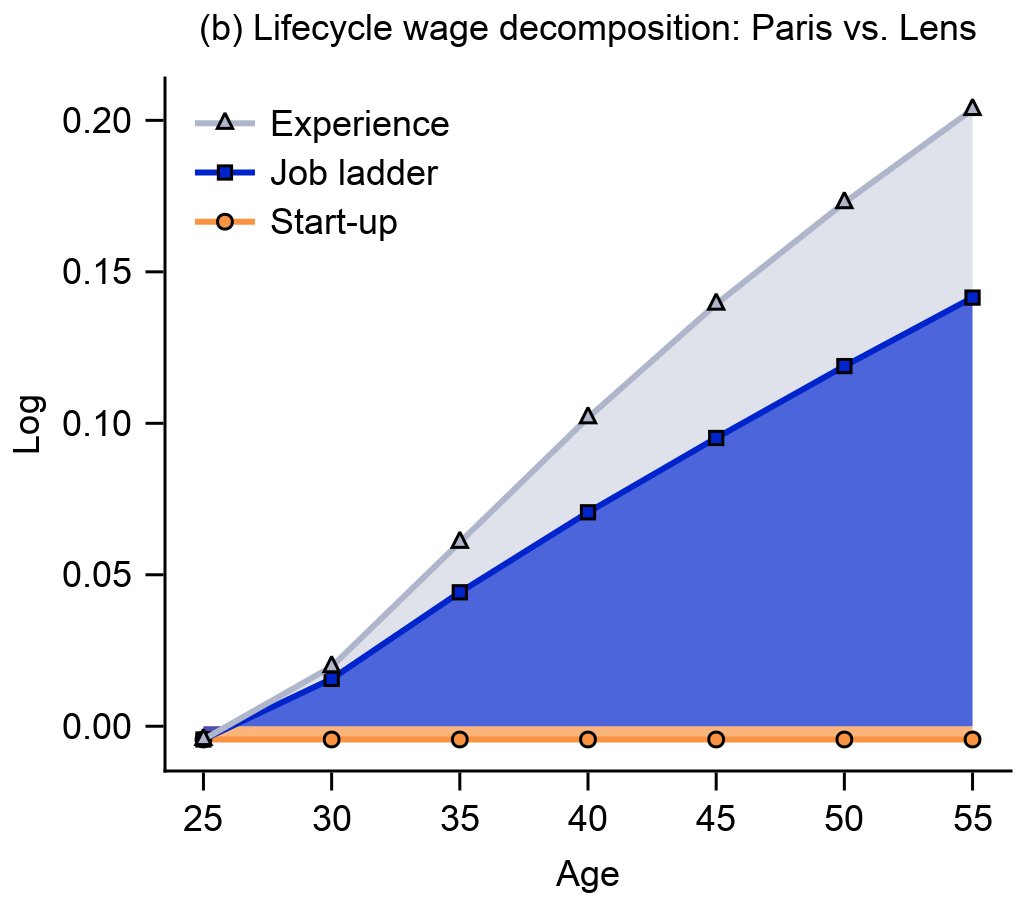
Using French matched employer-employee data, I find:
📌 High-paying jobs are concentrated in big cities
📌 Low-paying jobs are everywhere
📌 Workers access high wages in large cities as they switch from low- to high-paying jobs over time


![JohnHolbein1's tweet photo. Wait...
Speed cameras work?
"Cumulatively, over the seven months following [speed camera's] introduction, collisions declined by 30% and injuries by 16%." https://t.co/bVbwoxPCjV](https://pbs.twimg.com/media/G7rZOSMXcAAYpgh.jpg)
![JohnHolbein1's tweet photo. Wait...
Speed cameras work?
"Cumulatively, over the seven months following [speed camera's] introduction, collisions declined by 30% and injuries by 16%." https://t.co/bVbwoxPCjV](https://pbs.twimg.com/media/G7rZM6CXQAA35dS.jpg)





![JohnHolbein1's tweet photo. Wait...
Speed cameras work?
"Cumulatively, over the seven months following [speed camera's] introduction, collisions declined by 30% and injuries by 16%." https://t.co/bVbwoxPCjV](https://pbs.twimg.com/media/G7rZO64WkAABcuf.jpg)