The Journal of Writing Assessment provides a peer-reviewed forum for the publication of manuscripts that address a variety of topics in writing assessment.
We're excited to announce that JWA issue 19.1 was published today! This special issue on Neurodivergence & Disability in Writing Assessment includes 10 manuscripts. Read more at: https://t.co/R398cOW9sP
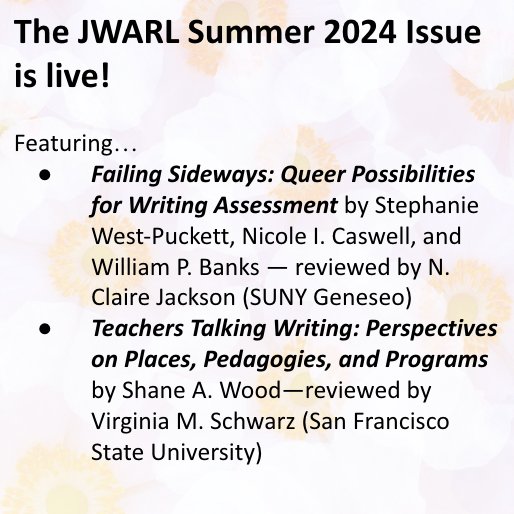
We are excited to announce the publication of the fall issue of the JWA Reading List (JWARL). This issue of JWARL presents three reviews. We hope you enjoy the new issue!
https://t.co/GErCBargbN
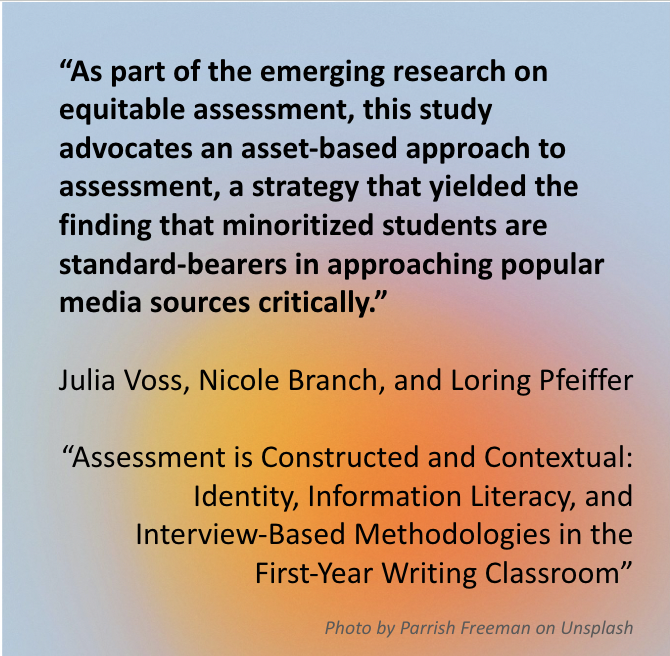
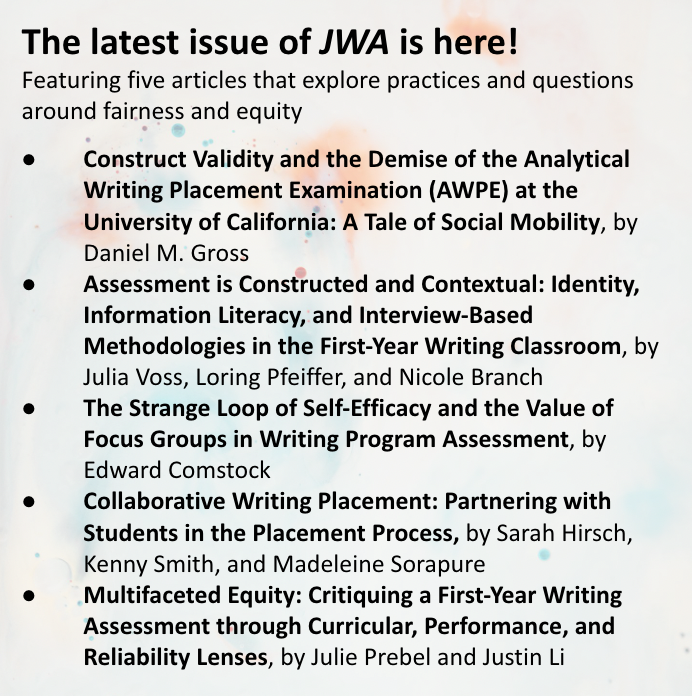
In “Assessment is Constructed and Contextual” Voss, Branch, and Pfeiffer share how interviews helped them understand student learning outcomes in ways that value minoritized students’ experiential knowledge. Read more: https://t.co/KVwuydhHbS
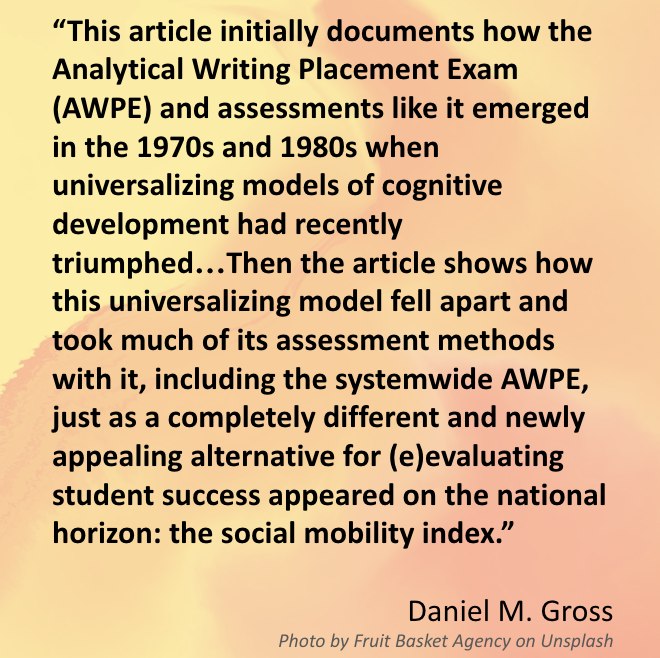
In “Construct Validity and the Demise of the Analytical Writing Placement Examination (AWPE) at the University of California,” Daniel Gross examines the shifts that culminated in the UC Academic Senate’s decision to end its longstanding AWPE. Read more: https://t.co/wUQ1BcKIYE
We are excited to announce the publication of issue 17.2 of JWA! Articles in the issue focus on issues of fairness and equity, especially in writing program assessment and in placement. Read more at: https://t.co/6DF0bTG9KF
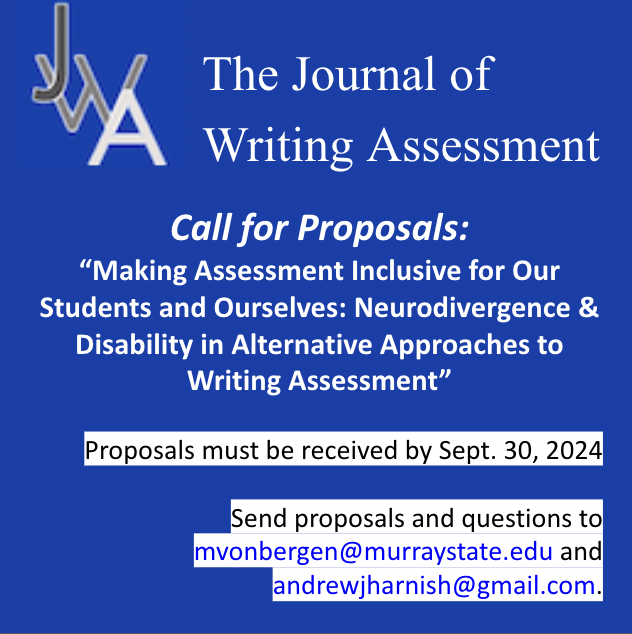
JWA is excited to announce a forthcoming Special Issue about neurodivergence and disability in alternative approaches to writing assessment. Special Issue editors Megan Von Bergen and Andrew Harnish invite your proposals. Read more: https://t.co/NFzc8cAo1e
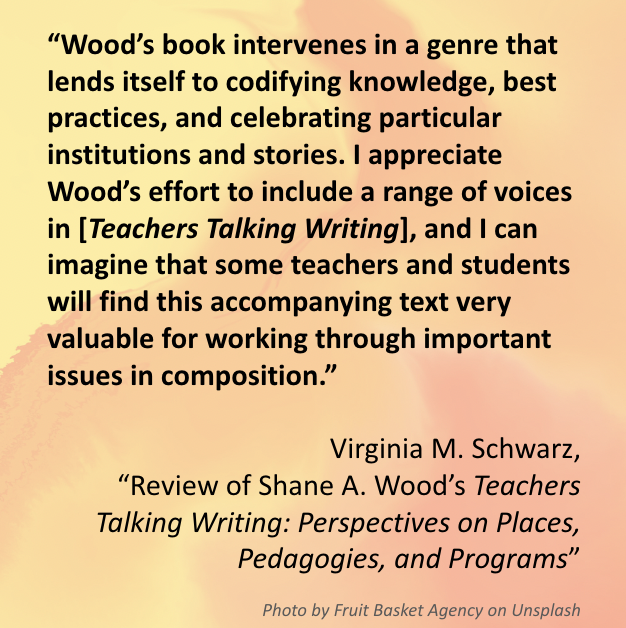
In the latest issue of the JWA Reading List, Virginia Schwarz reviews Shane A. Wood’s Teachers Talking Writing: Perspectives on Places, Pedagogies, and Programs. Read more: https://t.co/mAxIfY7fQ3
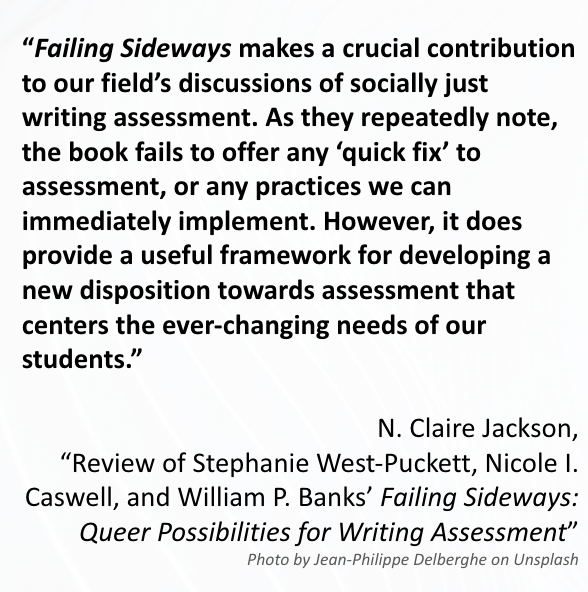
In the latest issue of the JWA Reading List, N. Claire Jackson reviews West-Puckett, Caswell, and Banks’ Failing Sideways. Read more: https://t.co/I4FQExlpfx
In “(Re)Placing Personalis: A Study of Placement Reform and Self-Construction in Mission-Driven Contexts” Sweeney and Colombini trace and compare efforts to reform placement processes at mission-driven liberal arts institutions. Read more: https://t.co/aY4QvYyhnp #4C24
In “It Takes a Campus,” Kelly A. Whitney and Carolyn
Skinner document the communicative and administrative agility required when adopting a DSP model for FYW and critique “academic paternalism.” Read more: https://t.co/mr2lUKPdkh #4C24
Check out Kristine Johnson and Sara Vander Bie’s piece, which includes guidance about DSP for multilingual & multicultural populations of international students. https://t.co/0XRgsAV90n
In “Directed Self-Placement for Multilingual, Multicultural International Students,” Johnson and Vander Bie argue DSP can contribute to equitable, socially just writing placements for them. Read more: https://t.co/0XRgsAV90n #4C24
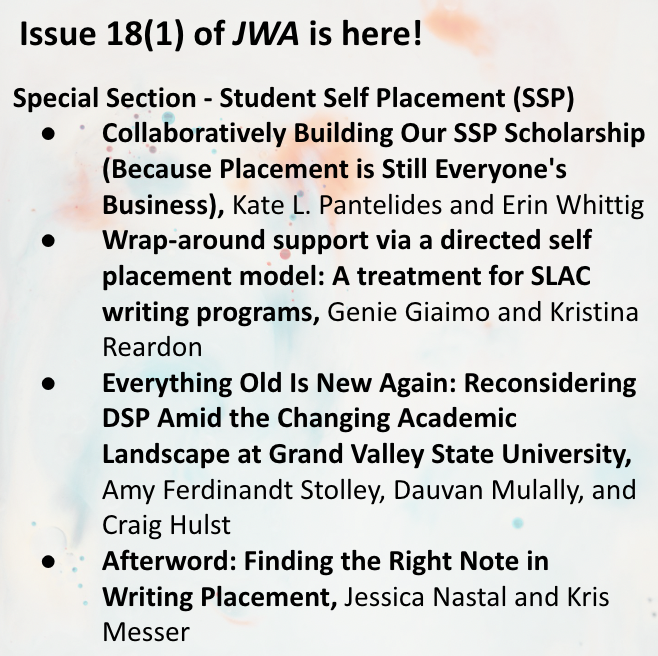
Have you seen JWA’s special issue on methods of student self-placement? Check out the introduction from issue co-editors Kate Pantelides and Erin Whittig!
In "Placement is for Everyone: A Love Letter to Our SSP Coalition," the co-editors define "methods of student self-placement" (SSP) and argue SSP asks us to rethink first-year writing and divisions in Writing Studies. Read more: https://t.co/x0Dkt72Juw #4C24
In “Informing Self-Placement,” Toth, Andrus, Onwuzuroha, Clawson, Frasier, Fochs, and Rivera provide a polyvocal narrative of the development, initial assessment, and ongoing revision of an Informed Self-Placement (ISP) process. Read more: https://t.co/q3yA74fqli #4C24
In “After Implementation,” Arnold, Jiang, and Hassel offer a heuristic others can use to evaluate the effectiveness of their own SSP after implementation and demonstrates the value of evaluating SSP processes. Read more: https://t.co/NhDOobI1H6 #4C24
In "Self-Characterization and the Self-Placement Assessment Ecology," Tinkle, Godfrey, Hammond and Moos ask: What can be learned about SSP’s impacts from the qualitative content of student (self-)reflections and (self-)characterizations? Read more: https://t.co/tyrQx4mz1k #4C24
Decker and Taormina-Barrientos describe how they revised a Directed Self-Placement survey based on Cavazos and Karaman’s (2021) Translingual Disposition Questionnaire and used Qualtrics to give students feedback on a novel language domain. Read more:
https://t.co/8BZWoAFtCx #4C24