Creator of Emerald-Man + Blue Moon comics.
Baptist. Amateur Writer and Cartoonist. Historian. Medievalist. Enemy of the Devil. Purveyor of bad opinions.
If you wanna support me this month, the Emerald-Man graphic novel is currently on sale on Amazon, and I am doing a summer commissions sale!
https://t.co/VTpfoxEOAS
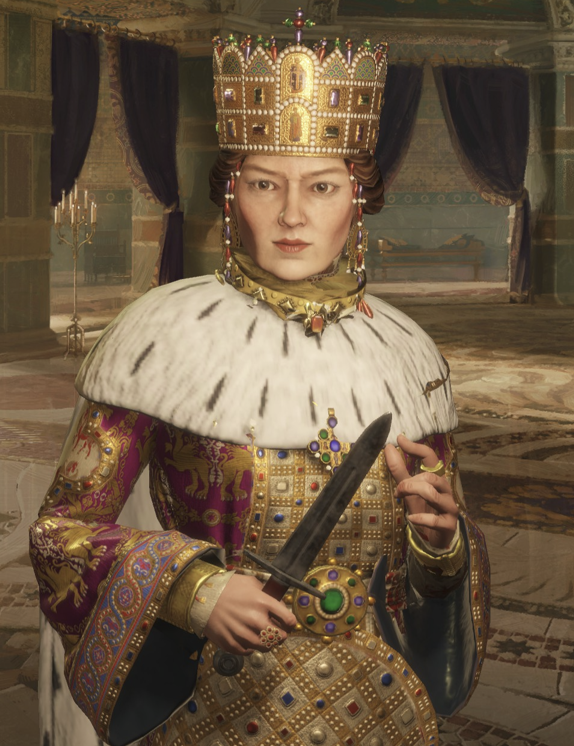
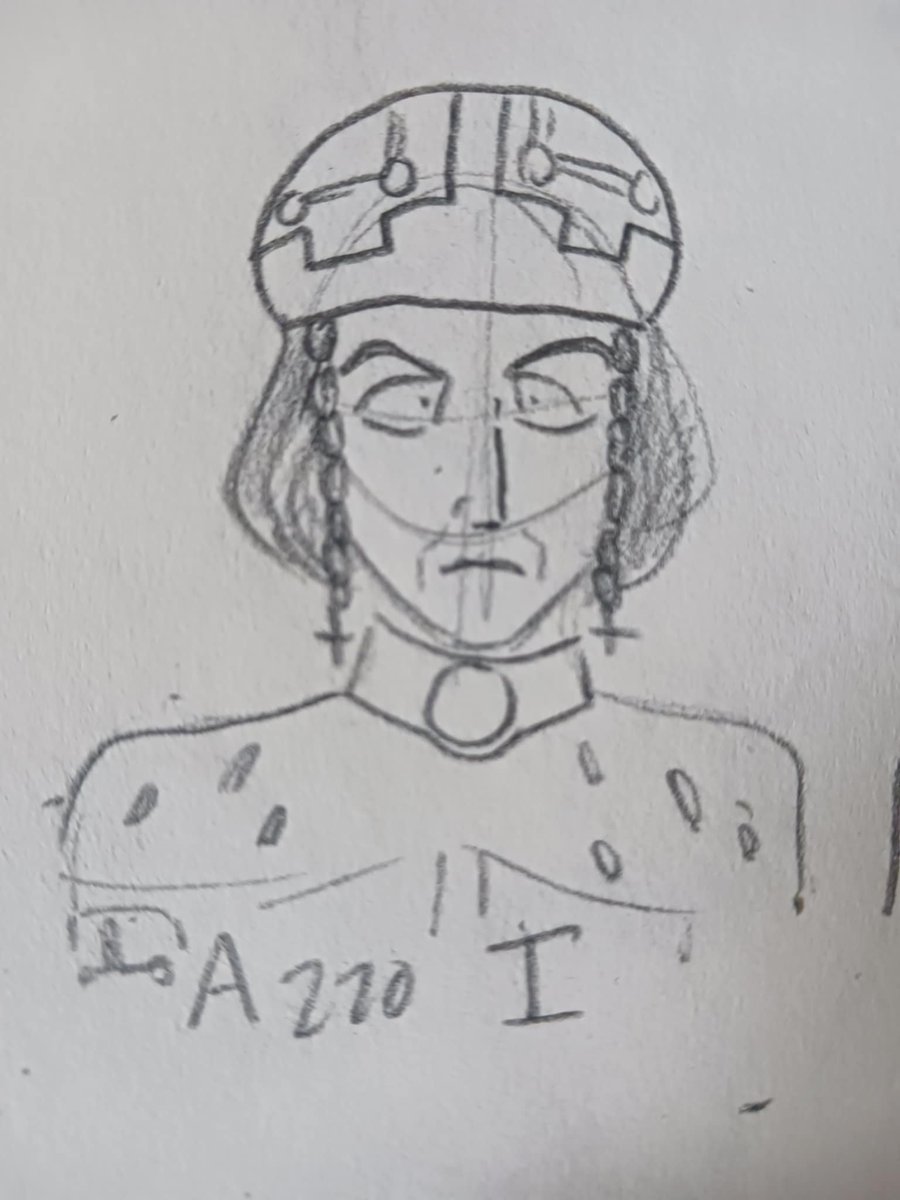
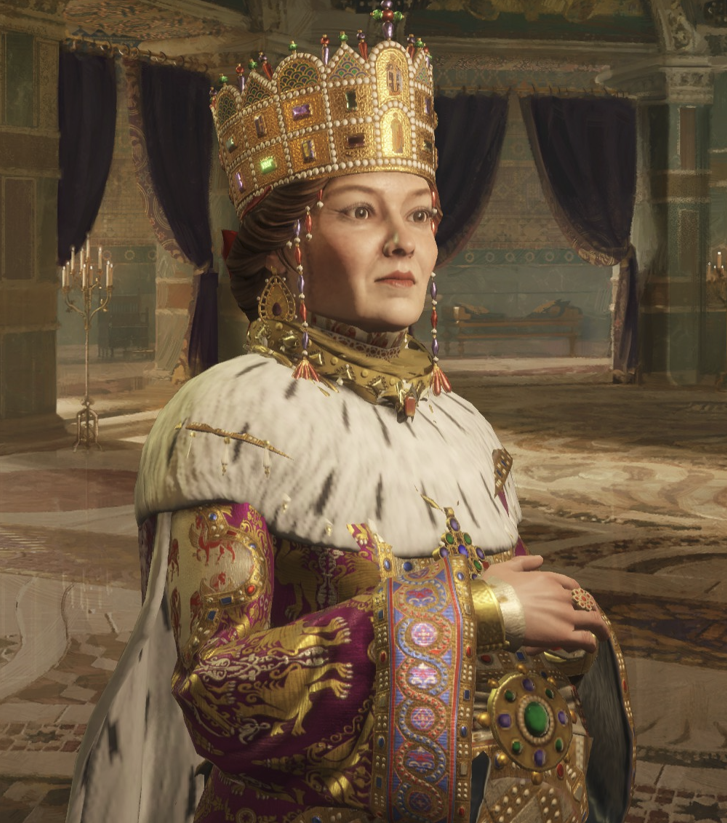
This part of the story ends, for now, under the rule of Anastasia V, who saw supreme absolute power under her rule. Unlike her mother who was a competent and fine ruler, Anastasia V enjoyed the splendor of royal life, dressing up in fine clothes and wigs while relishing the riches of the state.
Her tendency to gossip led her to being disliked across Europe at parties, considering she'd let alliance secrets out. She was not a particularly cunning woman either, so when ruling as absolute monarch she often did what she felt was alright. Her worst offense was losing the long standing alliance with England/Great Britain due to insinuating they were inferior to the French. (Her father was the French prince Sergi Habsburg.)
Yet despite her foolish faults, she was a powerful woman. One hopes, however, she was not the weak link in the dynastic chain...
Ck3 -> Vic 3 Latin Empire campaign, Part 5: War of the Protestant League and Absolutism
Inheriting the Latin Empire, Anastasia III (ruled 1570-1599) was largely remembered for her finishing her father's campaign into Crusader Africa and taking their coastal cities. She presented herself as a warrior empress in many of her portraits.
During her reign, the Protestants formed an official league against the Catholic Holy Roman Emperor, Garibald III of Bavaria. Sides were taken, with Hungary and Aragon backing the Catholic Emperor. Empress Anastasia III backed the German protestants (though she was no friend of Bohemia, the majority of them), along with the Netherlands and West Slavia.
Emperor Abolhassan de Hainaut would take his mother's place on the throne, the first Latin Emperor not to be crowned by the Pope in Rome. He ruled from 1553-1570. He put down the Italian civil war revolts and cemented his power as an openly Protestant emperor over the Latin empire.
He strongly reformed the church, listening to Dutch anabaptist teaching and listening to reformed teaching though sticking with a Presbyterian ideology and priesthood of the Lutherans, as to not alienate much of the old clergy. Though he was excommunicated by the Pope, it no longer mattered: as far as Emperor Abolhassan was concerned, he was loyal to God alone, not the wills of the Papacy!
Abolhassan saw the end of the old French regime in Burgundy as the French protestant wars broke out and disposed of the old Catholic emperor. Abolhassan invaded Crusader Africa and took much of it's Northern lands. However, the King of France, Henry Poitiers, rescinded his word to become Protestant when the war was over.
With Emperor Abolhassan's display of power, the Holy Roman Emperor saw a wave of Protestant sentiment grow larger in the Empire, Sweden and Norway turned into Protestant kingdoms, and Queen Elizabeth of England declared the new Anglican church. Besides Bavaria, Germany had largely become Protestant.
Emperor Abolhassan would die in 1570, once again without a male heir. His daughter, Anastasia III, would become Empress to inherit the brewing troubles.
Protestantism was now entrenched, the efforts of the Catholics had failed. Now, a terrible conflict would brew as Germany would become the hotbed of Protestant and Catholic leagues forming...!
Empress Anastasia IV (ruled 1667-1696) continued in the policies of her father. She invaded the remaining stronghold of Crusader Africa on a lone island in the Mediterranean, securing complete power over the sea. She expanded the military and reformed enlistment.
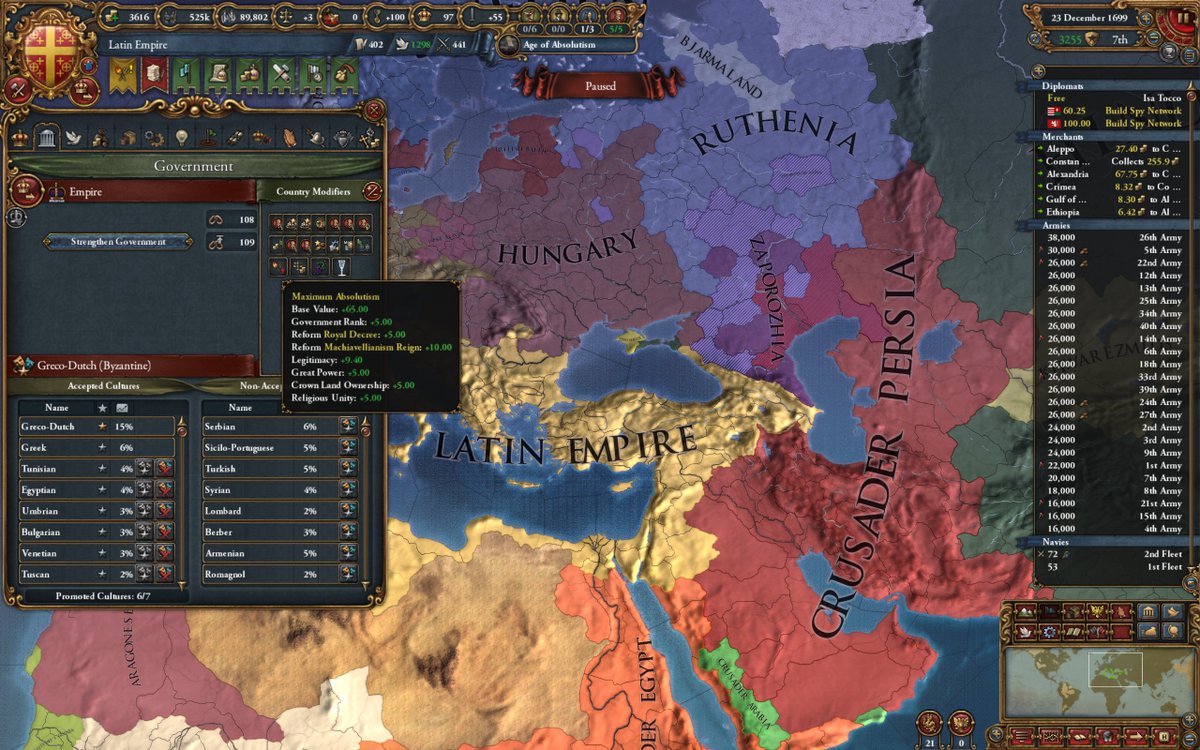
Absolute power continued to grow during her reign, in which she dismissed the general estates that had say over the empire since the first days of the Latin Empire. Now, all of the empire was under her control. She would die in 1696, once again passing to another daughter named Anastasia (lots of weird RNG with the daughters).
Emperor Abolhassan de Hainaut would take his mother's place on the throne, the first Latin Emperor not to be crowned by the Pope in Rome. He ruled from 1553-1570. He put down the Italian civil war revolts and cemented his power as an openly Protestant emperor over the Latin empire.
He strongly reformed the church, listening to Dutch anabaptist teaching and listening to reformed teaching though sticking with a Presbyterian ideology and priesthood of the Lutherans, as to not alienate much of the old clergy. Though he was excommunicated by the Pope, it no longer mattered: as far as Emperor Abolhassan was concerned, he was loyal to God alone, not the wills of the Papacy!
Abolhassan saw the end of the old French regime in Burgundy as the French protestant wars broke out and disposed of the old Catholic emperor. Abolhassan invaded Crusader Africa and took much of it's Northern lands. However, the King of France, Henry Poitiers, rescinded his word to become Protestant when the war was over.
With Emperor Abolhassan's display of power, the Holy Roman Emperor saw a wave of Protestant sentiment grow larger in the Empire, Sweden and Norway turned into Protestant kingdoms, and Queen Elizabeth of England declared the new Anglican church. Besides Bavaria, Germany had largely become Protestant.
Emperor Abolhassan would die in 1570, once again without a male heir. His daughter, Anastasia III, would become Empress to inherit the brewing troubles.
Protestantism was now entrenched, the efforts of the Catholics had failed. Now, a terrible conflict would brew as Germany would become the hotbed of Protestant and Catholic leagues forming...!
Ck3 -> Vic 3 Latin Empire campaign, Part 4: The Second Great Schism. (IT'S EU4 TIME)
Basileus Theodoulus III ruled the Empire of the Latins until 1457 AD. His 26 year rule saw a downsizing of the power of the Latin Empire, as he found it too unruly to keep under his control. He created four neighbor states loyal to Christendom, that being Crusader Africa, Egypt, Arabia, and Persia, while consolidating his rule in Italy and the Levant.
The Basileus died in 1457 AD, as his son, Azzo of Hainaut, ascended the throne at the age of 47. Azzo only ruled 70 years as he oversaw the managing of estates and the growing power of the Catholic Church. The crisis of Investiture hit him once again, as the Emperor of the Romans, Heinrich of Bavaria, accused Azzo of being a pretender to the Roman Throne. The Pope, seeing the siding of the Hungarians and Germans at his end, joined in and revolted against Emperor Azzo, to regain his power over Investiture.
Riots overtook the empire as those loyal to the Pope's primacy fought against the forces of Emperor Azzo. To placate them, Azzo gave further control to the church. However, the reputation of the Latin Empire would be in turmoil for decades.
Despite this diplomatic disaster, Azzo was a competent statesman that hired the artisan Leonardo da Vinci from Florence into his court, where he commissioned many art pieces and used his expertise in the sciences to develop the Latin Empire further into prosperity and riches. He also made a policy of reforming the army and jumpstarting the nation in further innovations.
Azzo failed to sire a male heir, so his daughter, Anastasia I, would become Empress after him when he died in 1477.
Taking the throne as she was in a coma was her eldest son, Theodoulus III (who ruled from 1431-1457). It was thanks to him that the Empire did not collapse, for with Basilissa Philomina's absolute monarchy thrown out of question, revolts had begun against the Latin Empire rule. Theodoulus III thus decided to make smaller crusader states loyal to him in Africa, Arabia, and in Ethiopia. He consolidated power in Italy and northern Egypt to offset the rebellions and decentralized.
It was thanks to his competent rule that the Latin Empire continued to live. Though, not as glorious as it once was. Though Theodoulus III was a good ruler, never again would it reach the glory and might of his grandfather.
When he had his mother's funeral, the empress was posthumously declared a saint by the Pope for her piety. It would be forever remembered, the House of Hainaut had reunified Christendom and brough the holy gospel to the lands of North Africa... For now.
TO BE CONTINUED IN EUROPA UNIVERSALIS 4
In open protest, the Dutch bibles spread across the empire. Pope Julius III openly opposed the Empress' rule for the unsanctioned translations she was now openly allowing. Julius declared Empress Anastasia II a heretic and that she was a pretender to the Latin throne.
In response, the Empress declared she would no longer listen to the words of Pope Julius and that the Latin Church would not be under his power. The Latin Empire would stand in protest of the Catholic Church!
Riots overtook the empire as civil war was declared against the empress in Italy in 1553 by Catholic-sympathetic Italian dukes, starting the Latin Religious War. For a year the Italian Peninsula was overtaken by rebellious counts demanding independence. The Empress died the same year, seeing the rule of her son, Emperor Abolhassan, take over.
Taking the throne as she was in a coma was her eldest son, Theodoulus III (who ruled from 1431-1457). It was thanks to him that the Empire did not collapse, for with Basilissa Philomina's absolute monarchy thrown out of question, revolts had begun against the Latin Empire rule. Theodoulus III thus decided to make smaller crusader states loyal to him in Africa, Arabia, and in Ethiopia. He consolidated power in Italy and northern Egypt to offset the rebellions and decentralized.
It was thanks to his competent rule that the Latin Empire continued to live. Though, not as glorious as it once was. Though Theodoulus III was a good ruler, never again would it reach the glory and might of his grandfather.
When he had his mother's funeral, the empress was posthumously declared a saint by the Pope for her piety. It would be forever remembered, the House of Hainaut had reunified Christendom and brough the holy gospel to the lands of North Africa... For now.
TO BE CONTINUED IN EUROPA UNIVERSALIS 4
Ck3 -> Vic 3 megacampaign Part 3: The Decline of Empire
Emperor Theodoulus II was in rather good health for his age when he suddenly died. Many had considered God had smitten him for "betraying" his people with such a curse after unifying the churches. Yet, the law was now law. St. Philomina of Hainaut was crowned the new Basilissa of the Latins, though the nobility had plotted to overthrow her quickly. But she was an intelligent woman and quickly imprisoned and exiled the dukes who threatened her rule.
She would be uneasily crowned by the Pope in 1406. Comparisons were made of Irene of Athens. To satisfy the fears of the people, she submitted to the Pope's authority. It was shortly after her crowning, though she was believed to be unable to have more children after a decade of infertility, she became miraculously pregnant once more, and gave birth to a daughter, whom she named Maria. Many believed this was a blessing from God.
As Emperor Theodoulus II grew older, it was believed his eldest son Eustratios would become emperor. But Eustratios would die of Consumption, and his second eldest son Theodoulus would become a leper, unable to become the emperor. His other sons had become deviants, none of them worthy of the glory their father had brought.
For years, Theodoulus had loved his eldest daughter, Philomina, the most. She had served him faithfully as a regent in much of his years of conquest as her brothers joined their father in war. She had served as a seneschal and spymaster for her father, being a very competent ruler, and someone who kept stability in the empire against those who sought to bring ruin to his rule.
In a controversial move, as the Emperor had a feast in Constantinople, he proclaimed to the nobility his eldest daughter would be his successor. The nobility was disgruntled at this news. They proclaimed they would not elect a woman to the throne. Thus, in royal decree, Theodoulus rewrote the law of succession, that it would be by blood the throne of the Latins was passed down, not the election of the governors.
Before the Emperor could appease his vassals in this controversial law, he died of a sudden heart attack in 1406. Thus was the end of his rule of 44 years. Now, a empress would take the throne...
Empress St. Philomena promised to bring peace during her reign, and she did. She also made major reforms. She prosecuted the Persian nobles who plotted against her and her father during his many conquests. Many of them were sympathetic to the Arabs and Moors and had sought independence. She swiftly put down the plot.
She also built more of Constantinople and the surrounding regions, making it the richest city in the world. She used her power as empress to become an absolute monarch, using blackmail of the impious to control them. Despite what some believed were underhanded tactics, she went on more pilgrimages than her predecessors, was charitable (to a fault), and ruled justly from her throne.
Alas, St. Philomina would see her end when the Persian Crusade was declared in 1495. This six year war had her leading the Latins against the remnants of the old Persian empire. As she battled the Persians, she was critically wounded as a bolt struck her helmet. When she was found, she was still alive, but had become incapable.
As she was in a coma, her son Theodoulus was given control of the empire. She would then die in the coma, a blade being driven into her by a mysterious force. In the future it would be revealed one of the servants had killed her, to "put her out of her misery." Theodoulus imprisoned the servant, but did not kill her. She had ruled 25 years.
As Emperor Theodoulus II grew older, it was believed his eldest son Eustratios would become emperor. But Eustratios would die of Consumption, and his second eldest son Theodoulus would become a leper, unable to become the emperor. His other sons had become deviants, none of them worthy of the glory their father had brought.
For years, Theodoulus had loved his eldest daughter, Philomina, the most. She had served him faithfully as a regent in much of his years of conquest as her brothers joined their father in war. She had served as a seneschal and spymaster for her father, being a very competent ruler, and someone who kept stability in the empire against those who sought to bring ruin to his rule.
In a controversial move, as the Emperor had a feast in Constantinople, he proclaimed to the nobility his eldest daughter would be his successor. The nobility was disgruntled at this news. They proclaimed they would not elect a woman to the throne. Thus, in royal decree, Theodoulus rewrote the law of succession, that it would be by blood the throne of the Latins was passed down, not the election of the governors.
Before the Emperor could appease his vassals in this controversial law, he died of a sudden heart attack in 1406. Thus was the end of his rule of 44 years. Now, a empress would take the throne...
Ck3 -> Vic 3 megacampaign Part 2: The Crusader Empire and the Church Unified
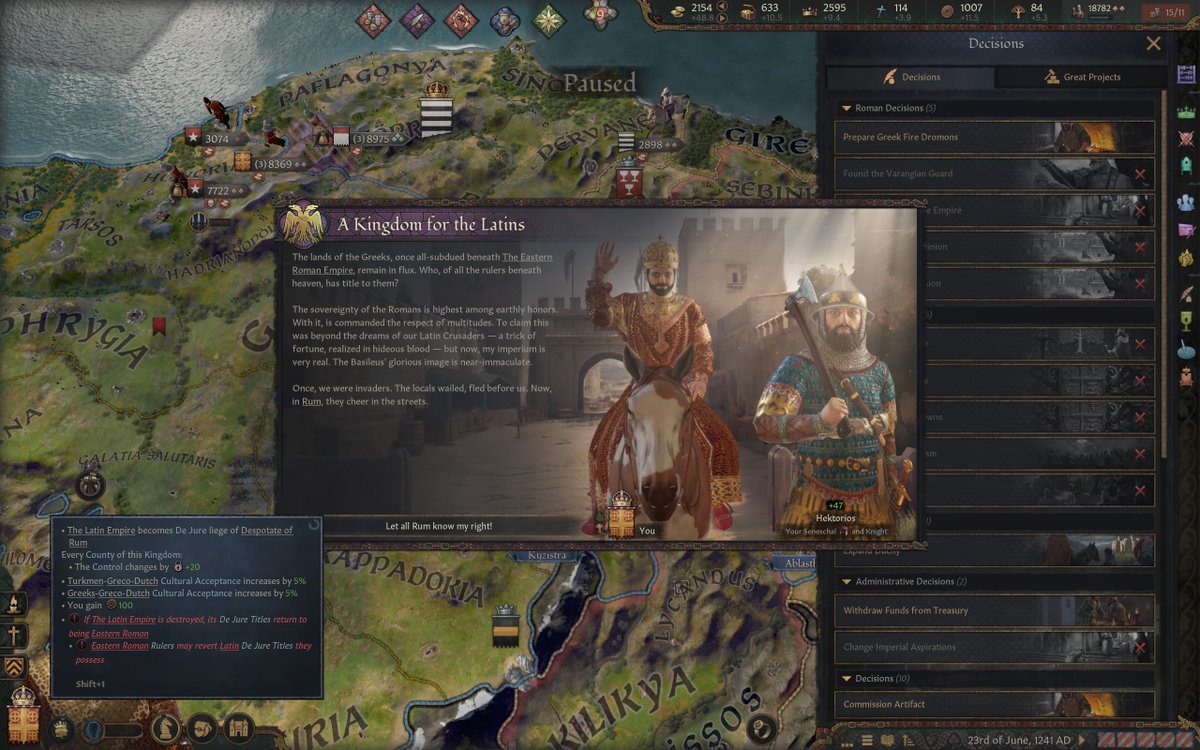
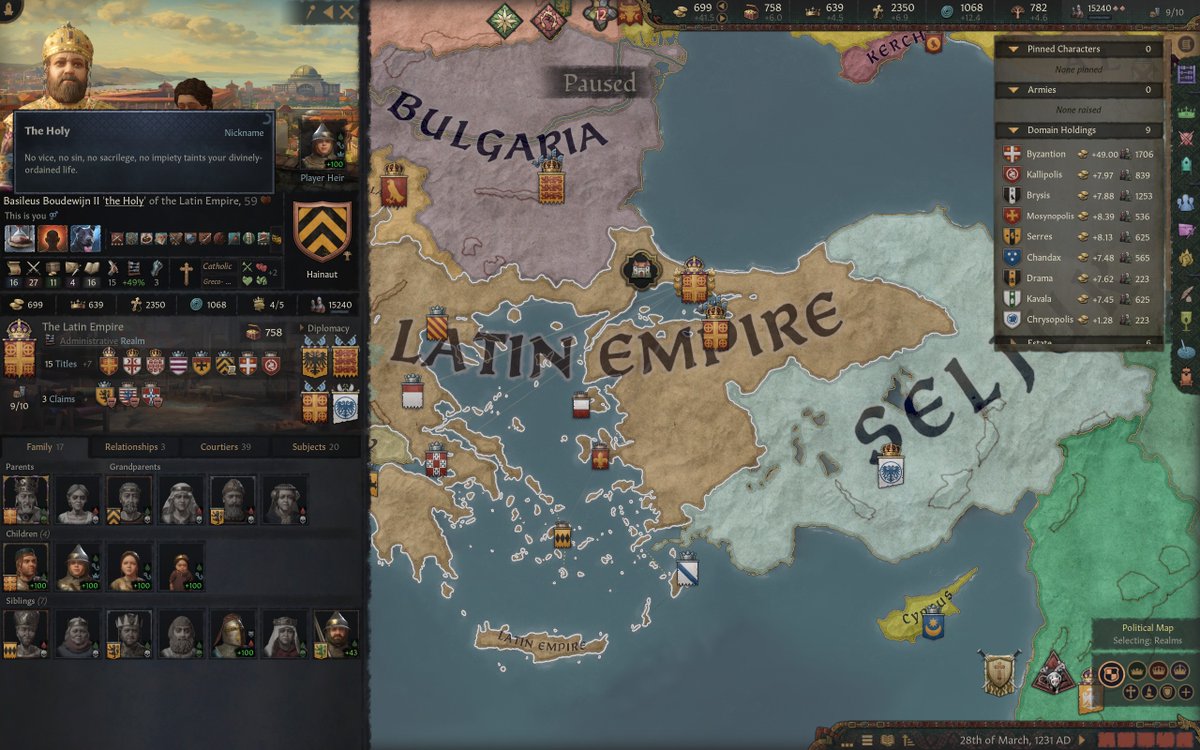
Baldwin III 'the Kind' (ruled 1233-1287) had a long and prosperous reign after the harsh efforts of his predecessors. His first act after being crowned in Rome was to take the Kingdom of Anatolia itself. From 1235-1241 he waged holy war against the Seljuks and retook the lands of Anatolia back for the Greeks. Slowly he had begun to carve in a proper crusader empire in the region, loyal to the Catholic church.
In the end of his days, he began to be called "The Holy" for his reverence of the Latin Roman church and pilgrimages, as well as his bravery against the Seljuks.
Baldwin would die of old age in 1233 AD, having a prosperous reign. He would be succeeded by his son, Baldwin III.
Then, there was one last act. The crusaders marched back to Arabia. In their zealotry, the conquests of the 7th century were undone. Mecca and Medina were sacked in 1396. Over the coming decades, the lesser counts and dukes in Arabia cleared out the Peninsula.