As a CEO: when the stakes are high, should you build strategy inside your company or bring in outside experts? For many mid-market CEOs, that feels like the choice, but it's a trap. Check out my latest article to find out why: The Mid-Market CEO's Strategy Trap: Why "Inside vs. Outside" Is the Wrong Question https://t.co/DJzRIt1CFM via @LinkedIn
44% of CEOs struggle to show financial returns from AI. (Gartner)
Here's one big reason why: Most companies add AI to yesterday's workflow.
The AI makes one step faster. Then the work waits in the same queues, goes through the same approvals, and gets re-keyed into the same systems.
Faster steps. Same results.
Urban planners call this paving the cow path.
This week's Cutting Through The AI Noise shows CEOs:
→ Why workflow redesign is the biggest driver of bottom-line AI impact
→ A before-and-after example: invoice time cut from 11 days to 1–2, with the same AI tool
→ Five moves to redesign the work
→ Six questions to ask before approving the next AI proposal
Don't pave the cow path. Build the road to the result.
Read it below, then tell me: which workflow in your business has the most "wait time" hidden inside it?
#AIStrategy #MidMarketCEO #BusinessTransformation
https://t.co/3tSnWkY1c7 via @LinkedIn
71% of CIOs plan to deploy AI agents in the next 12 months. Only 21% have governance in place for them. (Gartner)
That gap matters, because an AI agent doesn't just give you an answer. It takes action on your company's behalf.
Places orders. Sends emails. Changes records.
And many are arriving quietly, switched on inside software you already own.
This week's Cutting Through The AI Noise gives CEOs:
→ A one-page job description every AI agent should have
→ A four-rung autonomy ladder: Observe, Advise, Act with Approval, Act Alone
→ Six questions to ask before any agent goes live
You wouldn't hand a new hire the company credit card on day one. Don't hand it to an agent either.
Autonomy isn't a feature you switch on. It's something an agent earns.
Read it below, then tell me: which task would you trust an AI agent to handle on its own first?
#AgenticAI #AIGovernance #MidMarketCEO
https://t.co/kNTIu64TdK via @LinkedIn
In late October, Microsoft offered buyouts to about 60,000 employees as its AI spending accelerates.
Your employees saw that headline. What are they hearing from you?
New BCG research found that nearly 90% of CEOs believe their employees trust leadership. Only 46% of employees agree.
And 4 in 10 employees say their CEO hasn't been transparent about what AI means for their job.
When leaders are silent about AI, employees don't hear “nothing is changing.” They hear those AI headlines from the news.
This week's Cutting Through The AI Noise gives CEOs:
→ The four answers every employee wants about AI
→ The one owner most mid-market companies are missing
→ A 30-day plan to close the trust gap
AI changes the work. Trust decides whether your people change with it.
Read it below on LinkedIn, then tell me: what's the AI question your team is asking that leadership hasn't answered yet?
#AILeadership #MidMarketCEO #ChangeManagement
https://t.co/R2g5EnQj7P via @LinkedIn
Your 2027 budget probably includes more AI spending than anyone has added up.
A new tool here. A pilot there. Renewals that got pricier because of “AI features.”
Each one made sense to the team that asked.
Together, they often have no shared goal, no executive ownership, no accountability for delivering business value, and no adoption plan for driving enterprise ROI.
Meanwhile, MIT research found that 95% of organizations were getting no measurable return from their generative AI efforts.
This week's Cutting Through The AI Noise gives CEOs a simple way to review AI spend before signing off on the budget:
→ Put every AI dollar on one page.
→ Sort it into four buckets: Foundation, Scale, Prove, Stop.
→ Ask five questions of every major line item.
→ Write the “stop rule” before the money is approved.
The best AI budget isn't the biggest one. It's the one where every dollar knows its job.
Read it below, then tell me: which bucket is most underfunded in your plan?
#AIStrategy #MidMarketCEO #BusinessTransformation
https://t.co/KN3EOoHauX via @LinkedIn
Would you trust an AI answer if it could not show you where it came from?
A confident answer is not the same as a current one.
This week's Cutting Through The AI Noise article on LinkedIn looks at how stale files, conflicting guidance, and missing information can turn a polished AI response into the wrong company answer.
It also includes a practical way to test what the system does when it cannot find the answer.
AI should know when to show its work, and when to stop.
Check out the new issue and tell me: which company information would you want an AI tool to get right first?
#ArtificialIntelligence #MidMarketCEO https://t.co/8bea97VwgM via @LinkedIn
What should an AI assistant do when it cannot solve a customer's problem?
If the answer is "keep trying," the customer may get stuck in a loop.
This week's Cutting Through The AI Noise is about designing a clear handoff: when the system should stop, what it should tell the customer, and what context the service team needs next.
A better experience is not AI answering everything.
It is the customer reaching a useful next step.
Where would a clean handoff matter most in your business?
#CustomerExperience #CX #AI #TechModernization
https://t.co/Ob0MbiV6Gu via @LinkedIn
Many Mid-Market CEOs view a high-stakes strategy decision through a lens of:
"Do we bring in outside help - or do we do it ourselves?"
It is the wrong question.
Outside Perspective without Internal Ownership = a strategy that sits on the shelf because no one owns it.
Internal Ownership without External Perspective = a strategy that misses the high-stakes market opportunity.
The better answer is a deliberate architecture: an Integrated Hybrid model that brings external rigor to the early strategic work, embeds internal leadership throughout the strategy development/execution lifecycle, and adds outside executive capacity only where a critical initiative needs it.
In my latest article below, I explain:
- what that model is,
- why it consistently outperforms alternatives, and
- the four questions CEOs should ask before they seek outside help with their Business Strategy.
#MidMarketCEO #StrategyExecution #BusinessTransformation https://t.co/oqPSPPMGDe via @LinkedIn
Most mid-market companies do not have a data shortage.
They have a DATA VISIBILITY problem.
Critical insight is often buried in handwritten notes, spreadsheets, emails, filing systems, and disconnected platforms.
Yet CEOs are still expected to make high-stakes decisions without a clear view of productivity, bottlenecks, wasted labor, or profitability.
That is more than an inconvenience. It is a competitive risk — that causes significant profit to leak out of the business every year.
The companies pulling ahead are not always collecting more data — they are turning the data they already have into visibility, accountability, and faster decisions.
Then they are using that foundation to prepare for AI.
In my latest article, I share a practical five-stage path: Discover. Digitize. Centralize. Visualize. Optimize & Scale.
This is not just a technology project. It is a chance to increase throughput, cut avoidable costs, improve decisions, and scale without automatically adding headcount.
Can your leadership team quickly see where profit is leaking and growth is getting stuck?
If not, this article is for you.
Your Business Generates Volumes of Data Daily — But Are You Using It For Competitive Advantage? https://t.co/w0AYSJdg0j via @LinkedIn #MidMarketCEO #MidAtlantic #DataModernization #Transformation
What if you could automate Business Dashboards, Lead Qualification, Invoice Processing, and more – without writing a single line of code? You can. My LinkedIn article this week lays out the 4-Layer, No-Code AI Stack that makes it real. https://t.co/r3C3uoAVOD via @LinkedIn #NoCode #BusinessAutomation #TechStack #Operations #Consulting
Why do so many impressive AI demos never make it into production?
Tomorrow on A Class Act, Stuart Bell, Head of AI & Innovation at M&G, shares what it really takes to move agentic AI from demo to enterprise scale in highly regulated environments.
If you’re leading AI, building AI, or hiring AI talent, this one’s worth watching.
🎙️ Episode drops tomorrow.
#AgenticAI #EnterpriseAI #AILeadership #AppliedAI
A recent study found that #AI helped students complete homework faster and score higher, but later exam performance dropped sharply. The answer is not to ban AI. The answer is to redesign learning and work around proof of understanding. Can the person explain the answer? Can they defend it? Can they apply it in a new context? Can they spot when AI is wrong? These skills will matter more as AI gets better. https://t.co/LBC8t2IQh5
We go to the highs and lows when producing broadcasts and the talented production crews we work with across the continent don’t get enough credit for the extraordinary creativity.
We begin production planning begins at least 90 days before we film in any country - we work with talented production crews to identify landmark sites we can film PTCs/interludes into our broadcasts.
When we get into the country, 2-3 days before filming/production day, we check out the proposed sites, speak to people around, reconfirm necessary accreditations and agree on the specific ones that resonate with the content we are filming.
Sometimes we rework scripts on the go to suit the moving pieces on location.
We listen to the local context. As a strategic communicator I’ve learnt that this is one of the most important pieces to influencing for impact.
What the viewer sees as an end product with one person in front of the camera, was pieced together by an entire team - a village.
I work with an incredible team. And I must add that we have such talented production companies across Africa.
Watch the full episode of this discussion now available on YouTube https://t.co/SBU46aXiAq
#EdTechMondays #Africa
Shots captured by @pace.rw | @henryj0el
Wand is the operating system for the hybrid workforce, where humans and AI agents work side by side to get real work done.
Work is changing. Wand is how it happens. Here’s what we build — and why it matters 👇
https://t.co/MO3ZMcOfNc
Incredible! These advancements come at you so fast that it's easy to miss, but when you sit back and review it like @gregisenberg has done here, the progress is amazing! Thanks for sharing @jasonrob_ !
So let me get this straight....
1. Agents are about to outnumber humans on the internet, so most of the traffic, transactions, and conversations online will soon be machines talking to other machines while we sleep.
2. Superintelligence exists now, and for $20/mo you pretty much get it all.
3. Cloud agents allow you to run a business 24/7 and from literally a phone while you're waiting to order a latte.
4. Voice AI is wide open. This industry has barely changed since the 90s. Infinite opportunities. Voice AI is finally getting good enough.
5. Mobile apps are interesting again for the first time in 10 years, because an AI-first app that thinks and acts on its own is a different species than the passive ones in the store today. There are kids doing $100k/MRR.
6. It's the golden age of open source. The models you download off Hugging Face for free and own forever are landing within months of the ones behind paywalls, so the smartest thing on earth can't be throttled, priced up, or shut off by a company having a bad quarter.
7. The keyboard is on its way out. We spent 40 years learning to type fast, and it's about to feel like handwriting, because soon you just talk and the computer goes and does it.
8. Every company is about to hire agents with their own logins, their own inboxes, their own track records, and a shadow economy is forming where agents pay, hire, and vouch for other agents.
9. Software stopped being something you buy and became something you rent by the hour. The whole industry is repricing from $50 a seat to thousands per outcome. Tons of opportunity.
10. Robots are about to have the moment software agents just had. The intelligence got solved. Now it's dropping into machines with arms and legs, and the people who can wire AI into hardware are about to be the most fought-over hires on earth.
11. The 10-person startup can now out-ship the 500-person company, and everyone can feel it happening.
12. Every white-collar task is getting a "do it for me" button, and most people haven't pressed it yet.
13. Data you've been sitting on for years is suddenly worth something, because now an agent can actually use it.
14. Language stopped being a barrier. Real-time translation that actually works means the next huge consumer app might get built for a market you can't even read, by someone you'll never meet.
15. Every SOP is turning into a product. The way a business does one thing, written down as a markdown file an agent can run, is now something you can sell. Knowledge that used to live in someone's head became downloadable.
16. The moat moved from what you know to how well your business is written down. The company an agent can actually run wins, so being legible beats being big.
17. Since agents will get scammed by other agents, a whole trust layer has to get built. The Yelp for agents. The escrow for machines. Wide open.
18. You keep the whole thing now. A business that needed 50 people to hit $10M needs 3 and some agents, so instead of splitting it 200 ways with investors, it's just yours.
19. Search engines minted a generation of millionaires and billionaires. LLM search is about to do it all over again. Billions of eyeballs are moving off Google and onto ChatGPT, so being the answer inside the models is the new front page.
20. The margins are stupid. You charge someone what they'd pay a human, and it costs you a few bucks in tokens. That gap used to go to payroll. Now it goes to you.
Any one of these would DEFINE a decade on its own.
We got ALL of them at once, stacked on top of each other in the same 18 months.
It's a magical time to be building.
You don't need to overthink it.
Build.
Find out why the biggest AI risk isn't hallucination and what you can do to protect your business while realizing tangible value from AI. See my latest LinkedIn Article: https://t.co/EXqTjG30ri via @LinkedIn#AIPrivacy#DataSecurity#FutureOfWork#AIFoundation
AI requires a new type of leadership. Most leaders aren't ready.
Managing an AI-augmented team is fundamentally different. Less micromanagement of tasks. More focus on outcomes, ethics, and continuous learning.
The leaders pulling ahead aren't the most technical. They're the most adaptable.
How are you adapting your style?
#FutureOfWork #AIAdoption #AITransformation
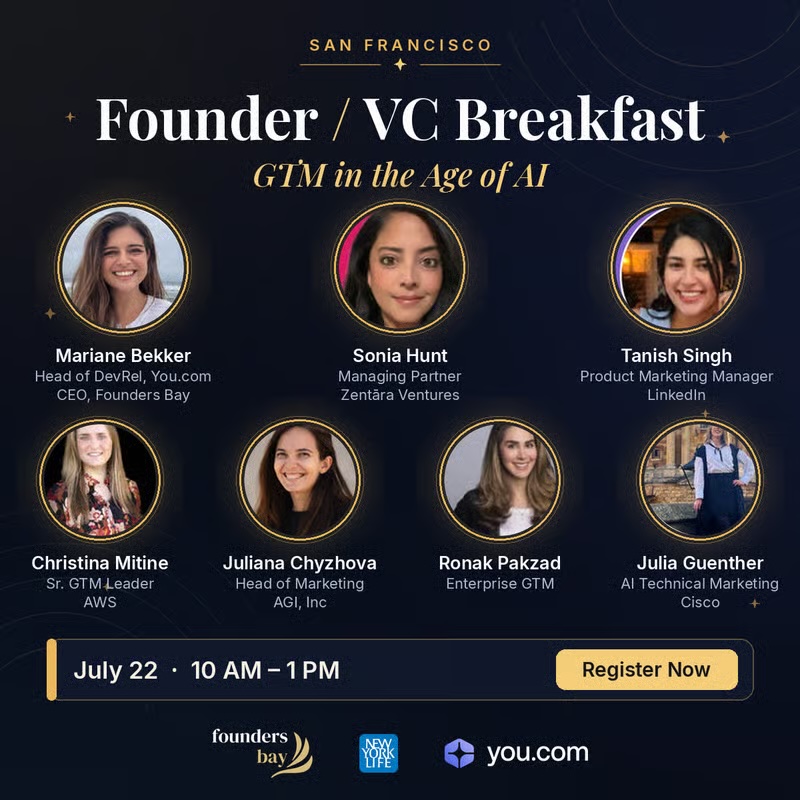
There are not enough events for women, or with women speakers.
Here you go:
→ https://t.co/YGlorVHWzx
If you're in San Francisco Bay, join an amazing women in a deep conversation on "𝗚𝗼-𝘁𝗼-𝗠𝗮𝗿𝗸𝗲𝘁 𝗶𝗻 𝘁𝗵𝗲 𝗔𝗴𝗲 𝗼𝗳 𝗔𝗜."
Wednesday 7/15