We preserve and teach about World War II armor, crew, and tactics to carry on the legacy and honor those who served in these vehicles.
#wwii#tanks#veterans
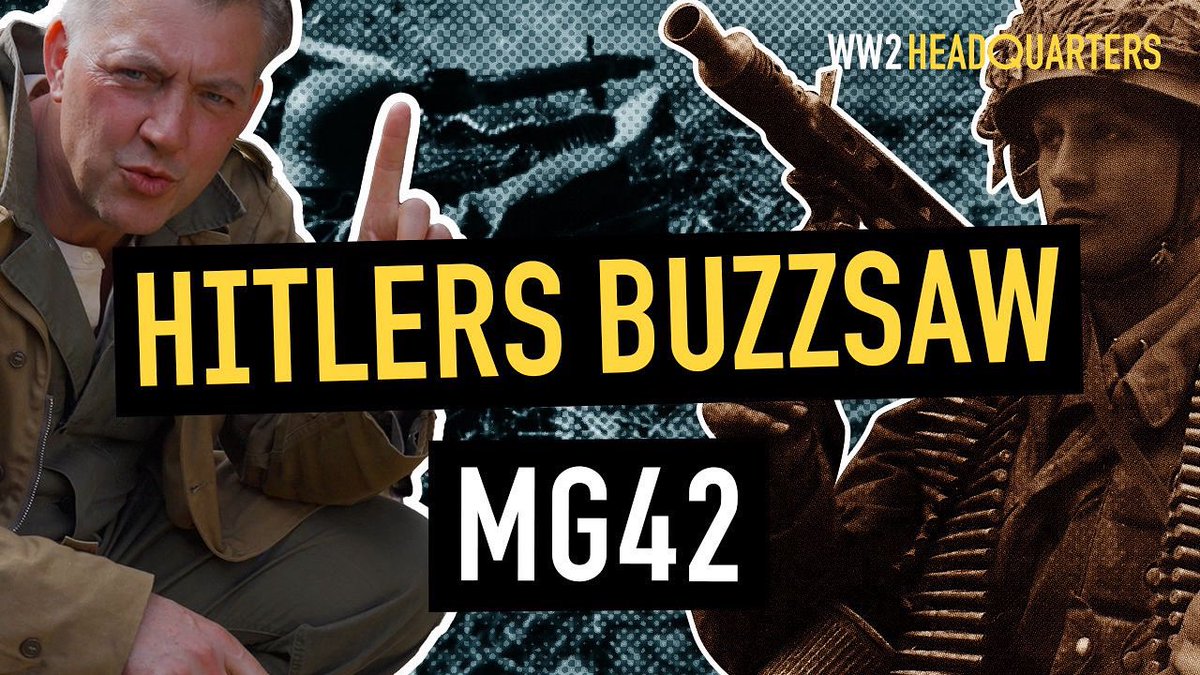
The MG42 – Hitler’s Buzzsaw – could fire 1,100 rounds per minute and was the backbone of the German infantry squad.
But was it really as deadly as legend claims? 🤔
@James1940 takes a closer look in our latest video 🎥 👉 https://t.co/ZXjvNNnN1g
@WW2Headquarters#WW2#MG42
@StephenWensley@ww2headquarters@James1940 A great place to start is with postwar study, ORO-T-117, which addresses many of the points you list!
https://t.co/unWjLtjo3Z
Now hear this!
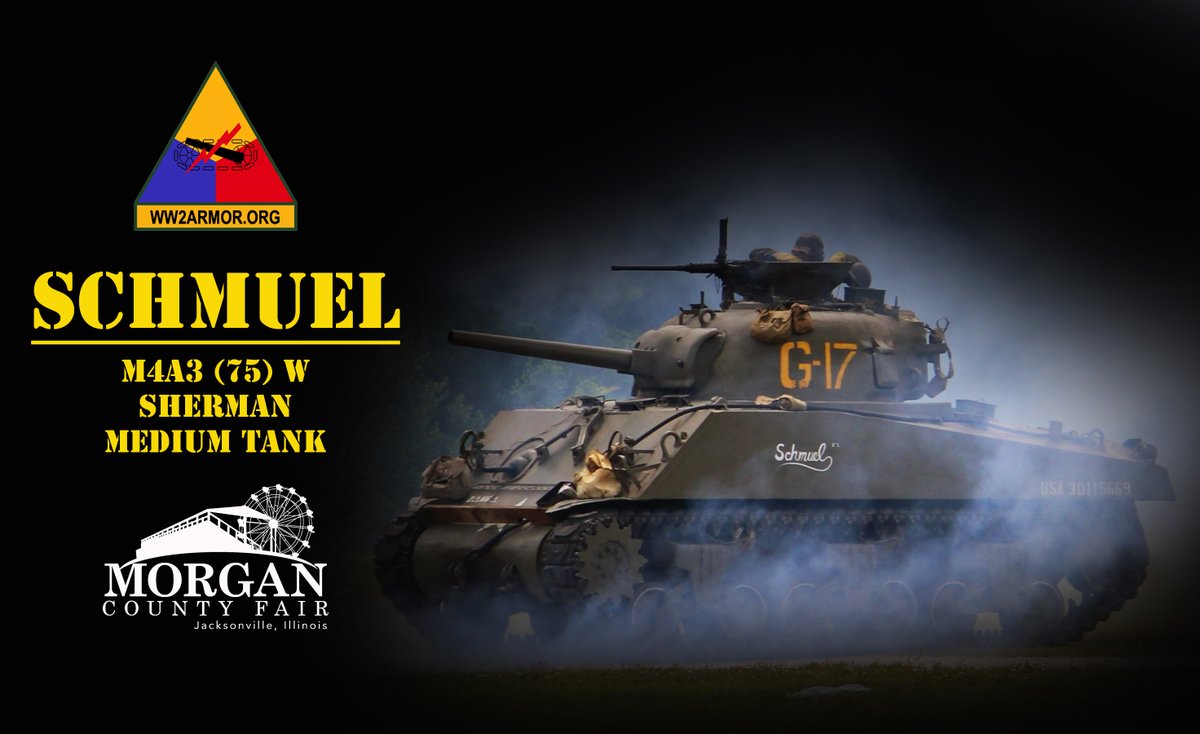
Today we continue highlighting one of the four authentic and fully operational World War II armored fighting vehicles that will be attending next month's Morgan County Fair 'Salute the Troops' event in Jacksonville, IL July 8 - 9, 2025!
Today, we are thrilled to announce SCHMUEL, our M4A3(75)W VVSS Sherman medium tank, will be making the trip to Illinois next month and will be crewed by WW2 Armor's Charlie crew!
SCHMUEL, which is the Hebrew base of "Samuel," is named in honor of the rabbi's father-in-law. Sam is a wonderful grandfather, father, and a friend to all.
SCHMUEL is serial number 62647 with a USA registration number of 30115669, and was built by Fisher Body Tank Plan in Grand Blanc, MI in November, 1944 under Production Order T-11315/1. SCHMUEL is one of 3,071 M4A3(75)W VVSS Sherman medium tanks produced by Fisher between February 1944 and March 1945.
The M4A3 has the 75mm gun M3 and wet ammo stowage (thus the "W" designator) beneath the turret floor, and is powered by the powerful Ford GAA V8 gasoline engine. This 1,100 cubic inch engine produces 500 HP at 2,600 RPM. Due to its great reliability and durability, the U.S. Army viewed the GAA as the premier tank engine.
That is all.
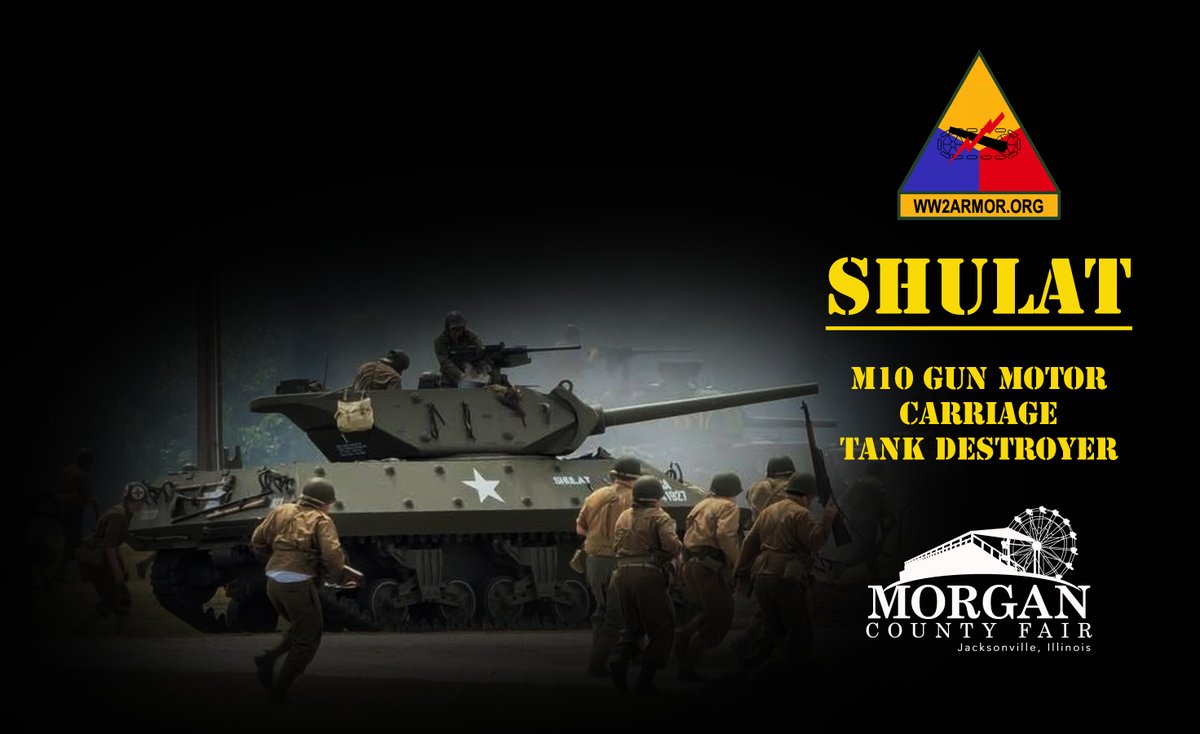
Now hear this! Today we highlight another authentic and fully operational World War II armored fighting vehicle that will be attending next month's Morgan County Fair 'Salute the Troops' event in Jacksonville, IL July 8 - 9, 2025!
Today, we are thrilled to announce SHULAT, our M10 Gun Motor Carriage (GMC), will be making the trip to Illinois next month and will be crewed by WW2 Armor's Baker crew! SHULAT (,שולט "dominator" in Hebrew) is a U.S. WWII M10 Gun Motor Carriage tank destroyer that was acquired in mid-2021. SHULAT is believed to have seen duty with the U.S. Army through the end of WWII.
After the war, it was in France and may have served in the French Army. SHULAT was then acquired by the Israeli Army and modified as to be similar to the conversion of the Sherman M50 program. SHULAT is one 4,993 M10s of the 2 different variations that were completed by January 1944. In tracing the serial number, 1223, this vehicle was built in February 1943 by Fisher Body division of General Motors at the Fisher Tank Arsenal in Grand Blanc, Michigan for the US Army. The chassis uses the M4A2 base with a 3-inch (76.2mm) gun in a turret that can be rotated 360 degrees. It is powered by two GM 6046 diesel engines.
Built as an expedient solution to the rising threat of German armor for the fledgling US Tank Destroyer Force, the M10 GMC was built upon the reliable M4 chassis and fitted with a 3-inch gun. It sported twin diesel engines in the base variant, an open turret for weight savings and vision, and a formidable main gun by 1942 standards. This design first was pressed into service in North Africa where it acquitted itself well against the more veteran panzer divisions. Beginning in North Africa and during the Italian and ETO campaigns it was also used to great effect in both direct and indirect fire against a variety of targets.
While the M18 GMC and M36 GMC were designed to supplant it, the design soldiered on throughout the war. The M10 GMC was the first American GMC employed by the U.S. Army’s Tank Destroyer Forces to land in France on D-Day June 6, 1944.
The 899th Tank Destroyer Battalion with its M10 GMCs landed with wave 25 on UTAH beach. During the invasion of France and later fighting against heavy German armor in the Fall and Winter of 1944, it proved capable of defeating even the vaunted Tiger II's formidable armor along with Panthers. We'll note that the later 76mm gun was ballistically identical to the 3-inch gun, although the shell casings were very different, period ballistics charts note them interchangeably. If you are interested in reading our research article published in July 2021 on the unique history of our M10 GMC we invite you to read it at this URL:
https://t.co/i6mROVRgng
That is all.
Now hear this!
Today we continue highlighting one of the four authentic and fully operational World War II armored fighting vehicles that will be attending next month's Morgan County Fair 'Salute the Troops' event in Jacksonville, IL July 8 - 9, 2025!
Today, we are thrilled to announce KOHEN, our M7B1 Howitzer Motor Carriage 'Priest', will be making the trip to Illinois next month and will be crewed by WW2 Armor's Dog/Easy crews!
KOHEN joined the WW2 Armor stables in March 2019 after a full restoration was completed by BAIV in the Netherlands. Its name ‘KOHEN’ is Hebrew for ‘priest.’ KOHEN served in the European Theater of Operations (ETO) during WWII, Korean War, and with the West German Army during the Cold War. KOHEN is Serial Number 4381 and Registration Number 40152844-S and was built in December 1944, by the Pressed Steel Car Company at their Hegewish Plant in Chicago, Illinois. After its production it was sent to Europe to join the U.S. Army fighting in the ETO, unit and location unknown. KOHEN served in the ETO throughout the end of the war in Europe. KOHEN later went on to serve with the U.S. Army during the Korean War, and was later transferred to Europe where it was upgraded to a M7B2 by the French Atelier de construction de Bourges in 1962. After its modification it was transferred to the West German Army where it served with the 3rd Artillery Battalion in Augustdorf, Germany. In the 1970s, KOHEN was retired from active service.
The M7B1 HMC Priest carried 69 105mm rounds with 19 stored in the left sponson, 17 in the right sponson, 8 beneath the floor on the left, and 25 beneath the floor on the right. Also, the M7B1 carried 300 rounds of .50 Caliber Machine Gun ammunition, 1,620 rounds of .45 Caliber Thompson Submachine Gun ammunition, 6 x White Phosphorous Grenades, and 2 x Fragmentation, Mk. II, w/fuse M7 grenades. The M10 Ammunition Trailer was also utilized to haul additional 105mm rounds with a capacity to carry an additional 45 rounds. The maximum rate of fire was eight rounds per minute. A total number of 4,315 Priests were built comprised of 3,489 M7 HMCs, 826 M7B1 HMCs, and 127 M7B2s (converted from M7B1s).
That is all.
Now hear this!
As promised in yesterday's Facebook post, today we start highlighting the four authentic and fully operational World War II armored fighting vehicles that will be attending next month's Morgan County Fair 'Salute the Troops' event in Jacksonville, IL July 8 - 9, 2025!
Today, we are thrilled to announce DUNERN, our M4A1(76)W Sherman medium tank will be spearheading our line up crewed by WW2 Armor's Able Crew.
In early April 1944, 130 M4A1(76)W Shermans arrived in England and a conference was held to determine how the tanks would be allocated to the various armored units in theater, but none of the units in England wanted the 76mm armed Shermans at the time. The reason being, the majority of the rounds fired up to that point in the war by U.S. tankers were High Explosive vs. Armor Piercing rounds, and High Explosive capabilities were considered the priority. Also up to that point, the 75mm armed Shermans were successful when used against German armored vehicles in North Africa, Sicily, and southern Italy.
All five U.S. tank battalions designated to come ashore on the Normandy coast on D-Day June 6th, 1944, were equipped with 75mm main guns. Although not all 214 Shermans made it ashore in the first waves, those that did played a crucial role in the battle to secure Omaha and Utah beaches and provided covering fire for the follow-on waves of troops landing behind.
After encountering the German Panther tanks in July 1944, U.S. commanders sought to bring the 76mm gun M1-armed Shermans into the mix. Of the 130 M4A1(76)W Shermans available, 52 were allocated to the 2nd Armored Division, 52 were allocated to the 3rd Armored Division, and the rest were spread across the separate tank battalions. These Shermans saw their first extensive action during Operation Cobra. These Shermans, like all M4A1 Shermans, had cast hulls, vertical volute spring suspension (VVSS, narrow track), and were powered by the Wright Continental R-975 model C1 radial engine.
DUNERN, our M4A1 (76)W Sherman medium tank, is Serial Number 67838 with a U.S. Registration Number of 30125817, and was built by the Pressed Steel Car Company (Chicago, IL) in December 1944 under Production Order T-146091/1. Since her addition to the WW2 Armor fleet in May 2022, we have proudly runned and gunned this steel steed at public events depicting scenarios from Operation Cobra and through the end of World War II, and we look forward to her first trip out of Florida next month!
Stay tuned for tomorrow's post highlighting the second out of four World War II armored fighting vehicles attending next month's Morgan County Fair's 'Salute the Troops' event in Jacksonville, IL!
That is all.
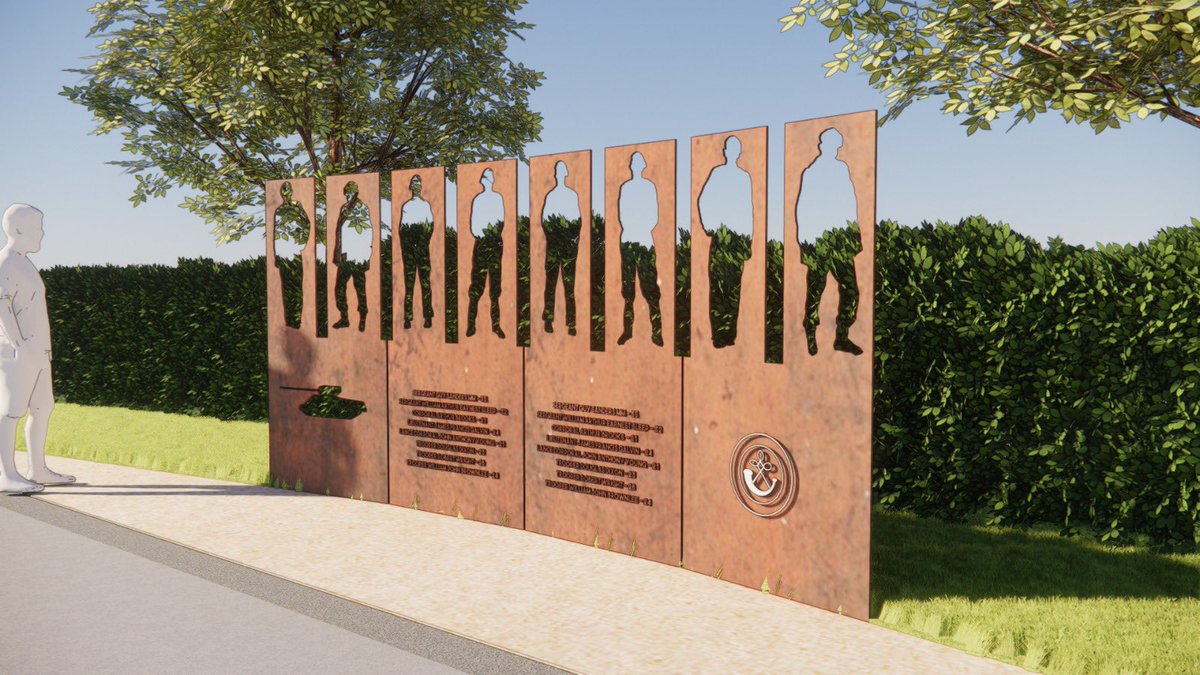
New piece today on Substack about our plan to create a new memorial to eight Sherwood Rangers killed in the same action in Normandy. Thanks to @stubertphoto for the amazing design. LINK: https://t.co/zIbvOVVJFI
Join us July 8th and 9th for the Morgan County Fair's 'Salute the Troops' event and display in Jacksonville, Illinois! We are excited to return once again to showcase and teach about the historic steel steeds of the U.S. Army in World War II.
July 8th will be a static display where folks can see the historic tanks, tank destroyers, and artillery up close and learn about their history and role in World War II with our crewmembers. July 9th we again will have a static display in the afternoon with the main show of showcasing the steel steeds in action at 6:00 PM.
It is going to be an excellent show and event once again, and we hope to see you there!
Now view this!
We had a special visitor fly by our free-range tank farm here in Central Florida late last week, the Goodyear Blimp! (.@goodyear) We were lucky enough to catch a quick photo of the Goodyear Blimp flying over with KOHEN, our M7B1 ‘Priest’ Howitzer Motor Carriage, who coincidentally has several WWII Goodyear produced roadwheels currently mounted! In fact, several of our WWII tanks, tank destroyers, support vehicles, and half-track have Goodyear produced roadwheels and wheels currently mounted as well within the collection.
During WWII, the Goodyear Tire and Rubber Company played a critical role in the in the production of military related products in support of the war effort, and was 30th in overall production between all companies and factories in the U.S. during the war.
While Goodyear specialized in rubber related products, the company produced a wide variety of military related items from its various factories around the nation such as barrage balloons, gas masks, aircraft outer wings and fuselages, aircraft breaks, wheels, rubber tracks for half-tracks, roadwheels for armored vehicles, military vehicle tires, track block bushings, fuel and oil cells, 75mm – 155mm ordnance charges, life rafts, pontoon boats, tank tracks, .50 caliber ammunition, FG-1 Corsair aircraft, airships, M5 3 in. anti-tank guns, and much more.
That is all.
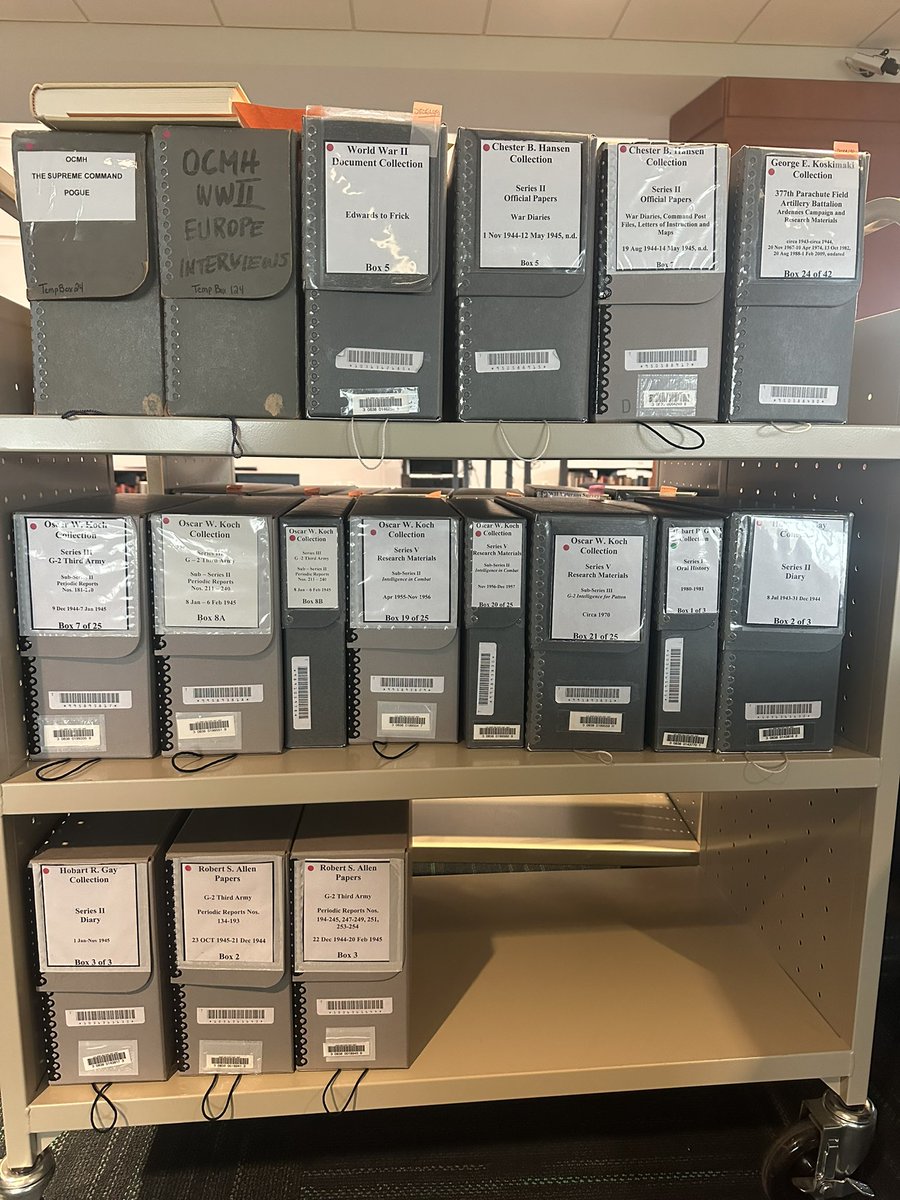
Absolute love archive work and the US Army Heritage & Education Center is one of the very best: amazing material and fantastically helpful staff with immense knowledge. What’s not to like? A lot to get through, though… @WeHaveWaysPod@USAHEC
This dog's name was Gunner. My uncle brought him back from WW2. He was raised and slept under my uncle's anti- aircraft gun. The gun crew shared their
rations to feed him. By the time he was 18 months old, my uncle said he would stand up and look at the sky. If he laid back down they knew all was ok. If he growled
and put his hackles up they got at the ready. He knew the sound of the German aircraft and my uncle said he
never got it wrong. He said Gunner was better than any early warning system. I'm probably the only one left in the family that knows that story now, so I thought I'd tell it before it's lost forever, like many stories must be from that time. Thanks for reading it.