How does funding uncertainty affect science? Every Oct, we get headlines bemoaning the impact of the federal budgeting process on science. Does it matter that grant $$ takes a bit longer to get out the door, or is it just a nuisance we can deal with?
Today we’re releasing *SciNet: The Anatomy of Science*, an open database that maps every scientific discipline down to its research tasks.
It describes what scientists spend their time on and helps us understand where AI has potential to accelerate discovery. 🧵
Our colleague Eva Yi Xie, a Princeton neuroscience PhD student, was detained by ICE at Reagan National Airport on her way home from SfN, where she’d just presented her poster. She’s being held in Chantilly, VA. Please help us bring her home. 📷
reminder: if someone sends you calendar invites with (their name) + (your name)
its not because they think they're more important than you
its because they are super considerate and dont want your calendar to end up with 27 meetings called (your name)
Hi, I'm Kirsten. I'm an expert in data centre and infrastructure policy. I worked in UK Government for 8 years. I'm planning to work on AI safety and trying to decide whether founding a non-profit might be right for me; advice welcome.
@bradchattergoon Never been asked that but I agree. with online dating, first date is more like zero-th date, basically just checking for baseline connection and ruling out huge red flags
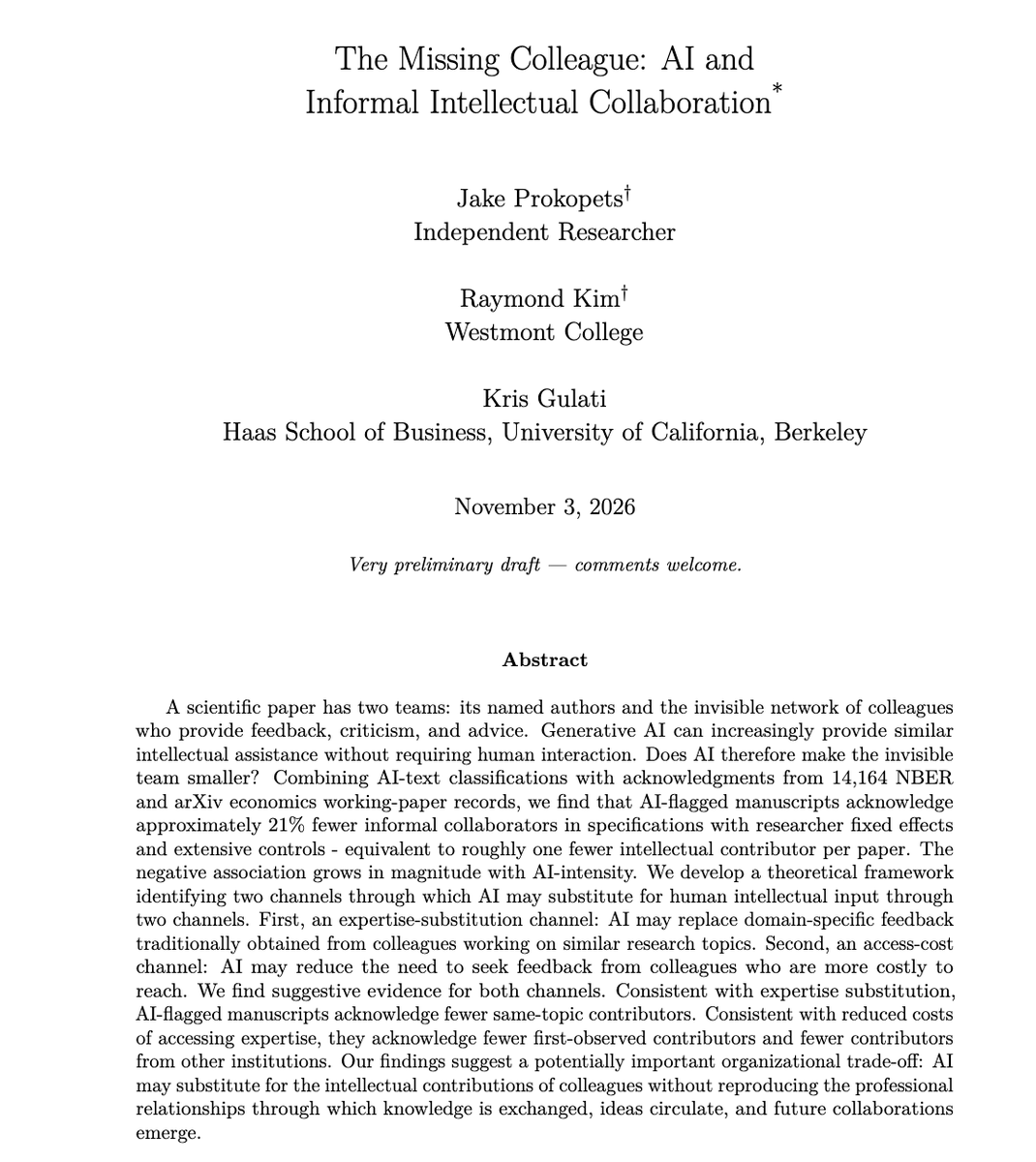
New paper with @ProkopetsJake and Raymond Kim!!
Every scientific paper has TWO teams.
One is listed on the title page.
The other is invisible: colleagues who challenge ideas, catch mistakes, and help make the research better.
Our new paper suggests AI may be making that invisible team smaller.🧵
4) The final q of the interview is masterful and strikes me as a great example of what it means to be "seen". I came upon this view as Caro gave his answer, and it all just felt very poignant.
/fin
I joined @GoogleDeepMind to develop a research program on the economics of AGI. Today, together with Andrew Koh (@andrewjkoh) and Shane Legg (@ShaneLegg), we are incredibly excited to release The Economics of Intelligence, the first in a series of projects from our group on how AGI will change the economy.
How do capability improvements transform the economy, and when? In this project, we define thresholds of economic capabilities, e.g., minimal AGI, based on how they transform the economy. We then track how the economy–market structure, employment, and wages–changes during the transition across capability regimes.
We have seen exponential increases in what AI agents can do but the broader economy seems almost remarkably unchanged. Part of the reason is that the solo AI agent is the wrong economic object; economic transformation is an equilibrium outcome where organizations compete. Looking at how intelligence functions within organizations, transformation will depend on when two key capability thresholds are crossed: competence (gains on individual skills, e.g., coding, math) and coordination (gains on ability of agents to cooperate and work together).
We show that what economic transformation looks like depends on whether AI becomes supercompetent, supercooperative, or both—the regime of artificial superintelligence (ASI). Tracking this transition shows why the real visible transformation may come from improvements in coordination—a capability most benchmarks don’t yet track. Past a certain threshold, AI capabilities can break the Coasian ceiling on firm size and lead to an economy that looks drastically different than the one we see today.
Two main takeaways:
1. To understand the path of transformation, we should be tracking agentic coordination more closely.
2. The impact of AI will likely show up in wages before market structure or employment.
We are really excited about this paper. Excited to hear people’s thoughts.
Link: https://t.co/9DTGSeKoSA