I'm a freelance Filipino-Japanese American artist and a college student who is working on science concepts. I create artworks. Instagram is @art_aprilflowers937
Another Cancer researcher and some of them already had an idea of Cancer having a Queen Bee and it originates from Stem Cells. The problem of destroying the Stem Cells Cancer originator is that many types with its strategy would destroy the whole body system. Killing the patient. Probably cutting the right stems while the Cancer metastasized. With new information of which and where to cut the diseased stems of the Stem Cells through nanobots with artificial intelligence.
Much like a miniscule tree with a diseased branch, of which we still do not yet know which diseased branch needed to be cut. Much like acupuncture. Which is why a camera that may be able to sense more than 1% of the electromagnetic spectrum would be probably needed for the information to come into fruition.
#CancerResearch #Treatment #Cancer #Nanobots #ArtificialIntelligence
Commuters in London were treated to some impromptu entertainment while waiting on the Underground, as a pair of mice put up their dukes for a sparring session.
Staten Island man struck by lightning while walking to a dentist appointment.
Thomas Fahmy says he is grateful to be alive and went to church on Sunday to thank God for giving him another chance.
"Once the lightning bolt struck me, the initial sensations that I had throughout my whole body were completely unprecedented; tingling, numbness, pain, just I feel this burning sensation."
"No burns. I had multiple body exams; no burns at all. I went to church on Sunday to say thank you, God."
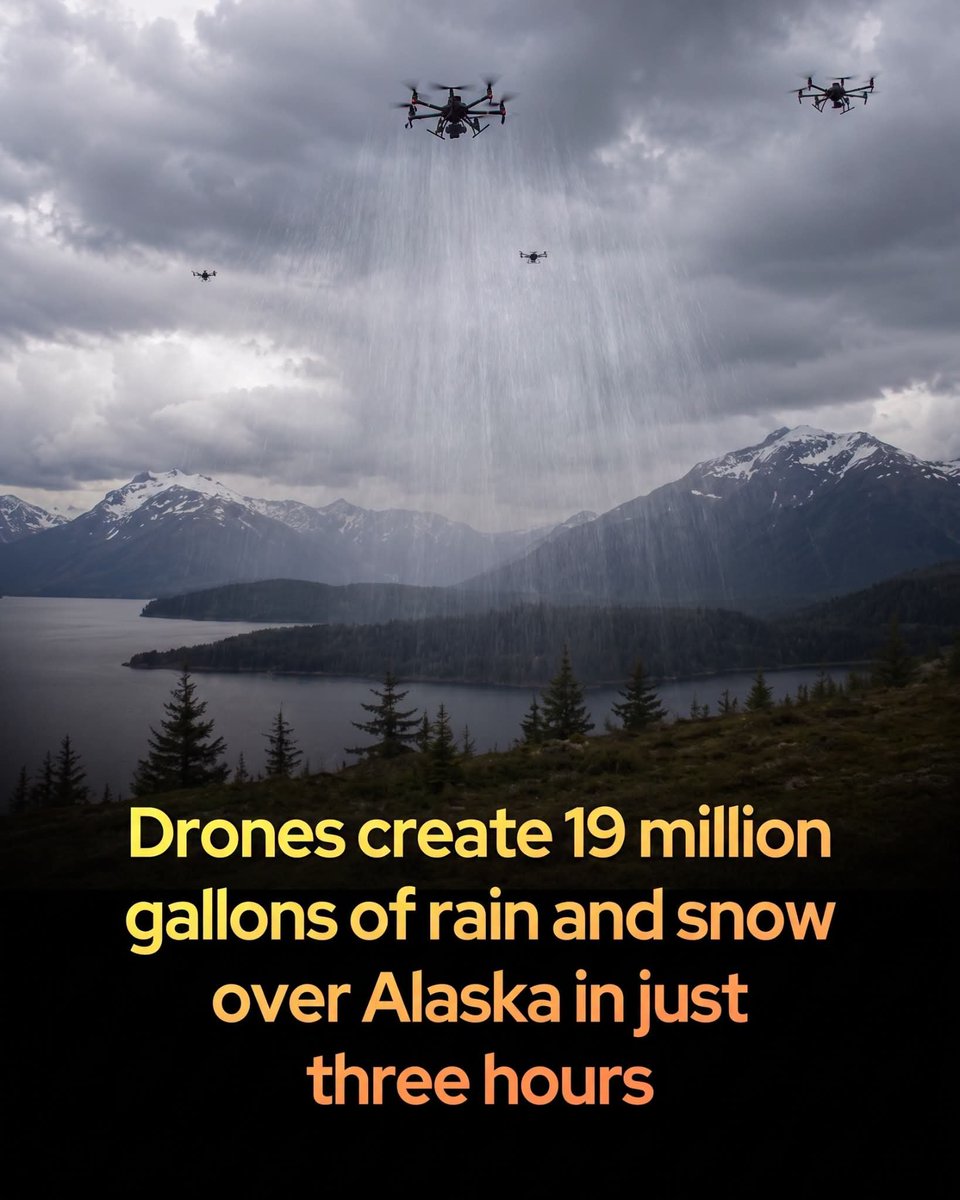
🚨 A U.S. startup just used drones to engineer the weather, triggering 19 million gallons of rainfall over Alaska.
On August 23, 2026, El Segundo-based startup Rainmaker executed a groundbreaking research campaign over Alaska’s Kenai Peninsula, deploying two autonomous drones into subfreezing, moisture-rich clouds.
Over a three-hour window, the aircraft released 19 silver iodide flares to trigger condensation in an existing weather system. According to Rainmaker's radar-based analysis, this targeted seeding successfully generated approximately 19 million gallons of net-new precipitation. The company frames this test as a scalable proof of concept for future operations aimed at replenishing critically depleted North American waterways like the Colorado River.
However, the unannounced operation has quickly ignited a fierce political and regulatory debate. Alaska State Representative Sarah Vance called for an immediate cease-and-desist, asserting that the state was not notified and warning against unconsented atmospheric experimentation. While proponents view drone-based cloud seeding as a revolutionary weapon against climate-driven water crises, critics raise serious concerns about the ecological ethics of private corporations manipulating regional weather patterns without public oversight.
source: Marcus, J. (2026). Cloud seeding start-up uses drones to generate 19 million gallons of water in Alaska. The Independent.
🚨 Breakthrough electronic skin lets robots feel.
It can allow them to detect injury and react instantly.
Scientists in China have achieved a significant milestone in robotics by developing a neuromorphic electronic skin that provides humanoid machines with a human-like sense of touch and reflexive responses.
Published in the Proceedings of the National Academy of Sciences, the research details a system that mimics the human nervous system by processing tactile signals locally. This decentralized approach allows robots to bypass central processors for immediate reactions, effectively enabling them to feel and respond to their environment with unprecedented speed.
Beyond simple contact registration, this advanced skin can distinguish between gentle touch and potential injury. When pressure levels exceed a specific safety threshold, the system triggers an instant withdrawal movement by sending signals directly to the robot's motors. By allowing machines to autonomously detect and avoid physical damage, this technology marks a critical step toward creating robots that can safely interact with humans and navigate complex, unpredictable environments without constant oversight.
Source: Sun, B., et al. Neuromorphic electronic skin for humanoid robots with injury detection and reflex-like responses. Proceedings of the National Academy of Sciences.
A groundbreaking study shows that ovaries don’t shut down after menopause, but turn into organs with a new function.
For decades, the medical community viewed postmenopausal ovaries as biologically inert, having completed their reproductive lifespan. However, a new study published in Molecular Human Reproduction challenges this conventional wisdom.
By examining the ovarian tissue of mice at various reproductive stages, researchers from Northwestern University discovered that as egg development and hormone production decline, the ovaries undergo a dramatic molecular transformation.
Rather than quietly shutting down, these organs adapt, developing a distinct 'immune-like' profile characterized by an influx of T cells, macrophages, and active inflammatory signaling pathways.
This discovery suggests that ovaries may continue to exert a powerful, systemic influence on a woman's health long after menopause. While scientists are still determining whether this post-reproductive immune activity is beneficial, harmful, or a mix of both, it raises critical questions about how ovarian aging impacts chronic inflammation across the entire body. Furthermore, early findings from human ovarian tissue hint that these dynamic molecular shifts are not unique to mice. This research fundamentally redefines our understanding of female anatomy, signaling that these vital organs may have a second act focused entirely on systemic health and immune function.
source: Converse, A., Dipali, S. S., Schowe, I. P., Kelly, E. B., Jambunathan, S. S., Ocañas, S. R., Stout, M. B., Pritchard, M. T., & Duncan, F. E. (2026). The post-reproductive ovary shifts from a reproductive to an immune-like organ. Molecular Human Reproduction, 32(2).