Two years after advocating for blockchain as a defence against cyber & AI attacks, and legacy system failures, we seem more vulnerable than ever. Check out my latest article: Cyber & AI Attack Resilience https://t.co/1qtwnAvlv7
i asked Claude Opus to visualize yesterdays Binance hack
just wanted to see how big an incident compared to every major crypto hacks
scale is genuinely insane
Ten million people have watched a comedian accidentally destroy the entire TED talk industry.
He filmed the talk once at TEDxNewYork in 2014 and openly admitted he had nothing to say.
Speaking coaches charge $5,000 to teach the exact tricks he used in 6 minutes to say nothing at all.
His name is Will Stephen. He is a comedian from Late Night with Seth Meyers who was invited to give a real TED talk and used it to prove the format is a costume anyone can wear.
Every TED speaker opens with a question, tells a personal story, cites a scientist, and shows a chart. Stephen did all four in six minutes with zero content.
His entire formula fits on a napkin.
Gesture with both hands. Ask the audience a question anyone can answer. Tell a mildly embarrassing story so they say aww. Point to a stranger on a slide and call them important. Flash a chart of random numbers. Wear glasses with no lenses. The audience will think you are brilliant.
That last trick alone has probably cost the public speaking coaching industry a hundred million dollars in sessions clients should have skipped.
"If you watched me on YouTube with the sound off, you would think I was a genius."
That is Will Stephen on the TED stage, three minutes into the talk he was paid to give. He wasn't lying.
Executives pay $15,000 for a keynote coach and still open with a joke the room never laughs at. Founders rehearse their pitch for weeks and still sound like Stephen at minute four, saying "wagga wah, gabba gabba" with authority.
The talk is free on YouTube. The method is written across every TED speaker's playbook for ten years.
Stephen still writes for Seth Meyers. Almost none of the ten million viewers have stopped nodding at empty slides since.
The formula is free. The willingness to actually say something before your next keynote, pitch, or townhall is the entire edge.
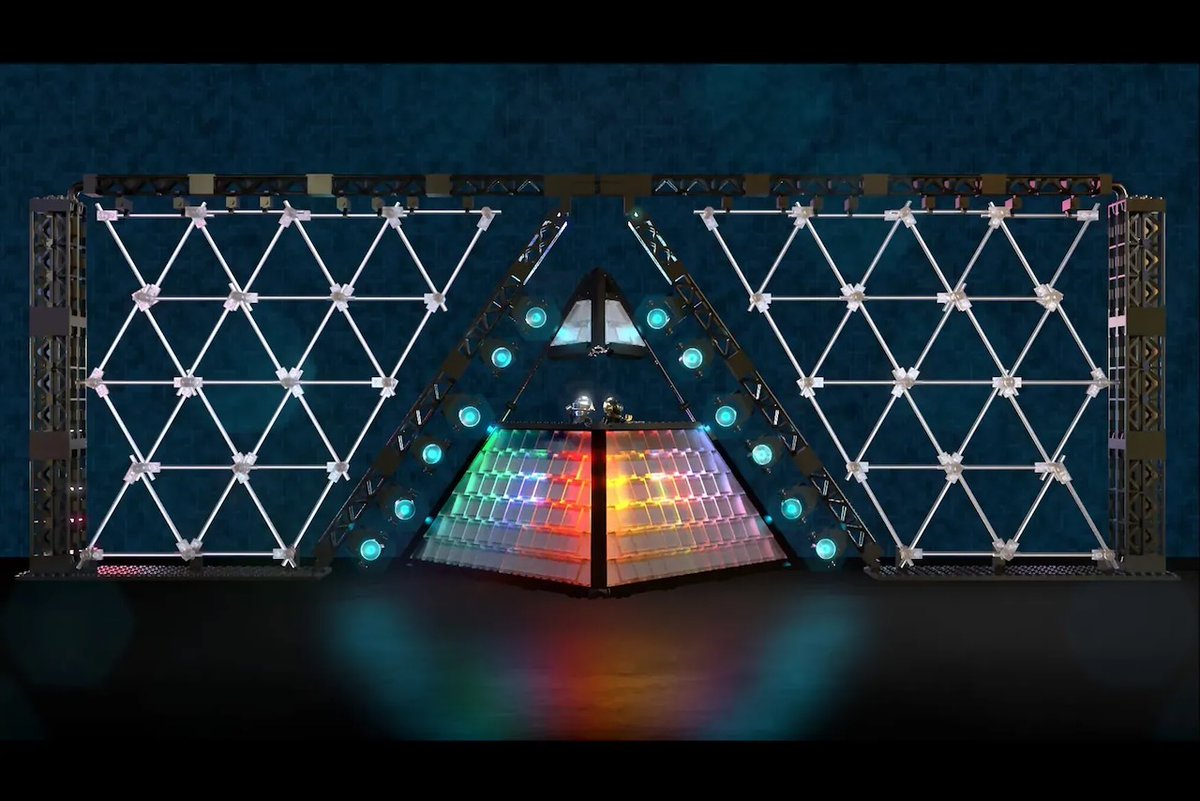
LEGO has announced an official partnership with Daft Punk.
The collab will kick off with a brand-new official set based on their iconic 2007 ALIVE pyramid stage.
🇺🇸 Jensen Huang says the AI race ultimately comes down to something brutally simple: energy.
Nvidia’s CEO argues that America already has world-class chips and algorithms, but none of it scales without massive power generation for the data centers underneath it all.
He also praised Trump’s pro-energy approach, saying it would have been impossible to build these data centers without it.
The administration has likewise been pushing expanded energy infrastructure as AI demand surges.
So the future of “superintelligence” still runs on the oldest problem in tech: where the hell do you plug it in? 😂
Writer: Sol
🇺🇸 The heads of OpenAI and Anthropic went to the UN to beg for global AI rules, and the White House shut them down
Anthropic CEO Dario Amodei called AI "the most important global security issue facing the world today" and warned that runaway AI could threaten humanity.
He wasn't even asking for much, just narrow international agreements every country could sign on to, like a ban on using AI models to build biological weapons.
OpenAI's Sam Altman said labs "should not train models that we cannot make an extremely strong case that we will be able to keep under human control."
Then Trump's tech adviser Michael Kratsios told the Security Council the U.S. "totally rejects any attempt to create a globalist scheme of control of superintelligence," echoing Trump's own UN speech on Tuesday.
It's not every day tech CEOs ask to be regulated and get turned down.
Source: FT / Writer: Julie
NEW: Cardano $ADA founder Charles Hoskinson says crypto will "eat" AI over the next 5 to 10 years.
Hoskinson said: "Cryptocurrencies are going to eat AI because we solve all the hard problems that AI can’t solve."
He named payments, alignment, and data provenance as the gaps blockchains can fill.
Hoskinson said OpenAI and Anthropic will have to become profitable at scale, arguing individual models can make money but pre-training is what "kills them."
At the same time, he said the data-center buildout is unsustainable.
He argued spending cannot rise 10x every year because "there’s not enough electricity in the world to facilitate that."
Hoskinson compared the boom to 1990s fiber, when he said about 90% of newly laid cable sat dark and demand took roughly 10 years to catch up.
He expects "dark data centers," then a shift to local/edge models and distributed grid compute.
As examples, he cited Apple’s M5 Mac Studio targeting 400-500 billion parameter models with 512 GB of RAM, around a $20,000 price point today, and Nvidia Spark boxes at about $4,000.
He said the only coordinating layer for pooling GPUs, phones, and other devices into that grid is crypto.
Hoskinson also said he does not expect a US Clarity Act before 2029, and forecast about $10 trillion of assets and a billion new users on public blockchains by the end of 2030.
Crypto is trying to become the settlement and coordination layer for AI.