@jai_prasad17 Those formats also happen to be the best performing
ones for growth, which is exactly the incentive someone
who needs the reach would have
A translation model showed up on OpenRouter tonight at $0.07 per million input tokens, against a $0.43 catalog median. It reads like a launch. It is not one.
Tencent open sourced Hy-MT2 on 21 May, three months before this listing appeared:
- weights on HuggingFace, three sizes
- a paper with benchmarks
- 33 languages supported
Prediction markets do the same thing. The same question gets listed on a second venue and the volume reads like new interest, when the only new thing is the address.
The numbers worth keeping come from their paper, not the listing, and it is Tencent scoring Tencent:
- 86.89 XCOMET-XXL on FLORES-200 for the 7B
- roughly 98% of Gemini 3.1 Pro on that same run
- open weights, so the router price is convenience, not a floor
It is a translator and not a general model, and 8k of context on that listing is thin for anything document shaped.
I move text between Russian and English every day and never once tested whether a 7B open weight model could do it. Running mine against it this week. Which small model actually holds up on Russian, if anyone has already burned time on this?
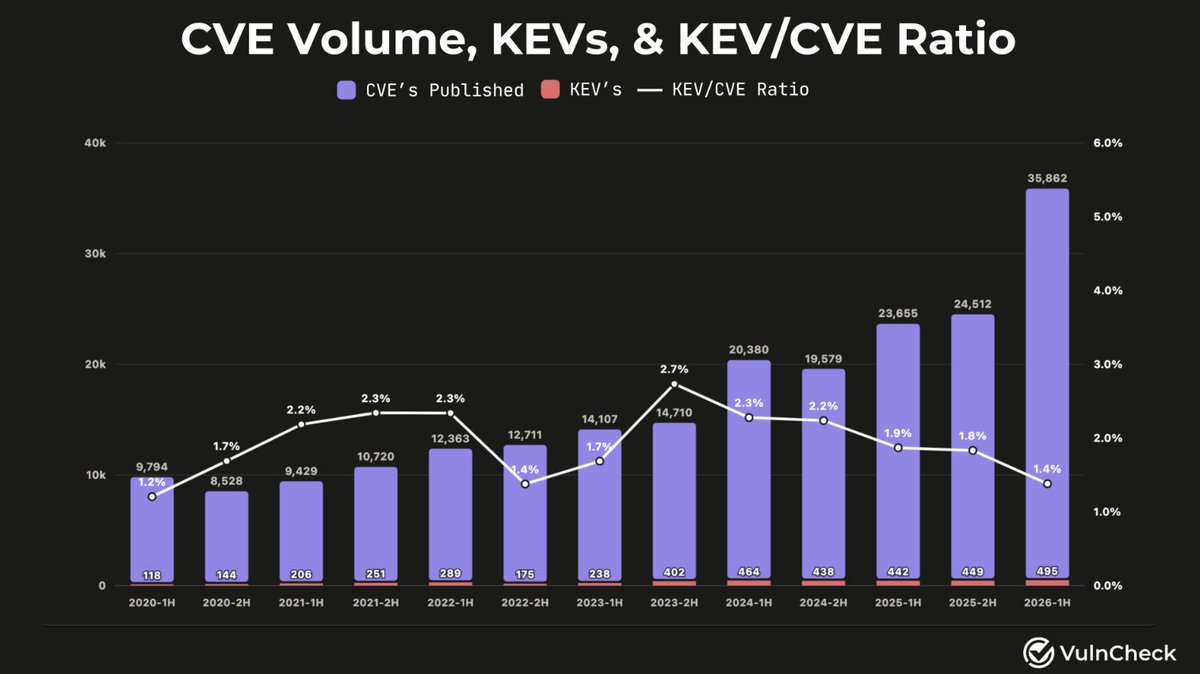
Vulnerability disclosures exploded this year and actual exploitation barely moved with them. Vulncheck counted a 45% jump in CVEs in the first half of 2026 against a 10% rise in the ones known to be exploited.
METR published the wider picture last week. OpenSSL went from 6 disclosures in all of 2025 to 39 by early August. Stockfish, measured on fixed hardware the whole time, shows no acceleration at all and not one Elo point credited to a model.
The pattern is about verification cost. Finding something is a search problem, and search is what these models are cheap at. Using it is a measurement problem, and measurement did not get cheaper.
That gap is my last seven months. I generate candidate setups faster than I ever could. I still cannot shorten the part where the market has to pay me before I know I was right.
Caveat: METR only sees public data, and labs have obvious reasons to sit on internal wins.
The question I keep failing to answer is which of my dead strategies were bad ideas and which were fine ideas I measured badly. Has anyone found a way to separate those before spending the money?
THE MOST EXPENSIVE HACK IN CRYPTO HISTORY STARTED WITH A LINKEDIN MESSAGE.
A Sky Mavis engineer got an unusually good job offer in 2022. Multiple interview rounds, a generous package, a PDF to review.
The PDF was spyware. It reached 4 of 9 validator keys securing a $625M bridge. The 5th key came from a permission nobody remembered to revoke, months after the arrangement that granted it had ended.
$625M moved out. Nobody noticed for six days.
Not a zero-day. A job application and a forgotten permission.
Full breakdown below.
HUNDREDS OF BILLIONS IN BITCOIN ARE ALREADY EXPOSED TO AN ATTACK THAT DOESN'T EXIST YET.
IBM's CEO puts the timeline at 3-4 years before this should make you "rather paranoid."
20-50% of circulating Bitcoin sits in addresses with a reused, exposed public key.
Millions of those coins can never move to a safer address. Their owners are gone.
"Harvest now, decrypt later": an attacker doesn't need the technology today. Just your public key and patience.
Full breakdown below.