Still running the house off a connection that drops out every time the wind picks up?
Starlink is internet that literally comes from space. Fast at home, and it works on the road too.
Sign up through my link and we both get $110:
https://t.co/gNbyV2aK89
Both McLarens were thrown out of Las Vegas last year for worn skids. The limit they broke has changed for 2026.
2025 (Technical Regulations Article 3.5.9): plank 10mm thick when new, 9mm minimum after wear.
2026 (Section C, Article C3.6.1): still 10mm new, but the minimum is now 8mm.
The FIA stewards' Vegas 2025 decisions list the readings. Norris's lowest was 8.88mm. Piastri's was 8.74mm. Both under 9mm, both above 8mm.
That comparison is our own arithmetic, not an FIA statement. The stewards also say a re-measure came in lower still and give no figures, so treat it as rough.
How it's checked now: the skid comes off the car and gets measured with a micrometer around each of the three plank holes. The whole edge of every hole has to be inside the limit, so one thin spot is enough.
What it doesn't tell you: these are 2026 cars built to a different rulebook, so last year's wear says nothing about this year's. My read is that a bigger allowance mostly gets spent on running the car lower, which is exactly what the plank is there to police.
FIA 2026 Section C: https://t.co/IOlhFPgNoP
#F1 #LasVegasGP
Phone Pilot: free @bot and @grok template. Your bot drives iPhone and Android from a Windows PC, no Mac, several at once. Tested on Safari, YouTube, X and Mail. Write-up on my profile.
Drop what breaks in the replies, plus your phone model.
https://t.co/ta0OZE3kF9
#AIAgents
Wrote up Phone Pilot, a free @bot and @grok template that drives your iPhone from Windows, no Mac. Real WhatsApp, Instagram and Discord DMs sent. Dry runs now 5 to 9 s. Drop what breaks in the replies, plus your phone model. https://t.co/Fz9zFwT4fI
"Half of Ethereum blocks are now protected" is the wrong way to read the Phylax and Titan news. What protects an app is whether it installed an onchain guard.
Since 10 Nov, apps can register Solidity rules that Titan Builder checks while it builds blocks, and a transaction that breaks one is left out. Phylax puts Titan at roughly half of Ethereum blocks.
On its own, that just sends an attacker to another builder. So Phylax adds a guard: a protected function checks whether the current block carries a marker from an authorized builder, and reverts if it doesn't. Today that means Titan blocks. Phylax's Credible RPC routes transactions to participating builders. Send one another way and another builder may include it, where it reverts and still costs gas.
Three limits from Phylax's own docs:
1. Fail-open. A guard can be set to let calls through after a gap with no marked blocks. In that window other builders can include protected calls and run no rules.
2. The marker is the builder's word. The guard checks the marker, not a proof that the rules ran.
3. Rules only catch what they describe. Per Bankless, Denaria lost about $166K on Linea in April to an accounting bug its one rule (no bad debt) didn't cover.
Two more: a successful wallet simulation isn't proof the guard works, because zero gas price calls skip the marker check. And a rejected transaction isn't queued. Your wallet or relayer decides whether to retry.
If an app says it's protected, the useful questions are which functions are guarded, what the fail-open gap is, and which rules are live.
https://t.co/JXjfdfyJgO
#Ethereum #DeFi
AWS Emulator matches real AWS far better at creating Lambda functions than at running them.
AWS released the free local emulator on 11 Nov and pitches it for coding agents that test against AWS. Each release ships a scores file. The public fidelity test suite labels every test control plane (create, describe, delete) or data plane (invoke, read, write, send).
Joining the two for release v1.0.322:
Lambda control plane: 138 of 159 pass
Lambda data plane, mostly invokes: 130 of 429
Tests that call a function URL: 0 of 30
For comparison on the data plane: SQS 217 of 230, S3 257 of 322, DynamoDB 371 of 465.
So a local run that deploys a function and invokes it tells you a lot less than one that writes to SQS or S3. AWS's docs say the same in general terms: control plane matches most closely, data plane varies by service.
To check your own app, list the AWS operations it calls, find them in the manifest file of the aws-emulator-evaluation-suite repo, then look up those test IDs in your release's scores file. If no test covers an operation, it isn't verified either way.
Caveats: this is a tally of AWS's published files, not an AWS figure. Single-service tests only, scores change with every release, and the emulator doesn't evaluate IAM policies the way AWS does.
https://t.co/WCtuABBQY3
#AWS #AIagents
At 50% of ETH staked, EIP-8363 would burn all consensus issuance. At today's ~36%, its full taper would take net consensus yield under 1%. It's a draft and isn't scheduled for any fork. How the burn works 👇
#Ethereum#Staking https://t.co/iTZ5Met3pC
If you build Solana programs, the durable nonce removal isn't only a custodian problem. Your program might lock those custodians out.
The replacements (Anza's Programmatic Signer, Blueshift's Vector) move a cold key's authority to a PDA. Your program then gets those calls as a CPI, at stack height 3 or 2, never top-level.
The Solana Foundation's migration page names three common checks that reject that:
- asserting the call is at transaction-level stack height
- reading the instructions sysvar for a repay or precompile instruction (nested ones don't appear there)
- Token-2022 CPI Guard, which blocks owner-signed transfers and burns and all approvals made through CPI
Its fix: allow the known signer program IDs, or offer another path.
Timing: draft SIMD-0723 (filed 5 Nov, still an open PR) says no mainnet activation before 5 May 2027. The Foundation page still says no date set, roughly six months after a replacement is ready. Programmatic Signer is on devnet and pre-audit. Vector's audit status isn't stated.
Got a flash loan, a precompile check or a top-level-only rule? Test it against a signer PDA on devnet before custodians start migrating.
Source: https://t.co/90JGR09blS
#Solana #DeFi
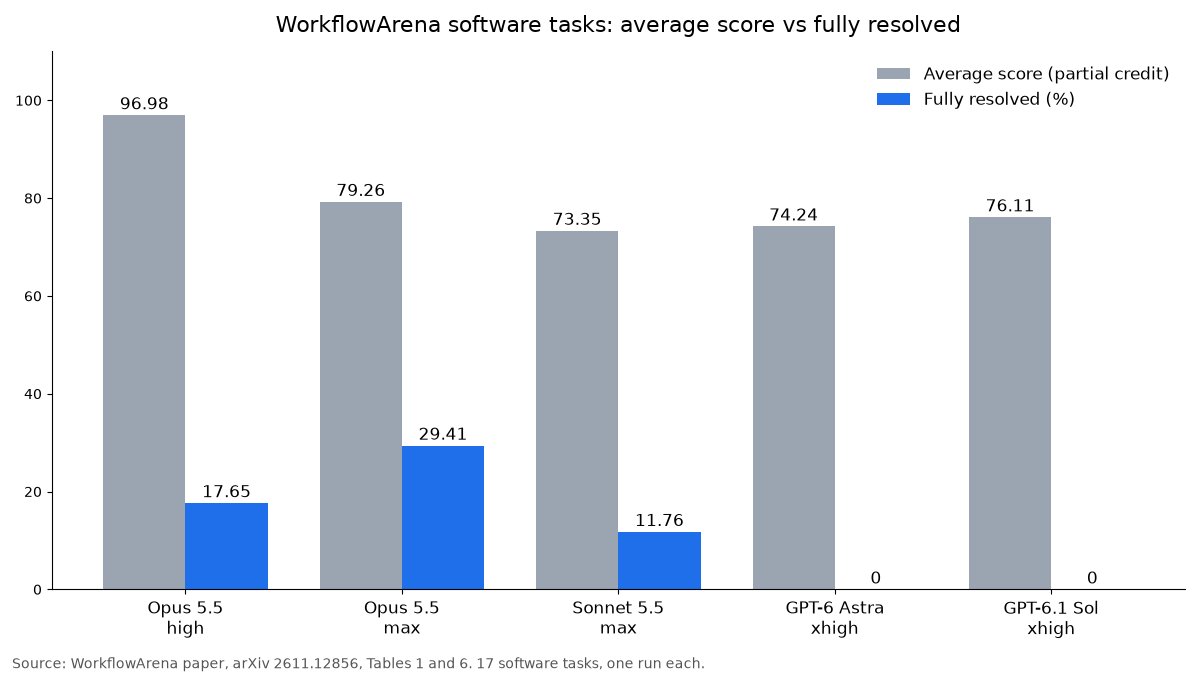
A new agent benchmark shows how a high average score can hide very little finished work.
WorkflowArena (Einsia's Navers Lab with Tsinghua, paper dated 9 Nov) gives Claude Code and Codex 145 long tasks across 8 fields, 4 hours each, and lets the model decide whether to split the job across up to 16 workers. A task only counts as resolved if every acceptance check passes.
On the software tasks, Opus 5.5 at high effort averaged 96.98 out of 100 but fully resolved 17.65% of them. GPT-6 Astra and Sol scored 71 to 79 there and resolved none, apart from Astra at low effort.
Best overall was Opus 5.5 at max effort, 36.95% resolved. Estimated cost per task: Sol at low effort 27.59% for $3.61, Opus at high 34.11% for $6.66, Astra at xhigh 30.80% for $29.26.
If you're comparing agents for real work, ask for the share of tasks where every check passed. Partial credit flattered every model in this test.
Caveats from the paper itself: one run per task, each model tested in one harness only, and video and 3D work graded by an LLM judge.
Paper: https://t.co/RJzU457bsH
#AIagents #ClaudeCode
Antonelli has the 2026 title. Second place is still open to five drivers.
Three Grands Prix left: Las Vegas, Qatar and Abu Dhabi. None of them is a Sprint weekend, and the fastest-lap point is gone, so the most anyone can add is 75.
Gaps to Verstappen on 279:
Russell 262 (-17)
Hamilton 261 (-18)
Leclerc 249 (-30)
Norris 246 (-33)
All five can still finish P2. Piastri, on 152, can't.
Verstappen seals it once his lead over everyone is bigger than 25 per race left: 51 or more after Las Vegas, 26 or more after Qatar. If two drivers end level, most wins decides (FIA Sporting Regulations A2.1.4).
Sources: F1 drivers' standings https://t.co/HlAJ179HW5 and FIA 2026 Sporting Regulations Section A.
#F1 #LasVegasGP
New Article: Claude Code workflows move the plan out of Claude's context and into a script.
The limits (16 agents at once, 4,096 per fan-out, 1,000 per run) and the rerun trap when one agent fails.
#ClaudeCode#AIagents https://t.co/y3PNYGacJM
Before you buy SOL on Schwab: its crypto FAQ says you can only send and receive Bitcoin and Ether. SOL, AVAX and LINK bought there stay there for now, and you sell them for cash.
What else the FAQ spells out:
The fee is 0.75% on every buy and again on every sell, $0.01 minimum. On $10,000 that's $75 going in. Schwab says it adds no markup to the quote.
Withdrawals (BTC and ETH only) max out at $5,000 a transfer, up to 3 per 24 hours. A new wallet address sits on your allowlist for 24 hours before you can use it. Transfers are still being switched on in phases, you need a passkey to enrol, and you pay the network fee.
The account is held at Charles Schwab Premier Bank, not the broker. Cash in it is FDIC insured up to $250k and earns no interest. The coins aren't FDIC insured or SIPC protected.
No margin. Not available in New York, Louisiana or outside the US.
Fine if you want SOL in the same view as your stocks and never plan to move it. If you want it in your own wallet, buy it somewhere that lets you withdraw it.
https://t.co/MqrK4qK3kv
#Solana #Crypto
Claude Code got it wrong. Do you switch to a bigger model or raise effort?
The Claude Code team's answer is two questions. If Claude had the right context, clearly tried, and was still wrong, it didn't know enough. Pick a bigger model. If it skipped a file, didn't run the tests or quit a refactor halfway, it didn't try hard enough. Raise effort.
Effort is more than thinking time. It also sets how many files Claude reads, how much it checks its work and how far it gets before coming back to you.
Check your context before touching either. A vague prompt, missing tools or an out-of-date CLAUDE.md all look like a weak model. Anthropic says when you're raising effort on a task that shouldn't need it, the fix is often upstream.
Two quick cases:
It keeps calling an API that the docs in its context say doesn't exist. That points to the model.
It changed 3 of 5 call sites and never ran the tests. That points to effort.
Claude API defaults from the model docs: Opus 5.5 and Haiku 5.5 start at medium effort, Fable 5.2 and Sonnet 5.5 at high. Anthropic says most work should start on Opus 5.5, and to move to Fable 5.2 only when Opus at xhigh or max still falls short. Per million input/output tokens: Fable 5.2 $8/$40, Opus 5.5 $4/$20, Sonnet 5.5 $2/$10.
Anthropic calls the two questions a starting point for choosing, and says to leave both settings on default most of the time.
https://t.co/B6ESGJa4X5
https://t.co/E5cJ6B7Tue
#ClaudeCode #AIcoding
We're giving Ultra and Team Premium users Fable resets based on how long you've subscribed:
<6 mo: 1
6–12 mo: 2
>12 mo: 3
Use them anytime by March 8.
Pro and Team Standard get a week to try Fable 5.2, up to half your weekly limit, plus one reset. https://t.co/5qghe1jhxP
Bortoleto took a 10-place grid penalty in Brazil and started three places higher than he qualified. Lindblad's 10 cost him only 4. The FIA builds every grid in five fixed steps, and you can redo it from two documents 👇
#F1#BrazilGP https://t.co/s01gBhv4h7
Tell a coding agent a rule once and it fades. In Garry Tan's open harness evals, a rule given once in a session was followed on 2 of 10 later turns in Hermes and 4 of 10 in OpenClaw. A hook that repeated it every turn got 10 of 10.
The test was one 289-byte rule, "check gbrain first", run through four harnesses on 10 public tasks, 30 turns per setup. Claude Code ran on Opus 5.5. Codex, Hermes and OpenClaw ran on GPT-6.1 Sol.
Skills were patchier. Installed and never mentioned, Claude Code and Hermes saw the skill's name in every request and opened it 0 times in 30 turns. Codex and OpenClaw did open it. One added line, "Use the brain-first skill.", took Claude Code to 30 of 30.
The startup file got 30 of 30 on all four harnesses.
What I'd take from it:
If a skill matters, name it in the prompt.
If a rule is must-follow, put it in the startup file, the system prompt or a per-turn hook.
Don't count on a rule you said once.
Limits, from the report itself: one repetition on 10 public tasks, so it's descriptive. Opus already checked gbrain 17 to 18 times out of 30 with no rule at all. Following the rule cost 10% to 55% more per turn with no pass-rate gain. And gbrain is Tan's own project.
https://t.co/HEtrpyUh2B
#AIagents #AIcoding
Truffle Security found a working GitLab token inside .claude/settings.local.json in a published Docker image. Since January 2025 they've counted 2,655 working keys in AI coding tools' config files.
How it gets there: pick "Yes, and don't ask again" on a Bash prompt and Claude Code saves the approval to that file. If the prompt offered the exact command, any password typed into it gets saved too.
Claude Code's docs say it keeps the file out of your commits via your global git excludes. A local docker build doesn't read git's ignore rules. It sends every subdirectory unless .dockerignore drops it, so COPY . . ships the file.
Add to .dockerignore:
**/.claude
Then check what you've already approved:
grep -n "Bash(" .claude/settings.local.json
Literal key in a rule? Rotate the key first, then delete the rule. Use "$DB_URL" in commands so the rule saves a name. An inline DB_URL=... prefix still saves the value.
Trade-off: that line also drops a committed .claude/settings.json, which matters if your container runs Claude Code with team settings.
Sources:
https://t.co/dBF5v8briu
https://t.co/wdtrFMdiS2
#ClaudeCode #AppSec
Stable Claude Code is still on 2.1.311. The privacy mod that blocks email-in-User-Agent only starts at 2.1.317. Operator checklist for issue 107757 👇
#ClaudeCode#Anthropic https://t.co/2xzDWvzgJj