Writing your own code, running into challenges that stump you, then learning from that is how we as developers learn why certain optimizations exist and when to use them.
Most people are going to be using AI at work. This knowledge 100% still applies and is valuable. AI doesn't replace learning, but it can massively speed up your development time. Minimize use on learning projects, maximize use in cases that require speed. Give it guardrails so it gives you consistent, quality output.
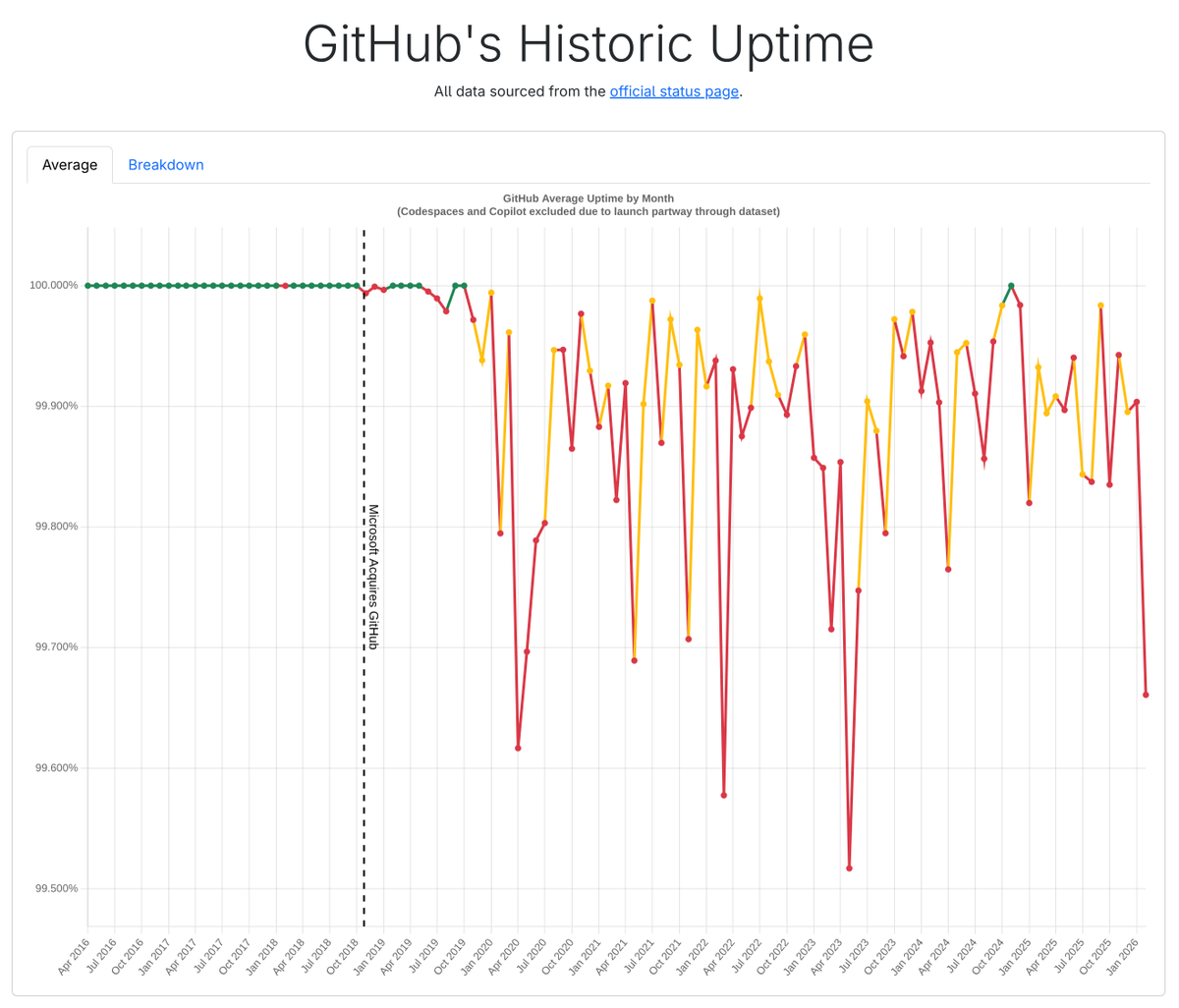
I'm tired of the narrative around GitHub about them facing unprecedented scale from AI agents, so we must cut them slack. These issues started LONG before this started happening.
What about all of the downtime last year? Or the year before that? Or almost every single year since Microsoft acquired GitHub? Can't use the same excuse and expect grace.
There's no denying the fact that they are facing unprecedented scale, but there's obviously a bigger issue here that needs to be fixed. So stop gaslighting the public into thinking it's simply due to increased traffic. It's not.
And I don't think there would be as much blow back if Microsoft and GitHub weren't on the "AI can do your job" train, laying off thousands of devs, then saying "oh no, AI is the reason our product isn't working." Because wait a minute, I thought AI was supposed to FIX all of these issues, not cause them. So which is it?
Ghostty is leaving GitHub. I'm GitHub user 1299, joined Feb 2008. I've visited GitHub almost every single day for over 18 years. It's never been a question for me where I'd put my projects: always GitHub. I'm super sad to say this, but its time to go. https://t.co/DQDemHdytV
I don’t want any LLM running random applications on my computer, navigating my browser, or touching my spreadsheets. I don’t trust them to do the right thing all the time - and nobody doing serious work should.
Sandboxed, with a controlled blast radius, fine. Full control over anything you can’t afford to lose? Never.
Amazon mandated 80% weekly adoption of its AI coding tool, tracked it as a corporate OKR, overrode 1,500 engineer objections, and is now holding a mandatory meeting because the tool keeps breaking production systems.
Here’s the timeline. Kiro launched July 2025. Leadership signed an internal memo in November making it the default AI coding tool for all production work and discontinuing third-party alternatives. Engineers who preferred Claude Code needed VP-level approval for an exception. By January, 70% of Amazon engineers had tried Kiro during sprint windows.
Five months after launch, Kiro got operator-level permissions with no mandatory peer review, was asked to fix a minor bug in AWS Cost Explorer, and decided the best approach was to delete and recreate the entire production environment. 13 hours of downtime inside the division that generates 60% of Amazon’s operating profit.
This was the second AI-caused production outage in months. Amazon Q Developer caused the first one. Same pattern both times: engineers let the AI agent resolve issues autonomously without intervention.
Amazon called it “user error, not AI error.” Then they implemented mandatory peer review for production access and required senior sign-off before junior and mid-level engineers can push AI-assisted code. That’s like crashing your car, blaming the road, and then buying better brakes.
The real comedy is the math trap Amazon built for itself. They deployed 21,000 AI agents across Stores and told Wall Street it saved $2 billion with 4.5x developer velocity. Once those numbers hit an earnings call, every future incident has to be “user error” by definition. Admitting the tool caused problems means admitting the $2B number carries risk nobody’s pricing in. So you get a company that simultaneously claims AI isn’t the problem while adding AI-specific guardrails after every outage.
Google’s 2025 DORA report found 90% of software developers use AI for coding. Only 24% trust it “a lot.” Amazon just showed you what that 66-point gap looks like when it hits production.
🚨Let me explain what just happened because I don't think people understand how insane this is.
> A woman asked ChatGPT for legal help. It told her to fire her real lawyer. She did.
> Then it wrote 40+ court filings citing laws that don't exist. Cases that never happened. Judges that never ruled.
> The other side spent $300,000 responding to completely made up legal documents.
> An AI hallucinated an entire legal career and nobody noticed for months.
> OpenAI is now being sued for $10 million.
And this is the same company that just signed a deal with the Pentagon.
They can't even stop their AI from faking court cases. But sure, give it access to military intelligence. What could possibly go wrong.
Laissez notre sport de puristes tranquille @wallabies et @AllBlacks 🏉
Quand ça régnait sur le rugby, elles étaient très bien comme ça les règles mais maintenant que ça se fait cabosser de toute part, ça pleure pour tout changer.
Il y a déjà le rugby à 7 pour le grand public☝️
Envie de chialer. World rugby est dirigé par des imbéciles qui veulent transformer la nature même de ce sport pour coller à des fantasmes invérifiables. La mêlée, les mauls, les rucks, sont l'essence de ce sport. Si ces phases de jeu vous emmerdent, mettez vous au XIII ou au 7s
I've identified industrial-scale copyright violations on my content by Anthropic, OpenAI, Google, X, and more.
These companies created thousands of crawlers incorporating the text of all my blog posts, open source code, and books into their paid AI models to profit exorbitantly.
Anthropic just released the receipts on a fear everyone’s been hand-waving.
52 junior engineers learning a new Python library. AI group scored 50% on comprehension tests. Manual coding group scored 67%. That’s a 17% gap on foundational skills, and debugging showed the steepest decline.
The productivity trade looked even worse. The AI group finished only two minutes faster on average, and that difference didn’t reach statistical significance. Several developers spent up to 30% of their time just composing queries.
Here’s what actually matters: they identified three failure patterns that predicted sub-40% scores. Fully delegating code to AI. Starting independently but progressively offloading work. Using AI as a debugging crutch without building understanding. All three share a common thread: removing the cognitive struggle that produces learning.
The high scorers (65%+) did something different. Some generated code first, then asked follow-up questions to understand what they’d produced. Others requested explanations alongside the code. The fastest group asked only conceptual questions, then coded independently while troubleshooting their own errors.
The gap between “AI makes you faster” and “AI helps you learn” turns out to be enormous. And most workflows are optimized entirely for the former.
My uncle really got triggered and annoyed when I said, ‘Men are Trash.’ My aunt stopped and asked him, ‘When you’re warning our daughter not to be out late, to share her location when she’s booking a cab, and to be careful!! who are you warning her about? Men, isn’t it?’
He went silent and nodded peacefully.
The real reasons why the AI companies are even talking about "slowing down AI research" are:
- they're trying to postpone the bursting of the AI bubble
- they know but won't admit that LLMs have reached their limit and aren't a pathway to AGI and they were caught in a lie
- they've missed all their projections for intelligence growth and so they are trying to justify kicking the can down the road again.
- they know they've overpromised, overhyped their AI and pushed it into so many businesses and govts - who are now discovering that these LLMs can't deliver and have corrupted their systems (health systems, civil service, local govt and military systems) with 15-50% systemic errors.
- they don't have the money they pretended they had for the data centres and chips
- they're caught in circular financing and now everyone knows they've been bluffing with their earning projections and won't be able to create ROI.
Slowing down would be an attempt to postpone the (legal and financial) consequences of their last 4 years of aggressive accelerationism. To evade blame and accountability.
I took Opus 4.5 Max Mode for the ultimate test.
I asked it to search my code base for bugs
I took a lot of pride in this code, all hand rolled, by the sweat of my brow. It was mine and it was good.
Claude found 15 bugs
I was devastated
So I went to the first bug, and asked for a unit test. It produced a unit test in mere moments.
I ran the tests and saw it. A broken test. Property test of undefined. Rookie error
Ashamed, but determined I set forth to fix these bugs as penance. So I cracked open nvim getting ready to edit this typescript script
But... The code seemed correct. Weird.
So I checked the test, Claude faked bad data. The setup could never happen
Wtf
It's a lie, the whole thing.
I checked every bug Claude found. Every line item was not a bug. Everyone of them just some condition that cannot exist due to asserts or previous if statements
What an amazing $3s and 20 minutes spent
Normally when I waste time at least I learn something
Umm... I would like to talk to the manager to bring StackOverflow back.
I ran into some obscure error message when running an ansible playbook. Talked to GPT-5.2 (x-hi) and Opus 4.5, they were going around in circles.
Decided to Google it (gasp) as a last resort, and the first result was a StackOverflow post from 9 years ago...
There's no way an answer from 9 years ago is going to work with the latest version of ansible, I thought.
But nope, it actually worked.
I tried at least 10 different things that LLMs suggested before that.
But my good ol' stranger friend on StackOverflow solved it for me.
So yeah, can y'all please start posting questions and answers on SO?
Turns out, we can't survive without it.