@KotanicalKarl@Moneytaur_ He’s offering something way better than just giving you A fish
he’s teaching HOW to fish
All it takes is time, effort, and consistency in the learning process
Everything you need is available on his X account “for free”
The only question is: how far do you want to go?
@MariusSm1th Amazing! Thank you, I usually tend to ignore when mitigated, will see how that plays and do some backtesting on similar plays
Thanks again Marius!
@MariusSm1th Ya ive been checking those wicks, a 10min OB on the MTF SH, as well as a 25min OB on the HTF SH wick
Regarding the LTF mitigated ones, why would you consider it if already wicked before especially if LTF
One of the biggest challenges in trading isn’t spotting the "perfect" level, nor it's finding a good setup, it's having the courage to take it.
You’ve done the work, your levels are clean, the environment is moving into your favor.. It’s all there.
Technically speaking, this is the moment you’ve been waiting for.
But then something strange happens.
Your logic starts to blur.
Confidence gives way to doubt.
Your finger hovers over the entry button, but you can’t click.
You hesitate… and the moment slips away.
Despite a perfect setup, your mind begins its usual "business":
"What if I’m not correct?"
"What if this level doesn’t hold?"
"What if I’m walking into a trap?"
"What if I just lose, again?"
You’re no longer trading the chart, you’re trading your own emotions: fear of being wrong, of losing again, of confirming that voice in your head that says maybe you're not as good as you thought.
This is paralysis, and it’s a silent killer in trading.
It doesn’t make noise like a blown account or a huge red day.
It whispers, it delays, it erodes confidence trade by trade.
And the most frustrating part? The setup was there.
But doubt took over, disguised as “caution.”
You convince yourself you're being smart by waiting when really, you're just afraid to be wrong.
You forget that trading is never about being right.
It's about executing your edge, regardless of outcome.
No setup, no matter how perfect, can override a mind that’s terrified of uncertainty, and in trading, uncertainty is part of the job.
You cannot eliminate it, you can only train yourself to move despite it.
This paralysis doesn’t mean your strategy is broken.
It means your relationship with risk, loss, and identity needs work because behind that hesitation is a deeper fear, that being wrong somehow means you’re not good enough, that another loss is a reflection of your worth.
But you have to remember: your job is not to predict the future.
Your job is to execute what your plan tells you to do, over and over again, regardless of fear.
Sometimes, the hardest part of trading isn’t building the setup, it’s trusting yourself enough to take it.
And that trust… it isn’t built through wins.
It’s built through presence, through showing up, through taking the trade even when it terrifies you, because that’s how you teach your nervous system that discomfort isn’t danger.
That fear isn��t a signal to freeze, but an invitation to act with intention.
You don’t become a confident trader by waiting for the fear to go away, you become one by learning how to trade alongside it.
Every time you flinch and don’t enter, you reinforce the idea that fear is in control.
And every time you step in, even when your stomach’s tight and your mind’s loud, you start shifting that power back into your own hands.
But this takes honesty.
You have to get real about what you’re actually afraid of.
Because often, it’s not the trade itself. It’s the story you’ve attached to it.
The meaning you’ve loaded onto it.
“If I lose this trade, it proves I don’t know what I’m doing.”
“If I miss this move, I’m failing myself again.”
“If I keep getting it wrong, maybe I was never cut out for this.”
These are not trading thoughts, these are self-worth wounds disguised as market analysis.
The more you internalize outcomes, the more personal every tick becomes.
Instead of being a participant in a probabilistic game, you become emotionally entangled in every candle and when your identity is on the line with every trade, how could you possibly feel calm enough to act?
This is why some traders spend years “studying” without progress, not because they lack knowledge, but because they never healed the emotional baggage that sits between knowing and doing.
Trading is not just technical.
It’s deeply psychological.
And the deeper you go into this game, the more you realize that the real work isn’t in the charts but It’s in the mirror.
You have to rebuild your relationship with uncertainty with failure and with yourself.
You have to learn to see losses as part of the equation, not punishments.
You have to forgive your past mistakes, or you’ll keep replaying them.
And maybe hardest of all:
You have to stop trying to prove something every time you trade.
You don’t need to win to validate your worth.
You don’t need to be perfect to be consistent.
You just need to be aligned with your process and courageous enough to honor it.
So next time you feel that hesitation rising or thenext time your hands get shaky and your brain starts spinning, pause, take a breath and come back to your plan reminding yourself that:
You are not here to be perfect, you are here to execute.
Win or lose, confidence is built through aligned action, not flawless outcomes.
And the more you choose courage over comfort, the quieter those doubts become.
Not because they disappear, but because you’ve stopped letting them decide for you.
That’s when you become dangerous, not because you can’t lose, but because you no longer fear it.
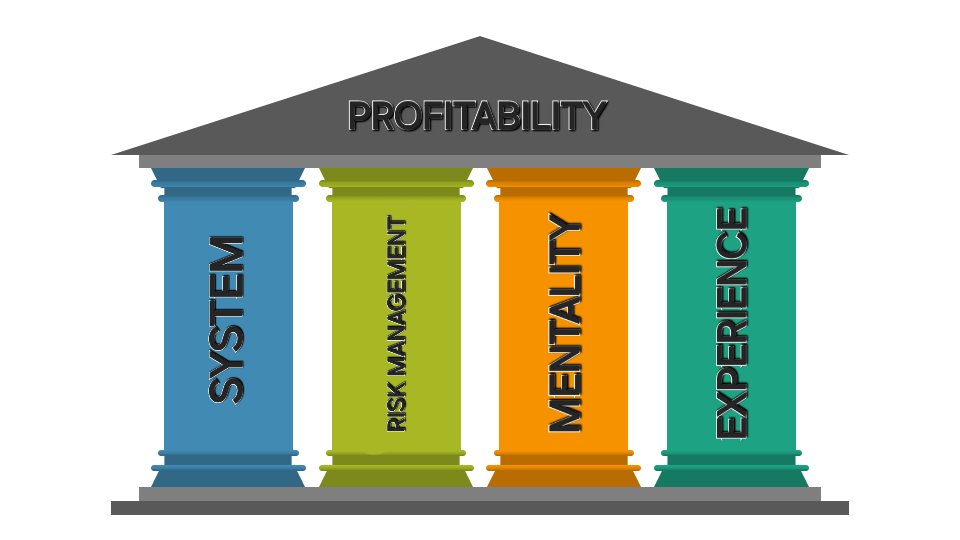
The 4 Pillars of Profitability:
In order to reach something so difficult, it almost seems impossible; we must break it down to its most basic elements and tackle each element in the most effective way.
Here are the four basic elements of profitability: System, Risk management, Mentality, and Experience. I call these four elements the four pillars that support the state of profitability.
System: This is the technical system that is used to dictate your entry, SL, TP, when to trail, and basically anything that happens on the chart. Contrary to most believe, this is the easiest element to learn and tackle.
Risk management: Risk management is a tool that no profitable trader can do without! RM is the only thing that is keeping you in the game, and by staying in the game, you guarantee to reach your goal, eventually. RM is a purely probabilistic / mathematical element, so you need to run simulations or do basic calculations based on your system and performance to see how much risk you can handle without blowing up
Mentality: This might be the hardest element to tackle, as you need to admit and embrace all your flaws and then reconcile with them logically. this requires you to develop considerable emotional intelligence and logic. You might need to reconcile with previous childhood trauma, past accumulated emotions, and even basic human reactions. You should expect to spend the most amount of time erecting this pillar.
Experience: Here is the thing about experience, you cannot force it. By staying in the game, you will go through many experiences and emotions. The deciding factor is how fast you learn from these experiences, and this is linked to the quality of your journal (will drop a thread on this later) as it is the only thing that creates a closed feedback loop.
Alright, we know what the pillars of profitability are now. How do we improve on each?
As for the System, you either decode and learn all you can about it from your mentor / the person who taught you, or backtest and see how you could improve on your own system if you developed it. Here is an extra bonus. Sometimes, the same system can yield different results based on the trader. Personally, I am not so good trading against the market structure and catching falling knives, so I avoid it for now. This might be due to me being naturally risk-averse, which might not be the case for you. So even if you learned the system from someone, you need to backtest and journal how you perform with that system and how you can improve.
As for the Risk management, you will automatically be able to increase your risk tolerance as you get better with your performance, as a higher winrate and RR means you can risk more without blowing up (Disclaimer: please make sure you know your stats well before increasing your risk tolerance). Additionally, increasing your trading size is like increasing your training weights. Just because you can bench 200lbs for two does not mean you can bench 400lbs for one. the mental strain that a larger size will have on you might reduce your performance, leading to an overall losing strategy.
As for the Mentality, I would propose to go through a dedicated system (i.e. the mental game of trading book and seminars) that is tailored for traders and provides a solid framework to work through any mental problems.
As for the Experience: you simply have to show up every day and learn from your mistakes as fast and as efficient as you can.
P.S. Notice how I said,: “ the four pillars that support the state of profitability.” ? this is because profitability is a state of being rather than a finish line. In a moment, you can be a profitable trader, and the next moment you are not, as one or more of the pillars aren’t stable.
In a future thread, I will explain how you can use a high-quality journal to extract as much valuable information as you can and boost your progress 10 folds!
"BTC updates series" continuation:
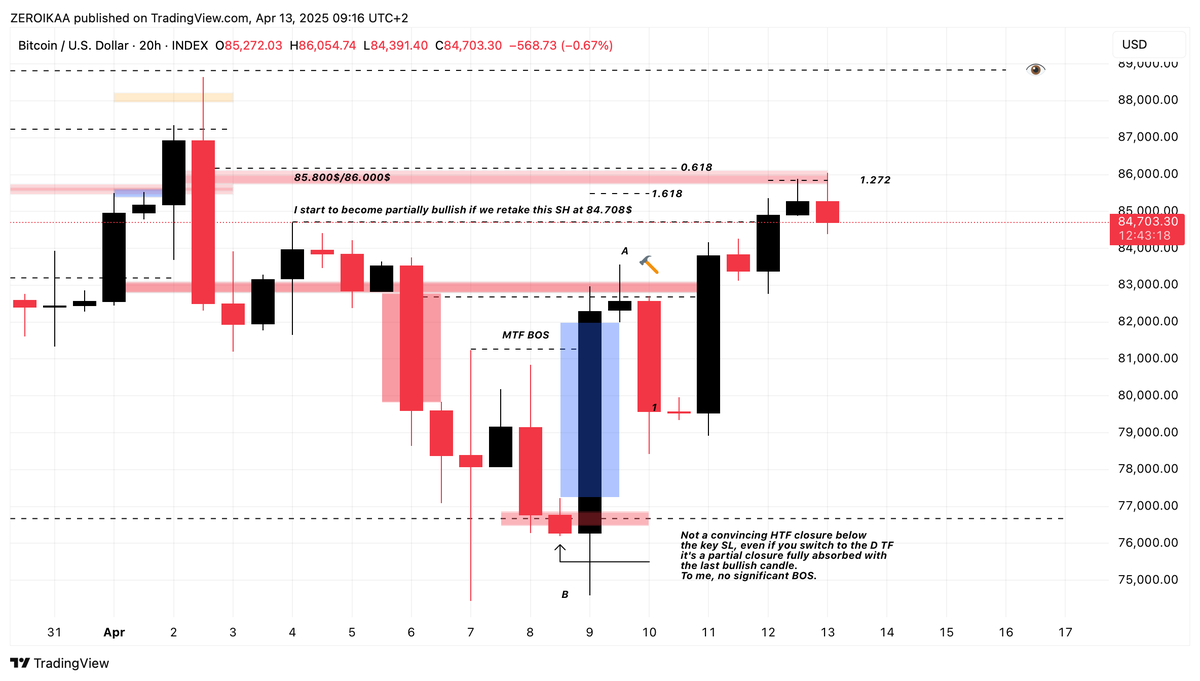
Respecting the plan mentioned in this post 10 days ago, we ultimately broke down since the PA was clearly showing SM collecting liquidity to the upside in order to fuel the next downward impulse, also "strengthened" by the fact that the classic OB had been tested several times, weakening the zone.
During the bearish impulse, an HTF supply at 83.000$ had been formed and considering that we didn't had a powerful closure below the key SL at 76.702$, the price had a higher probability of being attracted to that supply also due to the last imbalance formed on Sunday.
"Coincidentally", Trump had paused the Tariffs for 90 days (nice insider trading work Mr. President) pumping the market exactly from the SL till the HTF supply suggesting people to "buy the dip", something I mentioned live in this post https://t.co/Kgrn8dGHXv and constituting a fantastic short opportunity.
Now it's important to pay attention that the pump into HTF supply has created a MTF BOS and that's why despite the initial rejection we're seeing continuation to the upside, till..exactly, that MTF supply left behind before.
As you can see, another short opportunity is being presented with the price hitting the 1.272 Fib extension and facing a MTF correction.
I'll start to become more bullish only if we reclaim the 88.798$ high which is also the 3rd drive that led to the correction. (bullish entering longs, not macro and I'm gonna explain you why below..)
So, what I'm personally doing now?
I'm holding this short with the expectation that we might dump into the weekly closure or in the next 2/3 days, hopefully seeing a final breakdown preparatory to the next leg up.
As highlighted in this post https://t.co/ZUWENAoMhX this is the best scenario you can aspire, otherwise if we continue to rip higher from here the probabilities for seeing a powerful upside drastically decrease as there's no "fuel" in the reservoir.
It's also curious to notice that in this environment, several altcoins are approaching HTF supply/bearish imbalances so for this reason I remain in "short mode".
I'm personally not interested in buying anything spot (even if a lot of assets are trading at discount levels) until we break down on BTC otherwise, if not, I will enter on pullbacks exclusively with longs.
Time to observe at the moment.