On October 21, 1969, the Somali Supreme Revolutionary Council, led by General Mohamed Siyad Barre, staged a bloodless coup that transformed Somalia’s destiny and reshaped its modern history.
Under his visionary leadership, Somalia experienced one of the most remarkable transformations in Africa’s post-colonial era.
General Barre built over 260 industries, revolutionized the agricultural sector through modern irrigation systems, and established cooperative farming groups that empowered rural communities.
Somali banana production became the best in Africa, and the nation’s camels, cattle, goats, and sheep dominated markets across the Middle East.
He built roads, bridges, hospitals, and schools; free healthcare and education were free from primary to university level. He developed and wrote the Somali language, raising the literacy rate to 75% one of the highest in Africa at that time.
With the support of the Soviet Union, he trained and equipped one of the strongest militaries in Africa, making Somalia a respected and independent voice on the international stage.
General Siyad Barre’s Somalia championed Pan-African liberation, supporting freedom movements in Angola, Mozambique, Eritrea, Guinea-Bissau, Zimbabwe, South Africa, and many others.
Tragically, the enemies of Somalia, aided by secessionist movements such as SNM (now Somaliland), SSDF (now Puntland), SPM (now Jubaland), RRA (now South West State), and USC (now Galmudug, Hirshabelle, and Mogadishu), conspired to dismantle the unity he built.
General Barre fought tirelessly to preserve Somalia’s sovereignty and unity, but the progressive forces were defeated, and the enemies of the Somali nation prevailed, leading to the tragedy we witness today a once proud nation fragmented and weakened controlled by foreign entity.
Yet, hope endures. The young generation of Somalia must rise again, reclaim the spirit of 21 October, and restore the nation’s lost glory. Let the Somali people once more stand united, dignified, and strong a beacon of African pride and solidarity. RIP General
@AbdiwahabSheik7 Is this some kind of analysis? It's just a compilation of what is available everywhere in the media. The wisdom of the article is that Erdogan is "THE MOST IMPORTANT world leader today." Erdogan has strong trade and diplomatic relations with Israel. Everything else is theater.
What exactly is Hassan Sheikh Mohamud's endgame with SSC?
Just analyzed multiple World Bank documents revealing his administration systematically excludes SSC regions from development financing while authorizing parallel institutional frameworks for Somaliland. This isn't bureaucratic oversight, it's deliberate policy.
The constitutional contradiction is staggering: @HassanSMohamud publicly claims SSC as integral Somali territory, yet his Finance Ministers (both Dr. Elmi Mohamoud Nur in 2022 and H.E. Bihi I. Egeh in 2025) have signed agreements that exclude Las Anod, Buuhoodle, and Erigavo from ALL World Bank funding streams.
Meanwhile, unrecognized Somaliland gets "subsidiary agreements" for urban development and women's education. So let me understand this: territories Somalia doesn't recognize get better treatment than territories it does recognize?
This raises uncomfortable questions about @HassanSMohamud's true intentions. Is SSC recognition merely performative politics to maintain territorial claims while abandoning governance responsibilities? Are SSC people being used as pawns in a larger geopolitical game?
The pattern suggests either breathtaking incompetence or calculated betrayal. @HassanSMohamud's administration has created a development apartheid where SSC residents, supposedly equal under Somalia's constitution, are systematically denied the international development financing available to both Somalia proper and Somaliland.
What's the strategic logic here? Is this @HassanSMohamud's way of pressuring SSC into submission through economic strangulation? Or has he already written off these regions while maintaining the fiction of sovereignty for international consumption?
The SSC people deserve answers. They're being claimed as citizens while treated as expendable.
Federalism as a system of political ordering and power sharing might, historically, be tied to specific socio-political conditions. At least in Western Europe (and by extension in North America) and also in Ethiopia, what preceded federalism were centuries of strongly centralized rules in the form of kingships. The related societies were largely hierarchical and sedentary (consisting mainly of farmers). Against this backdrop federalism was seen as measure of establishing a fairer order and ensuring cohesion and inner peace. Yet, in a society characterized – since pre-colonial time – by decentralization, avoiding any form of institutionalized and centralized rule, like, e.g., Somali society, federalism might actually have the opposite effect: maybe it does not lead to cohesion and peaceful cooperation but actually fuels (already existing tendencies) of fragmentation.
@SuleimanHashi Aniga shaqsi ahaan maba aaminsani in madaxwayne xasan sheekh rabo in waxba ka dambeeyaan yacni in wadanku ka dambeeyo ma rabo, marka la eego sida uu wax u wado.
@OGAA_NSHO Waxba ma tarayso in shirkad somaliyed la xidho, balse aniga waxaan ka aaminsanahay shirkad bahal ah/horor ah oo ka faa'iiday dawladd la'aanta somaliya, marka aan sidaas leeyahay maaha hormuud kaliya eh waa kuwa is gaadhsiinta oo dhan.
Ahmed Saakin former federal MP and family member of renown poet Jama Kediye who was one of the first people to come to the scenes as the missile hit the vicinity of the poet retells what happens
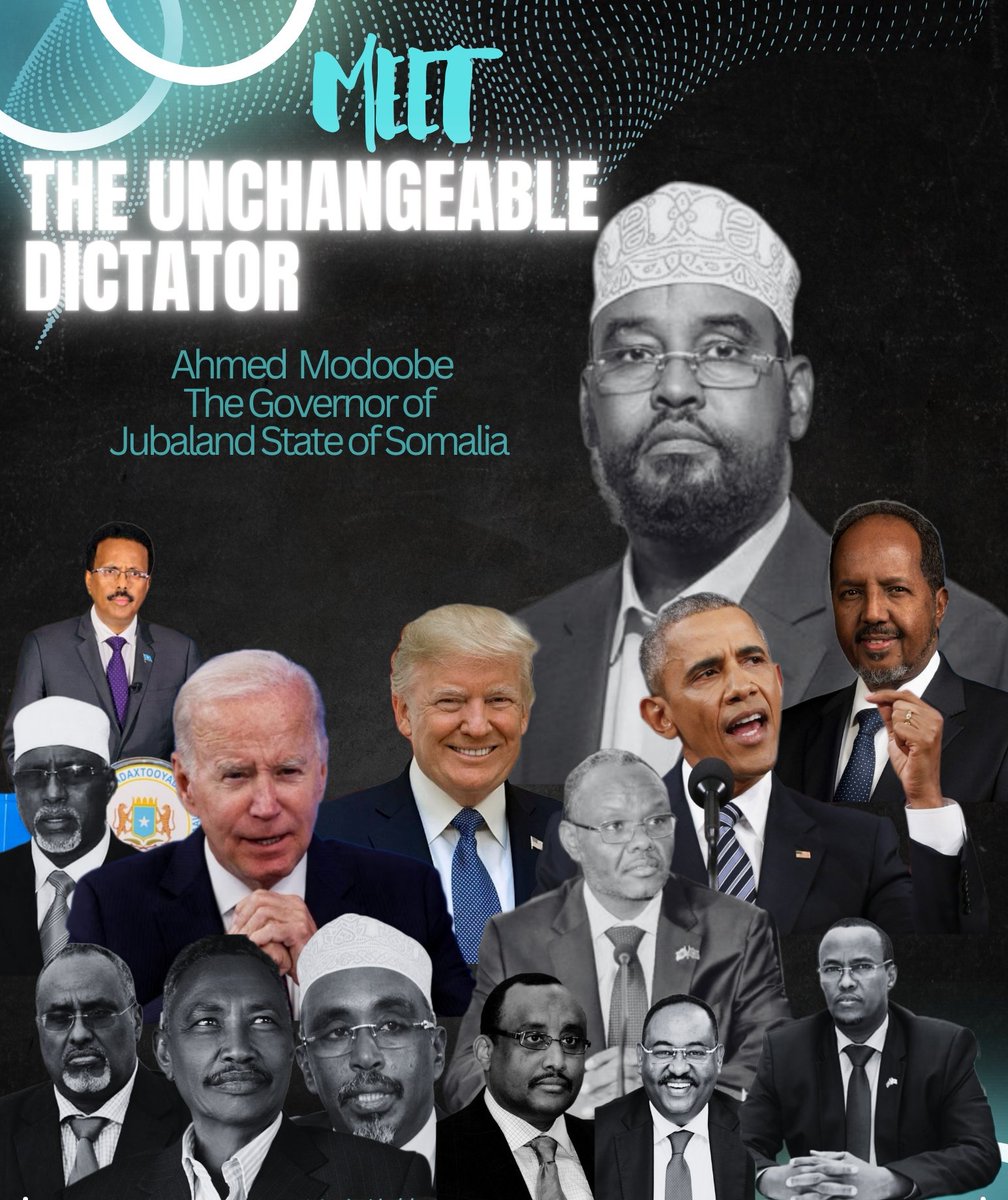
While we passionately discuss the rule of law and fair elections in #Somalia, it is disheartening to note that Jubaland, a region in the south, has not witnessed an election since 2013. As we gaze upon the poster, we witness a parade of presidents who have come and gone, occupying positions in federal member states, the central government, and even venturing as far as America. The cycle repeats itself: Ahmed Madobe in 2013, followed by Hassan Sheikh, and now, in 2023, the same pattern persists.
This raises a crucial question: Why does Hassan Sheikh hesitate to bravely confront Ahmed Madobe and demand his departure from Jubaland? It appears that internal issues with Puntland may be the cause of this trepidation. Alas, our international community was quick to criticize Farmaajo when he announced a two-year extension, yet they remain remarkably silent regarding Ahmed Madobe's nine-year extension. Such inconsistency reeks of hypocrisy. How can we truly envision Somalia's path to success if we fail to stand united against the autocratic rule of Ahmed Madobe? Moreover, how can Villa Somalia and President Hassan Sheikh expect the Somali people to embrace law and order when they themselves cannot hold Dictator Ahmed Madobe accountable?
Let us not forget Ahmed Madobe's involvement in the charcoal trade, while our government conveniently speaks of green grass initiatives. Before we dive into discussions on these lofty initiatives, should we not prioritize the sanctioning of Ahmed Madobe's illegal charcoal trade? This blatant contradiction epitomizes hypocrisy.
In the words of the renowned British novelist George Orwell, "all animals are equal, but some are more equal than others." If Hassan Sheikh engages in this game of favoritism, allowing one federal member state to act with impunity while holding others accountable, it is bound to fail. Equality under the law cannot thrive in such an environment.
Why are the secessionist in Somaliland persistently targeting individuals affiliated with esteemed organizations such as Amnesty International, renowned professors, dedicated journalists, and Action on Armed Violence (AOAV)? The accompanying screenshot serves as irrefutable evidence of these militants' aversion to international involvement and investigative efforts.President Hassan Sheikh Mahamud of Somalia finds himself in seclusion, undoubtedly cognizant of the ramifications. The abhorrent acts committed in Laascaanood have sparked global outrage, with potential implications that may lead to an investigation by the International Criminal Court (ICC). It is deeply disconcerting to observe foreign nationals, with no direct stake in the conflict, bravely attempting to report on the situation, only to face incessant harassment and. These actions flagrantly violate the established United Nations principles governing reporting procedures.
I recommend that everyone raise their voices, as this will result in positive change. I receive messages from many foreigners interested in Somalia in my direct messages. Let's not sugarcoat the issues with our leaders and instead, let's examine the root causes of the problems in our country. Despite receiving billions of aid, Somalia has not experienced any significant improvements. Numerous research papers and articles are published daily, discussing why Somalia is considered a failed state. We need to identify and address the individuals responsible for these problems. When we are born, we come into this world with nothing but our souls, and when we depart, our only possession is our soul as we face divine judgment. Our actions on this earth are meaningful. However, because we can't always trust ourselves, we must establish laws and transparent systems that can easily hold everyone accountable. Hopefully, there is now an increased motivation among the Somali people to create an environment of greater accountability. We are currently facing a widespread virus that can be cured with a single dose—unity.
#NoMoreSugarcoating #SomaliaInFocus