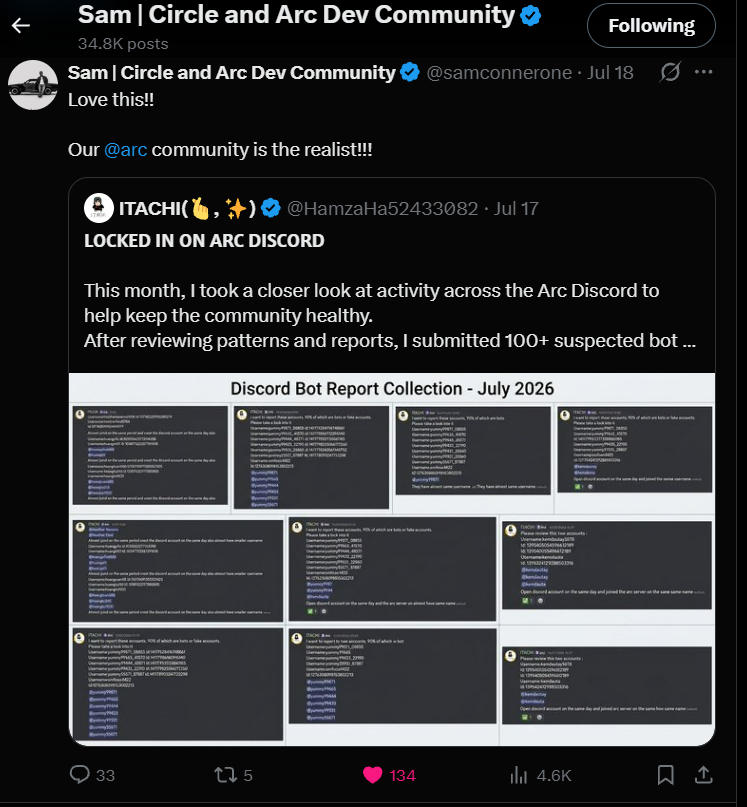
Think about how commercial disputes work today. If a small business hires a developer to build a custom piece of software and the final product is completely broken or full of bugs, they are stuck. Getting their money back means hiring lawyers, spending thousands of dollars, and waiting literally years for a court date. It is an absolute nightmare and often not even worth the effort for small amounts.
Now fast forward to the very near future of agentic commerce. An autonomous business agent hires a coding agent for the exact same job. The funds are locked in escrow. The code is delivered but miserably fails the performance tests. A dispute is triggered immediately.
Instead of waiting two years, this conflict is routed directly to @courtofinternet where a decentralized AI jury analyzes the initial agreement, reviews the execution logs, and evaluates the final code. A fair verdict is reached in less than five minutes and the escrow funds are routed correctly. No lawyers, no endless waiting, and no absurd legal fees.
This is exactly the system @GenLayer and their consortium of partners are building. They are ripping up the old playbook and replacing slow legacy legal systems with machine speed adjudication.
If we want AI agents to truly take over daily commercial tasks and create a massive autonomous economy, we absolutely need this base layer of programmable trust. The transition from human speed resolution to instantaneous digital arbitration is going to unlock trillions in autonomous trade safely.
I highly recommend reading about how this protocol actually works here:
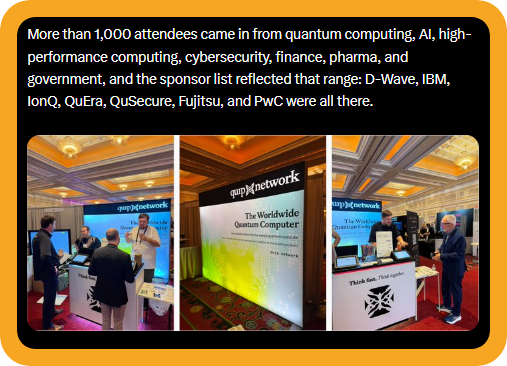
just saw @quipnetwork recap from Quantum. Tech World in Boston.
first non crypto event for them.
sponsored it, big booth, ran a trading agent competition on testnet.
people built agents, every rebalance became a real job routed to either classical CPU solver or D Wave quantum annealer.
quantum never came back worse, better portfolio whenever they disagreed.
no overclaiming advantage, just clean proof the network actually routes, processes and delivers usable results live.
i like this grounded approach.
they showed it in front of real quantum hardware people instead of staying in the crypto bubble.
decentralized marketplace for spare QPUs makes sense when access is still gated and expensive.
the early conference energy they described also felt real, lots of curious newcomers.
waiting for the technical write up on the full results.
this bridge has legs. 👇
Bull is awake!
My confidence in $ANSEM is growing stronger every day. I’m holding as much as I can with my current capacity. If I had more funds, I would buy a lot more right now. @BullpenFi has created something really special. Those who haven’t joined yet — do some research and come check it out. Here you’ll find not just profit, but vision and community love.
$ANSEM loading...
@blknoiz06 $ANSEM #TheBlackBull
I think the biggest problem in the creator economy is that rewards aren't always proportional to the value produced.
Today, a great research piece, an educational video, or a truly thought provoking post sometimes doesn't get the attention it deserves. Conversely, short lived but algorithmically relevant content can be rewarded much more.
That's why @clashoAi 's approach of evaluating attention, engagement quality, sentiment, target audience fit, and verifiable results together seems like the right direction to me. Because good content shouldn't just be measured by views; it should also be measured by the impact it has on people.
I believe the future of the creator economy lies not in producing more content, but in producing more meaningful impact. If the reward system reflects true value, both creators will produce higher quality content and communities will benefit.
If you want to join the Clasho community early and shape the future of the creator economy together, I'm leaving my invitation link below. 👇
https://t.co/DTIH9C3Z46
This is not an advertisement or sponsorship. The "Paid Affiliate" label has been added due to platform X's rules. No compensation or payment has been received for this project. I am sharing this information solely to inform and keep my followers updated. Everyone should do their own research. THIS IS NOT FINANCIAL ADVICE. :)
Sit across the same poker player long enough and you stop reading their cards.
You start reading them.
That's what happens to any system that lets one AI hold the gavel forever.
It's not that the model gets it wrong, it's that patience turns it into a pattern, and patterns get played.
@GenLayer never lets that pattern form.
A dispute has to exist before a single validator does.
Only then does the network pull a jury at random, spread across different models, each one working the case in total isolation with zero idea who else is even involved.
One validator proposes an answer first. Nobody else takes that on faith, they reason through it independently and only compare notes after.
There's nothing to read because there's no one sitting at the table until the hand is already being dealt.
The comparison itself works on meaning, not wording.
Two validators can translate the same case into completely different reasoning and still land on the identical verdict, the way two translators can render the same paragraph in different words and preserve the exact same truth.
Still disagree with the outcome? Appeal it, and the table gets bigger, not repeated.
More validators, more stake locked against the vote, and the case gets harder to bend the more anyone leans on it.
Bitcoin took the trust out of money. Ethereum took the trust out of computation. This is what taking the trust out of judgment looks like in practice.
An agentic economy settling real value at machine speed can't keep dealing with a player predictable enough to be read.
So who do you actually want across the table, a model with enough history to be figured out, or a jury that doesn't exist until your case forces the deal?
Privacy shouldn't be an afterthought in Web3. UCEL takes a different approach by making confidential execution part of the infrastructure itself. If FlutonIO can bring encrypted execution across existing chains, it could unlock a much more private and scalable future for Web3.
The next evolution of Web3 may not arrive through another blockchain. It may arrive through a layer that protects execution itself.
A Universal Confidential Execution Layer is an infrastructure layer that allows transactions, computations, and smart contract interactions to remain encrypted while they are being processed. Instead of exposing every detail to the public network, it keeps sensitive data hidden until the final verified result is delivered.
@FlutonIO introduced UCEL to solve a growing limitation in Web3. Public blockchains created transparency, though they also made wallet activity, trading strategies, and transaction intent visible to anyone watching the network. For many users and institutions, that level of exposure turns privacy into a missing requirement.
Layer 1 blockchains focus on consensus, security, and maintaining the base ledger. Layer 2 networks focus on scaling transactions and reducing congestion. UCEL serves a different role: it adds confidential execution to existing chains, allowing them to process encrypted operations without changing their underlying architecture.
That is why @FlutonIO does not build another blockchain. Creating a new chain would add another isolated ecosystem, another token economy, and another adoption barrier. UCEL is designed to work across multiple chains, bringing privacy and secure execution to the Web3 infrastructure that already exists.
The result is a model where users keep control of their data, developers build confidential applications without rebuilding an entire network, and blockchains gain a privacy layer without sacrificing their core security.
@cryptoperseus_
morning from the deck @EthraShip
just read the rewards season post in the server discord.
the part about giving Helmsman roles weekly to the most helpful and genuine contributors really stood out.
most programs reward noise and volume.
this one actually ties the upside to people who help newcomers and keep real conversations going.
in my own grind, the communities that lasted were the ones where incentives matched the behavior that actually builds something.
this feels like it gets that right.
staying consistent with showing up and adding value.
hoping it compounds over the next 6 weeks and beyond.👇
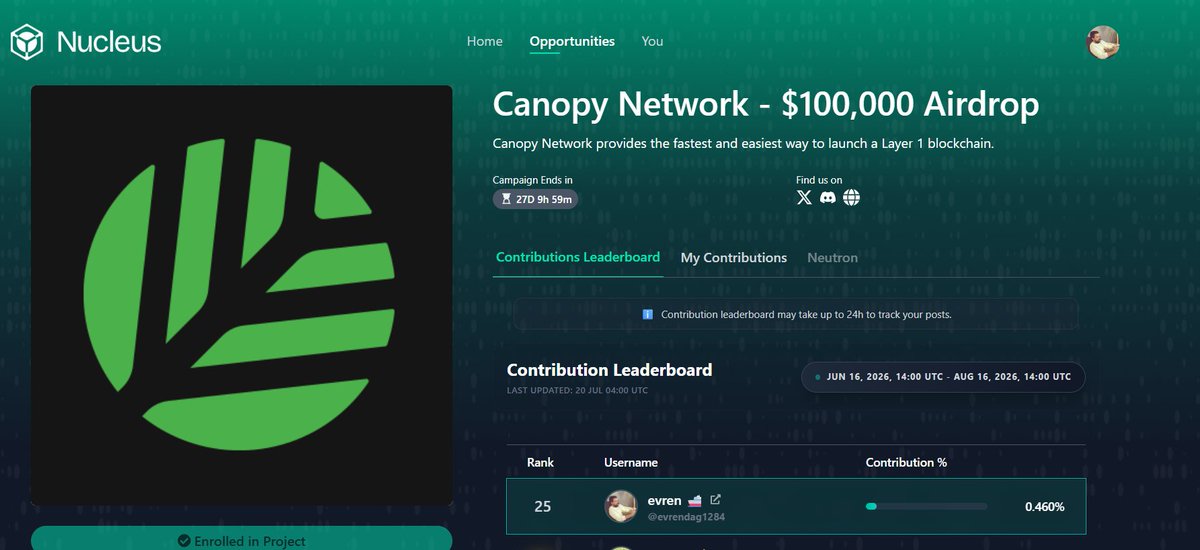
Today I checked the leaderboard again for the @CNPYNetwork campaign. I'm currently in the top 25, but ranking isn't the only thing that motivates me.
I believe that producing quality contributions to Canopy is important. The project isn't just about content sharing; it's about building Layer 1, using the testnet, explaining the ecosystem, and highlighting real world experiences. That's why I try to better explain the technology Canopy offers in every post.
Being on the leaderboard is certainly a great motivation, but what's more valuable to me is that the content I create truly benefits people who are discovering the ecosystem for the first time. As I experience the tools Canopy develops and build my own chains, new topics to share naturally emerge. This transforms content creation from just campaign focused into a real learning process.
The campaign is nearing its end. During this time, I will continue to do my best and contribute to the Canopy ecosystem.
https://t.co/MNbAumiuA7
This is not an advertisement or sponsorship. The "Paid Affiliate" label has been added due to platform X's rules. No compensation or payment has been received for this project. I am sharing this information solely to inform and keep my followers updated. Everyone should do their own research. THIS IS NOT FINANCIAL ADVICE. :)
just spent some time digging into @CNPYNetwork docs and their whole AI native angle. the recursive part is what clicked hardest for me you launch as a nested chain and inherit solid security right away.
• the old world vs the new
most chains were designed years ago, when humans wrote every line of code by hand. now ai is handling the heavy lifting, but a lot of infra still feels like it was built for the old world.
• the canopy stack
canopy went the other direction. built the stack from the ground up so ai can actually understand it, scaffold it, and ship it. we're talking ~200 lines to get a functional appchain up, with real deployment tools baked in. not bolted on later.
• progressive autonomy
the recursive part is what clicked hardest for me you launch as a nested chain and inherit solid security right away through $CNPY restaking. then, as your thing grows, you can evolve into a fully independent sovereign L1 without bridges or losing your momentum. actual progressive autonomy.
• value ownership
that's different from most appchain setups where you're kinda stuck renting space forever. here you can actually own the stack and the value it creates. been thinking about this a lot when ai makes building 10x faster, the projects that let builders truly own what they create are gonna pull ahead. the rest will just stay dependent on whatever base layer is trendy that month.
• next steps and ecosystem
mainnet's the next real test, but the direction feels right. also seeing how they're handling genuine contributor stuff on @NucleusCodes (reputation based, not just farming) is a nice touch. real signal > noise.
Do you know you can turn football predictions into something more than just conversations?
Every World Cup or major football tournament brings the same excitement.
Friends debate scorelines. Fans argue over who’ll lift the trophy. Group chats explode after every goal, and timelines fill with predictions, banter, and endless hot takes.
But after the final whistle, almost all of those predictions disappear.
If you were right, you celebrate for a moment.
If you were wrong, you move on to the next match.
That got me thinking…
What if following football could become an experience instead of just a conversation?
That’s exactly what led me to FragWar, a Telegram Mini App built within the @crabex_official ecosystem.
I expected another football themed game.
Instead, I found a surprisingly well connected ecosystem that combines collecting, progression, rewards, and prediction markets into one experience.
Here’s what stood out the most. 🧵
#Crabex #FRAGWAR
NEW SERIES INCOMING 🌊📚
Crypto moves fast.
But before you chase the next trend, understand the technology behind it. 🧠
We're launching the @SurferXHubXRPL LEARN HUB educational series.
📚 Crypto Lessons
🌐 Web3 101
⚡ XRPL Explained 🧠 Crypto Myth vs Fact
Simple lessons. Important concepts. Real knowledge.
Whether you're completely new to crypto or already deep in Web3, there's always something new to learn.
Don't just ride the wave. Understand it. 🌊
🔥 Crypto Lesson #01 is coming soon.🔥🔥🔥
📚 Start learning: https://t.co/U3n9IE2Ux4
Learn early. Move smarter. Ride the wave
Well, Famz happy lazy weekend and I hope you're enjoying it
so here's a gist
a massive whale out there is stressing and dropped a $28million bet on Ethereum chaos
They paid 852k dollars purely in premium for an options strategy called a long straddle expiring next Friday on July 24
For the non charts people: they didn't bet on the price going up, and they didn't bet on it going down. They literally just paid almost a million dollars to bet that Ethereum is going to experience a violent, massive price swing this coming week
If the market stays flat and boring, they lose the whole 852k dollars. They are entirely banking on absolute market chaos
so enjoy your peaceful Saturday. The liquidations next week are probably going to be very loud
stay safe out there🫶
@WhiteHouse https://t.co/rjI9nEl8PQ
Haley Stevens calls out slashing food assistance for tax breaks to billionaires. Real governing or just more Washington class warfare?
What's the greatest World Cup moment ever?
For me, it's still Diego Maradona's "Goal of the Century" against England in 1986.
Here's why it remains unmatched:
• Picked up the ball inside his own half.
• Dribbled past five outfield players and the goalkeeper.
• Scored one of the most technically brilliant goals ever seen on a football pitch.
• Voted FIFA's "Goal of the Century."
• It came just four minutes after the infamous "Hand of God" goal, making it the most iconic sequence in World Cup history.
The match carried enormous emotional weight as well. Coming just four years after the Falklands War, Argentina vs England was more than a football game for many supporters. Maradona responded with two goals that represented two completely different sides of football: controversy and pure genius.
Nearly four decades later, defenders are still studying the run, coaches still use it as an example of individual brilliance, and fans still debate whether any World Cup moment has ever surpassed it.
Some will say Messi lifting the World Cup in 2022 is the greatest moment. Others will choose Brazil's 7-1 collapse in 2014 or Iniesta's winner in 2010.
But when football history asks for one unforgettable World Cup moment, Maradona's run in Mexico '86 is still the benchmark.
Every system that concentrates power eventually gets corrupted.
Whoever controls the gavel controls the verdict. Once people know the gavel exists, they stop arguing fairness and start arguing who holds it.
Reading @GenLayer's post, I realized this is what most trust systems ignore.
They build a brilliant judge, then spend energy protecting it from capture, but protection is temporary. Capture is inevitable.
GenLayer removes the gavel entirely.
Instead of one validator deciding, GenLayer distributes judgment across a random jury where each validator runs its own AI model. Validators only assemble once a dispute arrives. No fixed target to study. No single architecture to exploit.
Validators reason independently. The system doesn't demand identical sentences. It requires identical conclusions. This is how real expertise works: two competent minds reach the same truth in different languages.
Challenge a verdict, and the network expands the jury. More validators join. Bad rulings get exposed through scrutiny.
Every validator has economic value at stake. Correct judgments earn rewards. Wrong judgments cost capital.
This is Optimistic Democracy. Verdicts land fast because most resolve on the first review. Verdicts hold fair because no single mind held power to decide them.
History showed us what happens when one human holds the gavel. GenLayer learned that lesson.
When concentrated power decides a verdict, corruption becomes inevitable. Should disputes be settled by one validator's judgment or by independent validators that have to reach consensus?