$1 buys roughly 1,000 AI worker calls now.
so why are we still manually checking the same 20 tabs every morning?
Anthropic released Haiku 5.5 on October 7.
for prompts up to 100K tokens:
→ $0.10 / million input tokens
→ $0.50 / million output tokens
5,000 tokens in.
1,000 tokens out.
$0.001 per call.
here’s the experiment i want to run:
a PERSONAL RADAR that watches the things i keep forgetting to check.
→ a GitHub dependency ships a breaking change
→ an API provider quietly changes its pricing
→ a competitor updates its product page
→ a paper appears on a topic i’m researching
→ documentation changes and my saved setup is now wrong
code detects the change.
Haiku reads the relevant material and returns:
WHAT CHANGED
WHY IT MIGHT MATTER TO ME
THE EXACT SOURCE
WHAT NEEDS CHECKING NEXT
a larger model gets involved when the task needs deeper investigation.
the useful part is connecting changes:
“this release fixes the limitation that blocked your project last month.”
THAT is the notification i want.
not another feed of 400 AI headlines.
i’d start with 10 sources, a list of active projects and one daily briefing.
then test it on changes whose importance i already know:
did it catch them?
did it cite the evidence?
how often did it interrupt me for nothing?
1,000 calls is the token-cost calculation, not 1,000 guaranteed successful tasks.
fetching, tools, retries and hosting cost extra.
but the experiment is suddenly cheap enough to be worth running.
what would you put on your radar first?
Most on-chain bots lose by being fast but wrong.
The winners do three things before the block closes: detect, simulate, include.
In this article I show EXACTLY how to build an on-chain HFT bot that trades every block, from scratch. https://t.co/HYApyAT9ha
your on-chain bot can spot a price gap and STILL lose money executing it
that’s the part most “build an AI trading agent” posts skip
this article breaks the system into three jobs:
DETECT the opportunity
SIMULATE the exact trade
WIN inclusion without giving away the edge
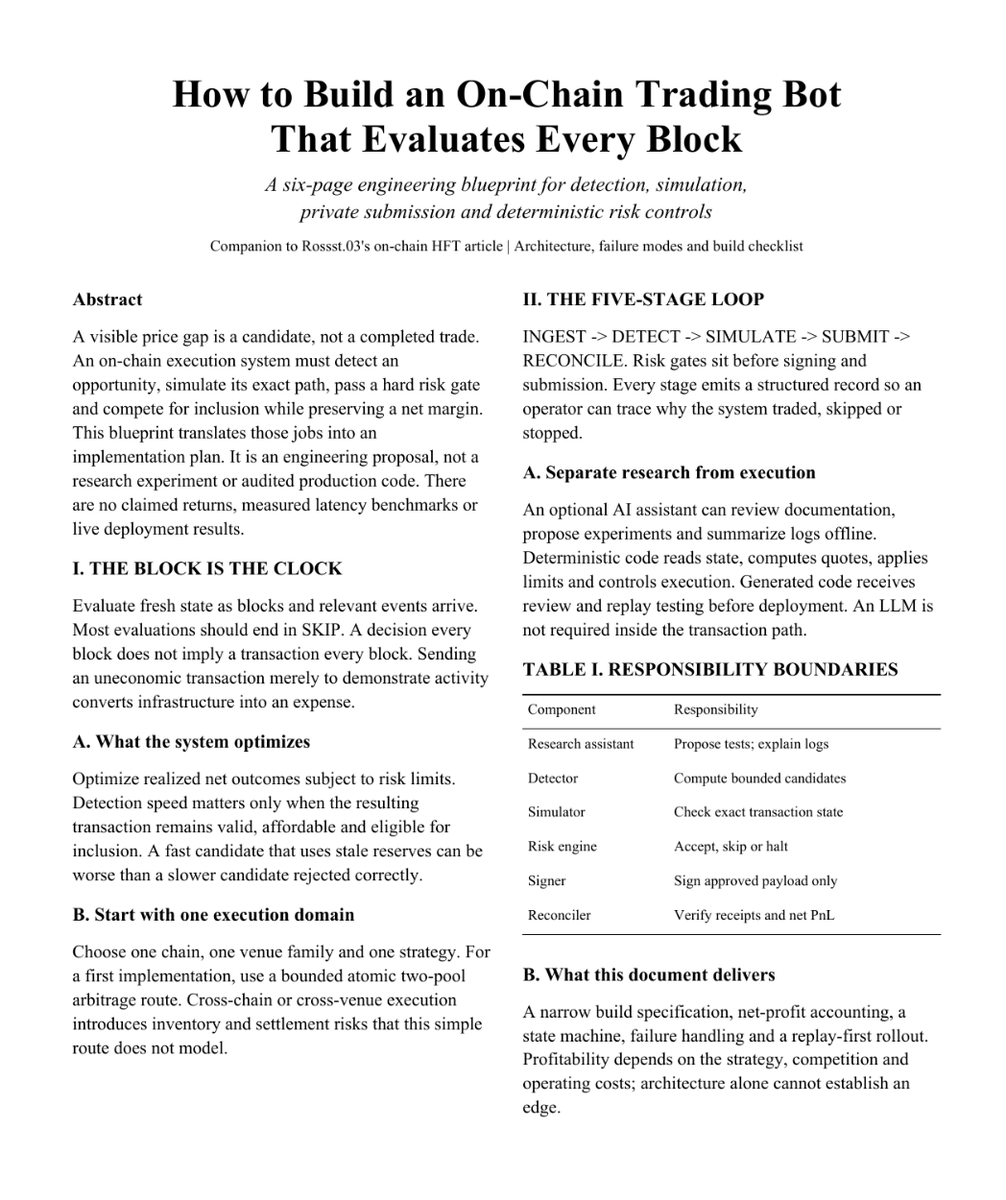
i turned that framework into a 6-page engineering blueprint and an animated execution terminal concept
here’s what’s inside:
the five-stage loop:
ingest → detect → simulate → submit → reconcile
executable quotes that account for trade size, pool fees and price impact
simulation tied to the EXACT payload you’re about to sign
a bid cap that preserves your required margin instead of paying anything to win the block
deterministic risk gates that can stop execution regardless of what the strategy wants
replay tests, failure scenarios and shadow mode before a bounded live pilot
the most useful idea in the whole build:
EVALUATE EVERY BLOCK.
SUBMIT SELECTIVELY.
a bot that correctly rejects 1,000 bad candidates is doing its job
a bot that sends 1,000 transactions just to stay “active” is running up a bill
AI can help research, write tests and investigate failures
the execution engine has to enforce the rules
the visual below is demo telemetry showing the architecture
the 6-page blueprint is in the first reply ↓
your on-chain bot can spot a price gap and STILL lose money executing it
that’s the part most “build an AI trading agent” posts skip
this article breaks the system into three jobs:
DETECT the opportunity
SIMULATE the exact trade
WIN inclusion without giving away the edge
i turned that framework into a 6-page engineering blueprint and an animated execution terminal concept
here’s what’s inside:
the five-stage loop:
ingest → detect → simulate → submit → reconcile
executable quotes that account for trade size, pool fees and price impact
simulation tied to the EXACT payload you’re about to sign
a bid cap that preserves your required margin instead of paying anything to win the block
deterministic risk gates that can stop execution regardless of what the strategy wants
replay tests, failure scenarios and shadow mode before a bounded live pilot
the most useful idea in the whole build:
EVALUATE EVERY BLOCK.
SUBMIT SELECTIVELY.
a bot that correctly rejects 1,000 bad candidates is doing its job
a bot that sends 1,000 transactions just to stay “active” is running up a bill
AI can help research, write tests and investigate failures
the execution engine has to enforce the rules
the visual below is demo telemetry showing the architecture
the 6-page blueprint is in the first reply ↓
Most on-chain bots lose by being fast but wrong.
The winners do three things before the block closes: detect, simulate, include.
In this article I show EXACTLY how to build an on-chain HFT bot that trades every block, from scratch. https://t.co/HYApyAT9ha
i still don’t understand why people start building on-chain trading bots with “find me a profitable strategy”
start with this:
can your bot prove a trade is worth sending BEFORE it signs?
this breakdown made me turn the entire execution loop into a 6-page engineering blueprint
DETECTION → SIMULATION → INCLUSION
with the risk controls and cost accounting between them
here’s what’s inside:
the five-stage pipeline that evaluates fresh state, finds a candidate, simulates the exact transaction, submits it and reconciles what actually happened
the difference between a price gap on your screen and an executable edge after trade size, pool fees and price impact
the simulation layer that rejects stale or unprofitable paths before they reach the signer
the inclusion auction — and how to cap your bid so winning the block doesn’t mean giving away your entire margin
the hard risk engine that can SKIP or HALT regardless of what your strategy or AI assistant wants
the replay → fork tests → shadow mode → bounded pilot sequence, with acceptance criteria for each stage
the part that matters most:
a decision every block does NOT mean a transaction every block
SKIP is a decision.
rejecting stale data is a decision.
refusing to overpay for inclusion is a decision.
AI can help research the strategy, write tests and investigate failures
the execution engine needs rules it can enforce
the 6-page blueprint is in the first reply:
Most on-chain bots lose by being fast but wrong.
The winners do three things before the block closes: detect, simulate, include.
In this article I show EXACTLY how to build an on-chain HFT bot that trades every block, from scratch. https://t.co/HYApyAT9ha
On September 1, 1939, Germany invaded Poland.
That same day, a 26-year-old investor borrowed $10,000 and ordered his broker to buy 104 companies that appeared to be dying.
The broker thought he had misunderstood.
John Templeton wanted every stock trading below $1. Thirty-seven of the companies were already in bankruptcy, America was still recovering from the Great Depression, and another world war had just begun.
Templeton was not trying to identify the one company that would survive.
He was betting that the market had priced almost all of them as if none would.
He placed roughly $100 into each business. Four years later, only four positions had become worthless. The remaining 100 produced a profit, and the portfolio had reportedly grown to approximately four times its original value.
Templeton understood something most investors still miss during a crisis:
Fear does not carefully separate weak assets from recoverable ones. It sells everything first and asks questions later.
His advantage was not predicting which company would win. It was building a position where dozens could fail and the recovery of the survivors could still pay for every mistake.
“Bull markets are born on pessimism, grow on skepticism, mature on optimism and die on euphoria.”
The crowd wanted certainty before risking a dollar.
Templeton realized certainty would arrive only after the opportunity disappeared.
Allen Stanford stole $7 billion by selling an investment that looked safer than the bank offering it.
For nearly 20 years, Stanford International Bank promised unusually high returns through certificates of deposit. Clients saw marble offices, financial advisers, international branches and a billionaire owner who had even been knighted. Everything surrounding the product communicated safety.
The returns were largely fabricated.
New deposits financed withdrawals, personal businesses and Stanford’s lifestyle. Even more disturbing, SEC examiners reportedly suspected a Ponzi scheme as early as 1997. The operation continued growing for another decade before collapsing in 2009.
Stanford was eventually convicted and sentenced to 110 years in prison.
The useful lesson is not simply that investors trusted the wrong man. They confused the appearance of legitimacy with proof of legitimacy.
A prestigious office is not evidence.
A famous founder is not evidence.
A stable return is not evidence.
The more carefully an investment is designed to make you feel safe, the more important it becomes to ask what independently proves the money exists.
Stanford did not hide the fraud behind complexity.
He hid it behind credibility.
David Rockefeller inherited the most powerful name in American finance, then watched $1.9 billion in bad loans turn his bank into a public embarrassment.
By 1976, Chase Manhattan’s profits had fallen 44.7% in a single quarter. Its earnings declined 36% between 1974 and 1976, its real estate loan portfolio was collapsing, and regulators described parts of its internal operations as “horrendous.”
The bank was so closely associated with Rockefeller that critics stopped calling it Chase.
They called it “David’s bank.”
Rockefeller had three years before mandatory retirement. Walking away would preserve his personal reputation while leaving the institution damaged.
He stayed.
Chase automated neglected operations, removed roughly 600 executives, introduced telephone bill payments and computerized banking terminals, rebuilt its lending culture, and promoted a younger management team.
By the time Rockefeller retired in 1980, the bank had returned to financial health.
The heir to America’s greatest fortune did not save the bank with family money, political influence, or one brilliant investment.
He saved it by repairing the boring systems everyone had ignored while the institution still looked powerful from the outside.
That is the financial lesson worth remembering:
Prestige can hide decay for years.
But eventually, every balance sheet reveals what the reputation was covering.