All the indicators you need to start making $1,000 a week trading:
($200 a day)
-VWAP
-9 & 20 EMA
-ORB 30min
⭐️ 3min chart
Only take entries when price is between the 9/20 EMA. Long above VWAP, short below. Take profit on breakouts and place a stop loss.
It’s this simple.
A Very Simple ICT Entry Model on Lower Time Frame Using The 8:30 Bell💡
▪️Short Term High, STH
▪️Swing Low
▪️Fair Value Gap, FVG
▪️Market Structure Shift, MSS
ICT 2022 Mentorship Model
Buyside Liquidity ➡️ Sellside Liquidity
This Would Get You Funded
It is past midnight and you are watching another strategy video.
Not because your strategy failed.
Because you never saw enough of it to trust it.
You are not searching for a method.
You are searching for certainty.
And certainty is not found.
It is built.
【Why Experience Makes You Better In Many Fields, But Years Of It Still Do Not Make You Successful In Trading】
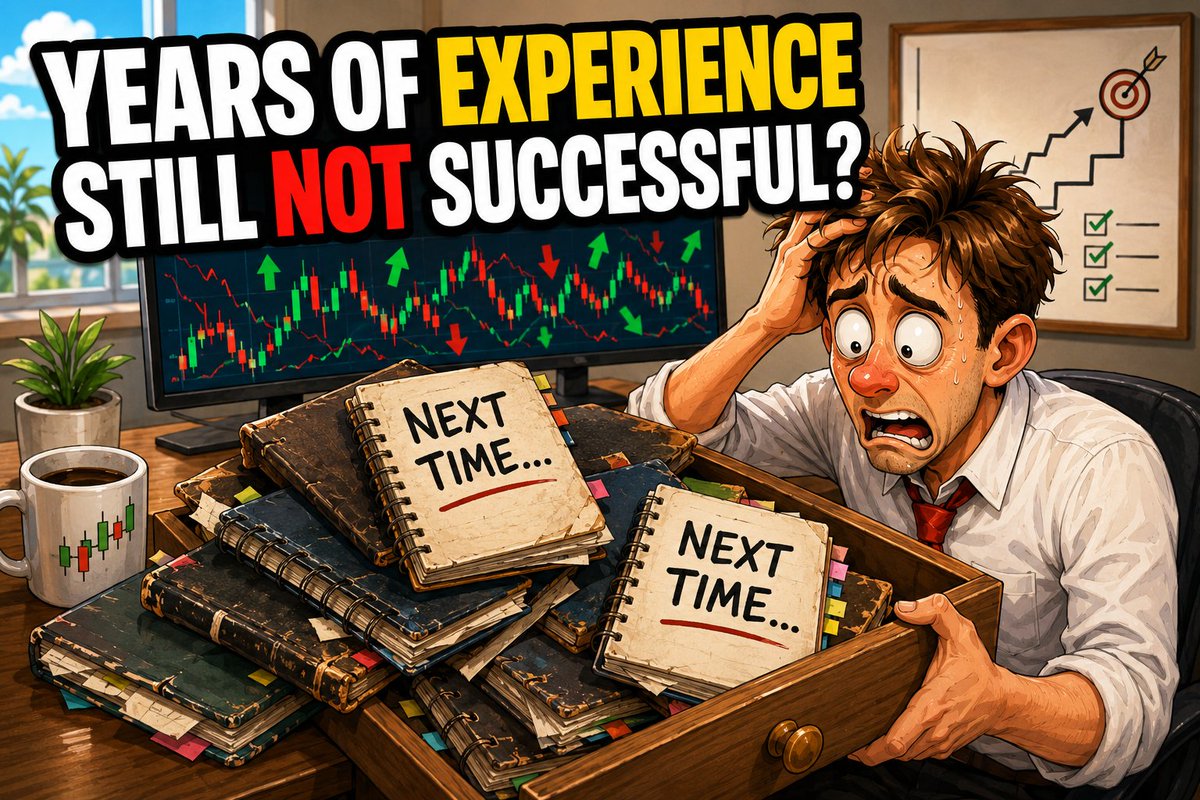
When you open your desk drawer, you find several old trading notebooks inside.
You open the page from a year ago.
On the page, it says, "Next time, I will do this."
You open the page from half a year ago.
There it is again, "Next time, I will do this."
And on today's page, you are about to write the same thing.
That "next time, I will do this" you have been writing for years has somehow never changed the trader you are today.
You have spent years facing the market.
You have taken plenty of trades.
And yet, you still have not succeeded.
If that is you, the problem is not that you have not worked hard enough.
It is that the advice, "You will get better with experience," which is true in other fields, becomes false in trading.
■ There Are Worlds Where Experience Teaches You, And Worlds Where It Does Not
Experience becomes learning only in a world where the relationship between action and result is stable.
In cooking, if you follow the right process, you usually get the right taste.
In driving, if you use the right controls, the car usually moves correctly.
That is why repetition gradually engraves the correct actions into your body.
This is the true nature of "getting better through experience."
But trading is different.
In trading, short term results are dominated by randomness, so correct actions can lose and wrong actions can win on a daily basis.
A trade executed according to your rules can end in a loss, and a sloppy trade that broke your rules can end in profit.
This happens all the time.
The causal link between action and result does not hold trade by trade.
So what happens if you use the result of each trade as your teacher in this world?
What accumulates inside you is not skill.
It is a pile of distorted lessons carved by random noise.
You learn that the action that happened to win was correct, and you learn that the action that happened to lose was wrong.
The more trades you take, the more that distorted learning repeats, and the deeper the wrong patterns settle inside you.
If you still have not succeeded after years in the market, it is not because you are not smart enough.
It is because you have been trying to learn from a place that cannot teach you.
■ What You Have Built Was Not Experience. It Was Noise.
With that in mind, look back honestly at what you have been doing.
What did you call "experience"?
Was it the time you spent winning and losing in live trading, then looking at the result and thinking, "I should have done this," or "next time, I will do that," and adjusting your approach based on what happened?
That was not you building experience.
That was random results rewriting your standards of judgment.
The troublesome part is that the whole process looks like effort to the person doing it.
You look at charts every day, reflect on every trade, and feel like you learned something.
That is why you can keep doing it for years, and the longer you do it, the more you believe you have built experience.
But learning from random results is not zero.
It is negative.
A person with the wrong patterns deeply engraved is farther away than a person who learned nothing.
■ "But Experienced Traders Are Actually Better, Aren't They?"
This is what many people will think.
"But traders who have been doing this for many years are actually better.
Isn't there such a thing as an experienced trader?"
Yes.
There are traders who have been doing this for a long time and are skilled.
But what built them was not the number of years they vaguely spent in the market.
What they did was designed practice.
They recognized the same defined conditions again and again on charts where they did not know the outcome, and they repeated the same judgment under those conditions.
And they accumulated that practice across a large sample size, passing through rule based wins, rule based losses, and losing streaks with their own hands.
The number of years only shows how much time they spent doing that practice.
The number of years itself did not make them better.
Two traders can both spend ten years in the market.
One spends ten years on designed practice.
The other spends ten years letting random results rewrite their judgment.
They will not end up in the same place.
And most of what people call "experience" in this industry is the latter.
The word experience puts these two into the same box.
That is why this advice becomes a lie.
■ Stop Building Experience. Start Building Practice.
So stop trying to build more experience.
Years do not make you better.
More trades do not make you better.
The attitude of trying to learn from live results is the very culprit that has been pulling you backward.
Only one thing makes you better.
Define in advance what you will look for, what must happen, and what you will do, then repeat that practice again and again with your own hands on charts where you do not know the outcome.
Only inside that practice does the causal link between action and result connect correctly across a large sample size.
Trading becomes something you can actually learn only through what remains after repetition, not through the result of a single trade.
If you have not succeeded after years in the market, it is not because you have no talent.
It is because what you were building was not practice.
It was experience spent drifting through randomness.
Change what you are building from today.
📚 Content for serious traders
https://t.co/tMFssKR6Oz
Thank you for reading.
A casino does not change the rules of blackjack after a losing night.
It does not fire the dealer who followed every rule.
It opens the next day at the same hour, with the same rules, at the same odds.
Because the casino never bet on one night.
The night was random.
The math was not.
Stop scrolling:
This 55-minute lesson could improve your trading more than weeks of watching charts.
The Psychology of Successful Trading with Dr. Brett Steenbarger is 55 minutes better spent than watching Netflix.
Your mindset is your biggest edge:
【Learn From Failure. Not From Losses.】
You stare silently for a while at the screen after your stop loss has been executed.
The number in your account has certainly decreased a little.
You open your trade history and check the entry point and the exit point.
Then you write this.
Next time, I will enter a little more carefully.
That one line is the very culprit pulling you away from success, and you still have not realized it.
■ First, Separate "Loss" From "Failure"
Many traders take the phrase "learn from failure" and receive it as "learn from losses."
This is the starting point of every problem.
Failure and loss are not the same thing.
The real failure in trading is failing to follow your rules or plan.
Or it is being so insufficiently prepared that you do not even have rules to follow in the first place.
That is indeed a failure you should learn from.
But a losing trade that happened after you executed according to your rules is not a failure.
It is a normal component of what the strategy produces across a large sample size.
In a strategy with positive expectancy, losing trades are part of what makes up that expectancy, not a defect that should be avoided.
And yet, every time you lose, you reflect on it and try to change something.
You keep changing what must not be changed.
■ If You Try To Learn From Losses, Randomness Rewrites Your Standards Of Judgment
Why should you not learn from losses?
Because short term results are strongly dominated by randomness.
No matter how correct the action is considered to be, it can still lose.
No matter how wrong the action is considered to be, it can still win.
This happens all the time.
In this world, what happens if you try to learn from the loss in front of you?
Your learning becomes synchronized with randomness.
Because the trade happened to end in a loss, you learn that the action was wrong.
Because the trade happened to end in profit, you learn that the action was correct.
Then you make small adjustments to the rules.
But the next trade is also dominated by randomness.
This time, that new rule loses.
You reflect again, and adjust again.
This is the endless improvement loop.
You think you are moving forward, but you are only stacking distorted patterns written by random noise inside yourself.
■ "But If I Do Not Learn From Losses, Won't My Growth Stop?"
This is what many people will think.
"But if I do not learn from losses, won't my growth stop?"
No.
That question comes from seeing trading as "a game of winning and losing the trade in front of you."
A trader who has truly grown is someone who has reached a state where they do not learn from losses.
This is not an abandonment of learning.
Rather, because they have already "finished learning" during preparation how to assign meaning to each individual win or loss, they do not take responsibility for the result in front of them.
What they are truly responsible for is repeating consistent behavior and preparing for that consistency.
That trader has verified the strategy across a large sample size, and has confirmed through their own hands that even rule based losses, losing streaks, and drawdowns leave positive expectancy after repetition.
For someone who has completed that confirmation, a rule based loss is inside the expected range, and there is nothing to learn from that individual loss.
The state of not learning from losses is a place only traders with a completed foundation can reach.
So this is not the stopping of growth.
It is growth itself.
■ Move Your Learning From Live Trading To Preparation
Then where should you learn?
Not in live trading.
The place to learn is preparation.
Cultivate probabilistic thinking.
Confirm the edge of your strategy across a large sample size.
Practice again and again with your own hands on charts where you do not know the outcome.
Pass through rule based wins, rule based losses, and losing streaks with your own hands.
Your learning can only be obtained there.
After you enter live trading, the only learning should be repeating execution on top of a foundation that is already complete.
Stop opening losing trades and reflecting on them.
Stop looking at your history and writing, "Next time, I will do this."
That is not learning.
Real learning should already be finished in preparation, not after a single live result.
📚 Content for serious traders
https://t.co/ZxU7qo7pJm
Thank you for reading.
The only difference between people who make things work and people who do not is "how they think."
People often talk about execution.
But in the end, the thing behind that execution is also thinking, and the cause of not being able to execute is also a matter of thinking.
So ultimately, it still comes down to a difference in thinking.
Then what is that thinking?
It is this.
How clearly you can design the path that reaches the goal.
More simply, it is the thinking that converts desire into cause and effect.
What matters is whether the path to the goal has been broken down to a level that can actually be executed, and whether the connection between each step is logically visible.
In that sense, execution is not the strength of your will.
It is something that naturally appears when the resolution of your thinking crosses a certain line.
Conversely, if you feel resistance toward the task you need to do, or if the only words that come out are "I need to try harder" or "I need to work harder," then what you are missing is the granularity of logical understanding that allows you to see the path to success with clear resolution.
You need to work backward from the goal.
How accurately do you understand your current position relative to that goal?
What conditions must be satisfied in order to close the gap between where you are and where you want to be?
What can you do now in order to satisfy those conditions?
Execution is something that naturally appears when the resolution of your thinking crosses a certain line.
So if you avoid the necessary work because it feels troublesome, that is not a problem of will.
It means the resolution of your thinking has not yet crossed that line, and the path has not perfectly connected inside your head.
Why, in trading, must you test and prepare thoroughly in advance?
Why must you remain consistent?
How deeply do you understand this?
Ask yourself again.
Because this understanding is what creates the thinking you need, and that thinking drives you toward the preparation you need, and that preparation builds the trust you need, and that trust creates the consistency you need.
Please make full use of my content when necessary.
Along with paid content, there is also plenty of free content on X, my blog, and my newsletter.
📨 Newsletter
https://t.co/nbu7ATvgoo
I hope it becomes an opportunity to deepen your understanding and resolution, change the way you think, and help you grow further as a trader.
“The best traders don’t try to predict every move—they manage risk and execute their edge consistently. Your job isn’t to be right on every trade; it’s to follow your plan with discipline. In the long run, consistency beats certainty every time.”
Mark Douglas
【Most Traders Break Their Rules With Perfect Discipline】
Every time you break your rules, you think, "I lack discipline."
But that is wrong.
You do not lack discipline.
If anything, you keep breaking your rules every time with "impressive discipline."
Because people follow what they truly believe.
■ You Do Not Lack Discipline
Many traders think this after breaking their rules.
"I failed to stay disciplined again."
"I lost to my emotions again."
"Next time, I will follow my rules properly."
But that way of thinking itself is wrong.
The problem is not that you lack discipline.
You are already extremely consistent toward something.
When unrealized profit shrinks, you immediately want to protect it.
When a loss comes close, you want to avoid the stop loss.
When losses continue, you want to change the rules.
When price moves slightly against you after entry, you begin thinking, "Maybe this time is different."
These may look like separate behaviors.
But the root is the same.
You value protecting the win or loss in front of you more than following your rules.
And you follow that value with surprising consistency.
So you do not lack discipline.
You are disciplined toward the wrong thing.
■ People Follow What They Truly Believe
You need to understand this.
People do not follow what they say is important.
They follow what they truly believe.
Even if you say, "Rules are important," if you break your rules to avoid the loss in front of you, then what you truly believe in is not the rules.
"This loss should be avoided."
"This profit should be protected."
"This losing streak is dangerous."
"I need to do something about this one trade right now."
These are the values you actually believe.
So you act according to them.
This is not a personality problem.
It is not weakness of will.
It is a problem of what you recognize as success in that moment.
A person who truly believes that following the rules is success will follow the rules.
A person who believes that avoiding the loss in front of them is success will act to avoid that loss.
Both are following what they believe.
So the problem is not whether you have discipline.
The problem is where your discipline is pointing.
■ "But Isn't Discipline Necessary"
Here, you will think this.
"But isn't discipline necessary in trading."
Of course it is.
But what most people call discipline is not the discipline trading requires.
Enduring unpleasant emotions while forcing yourself to follow the rules.
Suppressing the desire to win and forcing yourself to obey.
Clicking through fear with mental strength.
That is not completed discipline.
That is a state where what you believe inside is colliding with the rules you are trying to follow on the surface.
True discipline is not forcing yourself to obey while enduring.
Following these rules is what leads to success.
Not the win or loss in front of me, but positive expectancy that appears beyond repeating the same behavior across a large sample size.
Rule based losses, losing streaks, and drawdowns are all part of that structure.
When you can believe this from the bottom of your heart, the same behavior begins to continue naturally.
In that state, discipline is not endurance.
Following the rules becomes the most natural action for you.
■ Discipline Is Not The Starting Point
Most people have the order wrong.
They think that if they first develop discipline, they will be able to follow their rules.
But in reality, it is the opposite.
You define your rules precisely.
You test them across a large sample size.
You practice them again and again through your own hands.
You pass through rule based losses, losing streaks, and drawdowns.
You confirm through your own hands that positive expectancy remains beyond repetition.
Only beyond that is trust built.
And only beyond that trust does discipline appear naturally.
Discipline is not something you create at the beginning through intensity.
It is something that appears later as the result of preparation.
That is why blaming yourself by saying, "I need more discipline," every time you break your rules does not change the root.
What you truly need to look at is why you still believe the win or loss in front of you more than your rules.
In most cases, the answer is insufficient preparation.
Your rules are vague.
You have not tested enough.
You have not practiced through your own hands.
You have not passed through variance.
You still do not truly believe what happens when you keep repeating those rules.
That is why the win or loss in front of you looks stronger during live trading.
That is why you follow it.
You are simply calling that "lack of discipline."
■ Redirect Your Discipline
What you need is not to tighten yourself harder.
What you need is to redirect your discipline.
The discipline working to avoid the loss in front of you.
The discipline working to protect unrealized profit.
The discipline working to escape a losing streak.
The discipline working to feel safe in this one trade right now.
All of it needs to be redirected toward repeating the rules.
And that direction does not change through words.
It does not change through willpower.
It does not change because you decide, "Next time, I will follow the rules."
It changes only when you have prepared enough to truly trust those rules.
When you have defined the rules, tested them, practiced them through your own hands, passed through variance, and come to believe in the structure where positive expectancy remains even with losses and losing streaks included.
Only then does your discipline finally point in the right direction.
Following the rules stops being an effort.
Deviating from the rules begins to feel worse than taking a loss.
Protecting a large sample size begins to feel more natural than protecting the one trade in front of you.
That is when you finally stop trying to "have discipline."
Discipline works on its own toward what you truly believe.
So stop thinking you have no discipline.
You already have discipline.
It is simply pointing in the wrong direction.
📚 Content for serious traders
https://t.co/ZxU7qo6RTO
Thank you for reading.