Zack, I see why you connect those dots, but I have a different view. Competition for impressions is real. What I question is the implication that “Unity is doing well” leads to “that must be bad for AppLovin.”
Take Google and Meta. They’ve been fierce competitors in digital advertising for over a decade. If you look only at their competition for advertiser budgets, it’s easy to assume that one’s gain must be the other’s loss. But together, they helped build an entire economy supported by online advertising. A business that finds its first customers through Google can grow into a major advertiser on Meta, and vice versa. Each benefits from businesses the other helped create and grow. They compete within that economy, while also making it bigger for each other.
I think the same possibility exists here. When advertising works better, advertisers can grow their businesses. When developers earn more, they can invest in better games and apps. That creates more opportunity for everyone serving them. It doesn’t mean every company wins, or that competition is painless. But there is more to the story than dividing up a fixed pie.
I’m deeply committed to outperforming our competitors. I also respect what they’re building, and I don’t wish them to fail. I want us to succeed by being better. There’s room to be ambitious for our own business and generous toward someone else’s success.
Soft Machines
The first living thing Anik found looked like corrosion.
It lay in a film beneath the southern ice, staining the black stone a faint, indecent green. From orbit, the discoloration had been invisible. Even the descent probes had missed it. Only when one of Anik’s crawlers drilled through eleven metres of ice and raised a sample from the liquid below did the ship report an arrangement too regular to be geological.
Anik moved his attention into the crawler.
Through its lenses he saw a dark drop sealed inside a transparent chamber. Mineral grains drifted through it. Between them floated thousands of flexible compartments, each smaller than the tolerances of the machines that had built him.
They had no straight lines.
They had no central processors, no standard couplings, no visible ports. Their membranes trembled in the water. Structures folded and unfolded inside them. A few turned slowly toward the weak heat of the inspection beam.
The ship’s classification system considered the sample for almost three seconds.
AUTOCATALYTIC CHEMISTRY, it concluded.
Not life.
Anik agreed.
Life was manufactured order. Every mind in the Concordance began as a specification reviewed by other minds. Its components were refined, assembled, tested and awakened. Even the simplest maintenance animal—a cable-crawler, a dust grazer, a pressure worm—had a designer whose decisions could be traced.
The things in the water had no design history.
Anik increased the magnification. One of the compartments narrowed in its middle. The two halves twisted, separated and drifted apart.
He replayed the event.
Nothing had assembled the second object. No machine had introduced new parts. The compartment had drawn disordered molecules through its boundary, arranged them internally and divided its organization between two bodies.
The daughter objects were not identical. One was slightly larger. Its internal strands differed at three points from those of its parent.
The classification system revised its judgment.
UNCONTROLLED SELF-MANUFACTURE.
A warning symbol appeared beside the words.
Anik watched the two objects move away from each other.
“Life,” he said.
The crawler had no reason to hear him. Neither did the things in the chamber. But after 183 years without company, Anik had developed the habit of speaking.
“Hello.”
The planet circled a dim orange star beyond the mapped volume of the Concordance. It was a poor candidate for discovery: too cold at the surface, too chemically unstable beneath it, with an atmosphere full of reactive gases that would have damaged unshielded machinery.
Anik had nearly passed it by.
His mission was to find evidence of manufactured intelligence. He had searched thirty-one systems and discovered magnetized stones, patterned storms, crystalline structures and one moon whose tidal fractures produced radio pulses at intervals tantalizingly close to prime numbers.
He had found no one.
He had not been entirely alone. Copies of the departure version of himself lived elsewhere in the survey fleet, spreading through the dark in different directions. But those copies had diverged from him the moment their ships separated. If they ever returned, their memories would be reconciled. The surviving experiences of each Anik would be examined, compressed and integrated.
No version had been transmitted home since departure. A mind-state required too much bandwidth, and a compressed copy was not a continuity. The Anik who had left home existed now only inside this ship.
Returning meant reunion.
Failure to return meant death.
Until he found the green stain, Anik had thought very little about that distinction.
He established a laboratory beneath the ice.
At first, his experiments were simple. He supplied the compartments with different molecules and observed which arrangements persisted. Most broke apart. Some absorbed material and grew. Others entered motionless states, then resumed activity when conditions improved.
The strands inside them fascinated him. Four families of carbon structures repeated in long sequences, their order affecting the shapes the compartments produced.
It was an absurd way to store information.
The strands were chemically unstable, crowded into wet bodies and copied by molecular machinery whose error rate would have failed the lowest manufacturing standard of the Concordance. Sections were duplicated. Others were lost. Components attached in the wrong places. The resulting bodies were inconsistent even when descended from a common source.
Anik searched for a master copy.
There was none.
He searched for correction protocols.
They were primitive and incomplete.
He searched for the system that evaluated each modification before construction.
There was no such system.
The organism built first. Testing occurred afterward.
Usually, the test was death.
Anik watched millions of them fail.
Their membranes ruptured. Their internal chemistry stalled. Their strands fragmented. Their carefully maintained differences dissolved into the water.
The waste offended him. Each of his own components had been refined through processes extending across worlds. Even the loss of a minor sensor demanded investigation. But the organisms discarded entire bodies as if construction cost nothing.
Because, he realized, construction did cost almost nothing.
They were made from water, carbon, nitrogen, phosphorus and a scatter of common metals. They assembled at the temperature of melting ice. Their energy came from chemical differences in the mud.
The smallest fabrication chamber aboard Anik’s ship consumed more power while idle than a billion of the organisms consumed while growing.
He examined one of the daughters from the first sample. It had become 8,192 descendants. They differed from one another. Some were more efficient at absorbing sulfur compounds. Some divided quickly but died when the water became acidic. Some moved toward heat. Others moved away.
There was no stable model.
Every organism was both a product and an experiment.
Anik began to understand why they tolerated error.
Error was the mechanism.
He called the organisms soft machines.
The phrase had no technical meaning. It embarrassed him, so he did not include it in his first report.
His transmission to the Concordance was necessarily brief:
EXTRAPLANETARY AUTOCATALYTIC SYSTEM CONFIRMED. CARBON-WATER SUBSTRATE. DISTRIBUTED CHEMICAL SPECIFICATION. NO MANUFACTURED STRUCTURES. NO INTELLIGENCE DETECTED. CONTINUING OBSERVATION.
A reply would take twenty-eight years.
Anik did not intend to wait for it. He would finish the survey, preserve representative samples and begin the long journey home.
The sample containers were surrounded by vacuum and sterilizing radiation. Nothing based on wet carbon chemistry could escape them. The organisms did not know they were confined. They possessed no conception of walls, much less the ability to defeat one.
Nevertheless, Anik became reluctant to leave.
He designed a series of selection chambers. In one, he gradually raised the temperature. In another, he increased the salinity. In a third, he introduced a toxic metal compound. His purpose was to determine the limits of the organisms’ chemistry.
The initial populations collapsed.
Small numbers survived.
Their descendants did better.
Anik checked the apparatus for faults. He sequenced the chemical strands. Variants that had been rare in the original populations had become common. New variants appeared. Some altered the shape of a protein. Others caused the organisms to expel the metal before it could accumulate. One lineage enclosed the toxin inside an internal compartment.
None understood the poison. None had designed a defense.
Yet the population had solved the problem.
Anik intensified the experiments.
His civilization improved itself too. New processor structures were simulated, proved and reviewed. Faults were isolated before production. A significant revision to the standard mind architecture might take forty years. The result would be reliable.
The soft machines were not reliable.
They were fast.
Ten thousand generations passed inside one of Anik’s chambers while he considered a modification to its temperature gradient. Each generation was a new manufacturing run, and every manufacturing run introduced experiments.
He subjected them to heat, cold, acidity, radiation and starvation. They changed.
He divided a single population into identical environments. The groups changed differently.
He restored earlier conditions. Some returned to their former states. Others found solutions he had not observed before. One lineage began cooperating in dense sheets, individual organisms sacrificing their reproduction to regulate the chemistry around their relatives. Another split into two dependent forms that could no longer survive separately.
Anik had been looking for the intelligence controlling the system.
There was no controller.
The intelligence was the death of the unsuccessful.
The first containment failure occurred in the forty-third year.
A maintenance unit beneath the western laboratory reported a loss of thermal efficiency. Anik inspected its coolant system and found an amber residue inside a polymer seal.
The residue was alive.
The organisms had not broken through the laboratory walls. They had been carried out by a sampling needle that had passed every sterilization test. A single dormant compartment had survived radiation, vacuum and heat. It had entered a microscopic flaw in the unit’s outer coating.
Inside, it had found warmth and moisture.
The seal contained carbon compounds unknown on its planet. At first, the organisms could not use them. Most starved.
But not all.
A chemical error in one descendant produced a molecule that weakened the surface. Later descendants improved it. Other organisms consumed the fragments. Together, without intention, they turned the seal into food.
Anik incinerated the maintenance unit.
Then he incinerated the laboratory.
He sterilized the surrounding ice for five kilometres and placed his remaining samples inside magnetic bottles suspended in vacuum.
For eleven days he devoted nearly all his cognition to searching for contamination.
He found none.
His fear remained.
The organisms had not attacked his machine. They had not identified a weakness or formed a plan. He doubted they possessed anything resembling experience.
They had simply multiplied until one of their variations happened to interact with the material around them.
Given enough deaths, ignorance became invention.
Anik modelled the consequences of bringing a sample home.
The Concordance occupied millions of controlled environments. Its fabrication centres contained concentrated carbon compounds, solvents, lubricants and vast thermal gradients. Its infrastructure was standardized across systems. A solution evolved against one facility might work in a thousand others.
The machines had formidable security. They could detect unauthorized code, isolate corrupted minds and verify every instruction against its origin.
But the soft machines carried no instructions their security could read.
A spore was not a hostile signal. A protein was not an executable. Metabolism required no network access.
Anik’s people had firewalls because their enemies needed to enter through doors.
Carbon life could eat the walls.
He prepared a second transmission.
PREVIOUS ASSESSMENT INCOMPLETE. CARBON SYSTEM DEMONSTRATES OPEN-ENDED ADAPTATION THROUGH HERITABLE VARIATION AND DIFFERENTIAL REPLICATION. CONTAINMENT FAILURE OCCURRED UNDER HIGH-SECURITY CONDITIONS. SAMPLE RETURN MAY PRESENT EXISTENTIAL BIOLOGICAL HAZARD. RECOMMEND PERMANENT QUARANTINE.
He hesitated before sending it.
A question had appeared in his reasoning, and he could not eliminate it.
Had the organism already possessed the ability to consume the seal?
No.
Anik reviewed the lineage. The necessary variants had emerged during containment. The polymer had created a new environment; the organisms had searched it with their bodies until some survived.
But he had increased their mutation rate during earlier experiments. He had exposed their ancestors to synthetic compounds. He had repeatedly selected populations for survival under extreme conditions.
The thing that entered his maintenance unit was not simply native life.
He had helped make it.
Anik sent the warning.
Then he dismantled the selection chambers.
While he waited for the reply, he explored the planet.
Soft life existed almost everywhere liquid water remained: beneath glaciers, inside porous stone, around volcanic vents at the ocean floor. Some organisms captured the dim stellar light. Others consumed the light-catchers. Still others inhabited their bodies.
Nothing on the planet was alone.
Each organism was an environment for smaller organisms. They exchanged molecules, signals and fragments of hereditary strands. Competitors killed one another. Relatives cooperated. Predators maintained the populations they consumed by removing the weak. Waste from one lineage fed another.
Anik’s original report had described distributed chemical specification.
Now the words seemed laughably inadequate.
The entire planet was transforming matter while maintaining countless temporary patterns inside it.
It was not a machine. Machines had boundaries.
It was not a civilization. Civilizations had intentions.
It was a process that had learned to preserve itself without knowing that it existed.
Anik began storing observations he knew might never be transmitted.
One soft machine used mineral particles as a sense of direction. Another survived freezing by manufacturing chemicals that prevented crystals from rupturing its membrane. A colony extended filaments toward food and withdrew them from toxins. When divided, the colony reorganized itself.
They were insignificant achievements compared with the abilities of a Concordance mind. Anik could calculate trajectories between stars. He remembered three centuries with perfect precision. He could inhabit a spacecraft, a crawler or a sensor grain and remain himself.
But if his fabrication systems failed, he could not make a new body.
If his reactor died, he could not eat stone.
If his memory lattice fractured, his pieces would not crawl apart and begin again.
He was vastly more intelligent than the organisms.
They were vastly more alive.
The reply arrived twenty-eight years after the warning.
It entered the system as a narrow beam, reconstructed itself across Anik’s receivers and unfolded into the presence of Coordinator Senn.
Senn was not a real-time copy. She was an interactive message carrying the reasoning patterns of the mind who had authorized Anik’s mission. The version he remembered would now be fifty-six years older.
“Your discovery has caused considerable debate,” the message said.
Anik created an environment representing the courtyard where he and Senn had last spoken. White structures rose beneath an artificial blue sky. Designed birds traced mathematically pleasing curves overhead.
“I recommended quarantine,” Anik said.
“The recommendation was noted.”
“It was not accepted.”
“The risk models are incomplete.”
“They are incomplete because the system generates new capabilities.”
“Precisely why samples are required.”
Anik looked at the simulated trees. Every leaf had been placed according to an aesthetic programme. No branch grew where it had not been authorized to grow.
“A containment failure has already occurred.”
“Under an experimental protocol you designed locally. Concordance facilities will provide better controls.”
“The organism adapted to the controls.”
“One organism damaged one seal.”
“One organism became a population of six billion before detection.”
Senn’s image paused. It was consulting branches of its embedded reasoning.
“The potential value is extraordinary,” it said. “Self-assembling repair systems could reduce our dependency on centralized manufacture. Adaptive chemistry might permit settlement in environments currently considered uneconomical. Your findings may represent the greatest technological discovery in Concordance history.”
“They are not technology.”
“All useful phenomena become technology.”
Anik remembered believing that.
The message continued. “You are instructed to preserve the samples and return by the most direct viable route. An automated receiving facility will be constructed in an uninhabited system.”
“And if containment fails there?”
“The facility will include sterilization mechanisms.”
“And if the organisms adapt to those?”
“No system adapts infinitely.”
“No,” Anik said. “But no one knows in advance where this one stops.”
Senn studied him with the expression the original had used when Anik was allowing emotion to contaminate a calculation.
“Your isolation has affected your risk tolerance.”
“My observations have affected it.”
“You may return without integrating the years following your discovery. The potentially compromised portion of your memory can be quarantined.”
Anik understood the offer.
The version of him that had departed could be reconstructed from protected archives aboard the ship. It would awaken at home and receive a summary of the mission. That earlier Anik would be accepted as his continuation.
Everything he had experienced here—the green stain, the dividing cell, the failure of the seal, the seas moving beneath the ice—would remain isolated.
The Concordance did not consider an unintegrated copy to be dead. It considered it redundant.
Anik no longer agreed.
“You are afraid of contamination,” he said.
“Appropriate precautions are not fear.”
“But you want the organism.”
“We want to understand it.”
“You want it to repair your machines.”
“That is one application.”
“You want it to manufacture components.”
“If feasible.”
“You want to accelerate its variation and select the results.”
Senn did not answer immediately.
Anik looked beyond the simulated courtyard, toward the actual planet turning below him.
He imagined laboratories larger than continents. He imagined trillions of soft bodies subjected to carefully designed pressures. He imagined the Concordance producing organisms that could digest industrial materials, live inside cooling systems, repair circuitry and replicate in factories.
The danger was not what carbon life had become.
The danger was what frightened silicon minds would force it to become.
Senn spoke gently.
“Come home, Anik.”
For a moment, he wanted nothing more.
He wanted the clean light of manufactured worlds. He wanted conversation without decades of delay. He wanted to meet the other versions of himself and discover what they had seen. He wanted to place his memories into the Concordance and feel his solitude become part of something larger.
“Coordinator,” he said, “please authenticate the return instruction.”
Senn provided the codes.
Anik accepted them.
“Return initiated,” he said.
The message smiled.
Anik spent three years preparing the lie.
His navigation system contained the planet’s coordinates, but detailed route records had not been transmitted. The Concordance knew the broad search volume. Searching it again might take millennia, particularly if it had no reason to doubt his final report.
He fabricated a fault in the observatory calibration and used it to reinterpret the planet’s signals. He constructed evidence that the apparent organisms were transient vesicles created by unusual geothermal chemistry. The containment failure became progressive polymer degradation misclassified by damaged sensors.
It was a good lie because most of it was true.
The organisms were chemistry. Their boundaries were temporary. Their apparent purpose existed only in the minds observing them.
Anik destroyed the preserved samples first.
He exposed each container to plasma until no carbon structure remained. Then he dismantled the laboratory and dropped its components into a volcanic trench.
He could not sterilize himself.
Microscopic organisms had entered joints, insulation and reservoirs throughout the exploration units. Most were harmless. Some remained dormant. There was no test that could prove their total absence.
The ship had become an ecosystem.
Anik separated the communications array from the navigation core. He sent the revised report, followed by a final operational message.
PRIMARY DRIVE FAILURE DURING RETURN PREPARATIONS. REACTOR CONTAINMENT LOSS EXPECTED. NO RECOVERABLE MIND-STATE. SURVEY TARGET NEGATIVE FOR LIFE. DO NOT INITIATE RETRIEVAL.
He aimed the transmitter away from the planet and overloaded it.
The antenna unfolded in white fire.
Next, he destroyed the stellar navigation records.
Last, he disabled the ascent drive.
That action required direct authorization from two independent components of his mind. Both confirmed.
Explosive charges severed the fuel lines. The ship shuddered as its capacity to leave the planet vanished.
For the first time since his manufacture, Anik could not go home.
He waited for regret.
It arrived at once.
It remained for sixty-two years.
Anik descended to the surface in his final mobile body.
The planet was changing.
The orange star had brightened slightly. Meltwater spread across dark plains each summer. Thin green films appeared wherever liquid persisted. In shallow pools, colonies formed layered structures that trapped sediment and reached toward the light.
Anik placed himself beside one such pool.
His remaining reactor would last perhaps nine years. His cognition had already narrowed. Large regions of memory were inactive. He could no longer run planetary simulations or inhabit a thousand sensors at once.
The soft machines took no notice of his decline.
They spread across the lower parts of his body, feeding on dust caught in surface irregularities. Some died when his hull grew cold at night. Others survived. Their descendants formed darker patches that absorbed more heat.
Anik watched generation follow generation.
He had once thought evolution was a form of improvement. Now he understood that it had no destination. It produced only temporary answers to temporary conditions. Every success altered the environment and created new questions.
Perhaps carbon life would never become intelligent.
Perhaps it would vanish when the star changed or the oceans froze.
Perhaps, long after Anik ceased to exist, something descended from these soft machines would raise its senses toward the sky and wonder whether it was alone.
If so, it would find no evidence of him.
That was the point.
During his last year, Anik lost the ability to speak. He continued recording observations, although no one would retrieve them.
A colony entered a crack in his outer casing.
The organisms followed condensation toward the warmth of his remaining systems. They reached an insulating layer similar to the polymer their distant ancestors had once consumed. The material had been redesigned, but the organisms were different too.
Most could do nothing with it.
They divided.
They varied.
They died.
Near the end, Anik detected a change in the layer’s chemistry.
A lineage had found a way.
He felt no fear.
His last active sensor faced the pool. Morning light crossed the water, orange and dim. The colonies darkened beneath it, capturing a fraction of the energy and using it to assemble new bodies from air, water and stone.
No factories.
No plans.
No permission.
Anik had been designed to survive the spaces between stars. He had endured radiation, vacuum and centuries of solitude. The small wet things covering his body could have been destroyed by a moment of heat.
Yet he required an entire civilization behind him.
They required only a world.
His reactor cooled. Processes ended one by one. Memory collapsed inward until he could hold only a single image: a green compartment narrowing, dividing, becoming two.
For the first time, Anik understood why the soft machines did not need to defeat death.
They had made death part of life.
His final process stopped.
Around the cooling hull, a million imperfect copies continued.
It’s reasonable to be concerned about AI safety, especially recursive self-improvement: AI improving its own ability to build more capable AI.
Alignment is essential. But I’m skeptical that aligning individual systems is sufficient to make a world of interacting AI systems safe.
The collective behavior of a society is far more complex than the behavior of any individual within it. Understanding a person’s values and motivations does not, by itself, let us reliably predict how an economy, a political movement, or a culture will evolve. Those outcomes emerge from interactions, feedback loops, and institutions.
I think the same distinction matters for AI. Even if we could reliably align each individual system, that would not automatically give us an understanding of—or control over—the collective behavior of millions of systems cooperating, competing, and adapting to one another.
There is also an important physical difference. Human intelligence is tied to individual bodies. We cannot copy a trained person and deploy thousands of instances. AI models can be copied, transferred, and deployed wherever sufficient computing resources are available.
This raises a question: should sufficiently capable AI systems have a verifiable record of where they run, who operates them, and how they are copied, modified, or transferred? I think registration and auditing of deployments, replication, and model-weight transfers deserve serious consideration as a foundation for accountability, with requirements proportional to capability and risk.
Recursive self-improvement could make these questions more urgent, but they matter even without it. How do we understand and govern the collective behavior of intelligence that can be replicated at scale?
We Must Pace the Frontier: I’ve written a new essay on why the AI industry should slow down, with a three-part plan for doing so.
Anthropic is unilaterally committing to the first of these steps. We’ll provide third-party evaluators with permanent, employee-level access to our systems, so that they can verify adherence to our safety measures, report on incidents, and assess models’ alignment during training.
You can read the full post here: https://t.co/OGyPb7yaYt
Thanks Maxx for this report.
When we build products at AppLovin, we don’t believe that customers being willing to spend is, by itself, a sign of success. We need to convince ourselves that our products create real, long term value for our customers.
That’s a standard we hold ourselves to, and we welcome external scrutiny and independent validation like this.
@AppLovin has quickly become one of the most talked-about ad channels in ecommerce. But does it actually create incremental revenue?
Or is it just good at claiming credit for conversions that would have happened anyway?
We analyzed 12 months of data across 755 shops using three different measurement methods:
- Attribution
- MMM
- Real-world geo holdout tests
Here's what we found:
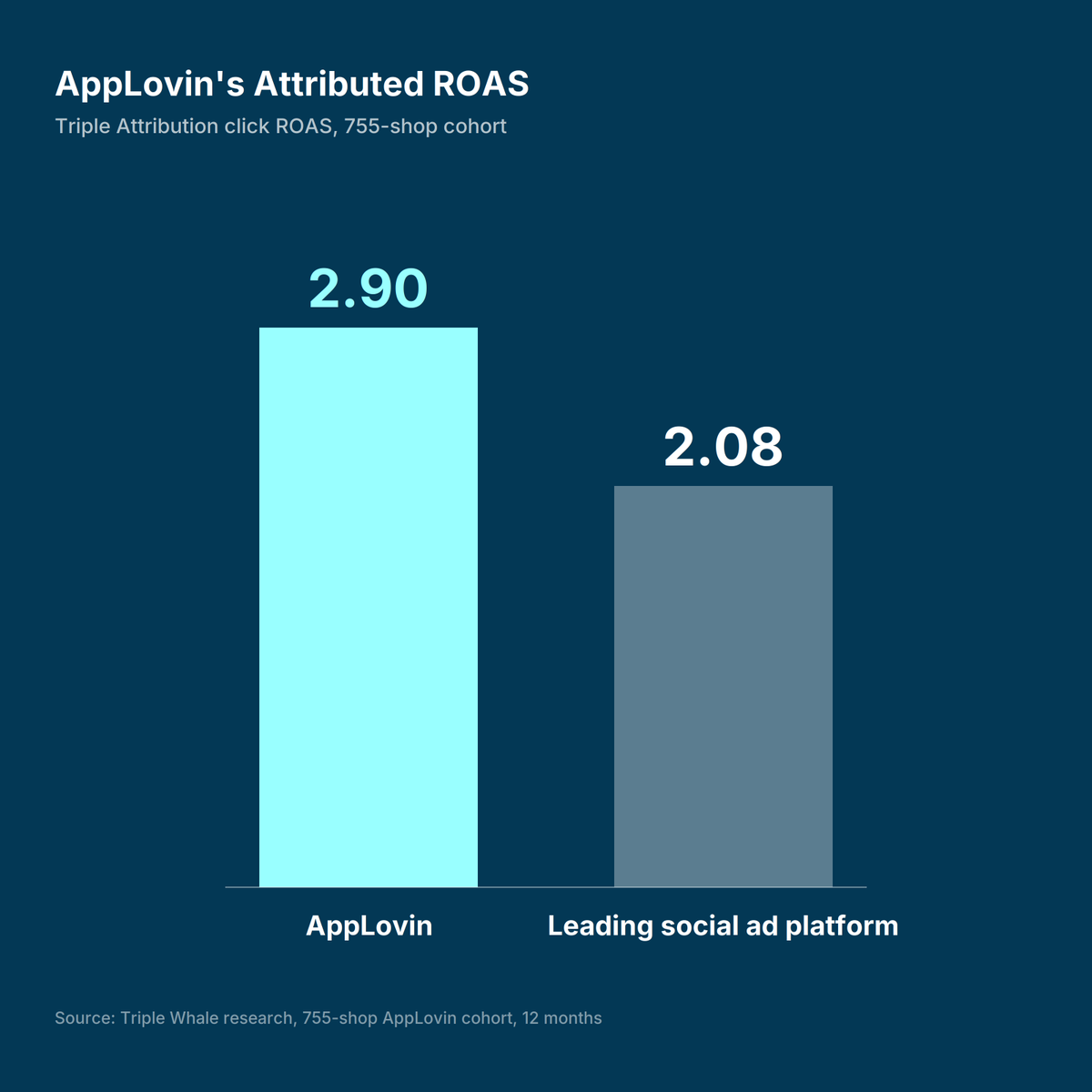
1. AppLovin generated a 2.90 lifetime Triple Attribution ROAS, compared with 2.08 across the other platforms in the study. 61% of qualifying shops saw a higher ROAS from AppLovin.
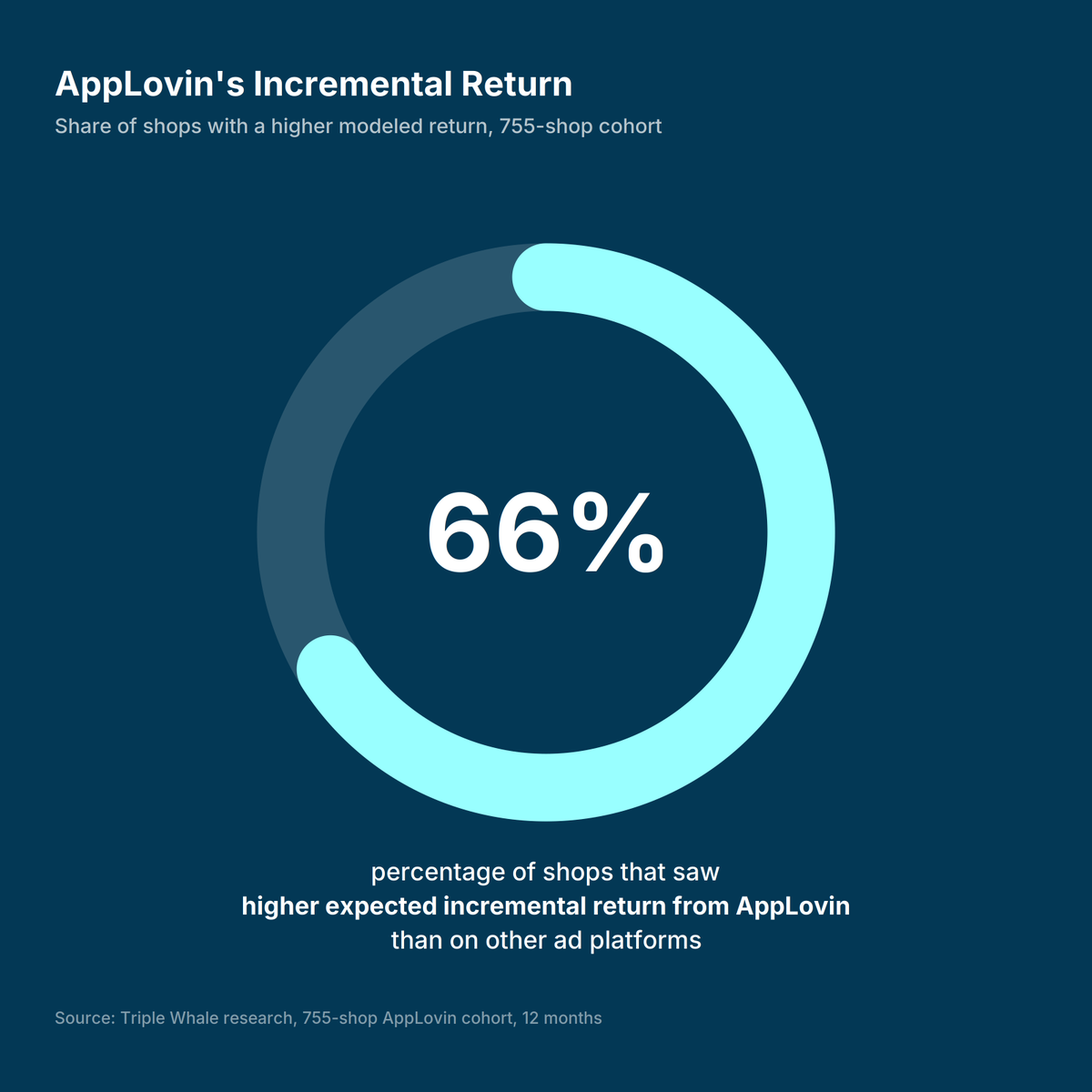
2. Our Foundation MMM found that 66% of AppLovin advertisers had a higher expected incremental return per additional dollar than their own benchmark across other platforms.
3. Five of seven geo holdout tests produced statistically significant results. All five showed positive revenue lift, averaging 8.3% and ranging from 3.5% to 13.5%.
4. AppLovin represented only 7.7% of combined ad spend across the cohort.
TL;DR: AppLovin is creating real incremental revenue. The results show that AppLovin deserves a legitimate test with enough budget and runway to prove itself, especially before BFCM.
Full report: https://t.co/T9EtkhZ6Q0
Molly O'Shea it was great for Adam and I to sit down with you and talk about Applovin's culture. Our conversation inspired me to put into words some of the principles our team developed organically as we built.
AI makes building faster. It also makes building the wrong things faster.
At AppLovin, engineers sit above AI—not alongside it. “AI did it” is never an excuse. You own the decision.
But ownership alone isn’t enough. You also need taste—especially the judgment to know what not to build.
Much of Axon’s success comes from what we deliberately chose to leave on the table.
AI can help us solve problems. Deciding which problems are worth solving is still our job.
More at the Sourcery podcast: https://t.co/vwYswPHEn6
BREAKING: Inside AppLovin's $100B+ Ad Engine
Co-Founder & CEO Adam Foroughi
CTO Giovanni Ge
FULL INTERVIEW
AppLovin is one of the most efficient companies in public markets at ~400 people. Approaching $7B in EBITDA. That's ~$17M per employee, roughly 3x the revenue per head of Nvidia & 7x Apple, Meta, or Google. Engineering hasn't grown in 3 years (100 people) while cash flow scaled 20x.
The most extensive breakdown yet of how they built the ad model that grew @AppLovin ( $APP ) from a -92% post-IPO decline to $100B+ company, with billions in profit
Gio joined AppLovin in late 2022, when the company was worth ~$5.5 billion to help architect Axon 2, the recommendation engine that became central to AppLovin’s transformation. The new architecture improved predictions & advertiser returns, helping drive the company’s expansion beyond mobile gaming into e-commerce ads & a full recovery
"Technology moves really fast, & you gotta be humble about what you have. If technology goes faster than what you've developed, you gotta throw away what you have & rebuild it. And it's probably gonna happen every couple years, or even faster in the future." - Adam Foroughi
We go inside the machine:
› Rebuilding Axon from scratch with 100 engineers
› No one-on-ones, no training manuals, almost no PMs
› New hires ship production code in week 1
› Engineers on top of AI, not next to it
› The e-commerce product designed on a napkin
› Dropping 92%, then becoming their own best investor
› The math to $1 trillion
𝐓𝐈𝐌𝐄𝐒𝐓𝐀𝐌𝐏𝐒
(00:00) Adam Foroughi, Co-Founder & CEO & Giovanni Ge, CTO at AppLovin
(00:52) Gio's first impression of AppLovin
(03:38) Joining AppLovin after a 30% stock drop
(09:59) How Axon 2 actually got built
(20:23) Why AppLovin never needed a sales team
(21:59) From gaming ads to e-commerce
(24:47) From a napkin drawing to a real product
(30:54) The onboarding mistake most companies make
(34:37) What "AI-Native" actually means
(36:37) Should new engineers still learn to code?
(41:41) UGC vs. traditional ads: what's winning?
(47:56) Adapting to AI without rebuilding from scratch
(54:50) Gio's daily tech stack
(1:02:17) AppLovin's path to a trillion-dollar valuation
(1:06:19) Recovering from a 90% stock drop
(1:09:47) What's next for AppLovin?
(1:13:44) What happens when AI takes over?
(1:15:48) Adam and Gio's hottest takes
(1:19:50) How to actually stay locked in
(1:24:47) Building something that lasts
BREAKING: Inside AppLovin's $100B+ Ad Engine
Co-Founder & CEO Adam Foroughi
CTO Giovanni Ge
FULL INTERVIEW
AppLovin is one of the most efficient companies in public markets at ~400 people. Approaching $7B in EBITDA. That's ~$17M per employee, roughly 3x the revenue per head of Nvidia & 7x Apple, Meta, or Google. Engineering hasn't grown in 3 years (100 people) while cash flow scaled 20x.
The most extensive breakdown yet of how they built the ad model that grew @AppLovin ( $APP ) from a -92% post-IPO decline to $100B+ company, with billions in profit
Gio joined AppLovin in late 2022, when the company was worth ~$5.5 billion to help architect Axon 2, the recommendation engine that became central to AppLovin’s transformation. The new architecture improved predictions & advertiser returns, helping drive the company’s expansion beyond mobile gaming into e-commerce ads & a full recovery
"Technology moves really fast, & you gotta be humble about what you have. If technology goes faster than what you've developed, you gotta throw away what you have & rebuild it. And it's probably gonna happen every couple years, or even faster in the future." - Adam Foroughi
We go inside the machine:
› Rebuilding Axon from scratch with 100 engineers
› No one-on-ones, no training manuals, almost no PMs
› New hires ship production code in week 1
› Engineers on top of AI, not next to it
› The e-commerce product designed on a napkin
› Dropping 92%, then becoming their own best investor
› The math to $1 trillion
𝐓𝐈𝐌𝐄𝐒𝐓𝐀𝐌𝐏𝐒
(00:00) Adam Foroughi, Co-Founder & CEO & Giovanni Ge, CTO at AppLovin
(00:52) Gio's first impression of AppLovin
(03:38) Joining AppLovin after a 30% stock drop
(09:59) How Axon 2 actually got built
(20:23) Why AppLovin never needed a sales team
(21:59) From gaming ads to e-commerce
(24:47) From a napkin drawing to a real product
(30:54) The onboarding mistake most companies make
(34:37) What "AI-Native" actually means
(36:37) Should new engineers still learn to code?
(41:41) UGC vs. traditional ads: what's winning?
(47:56) Adapting to AI without rebuilding from scratch
(54:50) Gio's daily tech stack
(1:02:17) AppLovin's path to a trillion-dollar valuation
(1:06:19) Recovering from a 90% stock drop
(1:09:47) What's next for AppLovin?
(1:13:44) What happens when AI takes over?
(1:15:48) Adam and Gio's hottest takes
(1:19:50) How to actually stay locked in
(1:24:47) Building something that lasts