Tipón, Peru sits at 3,500 meters in the Andes. Its stone water channels have been running continuously for over 500 years: no pumps, no electricity, no maintenance crew.
The Incas tapped a natural spring and engineered a gravity-fed system so precise the water still doesn't overflow, stagnate, or waste a drop.
Modern infrastructure can't say the same after 50 years, let alone 500.
Carved into an isolated mountain resembling a stack of wheat, the Maijishan Grottoes in Gansu, China, are a 1,600-year-old Buddhist marvel with over 190 cliff-side caves linked by cantilevered plank walkways.
Una persona que saltó en paracaídas sobre el desierto en el estado de Colorado de EE. UU. esparció 248 mil semillas desde el aire con el propósito de apoyar la biodiversidad.
🔴 Las Torres Gemelas Tianfu en Chengdu, China 🇨🇳, tienen fachadas LED masivas (más de 52.000 m²) que proyectan espectaculares shows de luces con mapeo de proyección por la noche.
In Xinjiang's cotton fields, China has already deployed AI-driven robots guided by Beidou Navigation.
Western liars still clinging to the stupid "Forced Labor" are incredibly dumb.
A hidden ocean beneath an alien world…Beneath a cracked, frozen shell that gleams like shattered glass under Jupiter’s glow, Europa hides one of the most tantalizing secrets in our solar system: a vast, dark, global ocean — possibly twice the volume of all Earth’s oceans combined. This isn’t just ice and rock. Scientists believe Europa’s subsurface sea is kept warm by powerful tidal forces from Jupiter, driving hydrothermal vents on the ocean floor that pump mineral-rich energy into the water. Liquid water. Chemical nutrients. Constant energy. All the ingredients life needs — right here, in the cold darkness of an alien moon.A silent, ice-covered world on the outside…
A churning, mysterious abyss on the inside that might be teeming with life we’ve never imagined. Europa isn’t just a moon.
It’s a promise.
The most promising place in our solar system to find life beyond Earth.
Shield AI has unveiled the X-BAT, a fully autonomous jet-powered aircraft that can take off and land vertically without a runway.
The aircraft can fly at altitudes of up to 50,000 feet and has a range of around 2,000 nautical miles.
Powered by Hivemind AI software, X-BAT is designed to carry out complex missions, operate in swarms, and work alongside piloted aircraft.
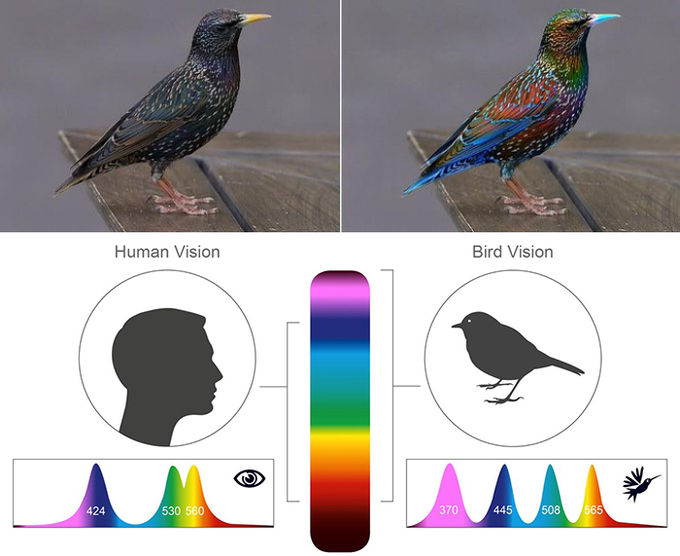
Left: how humans see starlings.
Right: how starlings may see each other - with bolder markings and more colour.
The amazing world of UV vision, seen through the eyes of… birds.
Researchers at the Norwegian University of Science and Technology have developed Olympus, a four-legged robot designed for exploring the Moon and Mars.
It can perform high, controlled jumps and stabilize itself in mid-air using reinforcement learning.
Its spring-powered legs help it move across craters, steep slopes, and rocky terrain where wheeled rovers may struggle, and it was unveiled last year.
Look at how cool the action is on this Sykes herringbone generator.
This design allows you to cut teeth down to a sharp vee (though this part has a central groove). All of these machines use a 30° helix angle on the guide.
My father used to run these back in the day, cutting gears up to 65" in diameter.
From Themobilegearhead on yt:
Yellow River’s Xiaolangdi Dam unleashes 2,600 m³/s “white dragon” to flush 100M+ tons of sediment downstream!
The 21-day operation lowers reservoir levels in anticipation of flood season while deepening the riverbed — a stunning display of engineering ingenuity to tackle the “suspended river” challenge.
Back in the early 1900s, before electricity was common everywhere, a Swiss company called E. Paillard & Co. engineered a clever solution-a fully mechanical wind-up fan. Instead of wires or batteries, it used a tightly coiled spring motor, just like a clock. Once wound, the stored energy slowly released through gears, spinning the blades and producing a gentle breeze for up to 30 minutes.
These fans were specially designed for tropical regions and remote areas where electricity simply didn't exist. Lightweight, portable, and surprisingly efficient, they offered comfort in hot climates without any power consumption. It was a perfect example of early innovation-simple physics turned into practical everyday technology.
Even today, many of these fans still work after more than a century, showing how durable and well-crafted they were. In a world now chasing sustainable solutions, this old invention feels ahead of its time-a reminder that sometimes the smartest tech doesn't need electricity at all.
#DIDYOUKNOW: Atlantic puffins are quite the lovebirds! 💙
Mated pairs typically stay together for their entire lives. These dedicated partners will strengthen their bond by touching their beaks together and raising one puffling per season!
Read more: https://t.co/pC3zYltVEy
The skeleton of an Archelon ischyros, the largest turtle to have ever lived, at the Yale Peabody Museum of Natural History, 1902.
Archelon is an extinct marine turtle from the Late Cretaceous, and is the largest turtle ever to have been documented, with the biggest specimen measuring 4.6 m (15 ft) from head to tail and 2.2–3.2 tons in body mass.
This specimen was discovered in South Dakota along the Cheyenne River by American paleontologist George Reber Wieland in 1895.
Look at more amazing historical photos: https://t.co/dQjceOPkrz