@mosh_oogo@elna_live@CryptoMyth81 He is same me. I moved my ELNA atfter LBP finished.
My account ID:
b59966b4c35f1c10cee130394f0547c135f5df98026e2bb3459033a19e401b22
Principal ID:
yhxcg-4lsrw-27tkj-u364t-hj5qn-2d7wf-foe6o-7joab-b6oo5-iyuex-mae
🚨 The widespread attacks against the Internet Computer continued again today, and thankfully, have failed again.
The cabal's latest attack targeted the ckBTC "bitcoin twin" minting canisters. This time, they spent thousands of dollars on ICP tokens in the course of their attack, but only caused minimal disruption.
What did happen: the attacks revealed the need for some useful hardening, and the NNS (i.e. the network's autonomous governance and orchestration system) took down the ckBTC canister for an upgrade. The downtime was ~1hr.
Though the disruption was minimal, we must not thank the attackers for helping improve the network, because they are criminals.
The attacks reveal more about who they are:
1. They are willing to throw buckets of money at their attacks, confirming they are professionals on a mission, rather than amateurs.
2. Since their attacks lack a common thread (such as trying to steal tokens), we can see their true purpose is to harm the reputation of the Internet Computer by causing disruption.
Of course, as an ecosystem, we have experienced widespread attacks designed to harm our reputation before, albeit in different forms.
Most famously, in May 2021, the Internet Computer was widely seen as a potential crypto industry disruptor.
A key narrative at the time was woven around the potential of web3 apps that would actually run on blockchain networks i.e. "onchain," as per the original meaning of that phrase.
The fly in the narrative's ointment, however, which was being used to sell the potential of some major up-and-coming chains, was that the Internet Computer was the only network that could actually host general-purpose apps and services built from "smart contracts" (which are far better called "network code") thanks to years of R&D by the DFINITY Foundation.
A successful launch of the Internet Computer threatened to puncture this web3 apps narrative, which was at the heart of their marketing and fundraising efforts. Furthermore, their insiders were aware of the years of R&D at scale that had been performed to create the Internet Computer network, and they were downright terrified of the competitive threat it posed.
Simply put, in the fever of 2021, they feared that if the Internet Computer launched successfully, it might dramatically reduce their ability to hoover up billions from the markets in the crypto bull run.
The resulting attacks by corrupt but powerful industry actors involved massive market manipulation on an exchange before/after launch that made the ICP token price crash, lawsuits by a corrupt law firm secretly on the payroll of a big industry actor, and massive further manipulation of public perception using huge social media astroturf armies, paid crypto press, and even a huge mainstream publication whose key reporter was linked to an actor who is now in jail.
Events took place on a historic scale that was completely extraordinary, and I hope the full story, including what it was like dealing with what took place, makes the light of day some day — I am pleased to say there is no comparison to what is happening today.
As a result of these past events, to this current day, a large majority of people who consider themselves crypto industry aficionados, and interested investors and journalists, remain completely unaware that most blockchain networks can only host tokens and lightweight financial logic. The corruption and criminality of the time successfully hid what the Internet Computer does differently from other networks, and created a reality distortion field that persists to this day.
Crypto Leaks, an investigative journalism website that publishes reports based on covertly recorded video created by undercover investigators, has exposed what was behind some of the extraordinary happenings.
Thankfully, several of those exposed by Crypto Leaks now sit in jail, and American judges later took action against the law firm involved, among other wins Crypto Leaks gifted to the industry. However, many of those exposed have so far escaped major consequences, and crypto press has often taken a hear-no-evil see-no-evil approach, preventing people from learning what happened. That's a shame, because we all want the crypto industry to be a clean place, where competition is fair and normal.
My personal view, is that the happenings of 2021 marked a pivotal moment for the industry, when the original crypto movement, and technical folks and idealists interested in making the world a better place through innovation and advanced cryptography and computer science, were overwhelmingly steamrollered by sharp-elbowed speculators and manipulators.
The Internet Computer ecosystem would have set a standard for the crypto industry that kept it honest, but as a result of its suppression at the time, we got an age of speculation and scams, and vaporware and narratives, in which money could often much more profitably be invested into hyping rubbish than into R&D that produces technological utility.
Thankfully, what happened is now far in the rearview mirror for the Internet Computer ecosystem, because it has moved on to mainstream pastures, and has a incredibly exciting future ahead. Those currently paying for the new tide of poisonous trolls on web3 social media, and black hat hackers, will be disappointed to find this isn't 2021.
Initiatives such as Caffeine (see caffeine dot ai), the AI chat service that builds apps on the Internet Computer, have shown that the network has enormous mass market utility, which does not depend on tokens and speculation — for example, 99% of those building on the Internet Computer using Caffeine have no idea that their apps run on a secure crypto network that can play the role of cloud.
Now, forthcoming advances like ICP "cloud engines", and initiatives such as Open SaaS and the Internet Intelligence Gateway, and growing sovereign tech adoption, and many other things currently underway, promise to take the network to another level entirely.
Crucially, as intended since work began in 2015, the network is becoming a revolutionary new tech stack for the AI era, and for the sovereign tech movement generally. While the massive potential exists in mainstream fields, projects like MULTI/DEX (dot ai) also continue to demonstrate how the extraordinary capabilities of the network can also be applied in fields such as defi.
As the Internet Computer rapidly approaches escape velocity all over again, the moment when its stunning differentiating features and capabilities will become obvious within the web3 industry also approach again.
Today, networks talk about AI tokens, and digital currencies for AI. Cynically, one might imagine these things were created because they are easy for retail investors to latch on to, if not undestand.
Meanwhile, the Internet Computer has pioneered a new kind of onchain "AIware" software (Motoko), which, when compared against software running on traditional technology stacks, creates apps and services that integrate AI in game changing and previously impossible ways, which software can also be written and maintained far more effectively and safely by AI agents working autonomously without human oversight.
The potential of AI is real and truly beyond anything we have seen before, and I predict that AIware will power one of the largest business transformation stories in history.
For the Internet Computer, an exciting event horizon approaches all over again, and my guess is this is agitating some people in the crypto industry. It may even be reactivating bad actors from the past.
But, we in the ICP community are not afraid, because these bad actors are a spent force. Moreover, the Internet Computer's future now depends on the mainstream world much more than it goes the crypto world, and the mainstream world affords these bad actors no power.
Of course, crypto would be better without them, and that's why DFINITY continues to offer substantial rewards to anyone who can provide information that exposes them, but —
This latest growing wave of attacks is in fact just a hot signal that it's game on again for the Internet Computer, which we should all welcome.
And, seeing the Internet Computer reach its potential, after all the years of toil and effort, is what keeps my fire, and the fire of many others, burning bright. We stay focused in pursuit of our goals, no matter how long it takes.
We are creating the next tech stack for the AI era, we remain undeterred, and the potential of what we have created is tremendous.
My thanks again to the ICP community 💪
I have a question about DFINITY Foundation’s long-term financial sustainability.
As the Internet Computer grows, network usage, Cycles consumption, and $ICP burn may all increase. However, as I understand it, this economic activity does not directly translate into revenue for the DFINITY Foundation itself.
So what is DFINITY Foundation’s long-term funding model for sustaining research, development, and operating costs?
In the early years, DFINITY raised substantial capital through token sales and private investment. But maintaining a large research and engineering organization for another 10 or 20 years would seemingly require a sustainable source of funding beyond simply drawing down treasury assets.
There are three things I am particularly curious about:
1. What is DFINITY Foundation’s long-term sustainable funding model?
2. Are treasury assets and $ICP holdings expected to remain the primary source of funding, or does the Foundation have other recurring sources of income?
3. What is the financial relationship, if any, between the Foundation and commercial initiatives built around the IC ecosystem, such as @caffeineai , Cloud Engines, enterprise adoption, or government-related projects?
I am not asking this as criticism.
In fact, I see it as one of the strengths of the Internet Computer that network usage fees do not simply flow to a centralized company in the same way they would with a traditional cloud provider.
But that is exactly why I am curious:
How does the network become increasingly decentralized and self-sustaining while DFINITY Foundation continues to fund the core research and development required to advance the protocol over the long term?
If there are official materials, financial disclosures, or previous statements from @dfinity addressing this, I would appreciate any links or references.
@dominic_w
Starlink hiện đã có mặt tại Việt Nam! Sử dụng internet tốc độ cao, ổn định tại nhà để xem nội dung trực tuyến, làm việc tại nhà, chơi game và nhiều hoạt động khác trên nhiều thiết bị thật mượt mà.
Đặt hàng trực tuyến chỉ trong vài phút.
If @dfinity manages to stop selling and doing a support in price at these levels $ICP can recover, we are doing excellent partnerships that are retaining investors trust and giving Dfinity more time to translate adoption in to more cycle burn, but they need to stop selling.
@ajki76 What you'll see are new forms of AI system that handle enterprise migration from legacy --> onchain. It must and will be fast and easy for enterprises to migrate
@thegreatafrikan Thanks! That's correct, since 2015, we've said that advanced smart contracts (better called network software) can provide a better backend tech stack, and we've not stopped working towards this
🚨 Last night, the Internet Computer network withstood a widespread, AI-enabled attack, which involved hundreds of canisters using malformed Wasm modules.
In advance of ICP cloud engines, Open SaaS, Intelligence Gateway, and MULTI/DEX, we are seeing a rising tide of attacks.
As many ICP community members have pointed out, a legion of trolling and FUD accounts have now appeared on social media, often repeating exactly the same poisonous messages, over and over, en masse.
The posts of the trolls trace back to agency paymasters, who themselves have received money from somebody. Obviously, whoever is funding this has no place in the tech industry, but sadly some people in the crypto industry see themselves as belonging to something else.
The well-funded organizations behind these attacks are not interested in making the world a better place by developing game-changing technology. They are only interested in extracting easy money through snakeoil narratives and scams that our industry still has not gathered the strength to end — they are vampires that prey on the ignorance of token buyers, and they attack anything that might disrupt the status quo by showing people the light of real technology.
These tell themselves they are just crypto bros playing the crypto game.
However, paying for, or organizing, attacks on public infrastructure, even at arms length, is a serious criminal act, which also reflects who they really are.
We want to know who is behind these attacks, and ask for help. DFINITY will offer rewards to those who can help us unmask the criminals, and bring them to justice. These guys need to be doxxed.
Thank you for your attention in this, and thank you to the ICP community that stands with the network 💪
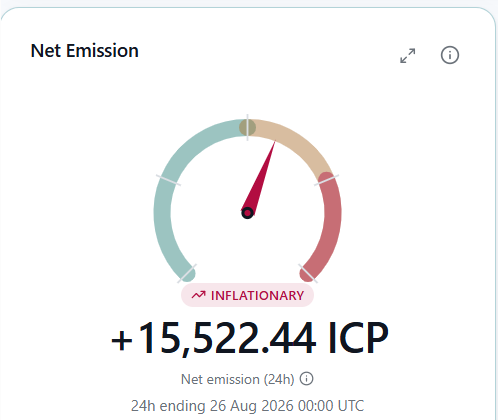
☁️The more I look at $ICP 🔥, the crazier the tokenomics get.
Websites on $ICP 🔥 burn $ICP 🔥. dApps burn $ICP 🔥. Canisters burn $ICP 🔥. Compute burns $ICP 🔥. Storage burns $ICP 🔥. Transactions burn $ICP 🔥. Cloud Engines burn $ICP 🔥. Messenger apps burn $ICP 🔥. AI apps burn $ICP 🔥. On chain games burn $ICP 🔥. DeFi burns $ICP 🔥.
And now even hacking can burn $ICP 🔥.
The more people actually use the network, the more $ICP 🔥 gets converted into cycles and ultimately burned.
☁️EVERYTHING IN THE $ICP 🔥 ECOSYSTEM LEADS BACK TO THE BURN☁️
Internet tốc độ cao, ổn định tại, giúp bạn xem nội dung trực tuyến, làm việc, chơi game và nhiều hoạt động khác thật mượt mà trên nhiều thiết bị.
Đặt hàng trực tuyến chỉ trong vài phút.