warren buffett is 96 and still telling everyone the same boring thing. almost nobody listens.
he’s been on stage at the berkshire meeting for decades saying it. no secret strategy. no trading system. no course to buy.
what most people spend every month:
- trading app fees: $30
- crypto “signals” group: $99
- stock picking newsletter: $49
- panic selling on red days: priceless
total: broke and stressed
what buffett actually tells regular people to do:
- buy a low-cost s&p 500 index fund and keep buying it
- think in decades, not weeks
- keep fees as close to zero as possible
- check your portfolio rarely
the tools you actually need:
index fund (voo / vti / fxaix)
own the whole market for ~0.03% a year. buffett told his own family’s trustee to put 90% here
brokerage (fidelity / schwab / vanguard)
zero commissions, fractional shares, done
auto-invest on payday
the money moves before you can spend it or second-guess it
high-yield savings
3–6 months of expenses, so a bad month never forces you to sell at the bottom
a simple spreadsheet
track your net worth once a month. not daily. daily is how you end up panic selling
what nobody tells you:
- the hard part isn’t picking stocks, it’s doing nothing when the market drops
- fees look tiny until you compound them over 30 years
- boring is the strategy. if it’s exciting, you’re probably paying for it
Sam Altman (CEO of OpenAI) at Stanford:
“The idea, the product, the team, the execution. That’s it.”
In just 26 minutes, he breaks down how to build something from zero at a level most founders never reach.
It’s a lecture he gave to Stanford students years before ChatGPT existed. A friend sent me the recording last night, and I couldn’t stop thinking about it.
After watching it, I realized I was only using about 15% of what it actually takes to build something people want.
Watch it till the end, then read the breakdown I left below on how to apply this to your own project
Two of the most valuable companies on earth started with a voicemail nobody returned.
Jensen Huang on the first time he tried to reach TSMC:
“I heard about this company in Taiwan, TSMC and UMC at the time. They were of course quite poor companies themselves, and they were barely making it.”
“TSMC was probably about $300 million, something like that. It’s a tiny little company.”
He had no intro and no network, just a phone book:
“Back in the old days there were yellow pages. I looked it up, TSMC. There’s a number there. I called their number and it’s a recording.”
“I left my name and my number and said a few things about NVIDIA: we’re a new startup company building computer graphics chips. I called several times. Nobody called me back.”
Most founders would stop there. Jensen didn’t:
“And so I finally wrote a letter to Morris Chang. Didn’t hear anything for a long time, and then one day it was 6 o’clock or something, this person called and said ‘this is Morris Chang from TSMC.’”
The best part:
“Everybody outside my office was playing video games and they’re all laughing and screaming. ‘Hey shut up! It’s Morris!’ I was so happy that the founder would actually call us back, because hey, maybe we won’t have to die.”
And the payoff:
“He invited me to Taiwan. I came back to Taiwan, and that was the start of everything. Not just that partnership, but just the whole industry.”
A $300M foundry and a startup fighting to survive bet on each other early, and today both are worth trillions.
The biggest returns don’t come from perfect timing. They come from showing up again after nobody answered.
Who are you still waiting to hear back from? Follow up today, and drop a 🔥 if you did.
Facebook paid $19B for WhatsApp. That's $42 per user, for an app charging $1 a year.
Back in 2014, Silicon Valley thought Zuckerberg had lost his mind. 450M users, almost no revenue, and a price tag bigger than most public companies.
Larry Ellison saw it differently:
"A lot of us were shocked — until we thought about it and understood the value of having access to that many consumers."
His point: look at what traditional businesses spend to win ONE customer. A cable company pays for ads, sales teams, discounts, installation, and still fights churn every month. $42 for a user who opens your app 20 times a day is a bargain.
And the real money was never the subscription:
"$1 per year per customer is not going to do it — but there will be opportunity to sell these same customers other things as they join your ecosystem."
It wasn't one guy doing something silly with money. Facebook and Google were in a bidding war. Zuckerberg won the auction.
The numbers today:
> 2014: 450M users, $42 per user
> 2025: 3.1B users, ~$6 per user
> Same $19B
Tools to think like this:
> CAC: what it costs to win one customer
> LTV: what that customer is worth over time
> Network effects: every new user makes the product more valuable
> Ecosystem: one product gets you in, the next ones make the money
The lesson: don't price a business by what it earns today. Price it by what it would cost to replace its customers.
Follow for more breakdowns of deals that looked crazy, until they didn't
A broke gambler invented the math that runs the entire financial system. Almost nobody in finance knows his name.
His name was Girolamo Cardano. Doctor, mathematician, addicted to dice. Around 1564 he wrote Liber de Ludo Aleae, “The Book on Games of Chance.” It was the first attempt in history to measure luck with numbers. It sat in a drawer for a hundred years before anyone published it.
In 1654, Pascal and Fermat picked up the problem in a series of letters about how to split the pot in an unfinished game. Out of those letters came probability theory. Then Bernoulli. Then Gauss and the bell curve. In 1952, Harry Markowitz turned it into modern portfolio theory. In 1973, it became Black-Scholes.
Every insurance premium, every pension fund allocation and every options trade on Earth still runs on that chain of ideas.
The man who put the whole story together was Peter Bernstein. He ran money at Bernstein-Macaulay and founded the Journal of Portfolio Management in 1974. In 1996, at 77, he published Against the Gods: The Remarkable Story of Risk. It became a bestseller, and Wall Street started calling him the historian of risk.
His argument was simple. For most of history, people believed the future belonged to the gods. The modern world started the moment we decided risk could be measured, priced and managed. It can’t be eliminated, but it can be managed.
He died in 2009, at 90. He left behind a 13-minute interview where he walks through all 500 years calmly, clearly, without a single chart.
Watch it once. You’ll never look at a premium, a portfolio or a probability the same way again.
Elon Musk gave SpaceX and Tesla about a 10% chance of success. he started both anyway.
that’s from his 2015 Stanford talk, and it’s the most honest thing a billionaire has said about money and risk.
2008 nearly wiped him out:
SpaceX: three failed launches in a row
Tesla: running out of cash in the middle of the financial crisis
the fourth launch finally worked
Tesla’s funding round closed on Christmas Eve 2008
one more failed launch or one investor saying no, and both companies were gone.
his view on cash: Tesla ran negative cash flow while it was growing fast, and he said that’s fine for a while. long term it has to make money, and growth doesn’t excuse losses forever.
his advice for a first business is to start where capital is cheap. software needs almost no money to begin, rockets need hundreds of millions.
and his definition of value is simple: make something genuinely useful. small improvements for a lot of people add up to a lot of money.
most people only take a bet when it’s 90% safe. he took two bets that were 90% likely to fail, and both paid off.
full talk in the reply. would you take a 10% shot with everything you have?
Ten extra years of $50,000 payments add just $121,630 to their value today.
That’s from Tom Leighton’s MIT lecture on sums. The setup is an annuity that pays $50,000 at the start of every year. At 6%, a dollar paid i years from now is worth 1/1.06^i today.
20 years of payments: $607,906. 30 years: $729,536. Forever: $883,333. The last payment in a 30-year deal is worth about $9,200 today. Payments far in the future barely count.
Adding them all up takes one trick. Write the sum S = 1 + x + x² + … + xⁿ⁻¹, multiply it by x, and subtract. Everything in the middle cancels, leaving S = (1 − xⁿ)/(1 − x). The same line prices mortgages, pensions and lottery payouts.
So when someone sells you a long stream of payments, the length matters much less than the rate. Ask for the rate first.
The full lecture is free on MIT OpenCourseWare. Would you take $700K cash or the 20-year deal?
In March 1999, at the peak of the dot-com bubble, Ted Koppel sat down with Warren Buffett in a Dairy Queen in Omaha.
Buffett had bought Dairy Queen a year earlier for about $585 million. While everyone else was buying internet stocks, he was eating a burger and drinking Cherry Coke in a restaurant chain he owned.
His logic was simple. He only buys businesses he understands, run by people he trusts, that generate cash year after year. Dairy Queen collects royalties from thousands of franchise stores, and that money goes back to Omaha to buy more businesses.
The market thought he was finished:
The Nasdaq went from about 2,500 to 5,132 between early 1999 and March 2000, more than doubling.
Over the same period, Berkshire stock fell from around $80,000 to $40,800 a share, almost 50%.
In 1999, Berkshire’s book value grew just 0.5%. Buffett called it the worst performance of his career.
Then the bubble burst. By October 2002 the Nasdaq had lost about 78% of its value from the peak. Berkshire was back near $70,000 a share.
Buffett said tech would change the world. He just admitted he couldn’t tell which tech companies would still be winning in 10 years.
If you can’t explain how a company makes money, you’re not investing, you’re guessing.
This video shows the moment Mark Zuckerberg got into Harvard in 2002. He was a teenager in pajama pants. His dad was holding the camera
Two years later he dropped out. Here’s the money story behind it
February 2004: he launches TheFacebook from his dorm room. It costs almost nothing to run
Summer 2004: Peter Thiel writes a $500,000 check for about 10% of the company. Most people thought it was a bad bet on a college website
2006: Yahoo offers $1 billion to buy Facebook. Zuckerberg is 22. He says no. Almost everyone around him thinks he’s crazy
2007: Microsoft pays $240 million for just 1.6%. That puts Facebook at a $15 billion valuation, a year after the “crazy” decision
2012: Facebook goes public at a $104 billion valuation
Thiel’s $500,000 eventually returned more than $1 billion
The kid in pajama pants turned down $1 billion at 22 and became one of the richest people on the planet
Would you have taken Yahoo’s $1 billion at 22, or bet it all on your dorm room website?
In 1984, Las Vegas banned him for counting cards.
So he flew to Hong Kong with $150,000 and a few computers.
Within months, he'd lost most of it.
Then he went on to make an estimated $1,000,000,000.
His name is Bill Benter.
He didn't have inside tips. He didn't "feel" which horse would win.
He noticed something everyone else missed: in Hong Kong horse racing, the odds aren't set by the house. They're set by the crowd.
And crowds are emotional. They overbet favorites, chase hype and ignore data.
So Benter built a model that estimated each horse's REAL chance of winning. Then he compared it to the crowd's odds.
When the crowd was wrong, he bet.
When it wasn't, he walked away.
He didn't need to win every race. He only needed the math on his side every time he played.
The rule behind every bet:
EV = p × b − (1 − p)
p = your chance of winning
b = what you win per $1 bet
Positive EV? Take the bet. Negative? Walk away, no matter how sure it feels.
His first year was brutal. By 1988 he was up $600,000. The year after, $3 million. The rest is history.
Here's what most people miss:
This isn't a gambling lesson. It's how investors, founders and traders think. Every decision you make with money is a bet. Most people make it on feelings.
The formula is simple. The thinking behind it isn't.
It starts with probability, and MIT's first lecture on it is right below. 45 minutes, completely free.
Bookmark it now. Watch it tonight.
Follow me for the math behind money that nobody explains.
Last week: 1,000 Mac Minis in a data center.
The obvious pushback: "Sure, but what about the power bill?"
So here's 5 of them on a wall meter, under load.
~300 watts. For all five.
One Nvidia H100 is rated at up to 700W. By itself. Before cooling.
Is one H100 faster than 5 Minis? Absolutely. But you can run five machines off a regular office outlet. No special power, no liquid cooling, no data center.
Nvidia fans, your move.
Waiting 10 years to start investing doesn't cost you 10 years.
It costs you more than half of everything.
Same person. Same $300 a month. Same 8% average return. Retire at 65.
Start at 25 → $1,047,000
Start at 35 → $447,000
Start at 45 → $177,000
Read that again.
The 25-year-old puts in just $36,000 more than the 35-year-old.
And ends up with $600,000 more.
That's not because they were smarter. Or earned more. Or picked better stocks.
They just gave compound interest more time to do the heavy lifting.
In the last 10 years before retirement, the money grows more than in the first 30 combined. But you only get those last 10 years if you started the first 30.
Most people wait for:
→ a bigger salary
→ the "right time" in the market
→ to "learn more first"
Meanwhile, the most valuable thing they own is quietly running out: time.
You can't buy back a decade.
But you can start today with whatever you have.
How old were you when you started investing?
A hedge fund legend put a jar of jelly beans in front of a class of 9th graders.
Two rounds later, he'd shown why most investors lose money.
His name is Joel Greenblatt. His fund, Gotham Capital, returned about 50% a year for a decade (1985–1994, before fees).
He asked the kids one question: how many jelly beans are in the jar?
Round 1: everyone wrote their guess on a card. No talking. No looking around.
The average: 1,771.
The real number: 1,776.
Off by five.
Round 2: everyone said their guess out loud, one by one. They heard each other. They adjusted.
The average: 850.
Same kids. Same jar. Less than half the right answer.
The only thing that changed was influence.
Then he explained the twist:
The stock market is round 2.
Everyone has just read the same headline, heard the same tip and watched the same panic on TV. Prices stop reflecting what a business is worth and start reflecting what everyone else thinks.
That's where the opportunity is.
His whole philosophy fits in one line:
"Figure out what a business is worth and pay less."
Simple. But almost nobody does it, because it means ignoring the crowd when the crowd is loudest.
The best investors aren't smarter. They're cold-hearted jelly bean counters.
He told this story at Google, then spent the rest of the hour explaining how he applies it with real money.
55 minutes. One jar. Free.
Bookmark it. It's worth more than most investing courses.
Follow me for the ideas behind money that actually work.
MIT students fill a lecture hall every January for one class that isn't about engineering, math or code.
It's about how to speak.
Patrick Winston taught it for over 40 years. He believed your success in life comes down to 3 things: how well you speak, how well you write, and the quality of your ideas. In that order.
I watched the full hour so you don't have to. Here are the 12 rules that changed how I think about talking to anyone:
1. Talent matters least. Speaking = knowledge + practice + talent, and knowledge has the biggest weight. You can learn this.
2. Never start with a joke. People are still putting phones away. Nobody's ready to laugh yet.
3. Start with a promise. "By the end of this, you'll know something you didn't know before." That's why people stay.
4. Say it 3 times. At any moment, a chunk of your audience is drifting. Repetition isn't boring. It's how ideas land.
5. Build a fence around your idea. Say what it is AND what it isn't, so nobody confuses it with something else.
6. Use verbal punctuation. "Now, the second point..." gives people who zoned out a way back in.
7. After you ask a question, wait. Up to 7 seconds. The silence feels awkward to you. To them, it's thinking time.
8. Pick the right room. Well lit, not too big, and ideally late morning when people are awake and not hungry.
9. Too many words on a slide is a crime. If they're reading, they're not listening. Your slides should be a support, not a script.
10. Props stick. People forget your slides. They remember the thing you held in your hand.
11. Getting remembered needs 5 S's: a Symbol, a Slogan, a Surprise, a Salient idea, and a Story.
12. Never end with "Thank you." It suggests people only stayed to be polite. End with what you contributed, and make that your final slide.
The lesson under all of it: the people who seem "naturally good" at speaking just know rules most of us were never taught.
Full lecture below. Save it for later, because you'll want to watch it twice.
I post things like this every week: money, skills and ideas that compound. Follow so you don't miss the next one.
Your savings account is quietly robbing you.
If inflation is 4% and your bank pays 0.5%, you're losing 3.5% a year. Every year.
That's not saving. That's a slow, polite loss.
Wealthy people don't hold more cash. They hold assets that outrun inflation.
You don't need a fortune to start. You need a simple system and 10 years.
Want the 3-step version? Follow and reply "MONEY".
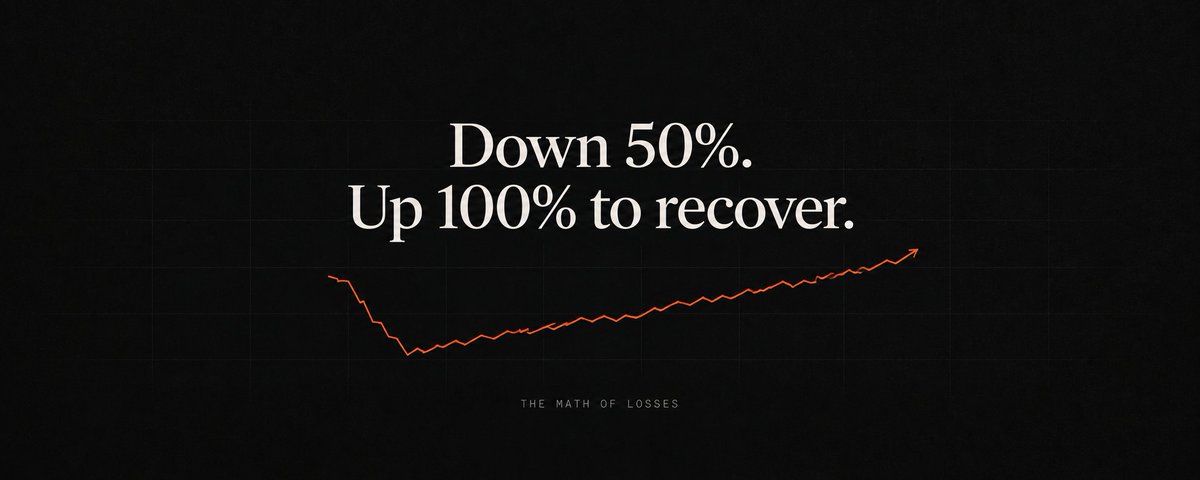
Drop 50% and you need +100% to get back to even, not +50%.
That asymmetry is the most underrated idea in financial math.
Lose 10% and you need +11%.
Lose 25% and you need +33%.
Lose 50% and you need +100%.
Lose 90% and you need +900%.
The cause is simple: a loss shrinks the base you're climbing from. Gains are applied to a smaller number than the one you fell from, so the climb is always steeper than the drop.
The same trap hides inside "average" returns. Up 50% then down 50% sounds like break-even. It's actually -25%: $100 becomes $150, then $75. The simple average says 0%, but the real result, your compound return, is negative. This is called volatility drag, and the more a portfolio swings, the more it eats.
Here's the practical version. Two investors both average 10% a year. One gets a smooth 10% every year. The other swings between +40% and -20%. The smooth one ends up with more money, every time, because the volatile one keeps climbing out of holes.
So the first rule of money math isn't "maximize returns." It's "avoid the deep holes," because the math punishes losses harder than it rewards gains.