The first real, 1:1 backed tokenized stocks are coming.
→ Own actual tokenized shares of U.S. companies
→ Trade, hold, and redeem - all onchain
→ Automatically receive dividends
No derivatives, no IOUs.
Welcome to the future of stocks.
We're bringing global crypto derivatives to the U.S.
Coinbase is the first regulated company to bring global crypto options & perpetual futures to the States, thanks to @CFTC.
→ Tap the deepest crypto options & perps liquidity
→ Access >$31B BTC options OI via Deribit
→ Trade on a trusted, regulated exchange
@JoestarCrypto You know that $eth real value is around 40- 70 billion marketcap if you compare it with traditional stock. How much value is secured by the network now? Is not overvalued
Welcome to 2026! Milady is back.
Ethereum did a lot in 2025: gas limits increased, blob count increased, node software quality improved, zkEVMs blasted through their performance milestones, and with zkEVMs and PeerDAS ethereum made its largest step toward being a fundamentally new and more powerful kind of blockchain (more on this later)
But we have a challenge: Ethereum needs to do more to meet its own stated goals. Not the quest of "winning the next meta" regardless of whether it's tokenized dollars or political memecoins, not arbitrarily convincing people to help us fill up blockspace to make ETH ultrasound again, but the mission:
To build the world computer that serves as a central infrastructure piece of a more free and open internet.
We're building decentralized applications. Applications that run without fraud, censorship or third-party interference. Applications that pass the walkaway test: they keep running even if the original developers disappear. Applications where if you're a user, you don't even notice if Cloudflare goes down - or even if all of Cloudflare gets hacked by North Korea. Applications whose stability transcends the rise and fall of companies, ideologies and political parties. And applications that protect your privacy. All this - for finance, and also for identity, governance and whatever other civilizational infrastructure people want to build.
These properties sound radical, but we must remember that a generation ago any wallet, kitchen appliance, book or car would fulfill every single one of them. Today, all of the above are by default becoming subscription services, consigning you to permanent dependence on some centralized overlord.
Ethereum is the rebellion against this.
To achieve this, it needs to be (i) usable, and usable at scale, and (ii) actually decentralized. This needs to happen at both (a) the blockchain layer, including the software we use to run and talk to the blockchain, and (b) the application layer. All of these pieces must be improved - they are already being improved, but they must be improved more.
Fortunately, we have powerful tools on our side - but we need to apply them, and we will.
Wishing everyone an exciting 2026.
Milady.
1 gigagas/sec (10K TPS) on Ethereum L1 with zkVMs
no compromises:
→ consumer hardware (zkVMs)
→ home internet (DAS)
→ censorship resistance (FOCIL)
→ 100% uptime (client diversity)
→ 8K consensus nodes
Built for internet finance. Believe in something real.
Our discussions about the Layer 1 scaling roadmap have been extensive, and the feedback so far suggests that the community appreciates our ambition. Turning that ambition into reality now depends on the focus of the core development teams and researchers.
Following the recent changes in leadership at the Ethereum Foundation, we aimed, among other things, to free more of Vitalik’s time for research and exploration, rather than day‑to‑day coordination or crisis response.
Each time Vitalik shares insights or communicates a direction, he accelerates major long‑term breakthroughs. His recent posts on RISC‑V and zkVMs have advanced promising avenues, while his writing on privacy has helped realign the community around the Ethereum Foundation’s core values.
I want to make clear that Vitalik’s proposals will always carry weight, but they are intended to start conversations and encourage progress in difficult research areas. Community review may refine them significantly or even reject them. We want the same freedom for our other researchers, who show courage by posing difficult questions and suggesting alternative approaches, for example @drakefjustin and @dankrad. Ethereum researchers often ask that readers recognize the exploratory nature of their posts and proposals.
Focus remains essential. Within the EF we will shift much of our research effort toward near‑term goals, aiming to address user experience and scaling challenges in the next two protocol upgrades.
We are concentrating on Layer 1 scaling, support for Layer 2 scaling, and significant UX improvements (including interoperability) in the Pectra, Fusaka, and Glamsterdam upgrades.
In parallel we are exploring ways to bring forward projects that currently look three to five years away. Posts from our top researchers help some of them to ship within one or two years through initiatives such as next‑generation execution and consensus layers.
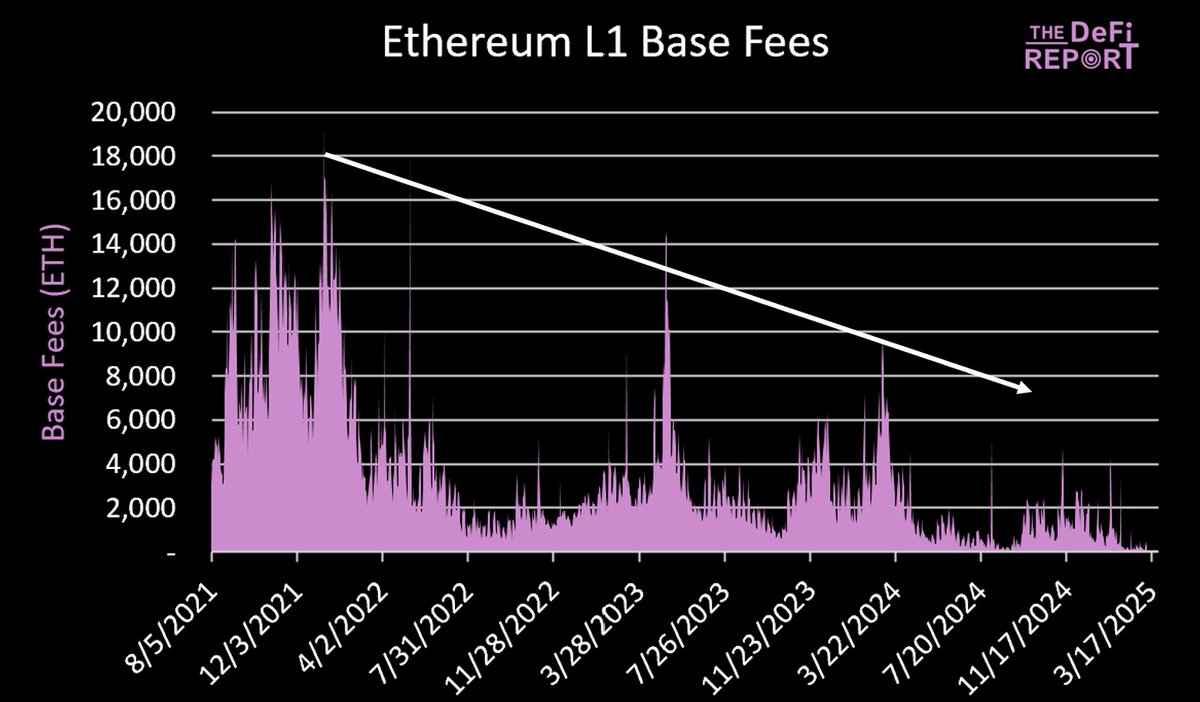
Instead of looking at a chart of Ethereum's Base Fees, imagine you're looking at a chart of Amazon Sales from 1999-2003.
Now.
Would it be reasonable to justify this chart by explaining how much value Amazon was creating for its Suppliers and Customers?
That we should look at how well *they're doing* instead of Amazon?
That "they're growth" is more important than Amazon's?
And that we should assume that *they're growth* would flow back to Amazon and its shareholders?
While at the same time, Amazon's suppliers and users have alternative (cheaper) options?
----
It's not over for Ethereum by any means.
But at this point in time, it should be obvious why ETH didn't perform this cycle.
----
I'm sharing a deep dive with readers of @the_defi_report next week in which we go DEEP on Ethereum's economics at the block building layer.
This will set the foundation for further analysis regarding the future of ETH.
If you'd like to have the free report dropped into your inbox when it's published, you can sign up below 👇
P.S. If you're curious, Amazon's revenue went from $1.6b to $5.2b from 1999-2003.