As someone who partially grew up among European elite kids like him, this reminds me just how incredibly hollow some of them are.
For a quick background, I went to one of the poshest high schools in France (Janson de Sailly, for those who know) and, afterwards, to what was at the time - and probably still is - the most expensive undergraduate school in Europe (EHL in Lausanne, Switzerland).
Needless to say, many of my classmates were from unbelievably privileged backgrounds. Just in my classroom in Lausanne I had the son of a (very famous) Russian oligarch, the son of Italy's largest real estate developer and the son of Spain's largest real estate developer (funnily, the latter two were flat mates).
Another classmate of mine came from the richest family in Naples, Italy and - while we were at school - his father (known in Naples under the nickname "Il Sultano") got arrested for having bribed half of Naples's city council - which, if you know Naples, ought to tell you something.
These were the kids I was doing group projects on business ethics with (literally) 😅
Anyhow, my story, and probably my luck, was that - before going to high school in Paris - I was raised in very normal public schools in the South of France where my friends were anything but wealthy. Their parents were farmers and everyday workers.
Which means - and I'd come to realize this was very important in life - that it was easy for me to understand how big a mistake it is to see money as identity and meaning - and to confuse someone's net worth with their actual worth.
What really struck me at the time was the contrast with my "poor" classmates of earlier in my life. They couldn't define themselves by what they had - by definition - and this forced them to reach deeper for their identity: their skills, knowledge, humor, etc.
Rich kids can skip that entire process, and the tragedy is that most of them do: they reach for the readymade identity that money provides. I remember being incredibly frustrated by many of my classmates, like "ok, I get it, your dad is rich and you own a lot of nice things but who are YOU, what else is there?" The answer, more often than not, was nothing.
To be fair, there were exceptions. One of my classmates I was most impressed by came from one of Zurich's wealthiest families (which, if you know Zurich, means insanely wealthy) yet he was almost OCD in not showing he had money: driving the shittiest car imaginable, living in a small studio, etc. He was very intellectual, very contrarian, and clearly at war with the idea that his family's wealth ought to define who he was.
I only discovered who he actually was when I started my first company and he approached me to invest: to discuss the investment I went to one of his family homes, which it turned out was a literal palatial castle on the shores of Geneva lake. The guy had decided to live in a small rundown studio when he literally had a castle sitting empty a 5-min drive away.
THAT I was impressed by: it's easy to see that money isn't meaning when you don't have any. To see it when you have more than almost anyone - when everyone around you is organized around the opposite assumption - is much harder. But to actually live it, to choose the studio when you have the castle keys in your pockets - with no audience to applaud you for that - that shows real depth.
At the end of the day, I think, the real distinction isn't between rich and poor but between people who exist from the inside out and people who exist from the outside in.
Wealth just happens to make it incredibly easy to be the latter, to skip the work of becoming someone and settle for a borrowed identity that glitters from the outside but is hollow all the way through. A Potemkin village identity.
This is actually a real societal issue, and magnified by social media (with idiotic posts like this one 👇): the more "outside in" folks out there, the less people with genuine internal anchors, the more fragile everything becomes.
When you think about it, everything that genuinely matters in a society is built by people who think for themselves: they take the world in, pass it through something genuinely their own, and give back something that didn't exist before: an idea, a conviction, a stand.
Every reform, every invention, every act of moral courage in history came from someone with an internal anchor strong enough to resist the current. Remove those people and all you have left is the current.
This isn't new, by the way. Most ancient traditions warn against exactly this, from the Bible (the golden calf story) to Confucius, who built his entire ethics around the distinction between the exemplary person (the Junzi, 君子) - oriented around internal cultivation and righteousness - and the petty person (Xiaoren, 小人), oriented around profit and gain. The junzi builds himself from the inside, the xiaoren chases what's outside.
So please, do not make the mistake of being impressed by wealthy people flaunting their wealth. Don't focus on the glitter, focus on the hollowness it's trying to hide.
MUST WATCH AND SHARE CLIP 🔥
Hong Kong lawmaker Dominic Lee to the UN Human Rights Council in Geneva:
“What moral authority does the U.S., a country ruled by the Epstein class, have over my country which has lifted 800 million people out of poverty? What moral authority do NATO countries have who preach human rights while turning a blind eye to the Zionist genocide in Gaza?”
“I’m not giggling, I’m mad at your politicians.” Speaking to Zanny Minton Beddoes, The Economist’s editor-in-chief, Tucker Carlson says European leaders are “liars” trying to “divert attention” from the “disasters” in their own countries.
Click the link to watch the full interview: https://t.co/npiRszgaM7
Israel just attempted to assassinate the great Steve Sweeney while he was reporting from Southern Lebanon
Relieved to hear Steve is recovering
The terrorist regime that has murdered hundreds of journalists over 2-3 years will never recover from this
@RWSverkeersinfo Thanks. Link had ik al stond niks op, vandaar de vraag :). Zag inderdaad later dat een trailer te hoog beladen was met grind. Krijgt zo iemand een boete? Heel de A4 15/20 min stil is een aardige impact op veel mensen omdat 1 iemand niet even zijn werk doet.
@AlexanderNL Speelt al langer. De reden dat een paar jaar terug de "voorspelling" radar is verdwenen kwam door dreigingen vanuit commerciële partijen over oneerlijke concurrentie. UX van de nieuwe app is echt wel weer een stap terug imho
🛰 Nederland lag er de afgelopen dagen schitterend bij vanuit de ruimte! Let ook op de grotendeels leeggelopen Waddenzee door de oostenwind ☀️
Satellietbeeld via NASA
@hmblank@detechnoloog Enorm jammer dat je gestopt bent. Ik vind je toch altijd een beetje de Walt van Nederland ;)
Altijd met enorm plezier geluisterd naar je in deze podcast.
Please revert to the old UX flow from @Google Search to Maps integration. Every day I have more frustration with getting to Maps from a simple search..... Why can't I click on the map anymore to go to Maps?! Argh....
☄️ Een meteoor (of meteoriet - als ie de grond heeft geraakt) afgelopen nacht boven Berlijn. Dit exemplaar was enkele uren voor "impact" door astronomen gespot en tot op de seconde nauwkeurig berekend waar hij de dampkring zou binnen dringen. Bijzonder!
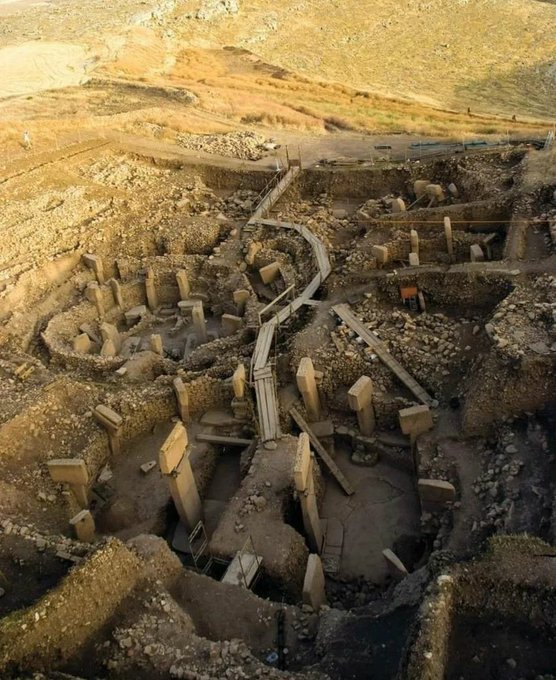
Göbekli Tepe is a Neolithic settlement inhabited from c. 9500 to at least 8000 BCE, in the Southeastern Anatolia Region of Turkey.
Its structures are therefore 11,000 years old, or more, 6,000 years before Stonehenge and the great pyramids of Giza, making them humanity's oldest known monumental site, built not for shelter but for some other purpose.
Archaeologists still consider the place a mysterious riddle that predates Earth's great civilizations by thousands of years.
Many things if not everything in Göbekli Tepe constitute an issue in explaining why, how and when. From the techniques used to erect the monoliths without the help of animals to the fact that no habitative human settlements were found near this temple except the ruins of what was possibly a small village.
The site was believed to be a shrine, a temple, but hypotheses have been made about the structures being an astronomical observatory due to its configuration and alignment with different stars, particularly Sirius.
Discoveries in the region suggest a pivotal moment, marking the onset of revolutions in agriculture, religion, and society. The complex of temples or shrines at Göbekli Tepe might have symbolized fertility, life, or abundance, given the presence of reliefs depicting animals.
The people of Göbekli Tepe, with sufficient natural resources, found the time to write a new chapter in the history of life. Archaeologists have read only a small part of that story.