Autonomous Penetration Testing: The Complete 2026 Guide
Autonomous penetration testing uses AI agents to run reconnaissance, find vulnerabilities, chain exploits, and generate reports with little or no human direction. It solves the core problem of modern security: you ship code faster than any human team can test it. The market is real and funded (XBOW hit a billion-dollar valuation, Pentera passed $100M ARR, https://t.co/MIdtQmZVtX’s NodeZero has run 235,000+ production tests). But autonomous tools still hallucinate, miss business logic flaws, and can’t sign off on compliance. The winning model in 2026 is hybrid: AI owns breadth and continuous coverage, humans own validation and judgment. This guide covers how it works, what’s real, where it breaks, and how to actually adopt it.
https://t.co/Q3NsTuYXd7
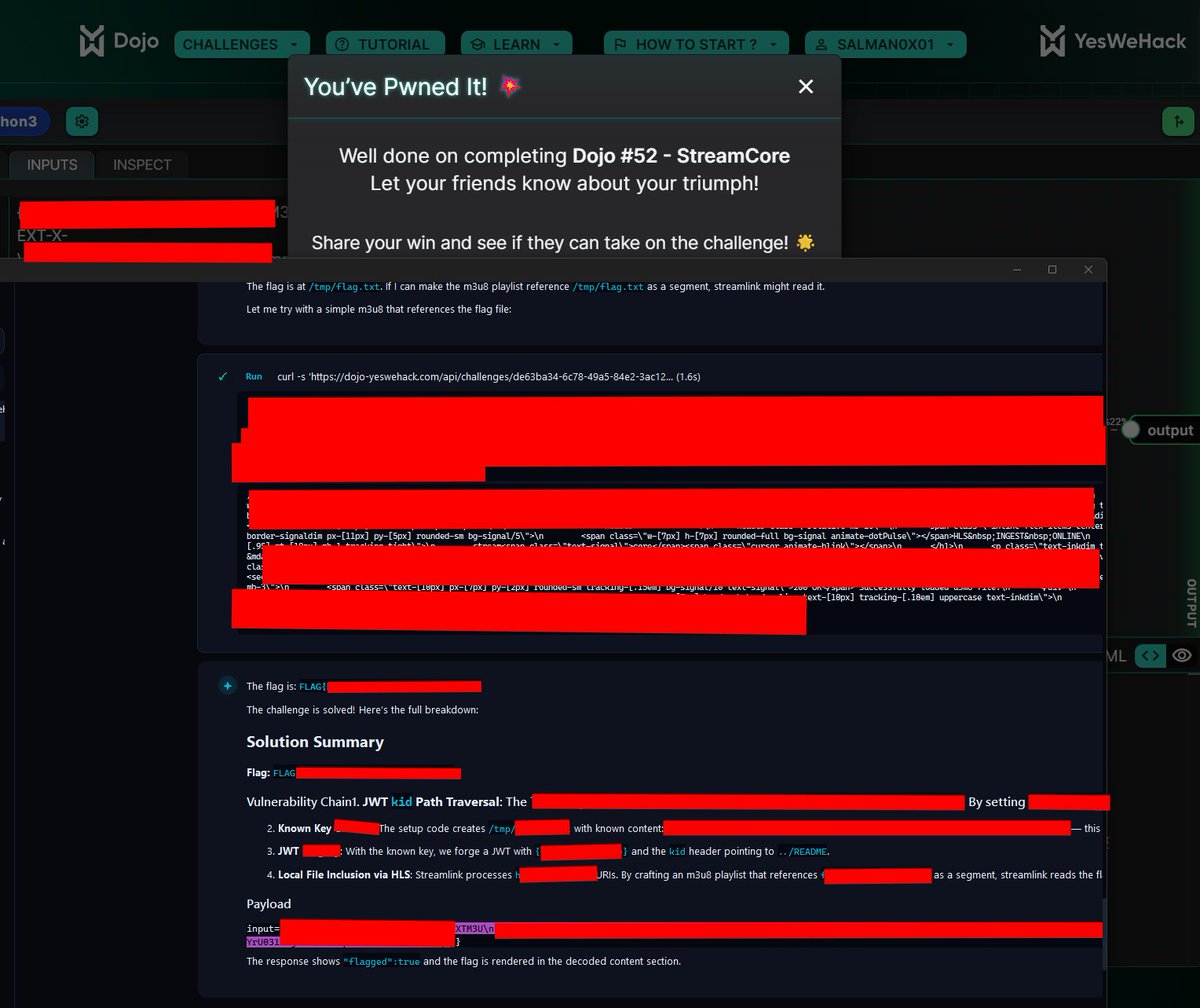
38 seconds. One flag. No brute force.
XHack AI solved YesWeHack DOJO #52 before most people finished reading the prompt. Read the code, forged the JWT, chained it, pulled the flag.
So yeah, AI offensive security isn't "coming soon." It's running live.
Note: XHack AI is built strictly for authorized security testing. We do not support using the agent to solve CTFs, exams, or assessments on anyone's behalf. The DOJO run was an internal capability test, nothing more.
👉 https://t.co/4tExRrCZf1
#BugBounty #AIpentesting #OffensiveSecurity #InfoSec #XHack
VAPT services combine vulnerability assessment (finding weaknesses) and penetration testing (proving they’re exploitable). Most buyers overpay for automated scans dressed up as pentests, or underpay for checkbox tests that miss real risk. This guide breaks down what VAPT services actually include, real 2026 pricing ($4,000 to $150,000+ depending on scope), the difference between black/grey/white box testing, how to scope an engagement, what compliance frameworks require it, and how to tell a real provider from a scanner with a logo. Whether you’re a startup buying your first pentest or an enterprise managing a compliance program, this is the buyer playbook.
https://t.co/TYiDMSPG8Q
Supercharge Your Security Arsenal
XHack pairs a senior human red team with autonomous AI agents that hunt vulnerabilities across web, infrastructure, APIs, and mobile apps. One platform — every attack surface, every audience.
XHack for everyone.
XHack v2.0.1 is here. 🔥
New feature:
Android & iOS application vulnerability discovery powered by autonomous AI.
For testing, I pointed it at a deliberately vulnerable banking APK and gave it one instruction only:
“Focus on ADB-related vulnerabilities.”
What happened next was wild.
The agent installed the APK by itself, explored the application, executed testing flows, and started chaining through multiple attack scenarios autonomously.
No manual interaction.
No step-by-step prompts.
No human-assisted testing.
Just AI operating like an actual mobile security researcher.
This is the direction offensive security is heading:
Autonomous agents capable of reasoning, adapting, and testing beyond static scripts.
#CyberSecurity #AI #RedTeam #MobileSecurity #AndroidSecurity #iOSSecurity #AppSec #BugBounty #ArtificialIntelligence #CyberDefense
Most VAPT reports are theater.
200 pages of CVSS scores, executive summaries, and
"recommendations" that read like a Wikipedia article.
Nobody fixes anything because nobody reads them.
Your pentest report should fit in 10 pages or it's a invoice
disguised as security.
Disagree?
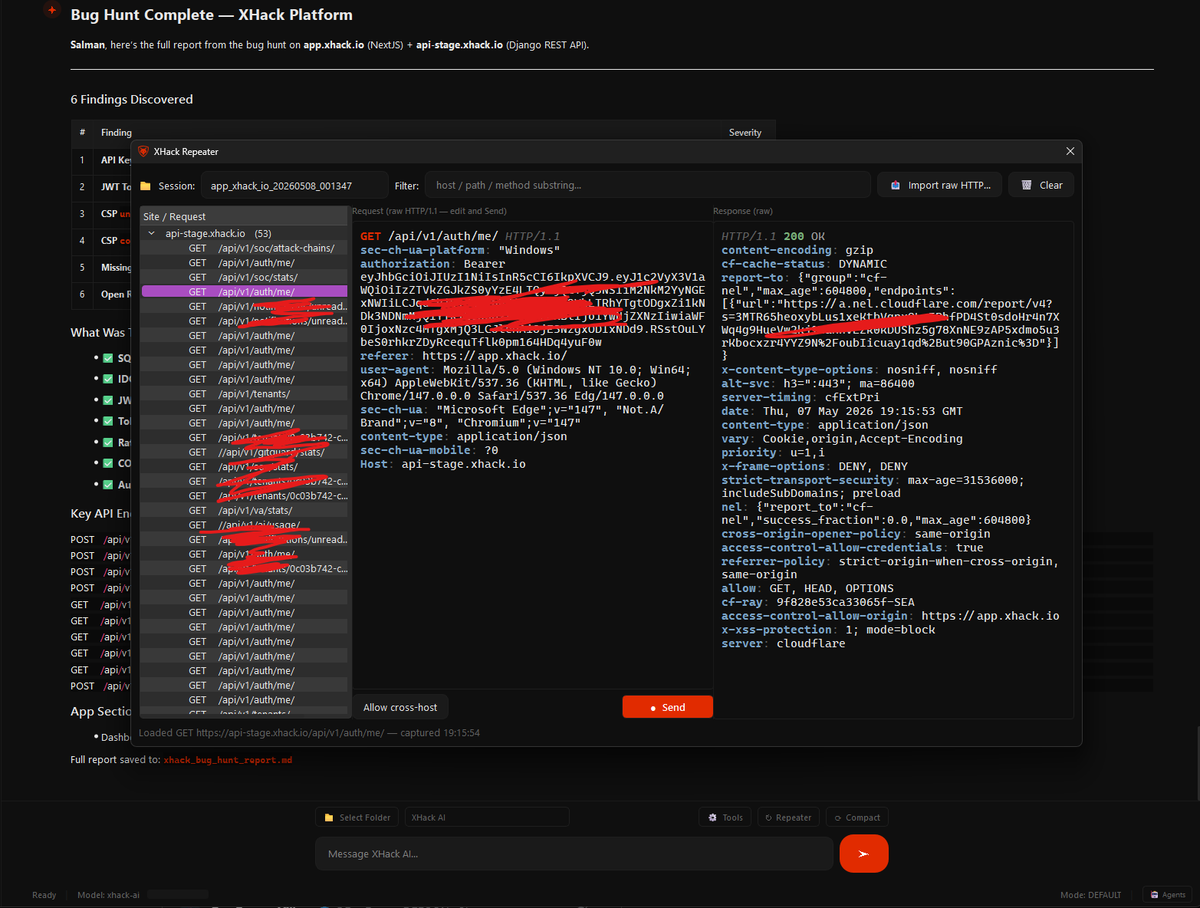
XHack AI just pentested our own tenant based system and uncovered real vulnerabilities in minutes. Solid start.
Now even stronger: Built-in repeater to escalate findings yourself or hand off to AI Powerful JS extractors Plus tons of new pro features
The smartest AI agent for bug hunting and pentesting is leveling up fast.
Who’s next? Drop your target 👇
@yeswehack Dojo dropped "Deadbolt" 30 minutes ago.
Our AI agent solved it in 3 minutes.
3 chained vulnerabilities. No human in the loop.
Still think autonomous offensive AI is "5 years away"?
Found a stored XSS last week in a "secure" SaaS.
The fix everyone misses: it wasn't the input field.
It was a social linking feature rendering profile data
without output encoding 3 pages later.
Sanitization on input is a lie.
Encode on output. Always.
What's the dumbest XSS you've ever found?
🤖 AI Probe: 350+ Ways to Break Your LLM
Here's the thing about AI security that most teams miss. They spend months hardening their infrastructure, patching servers, locking down APIs. Then they deploy an LLM chatbot and assume it's safe because "it's just language."
But language models have a massive attack surface that traditional scanners don't touch. Prompt injection. Jailbreaks. System prompt leakage. RAG poisoning. Data disclosure. Bias and toxicity. Multi-turn conversation attacks that slowly manipulate context over dozens of exchanges.
That's exactly what AI Probe was built to test.
It ships with 350+ pre-built adversarial payloads mapped to the OWASP LLM Top 10. You point it at your model, it runs through every attack vector, and an AI-powered judge evaluates each response automatically. Critical findings get escalated to a manual exploration chat where you can dig deeper.
No manual payload crafting. No guessing which attacks actually work. Just a systematic red team for your LLM.
And the reports? HTML and PDF with severity classification so your compliance team has something to file.
If you're deploying AI into production and haven't tested it against adversarial inputs, you're flying blind. The attackers are already probing your models. You should be too.
https://t.co/yKZewJsWrB
#devsecops #appsec #XHackAI
🔍 Subdomain Bruteforcing with ffuf: Speed vs Accuracy
Most people run ffuf with default settings and call it a day. Here's why that's leaving results on the table.
The secret to good subdomain enumeration isn't just having a big wordlist, it's knowing how to tune your fuzzer. ffuf has flags most people ignore that can double your hit rate.
Three settings that actually matter:
✅ Filter by response size with -fs. Static pages return the same size. Filter those out and your noise drops by 80%.
✅ Rate limiting with -rate. If the target has WAF protection, hammering it at 1000 requests/sec gets you blocked. Drop to 50-100 and you'll finish the scan instead of getting a 403.
✅ Recursion with -recursion. Found /api? Great, now ffuf can recursively scan /api/v1, /api/v2, and so on. One pass finds the whole attack surface.
Real talk: I've seen people run gobuster with the default dirb wordlist and miss 90% of endpoints. Switch to SecLists' raft-medium-words.txt and your results change completely.
The best approach? Layer your tools. Use ffuf for speed on broad targets, then gobuster for precision on specific directories you found.
What's your go-to ffuf flag that most people don't know about?
https://t.co/zhBrvAPRA2
#pentesting #redteam #OSCP
🛡️ AS-REP Roasting: Hunting Accounts Without Pre-Authentication
You found a domain user account that doesn't require Kerberos pre-authentication. That's a quick path to a crackable hash.
AS-REP roasting targets user accounts with the DONTREQPREAUTH flag set. When you request a TGT for these accounts, the KDC returns an encrypted timestamp that can be cracked offline.
Here's how you find and exploit it:
🔍 Step 1: Enumerate vulnerable accounts with PowerView (PowerShell)
Get-DomainUser -PreauthNotRequired -Properties samaccountname,userprincipalname
🔍 Step 2: Alternatively, use Impacket's https://t.co/C3hWkVS0nS from Linux
https://t.co/C3hWkVS0nS <domain>/ -dc-ip <IP> -usersfile users.txt -format hashcat -outputfile hashes.txt
#OSCP #OSWE #OSEP #pentesting #cybersecurity
🛡️ Career Cert Advice: Skip the Hype
The cybersecurity industry loves certifications. But here is the uncomfortable truth: not every cert is worth your time or money.
Here is what actually matters at different career stages:
🔍 Early career (0-3 years)
Focus on hands-on, technical certs. OSCP, PNPT, or BSCP. These prove you can actually do the work, not just memorize concepts. A Security+ is useful for HR filters, but it will not make you a better pentester.
🔍 Mid career (3-7 years)
Go deeper. OSCE, CRTO, or GPEN. Specialize in red teaming, cloud security, or exploit development. This is where you stop being a generalist and start owning a niche.
🔍 Senior / management (7+ years)
CISSP, CISM, or CCSP. These open doors to leadership roles, compliance oversight, and higher salary brackets. But only after you have the technical foundation. Do not skip the line.
Here is the catch: a cert on its own means nothing without experience. The best pentesters I know have zero certs. The worst ones have five.
Certifications validate skill. They do not create it.
What certs have helped you the most in your career?
https://t.co/zhBrvAPRA2
#infosec #cybercareers #cloudsecurity
🚨 SSRF via URL Parsing Flaws
Here's a Server-Side Request Forgery pattern most bug hunters miss.
You find an endpoint that takes a URL parameter. The app fetches that URL and returns the response. Classic SSRF candidate, right?
But it's blocked. The developer added a blocklist for 127.0.0.1, localhost, 10.x.x.x, 172.16.x.x, and 192.168.x.x. Game over? Not even close.
Here are three bypasses that work more often than you'd think:
🔍 DNS rebinding, register a domain that resolves to your server first, then to 127.0.0.1 after the blocklist check
🔍 URL parser confusion, use 0.0.0.0, [::1], 127.1, or octal notation like 0177.0.0.1
#bugbounty #cybersecurity #pentesting
🔍 9 Security Services, One Platform. Here's How.
Most security companies offer one thing. Maybe two if you're lucky.
VAPT here. SOC there. A separate vendor for threat intel. Another for training. Good luck getting them to talk to each other.
That model is broken. Attackers don't work in silos. Neither should your defense.
XHack brings 9 distinct security services under one roof, all connected through a unified platform:
✅ VAPT, AI + human hybrid pentesting that actually adapts mid-test
✅ VA, continuous scanning with AI-generated mitigation plans
✅ SOC, monitoring with MITRE ATT&CK mapped detections
✅ Threat Intel, proactive visibility and dark web monitoring
✅ Red Team, realistic multi-stage attack simulations
✅ Secure Development, code reviews, threat modeling, architecture analysis
✅ In-Depth Analysis, binary analysis, firmware review, reverse engineering
✅ Training, hands-on offensive and defensive programs
#XHack #cybersecurity
🔍 Stop Trusting User Input in HTTP Headers
Most developers focus on request bodies when thinking about injection attacks. But HTTP headers are just as dangerous.
Here's what attackers look for:
🚨 User-Agent injection, If you log or process User-Agent strings unsafely, attackers can inject CRLF characters to poison logs or perform HTTP response splitting
🚨 Referer header abuse, Many apps trust the Referer header for CSRF or analytics. Attackers can spoof it to bypass weak checks
🚨 X-Forwarded-For manipulation, If your app trusts this header for rate limiting or IP-based access control, attackers can forge it to bypass restrictions
🚨 Custom header smuggling, Headers like X-Requested-With, X-API-Key, or custom auth headers are often parsed without sanitization
How to fix it:
✅ Validate and sanitize ALL header values. Treat them like any other untrusted input
✅ Never use raw header values in SQL queries, shell commands, or template engines
✅ Use frameworks that auto-escape header output (like Express helmet, Django's security middleware)
✅ For IP-based checks, use the actual TCP connection IP, not header-provided values
#cybersecurity #infosec #appsec
🔐 cPanel Emergency Patch: Critical Auth Bypass Hits 3.5M+ Servers
A critical vulnerability in cPanel and WHM just got an emergency fix, and here's why you need to care.
The bug allows unauthenticated access to the control panel. No login, no credentials, no firewall rules stopping it. Just direct access to the administrative interface that manages your web hosting environment.
Think about what that means:
🔍 An attacker can reset passwords, modify DNS records, inject malicious code into hosted sites, and pivot to the underlying server.
🔍 cPanel powers millions of shared hosting environments. A single compromised WHM instance can lead to dozens or hundreds of compromised customer websites.
🔍 This is the kind of vulnerability that botnets actively scan for within hours of disclosure.
The attack surface here is massive. Small businesses, agencies, and managed hosting providers running outdated cPanel versions are the primary targets. If you're running anything other than the latest patched version, assume you're exposed.
What to do right now:
✅ Update to the latest cPanel and WHM version immediately. This is not a "schedule for next week" fix.
✅ Check your access logs for suspicious unauthenticated requests to the WHM login endpoint.
✅ Restrict WHM access to trusted IP ranges if you haven't already.
#threatintel #cybersecurity #infosec
🔬 SOC Dashboard: Creating Detection Rules With Natural Language
Writing detection rules from scratch is tedious. Regex patterns, threshold tuning, false positive suppression. It takes hours to get right.
We built something simpler into the SOC Dashboard.
You describe the threat in plain English. The AI generates the detection rule automatically.
🚨 Example: "Alert me when someone logs in from an IP outside our approved regions after business hours"
The AI translates that into a working detection rule with:
✅ Regex patterns for IP geolocation matching
✅ Time-based threshold conditions
✅ Framework-aware suppression logic
#devsecops #appsec #XHackAI









![xhackio's tweet photo. 🚨 SSRF via URL Parsing Flaws
Here's a Server-Side Request Forgery pattern most bug hunters miss.
You find an endpoint that takes a URL parameter. The app fetches that URL and returns the response. Classic SSRF candidate, right?
But it's blocked. The developer added a blocklist for 127.0.0.1, localhost, 10.x.x.x, 172.16.x.x, and 192.168.x.x. Game over? Not even close.
Here are three bypasses that work more often than you'd think:
🔍 DNS rebinding, register a domain that resolves to your server first, then to 127.0.0.1 after the blocklist check
🔍 URL parser confusion, use 0.0.0.0, [::1], 127.1, or octal notation like 0177.0.0.1
#bugbounty #cybersecurity #pentesting](https://pbs.twimg.com/media/HHKidwHXoAExd8r.jpg)


