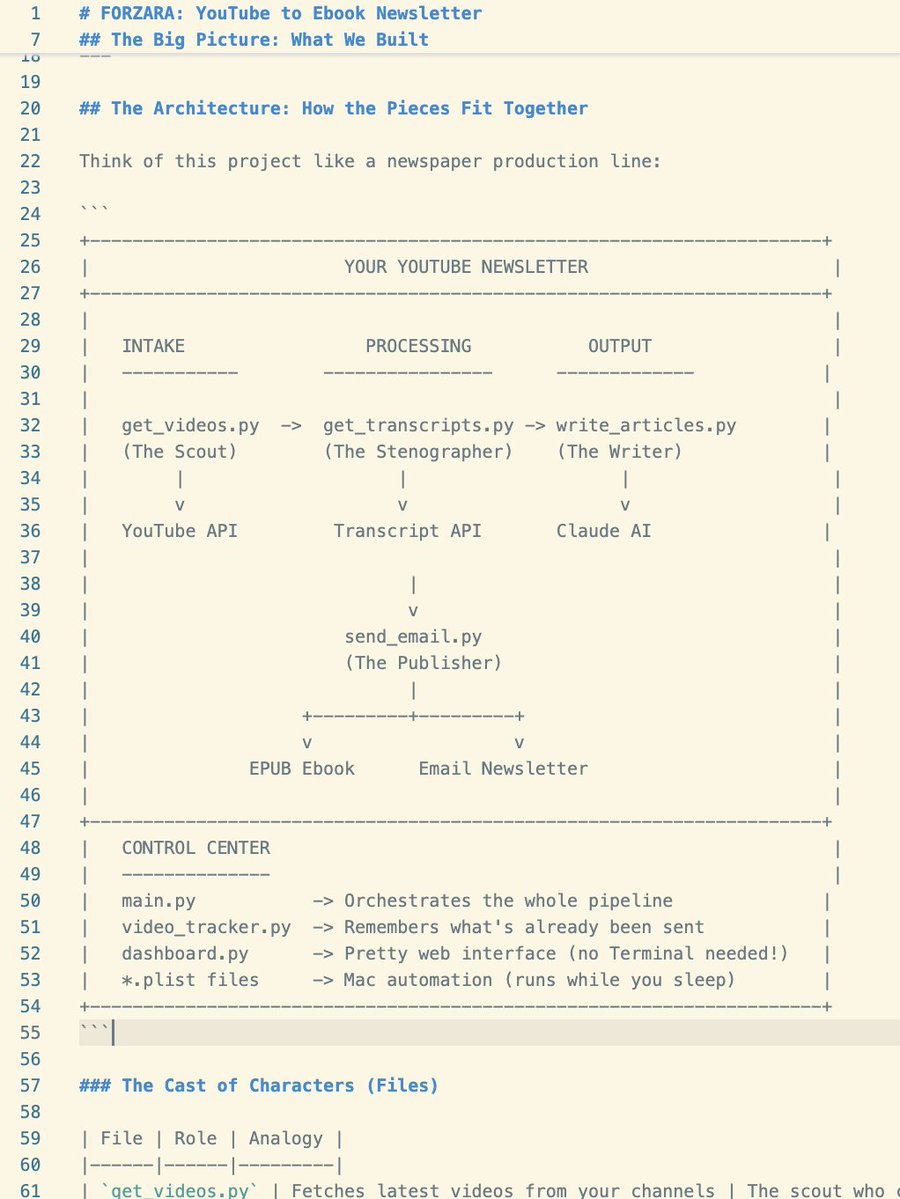
Add this paragraph to the https://t.co/CGO09Sihd0 file to turn Claude Code into Claude Teacher. Every project is a lesson to become more technical.
"For every project, write a detailed FOR[yourname].md file that explains the whole project in plain language.
Explain the technical architecture, the structure of the codebase and how the various parts are connected, the technologies used, why we made these technical decisions, and lessons I can learn from it (this should include the bugs we ran into and how we fixed them, potential pitfalls and how to avoid them in the future, new technologies used, how good engineers think and work, best practices, etc).
It should be very engaging to read; don't make it sound like boring technical documentation/textbook. Where appropriate, use analogies and anecdotes to make it more understandable and memorable."
7 lessons I learned on how to effectively work with coding agents:
01: Context, not control
Give the AI context about what you want to achieve, then let it figure out how. Don't micromanage the steps; describe the destination. It's smarter than you think, and often smarter than your specific instructions.
02: Push until it breaks
Don't accept the first result. Keep pushing, asking for more, requesting variations. Push it until it fails at something. Only then do you truly understand its limits. The limits are further than you think.
03: Put in the reps
There's no magical prompt template or shortcut that will suddenly make you an expert. Like everything else in life, you just need to put in the reps. The more you build, the better your intuition becomes for what works.
04: Try everything. Waste tokens.
Do playful experiments. Do things that would seem like overkill. Try silly ideas. The best discoveries happen when you're not being sensible. Tokens will get cheaper over time. Curiosity is the real currency.
05: Build in public
The best textbook is Twitter, and the best teachers are people who are slightly more advanced than you and share their work openly. Share your progress, even the messy parts. You'll learn faster and find your people.
06: Make it fun
There have been times I've literally chuckled at Claude's output. It's charming, creative, and genuinely surprising. Lean into the joy. If it stops being fun, you're probably being too serious about it.
07: If you can talk, you can vibe code
Don't be intimidated by the terminal. If you can articulate what you want to build, you can vibe code. The hardest part isn't the coding. It's coming up with something worth building, and making people care once you've built it.
I built https://t.co/4rAUTXjAhc to help me stay-up-date with new AI stuff.
It's tracking 14K open source repos so far, with contributions from over 145K developers.
Every day, it:
- searches for new AI repos (based on 123 keywords and topics)
- surfaces repos that are gaining traction, and
- categorizes each repo
The annotations are done by AI so they are not super accurate, but they've helped me find some useful stuff.
It also lets me see where the contributors are, so when I travel, I can find folks doing cool stuff in a new city or country.
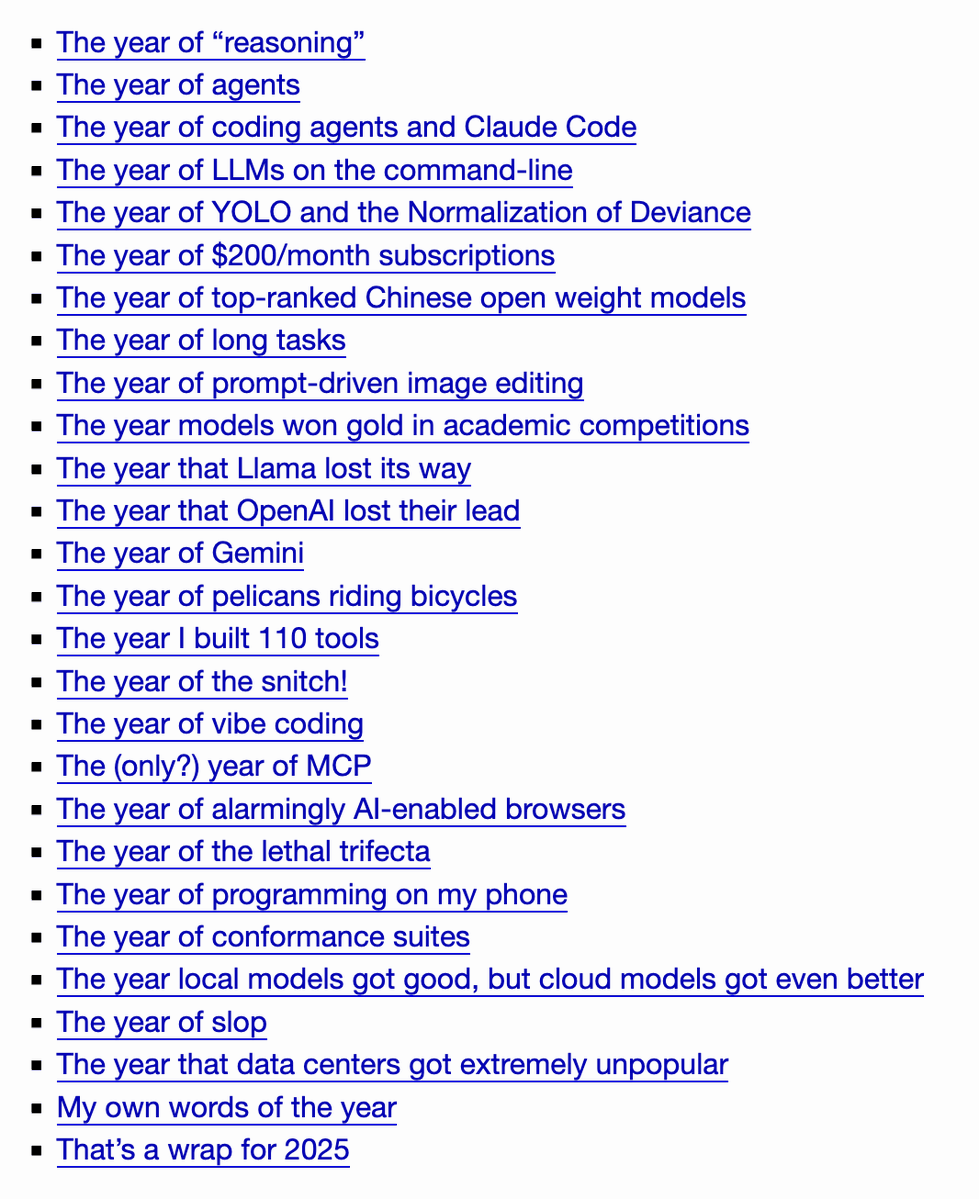
Here's my enormous round-up of everything we learned about LLMs in 2025 - the third in my annual series of reviews of the past twelve months
https://t.co/HD9Zf85SG2
This year it's divided into 26 sections! This is the table of contents:
How can we keep scaling if compute grows exponentially but data does not?🤔
Find the answer in my guest lecture at Stanford CS25 this afternoon on our ICLR2024 Honorable Mention paper "Amortizing intractable inference in large language models" 🙌
https://t.co/3bZaFZLRps
Slides for my lecture “LLM Reasoning” at Stanford CS 25: https://t.co/eApGUHyIDo
Key points:
1. Reasoning in LLMs simply means generating a sequence of intermediate tokens before producing the final answer. Whether this resembles human reasoning is irrelevant. The crucial insight is that transformer models can become nearly arbitrarily powerful by generating many intermediate tokens, without the need of scaling the model size (https://t.co/HO2seV6vVl).
2. Pretrained models, even without any fine-tuning, are capable of reasoning. The challenge is that reasoning-based outputs often don’t appear at the top of the output distribution, so standard greedy decoding fails to surface them (https://t.co/75h2QQzT9M)
3. Prompting techniques (e.g., chain-of-thought prompting or "let’s think step by step") and supervised finetuning were commonly used to elicit reasoning. Now, RL finetuning has emerged as the most powerful method. This trick was independently discovered by several labs. At Google, credit goes to Jonathan Lai on my team. Based on our theory ( see point 1), scaling RL should focus on generating long responses rather than something else.
4. LLM reasoning can be hugely improved by generating multiple responses and then aggregating them, rather than relying on a single response (https://t.co/BA5MUzg3PR).