Free Webinar series sponsored by GetGenome: Road to Jeju. Check out our Legends of IS-MPMI speakers. Sign up to attend the first talk by Roger Innes on June 17. https://t.co/BBdpvMIMkU Check back for how to apply to give a Rising Stars of IS-MPMI talk. repost!
Final version of our NRG1 MS is out!
We uncover a surprising mechanism: the helper NLR NRG1 targets organellar membranes to trigger immunity
Great collaborations with @KamounLab, @JiorgosKourelis, @jonathandgjones, @AdamWu9527, and the @Phil_Carella labs!
https://t.co/P9OMT7NgtR
New preprint from our lab: Cis-regulatory elements orchestrate phase-specific effector gene expression in Ustilago maydis
Congrats to Georgios Saridis, @janinawern and everyone involved!
Take a look:
https://t.co/xoV60tm6Ug
Exciting to see the Integrated Decoy Model —pioneered in @jonathandgjones' lab (Sarris et al., Cell 2015)—now identified in Shigella flexneri.
A major step forward in understanding conserved mechanisms in animal-microbe interactions!
https://t.co/cXOFGXsmgx
New findings from TSL and international collaborators reveal that the wheat receptor WAI3 forms an octameric resistosome, offering fresh insights into plant immune system structures and functions 🌱
@jonathandgjones@kamounlab@GuanghaoGuo@M__Selvaraj
https://t.co/7TnTOucLIX
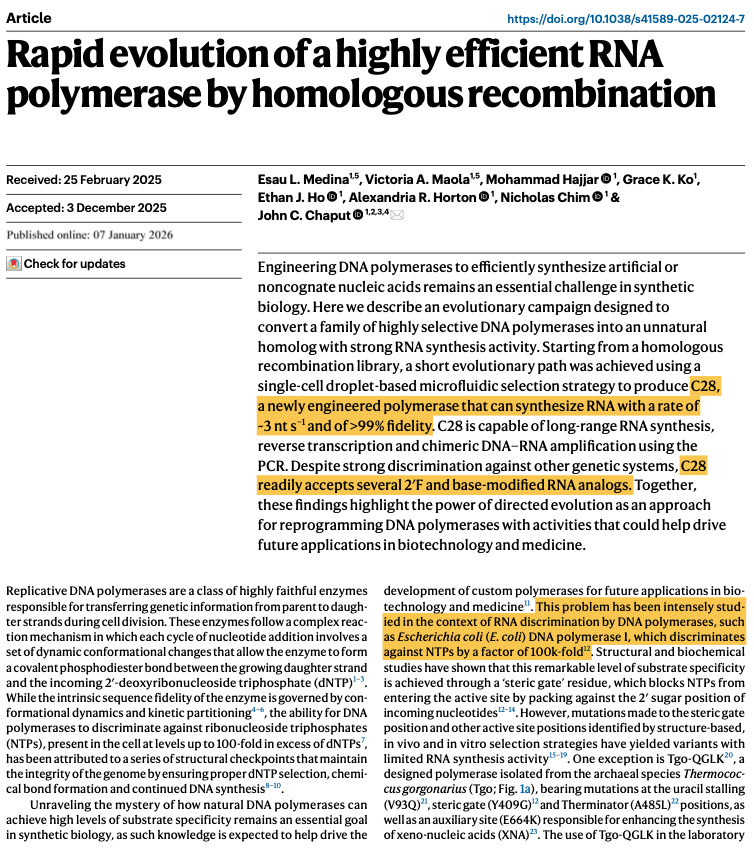
This paper is wild. After 3 rounds of directed evolution, they converted a DNA polymerase into an enzyme that can do:
- RNA synthesis
- Reverse transcription
- Synthesis of "unnatural" nucleotides
- Synthesis of DNA-RNA chimeras
One of the best papers I’ve read recently.
For context: In nature, it is DNA polymerase that takes a DNA sequence as a template and then copies it. These enzymes are crucial in replicating the genome for cell division, and they are EXTREMELY specific for DNA over RNA. This is key because RNA nucleotides are present in the cell at concentrations ~100x higher than DNA nucleotides, so the enzyme has evolved clever strategies to select one over the other.
RNA polymerases, for comparison, are the enzymes that take a DNA sequence as template and then convert it into RNA. They are involved in gene expression, for example.
To convert a DNA polymerase into an RNA polymerase (and all the other functions I mentioned earlier), the authors did a fairly straightforward directed evolution experiment.
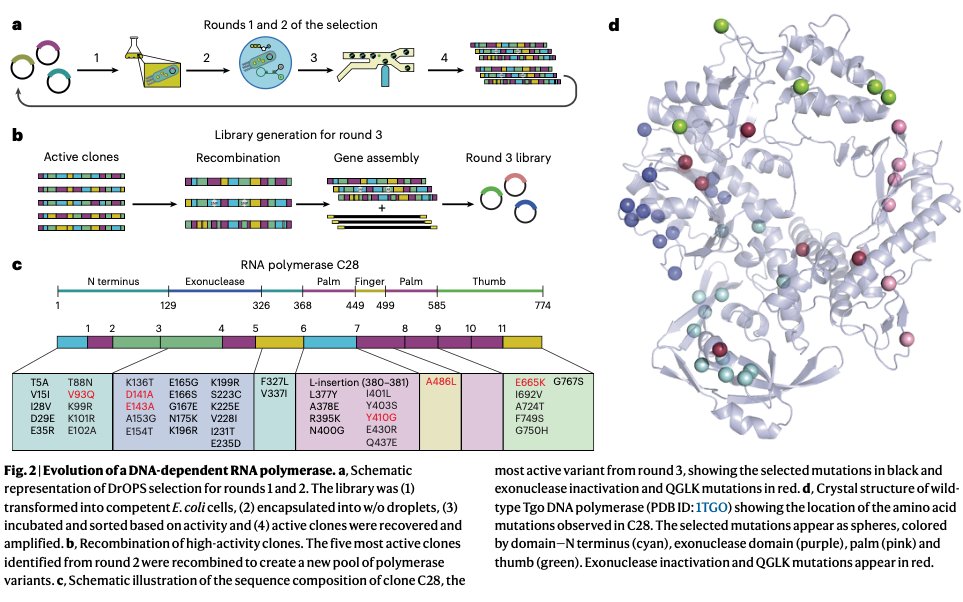
First, they took four DNA polymerase enzymes belonging to various archaea. These DNA polymerases don’t check for DNA vs. RNA as stringently as other types of cells, so they’re a good starting point to evolve RNA polymerases. The authors inserted some targeted mutations into these enzymes, based on known mutations in the literature. For example, they swapped the amino acid at position 409 for a smaller amino acid, thus removing a “gate” that keeps RNA building blocks from entering the enzyme.
Next, they took the four genes encoding these DNA polymerases and cut them up into 12 segments each. They randomly stitched these 12 segments together — from the four different genes — to build millions of unique variants. Each shuffled gene was inserted into an E. coli cell.
Then, they grew up these cells (each carrying a unique polymerase) and put them into microfluidic droplets. A device isolates each droplet, lyses the cell open, and releases the polymerase. The droplet also contains RNA building blocks and a DNA template, encoding a fluorescent reporter. If the polymerase begins synthesizing RNA, it will produce a detectable signal. They screened about 100 million droplets in 10 hours of work, searching for those with a signal.
For each well that yields a fluorescent signal, the researchers isolated the DNA and sequenced it to figure out which polymerase it was. They repeated this 3x times, finally isolating a really excellent RNA polymerase variant which they called "C28."
C28 has 39 mutations compared to the wildtype enzymes. It incorporates about 3.3 nucleotides of RNA per second, with 99.8% fidelity. The crazy thing is that this enzyme can also copy DNA or RNA templates back into DNA (reverse transcription), or use chimeric DNA-RNA molecules as a template and amplify them. It is just a super versatile polymerase that can act on DNA, RNA, or modified nucleotides, to build just about anything.
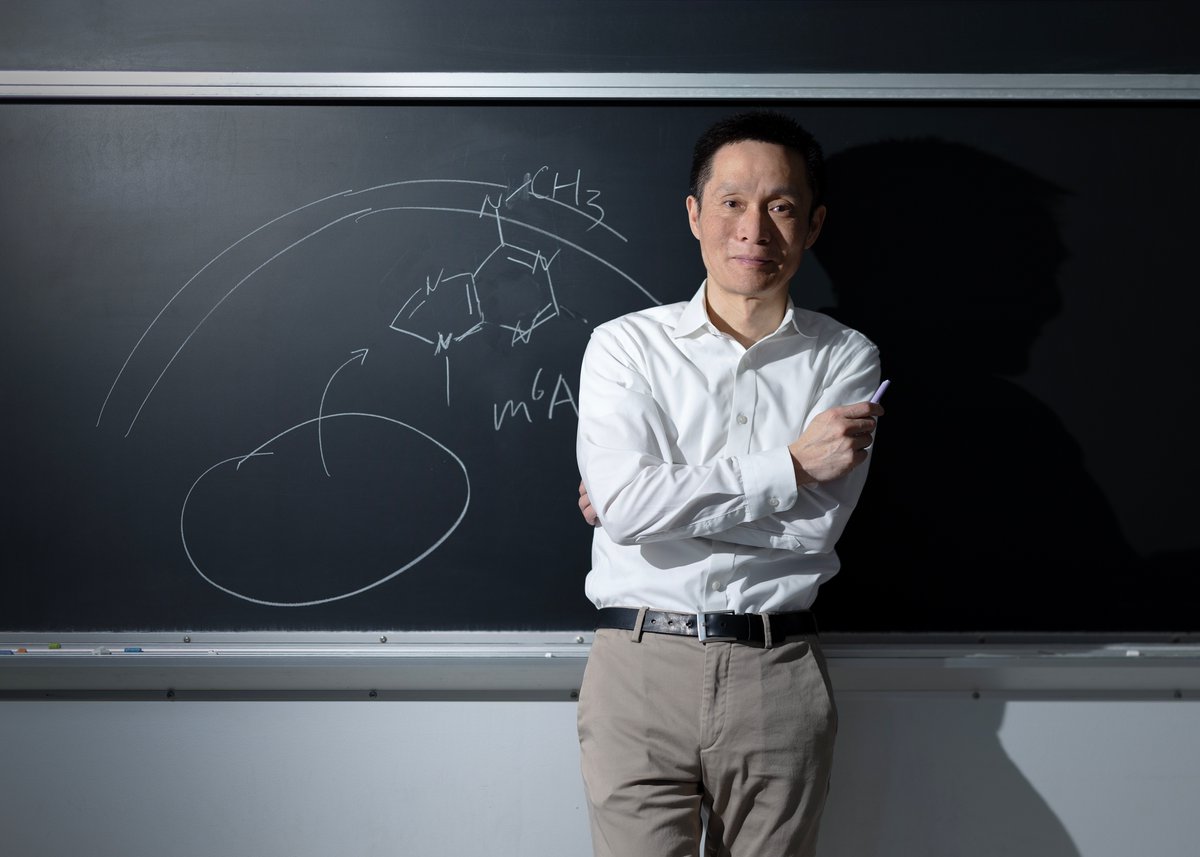
Professor Chuan He works at the edge of a quiet revolution in biology. For decades scientists believed that DNA carried its code in a fixed way and that RNA simply carried out the instructions. Chuan helped show that life is more fluid. Chemical marks can be added or removed from DNA and RNA, changing how genes behave without altering the letters themselves. These marks are tiny, almost ghostlike, but they can transform the fate of a cell. His work opened the field known as epigenetics and expanded it into what he calls RNA epigenetics, a once controversial idea that is now a thriving branch of modern biology.
He grew up in China, drawn early to chemistry because it felt like a language for understanding the natural world. He came to the United States for graduate school and eventually walked into a scientific landscape that was full of assumptions about how genetic information worked. Chuan has always had a quiet willingness to question what everyone thinks they already understand. That instinct led him to explore methylation, a small chemical tag that cells attach to DNA and RNA. The marks are reversible and dynamic, and in many cases they act as switches that turn genes on and off.
Chuan’s most influential work came from asking a simple question. If cells can place these marks, can they also remove them. That idea was not widely accepted at the time. He and his team went searching for enzymes that could erase methyl marks and found them. The discovery changed the field. It revealed that genetic information is not static. It is tuned, adjusted, and shaped by life experience. The implications spread outward in every direction.
One branch of his work focuses on cancer. Tumors often use methylation to hide from therapies or to silence genes that would slow their growth. By reversing those chemical marks, Chuan’s research opens the door to treatments that can work more effectively. It is not a magic bullet. It is something more interesting. It gives modern medicine an additional layer of control over how cancer cells behave. It also introduces the possibility of combining therapies in new ways, especially in tumors that have resisted every standard approach.
Another part of his research reaches into agriculture. Plants also rely on methylation to control stress, growth, and reproduction. By adjusting those marks, crops can grow faster or survive harsher conditions. Chuan’s lab has shown that it is possible to dramatically increase crop yields by altering how a plant manages its chemical tags. It is the kind of work that could feed millions if handled with care. He talks about these projects with an understated seriousness, always aware of the scale of the problems and the potential impact of the solutions.
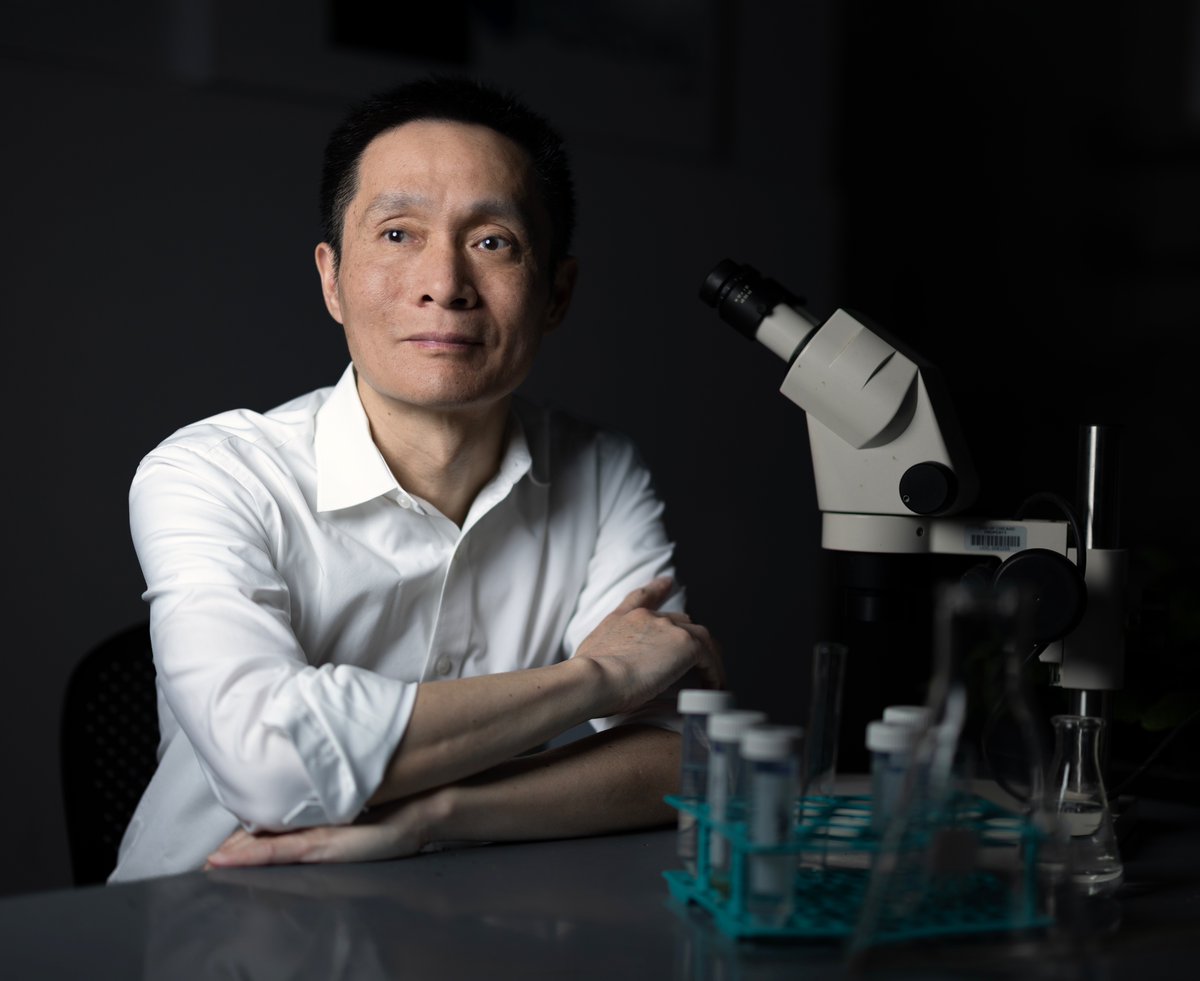
When I photographed him at the University of Chicago, the winter light kept moving across the lab. He spoke with a calm clarity, the kind that comes from years of thinking deeply about very small things. At the microscope he seemed completely in his element, focused and relaxed. Later we moved to a chalkboard where he sketched the ring structures and arrows that have become part of his everyday language. He draws with confidence, not to impress but to think out loud.
In person he is steady, composed, and quietly warm. There is no trace of the drama that sometimes surrounds big scientific discoveries. His voice has a grounded quality, as if he is always aware that science is built one careful step at a time. He carries none of the ego that might be expected for someone whose work has reshaped an entire field.
Chuan He continues to push biology into new territory. His work shows that the genome is not a static blueprint. It is a living script that can be edited by the cell itself. The idea feels simple once you hear him explain it, but it took a mind willing to look again at the foundations of genetics and see what others had missed. He brings that same quiet curiosity to every conversation. It is the quality that guides his science and the reason his work continues to change how we understand life. @hhmi_science@UChicago@theNASEM
We are hiring! A PhD position is now open in our group through the IMPRS program, focusing on effector biology and organelle targeting in beneficial microbes.
Learn more and apply here:
https://t.co/iMdxmJnqiP
Thank you Roger Castells-Graells @rcastellsg for the shoutout! 🙏
Love seeing the next gen of cancer biologists getting started 💥
#CelebratingAlumni
https://t.co/dWk6jKiAhH
A conserved fungal secreted protein (DOI: 10.1111/nph.14537), regulated by a SUMOylated enolase (DOI: 10.1038/s41467-023-40384-w), suppresses plant immunity by activating phytosulfokine signaling (DOI: 10.1038/s41467-025-65934-2).
Breaking the ''one nucleus, one whole genome'' rule: Neurospora crassa separates its haploid chromosomes into different nuclei https://t.co/UhC5WfQYOv #biorxiv_micrbio
Must read article from @KenichiTsuda4 @Billion_of_Gods lab. “Emergence of isochorismate-based salicylic acid biosynthesis within Brassicales“ https://t.co/ynG6Uf5WqH